When should a small business consider third party HR services? In most cases, the right moment arrives when day-to-day HR tasks start consuming more leadership time than the business can afford, when compliance risk grows faster than in-house knowledge, or when headcount climbs past the point where informal processes still work. For many growing companies, this shift happens somewhere between 10 and 50 employees, though it can occur earlier depending on industry, state requirements, and growth speed. This article explains the clearest signals, walks through what third-party HR support actually includes, and outlines practical next steps for employers exploring outsourced HR services like those offered at Soteria HR.
Key Takeaways
- Most small businesses should evaluate third-party HR services once internal tasks outpace available time, often between 10 and 50 employees.
- Legal thresholds — such as the ADA’s 15-employee mark and the ACA’s 50-employee mandate — frequently force the decision.
- Third-party HR support ranges from basic administration to a full ASO partnership that avoids co-employment.
- Outsourcing HR does not remove an employer’s legal responsibilities; the business stays the employer of record.
- A free HR Health Assessment is a low-risk starting point before committing to a provider.
When Should a Small Business Consider Third Party HR Services?
In short, a small business should consider third party HR services as soon as HR work starts crowding out core priorities, or when legal exposure grows beyond what an owner or office manager can track alone. Specifically, this often lines up with concrete legal thresholds. For example, the Americans with Disabilities Act applies once a company reaches 15 employees, according to the U.S. Equal Employment Opportunity Commission (EEOC). Similarly, the Affordable Care Act’s employer shared responsibility provisions apply at 50 full-time equivalent employees, per Internal Revenue Service (IRS) guidance. As a result, the same growth that justifies new hires also tends to trigger new compliance duties leaders were not expecting.
Beyond legal thresholds, timing also depends on internal capacity. Therefore, leaders should ask whether HR tasks are handled consistently, or only when something goes wrong. In addition, companies without a dedicated HR professional often discover gaps during an audit, a terminated employee’s complaint, or a benefits renewal — moments when the cost of being unprepared is highest. Consequently, it is usually less expensive to bring in outsourced HR support before a crisis than to respond to one after it happens. Our guide on whether it’s worth hiring an external HR partner for compliance goes deeper into this cost-benefit comparison.
What Are Third-Party HR Services?
Third-party HR services are HR functions delivered by an outside firm rather than handled entirely by in-house staff. In practice, this can mean a company hands off specific tasks — such as benefits administration or employee records — while keeping its own HR manager, or it can mean relying on an outside partner for nearly everything HR-related. Either way, the business remains the legal employer and keeps responsibility for employment decisions and related obligations.
Soteria HR, for example, structures this work around HR administration, HR consulting, and benefits administration, with payroll coordination layered in as needed. For organizations wanting broader support without co-employment, an Administrative Services Organization (ASO) — an arrangement where a provider manages HR administration on the client’s behalf while the client remains the employer — offers a middle ground between light-touch consulting and a full Professional Employer Organization (PEO) relationship, which does involve co-employment. However, not every provider structures services the same way, so it helps to understand your options first. Our overview of where small businesses can find reliable HR resources and support breaks down what to look for in a provider.
Seven Signs It May Be Time to Outsource HR
Beyond thresholds and formal definitions, certain everyday signals tend to repeat across growing companies. In particular, watch for these seven signs:
- Leaders spend several hours a week answering employee questions instead of running the business.
- Job postings, offer letters, or handbooks have not been updated in more than a year.
- Benefits renewals feel confusing, and nobody is confident the plan still fits the workforce.
- A recent termination or complaint revealed gaps in documentation.
- Hiring has outpaced the company’s ability to onboard consistently.
- State or local employment law changes are tracked informally, if at all.
- The existing HR team is stretched thin and needs backup rather than replacement.
If two or more of these sound familiar, that is usually reason enough to start a conversation. Meanwhile, businesses that already have an internal HR team are not excluded — outsourced support often works alongside existing staff rather than replacing them. Our article on third-party HR and what growing businesses need to know expands on how this partnership typically works.
How to Evaluate an External HR Partner
Once a business decides to explore outside help, the evaluation process matters almost as much as the decision itself. Following a consistent process helps avoid a mismatched partnership.
- Audit current HR gaps. Review onboarding, leave management, benefits administration, and recordkeeping to identify where time is lost or compliance risk is highest right now.
- Clarify the service model. Ask whether a prospective partner offers administrative support only, HR consulting, or an ASO arrangement, since each option changes who handles specific employment responsibilities.
- Compare scope against needs. Match services such as HR administration, benefits administration, and payroll coordination against the company’s current size and growth plans for the next one to two years.
- Check pricing and references. Request a clear pricing structure, ask for client references, and confirm expected response times before signing any agreement.
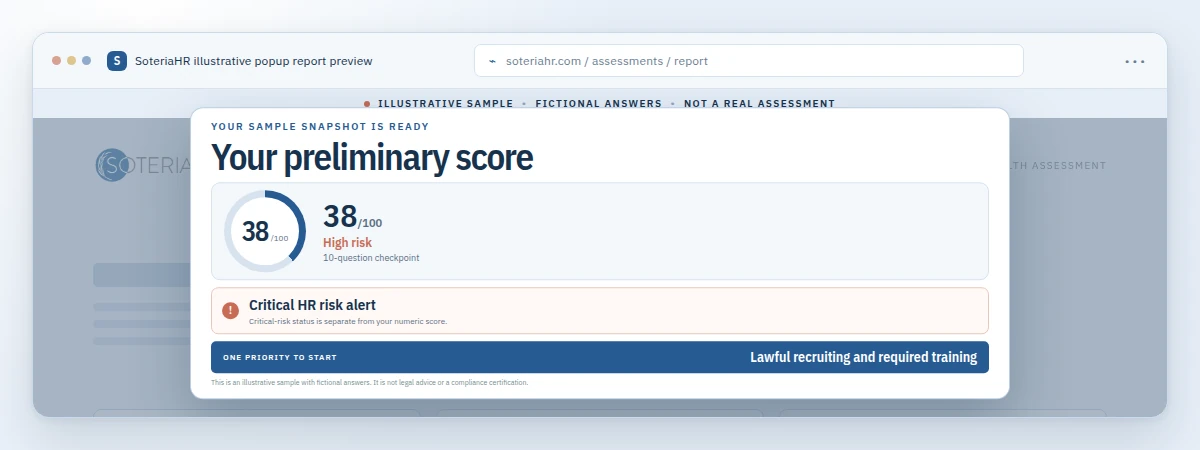
- Start with an assessment. Use a short, self-reported tool such as Soteria’s free HR Health Assessment to establish a baseline before committing to a formal engagement.
This process rarely takes more than a few weeks. However, rushing it tends to create mismatches later, particularly around scope and pricing expectations. For a closer look at how consulting engagements are typically structured, see our guide on the best HR consulting services for small businesses.
“We’ve got your back — so you can focus on growth.”— Soteria HR
Third-Party HR vs. In-House HR vs. PEO: Key Differences
Not all outside HR support looks the same. Therefore, it helps to compare the three most common models side by side before deciding which fits a particular business.
| Model | Who Is the Employer | Typical Scope | Best Fit |
|---|---|---|---|
| In-House HR Team | Your company | Full HR function built internally | Larger teams needing deep, full-time HR |
| Third-Party HR / ASO | Your company (no co-employment) | HR administration, consulting, benefits admin, payroll coordination | Growing companies wanting flexible support without losing employer status |
| PEO | Shared / co-employment | Bundled HR, payroll, and benefits, often at scale | Businesses comfortable with co-employment trade-offs |
In contrast to a PEO, an ASO relationship leaves the client as the sole employer of record. As a result, the client keeps direct control over hiring, firing, and other employment decisions, while the outside partner handles the administrative workload.
What Third-Party HR Services Typically Cost
Pricing for outsourced HR support varies by scope, headcount, and the mix of services involved. Generally speaking, providers charge a flat monthly fee, a per-employee rate, or a blended structure that scales with growth. In addition, consulting-only engagements — such as a single handbook project or a training session — may be priced separately from ongoing administrative support.
Because pricing structures differ so widely, the most reliable way to get an accurate number is a direct conversation. Specifically, a provider needs to understand current headcount, which services are in scope, and whether benefits administration or payroll coordination will be included. For a broader comparison of what outsourcing commonly includes and costs, see our breakdown on small business HR outsourcing made simple.
Common Mistakes When Outsourcing HR
Even well-intentioned outsourcing decisions can go wrong. For instance, some businesses assume a provider will assume full legal liability, which is rarely accurate; in most outsourced and ASO relationships, the client remains the employer and keeps responsibility for employment decisions. Others wait too long, choosing to outsource only after a claim or audit has already started, which limits how much a provider can help.
Similarly, a mismatch in scope causes friction. If a business needs deep compliance support but hires a provider that only handles basic administration, gaps remain. Above all, clarity about what is — and is not — included in an engagement prevents most of these problems before they start. The U.S. Department of Labor publishes guidance that outlines many of the obligations employers keep regardless of who handles day-to-day HR tasks.
Not sure where your business stands?
Take the free HR Health Assessment at soteriahr.ai or talk to an HR expert directly.
Frequently Asked Questions About Third-Party HR Services
When Should a Small Business Consider Third Party HR Services?
A small business should consider third party HR services once HR tasks start taking up significant leadership time, once the company nears legal thresholds like 15 or 50 employees, or after a compliance gap has already appeared. In most cases, earlier is less costly than later.
What Is the Difference Between Third-Party HR Services and a PEO?
Third-party HR services, including an ASO model, let a business remain the sole employer while an outside partner handles administrative tasks. A PEO, by contrast, involves co-employment, meaning the PEO becomes a joint employer of record for certain purposes.
How Much Do Outsourced HR Services Cost for a Small Business?
Costs vary based on headcount, scope, and whether benefits administration or payroll coordination is included, typically ranging from a flat monthly fee to a per-employee rate. Because pricing differs by provider, a direct consultation is the most reliable way to get an accurate estimate.
Can a Company With Only 10 Employees Benefit From HR Outsourcing?
Yes. Companies with around 10 employees often lack a dedicated HR professional, which makes outsourced support useful for basic administration, onboarding, and policy guidance well before hitting larger legal thresholds.
What Tasks Do Third-Party HR Providers Typically Handle?
Common tasks include employee records, onboarding and offboarding, policy development, leave coordination, benefits administration, and payroll coordination. Scope is usually customized to each client’s size and needs.
Does Outsourcing HR Mean Giving Up Control Over Employment Decisions?
No. In an ASO or similar third-party arrangement, the client remains the employer and keeps responsibility for hiring, firing, and other employment decisions. The outside partner supports administration rather than replacing the employer’s authority.
How Long Does It Take to Onboard an External HR Partner?
Onboarding timelines vary, but many engagements begin with an assessment and document review that can take a few weeks before full support is in place. Complex benefits transitions may extend that timeline.
What Is an ASO, and How Does It Differ From a PEO?
An Administrative Services Organization (ASO) provides HR administration without co-employment, so the client stays the sole employer. A PEO, in contrast, enters a co-employment relationship, which shifts some employer responsibilities to the PEO.
What Are Common Mistakes Businesses Make When Choosing an HR Outsourcing Partner?
Common mistakes include assuming the provider takes on full legal liability, waiting until after a compliance problem appears, and mismatching scope — hiring for basic administration when deeper compliance support is actually needed.
Do Outsourced HR Services Help With Compliance Risks Like EEOC or DOL Requirements?
Outsourced HR providers can help track and apply requirements tied to agencies such as the EEOC and the U.S. Department of Labor, including policies, documentation, and leave coordination. However, the client remains responsible for its own compliance decisions.
How Do I Know if My Internal HR Team Needs Outside Support?
Signs include an internal team that is stretched thin, inconsistent documentation, or gaps appearing during audits or employee complaints. Outsourced support can supplement an existing team rather than replace it.
What Is the HR Health Assessment, and How Does It Help?
The HR Health Assessment is a free, self-reported tool from Soteria HR that highlights potential HR gaps and priorities in about two to twelve minutes, depending on which version is used. It is a preliminary check, not a certified compliance audit.
Can Third-Party HR Services Support Benefits Administration Like COBRA and ACA?
Yes, many providers assist with benefits enrollments, terminations, and compliance-related communications tied to COBRA, ACA, and Section 125 plans, where applicable. Scope and applicability should be confirmed for each specific plan.
What Size Company Benefits Most From Third-Party HR Support?
Employers with roughly 10 to 250 employees are a common fit, though this is a priority range rather than a strict cutoff. Both companies without any HR department and those with an existing HR team can benefit.
How Is Outsourced HR Different From Hiring a Full-Time HR Manager?
Outsourced HR typically costs less than a full-time hire while providing access to a broader range of expertise across administration, consulting, and benefits. A full-time HR manager, on the other hand, offers dedicated daily presence but less breadth without additional specialists.
Deciding when a small business should consider third party HR services usually comes down to a mix of legal thresholds, internal capacity, and risk tolerance. As this guide has shown, the signs are rarely subtle once leaders know what to look for — mounting administrative work, approaching headcount thresholds, or gaps revealed by a recent compliance issue. In addition, outsourcing does not remove an employer’s responsibilities; it simply adds experienced support to carry part of the load. For businesses ready to explore next steps, starting with a free HR Health Assessment at soteriahr.ai or speaking directly with an HR expert at (800) 399-2458 are both practical ways to begin the conversation.