Which HR and admin services are best for scaling small teams? For organizations moving from founder-led operations to a structured workforce, the strongest combination typically includes HR administration, HR consulting, benefits administration, and payroll coordination support — often delivered through an ASO (Administrative Services Organization), a model that provides dedicated HR support without creating a co-employment relationship. In practice, this means the client organization remains the legal employer and keeps responsibility for employment decisions, while gaining access to professional HR guidance that can expand as headcount grows. Soteria HR, based in Pasadena, California, builds this kind of flexible support for employers across Los Angeles, Orange County, and nationwide.
Key Takeaways
- HR administration, HR consulting, benefits administration, and payroll coordination form the core services that help small teams scale without added legal risk.
- An ASO (Administrative Services Organization) delivers tailored HR support while the client remains the employer of record.
- Federal thresholds, such as FMLA eligibility at 50 employees and the ACA employer mandate at 50 full-time equivalents, often dictate when formal HR support becomes necessary.
- A free HR Health Assessment at soteriahr.ai can surface gaps before a scaling decision becomes a compliance problem.
- Reviewing the HR service mix quarterly keeps support aligned with headcount, benefits needs, and compliance exposure.
Which HR and Admin Services Are Best for Scaling Small Teams?
Quick answer: The best HR and admin services for scaling small teams are HR administration for daily recordkeeping and onboarding, HR consulting for policy and workforce planning, and benefits administration for coverage compliance — frequently bundled under an ASO so one partner handles all three as headcount grows.
In short, HR and admin services for scaling teams are the combination of administrative systems, compliance guidance, and benefits support that keep a growing company organized as it adds staff. However, not every company needs every service at once. For example, a ten-person company may only need HR administration and light consulting, while a fifty-person company is more likely to need full benefits administration because of ACA employer-mandate thresholds.
Therefore, the right starting point depends on current headcount, internal HR capacity, and how quickly leadership expects to hire. Soteria HR’s guide on which HR administration services are essential when scaling a team walks through this prioritization in more detail.
What Is HR Administration, and Why Does It Matter as You Scale?
HR administration is the day-to-day work of keeping a workforce organized — employee records, onboarding and offboarding, policy updates, leave coordination, unemployment support, and payroll coordination. In particular, it is the function most small companies outgrow first, because a founder or office manager can handle it for five employees but not for twenty-five.
As a result, inconsistent recordkeeping and missed onboarding steps tend to appear right around the point where hiring accelerates. Specifically, the U.S. Department of Labor notes that the Family and Medical Leave Act (FMLA) applies once an employer reaches 50 employees within a 75-mile radius for 20 or more workweeks — a threshold that catches many growing companies off guard. Similarly, state-level leave and wage rules often attach new obligations at smaller headcount marks.
Above all, good HR administration is proactive rather than reactive. It tracks these thresholds before they arrive instead of scrambling afterward. Soteria HR’s related guide on which HR administration services a small team should prioritize when scaling covers this topic from a slightly different angle, with practical sequencing advice.
How HR Consulting Turns Growth Priorities Into Workable Process
HR consulting addresses the strategic side of growth: employee relations, workforce planning, culture, recruiting practices, performance management, and HR systems. In contrast to HR administration, which keeps existing processes running, consulting is about designing the processes a company does not yet have.
For instance, a company hiring its first managers often needs help building performance-review structures and manager training before problems like inconsistent feedback or informal discipline create legal exposure. Consequently, many leadership teams bring in consulting support specifically around a hiring surge, a new office location, or a leadership transition. The U.S. Equal Employment Opportunity Commission (EEOC) offers general guidance on fair hiring and workplace practices that HR consultants frequently incorporate into these designs.
Furthermore, consulting pairs naturally with administration — one sets direction, the other executes it daily. Soteria HR’s piece on how to support a growing team effectively expands on how these two functions work together in practice.
Benefits Administration: Keeping Coverage on Pace With Headcount
Benefits administration covers enrollments and terminations, employee communications, and carrier coordination, along with support for applicable rules under the Affordable Care Act (ACA), COBRA, Section 125 cafeteria plans, and Form 5500 filings. In particular, the ACA employer mandate becomes relevant once a company reaches 50 full-time equivalent employees. At that point, the Internal Revenue Service states that applicable large employers must offer qualifying health coverage or face potential penalties under the Employer Shared Responsibility Provisions.
Therefore, benefits administration is one of the first services that moves from “nice to have” to “necessary” as a small team scales past that mark. In addition, COBRA notice requirements and Section 125 plan-document rules carry their own timelines, so missing a step can create compliance gaps that are costly to unwind later.
Above all, scope and applicability should be confirmed for each specific plan and jurisdiction rather than assumed. Soteria HR’s overview on which HR and admin services best support growing small and mid-sized businesses discusses how benefits administration fits alongside administration and consulting.
Payroll Coordination and ASO Support Without Co-Employment Risk
Payroll coordination is not the same as running payroll. Instead, it means reviewing existing payroll workflows and coordinating with external payroll providers and client systems to improve information flow, administration, and issue resolution. As a result, new hires, pay changes, and terminations move accurately between HR and payroll systems instead of getting entered twice or missed entirely.
An ASO (Administrative Services Organization) often ties these pieces together. Unlike a Professional Employer Organization (PEO), which typically establishes a co-employment arrangement, an ASO provides tailored HR support — administration, consulting, benefits, and payroll coordination — while the client organization remains the sole employer and retains responsibility for employment decisions and applicable obligations. Consequently, leadership keeps direct control over hiring, termination, and policy decisions while still gaining day-to-day HR capacity.
For companies weighing this distinction, Soteria HR can be reached directly at (800) 399-2458, or a visit to soteriahr.com can clarify how an ASO relationship is structured for a specific headcount and industry.
5 Steps to Build a Scalable HR and Admin Service Stack
Building the right mix of services does not require guessing. In particular, the following sequence helps leaders match HR support to actual headcount and risk rather than to a generic package.
- Audit your current HR workload. Start by listing every HR and administrative task currently handled by founders or office managers, including onboarding, recordkeeping, and benefits questions, so you can see where time is being lost.
- Identify compliance thresholds ahead of time. Map upcoming headcount milestones against federal and state thresholds, such as FMLA eligibility at 50 employees, so you are not caught adding obligations without a plan.
- Choose a service model. Decide whether you need project-based HR consulting, ongoing HR administration, full benefits administration, or a broader ASO relationship based on how much internal capacity you currently have.
- Integrate payroll coordination. Connect your chosen HR support with your payroll provider so that new hires, pay changes, and terminations flow accurately between systems without manual re-entry or duplicated work.
- Review and adjust quarterly. Schedule a recurring review with your HR partner to confirm the scope still matches your headcount, benefits needs, and compliance exposure as the company continues to grow.
Common Mistakes When Choosing HR and Admin Services While Scaling
Even well-intentioned leaders make predictable missteps when adding HR support. First, many wait until a compliance deadline forces action instead of planning ahead. Consequently, policies get written under pressure and rarely reflect best practice.
Second, some companies assume outsourced HR means losing control of employment decisions. In reality, under an ASO model the client remains the employer and keeps that authority. Third, others buy a one-size-fits-all package instead of scoping services to actual headcount and risk, which often means paying for support they do not yet need — or missing support they do.
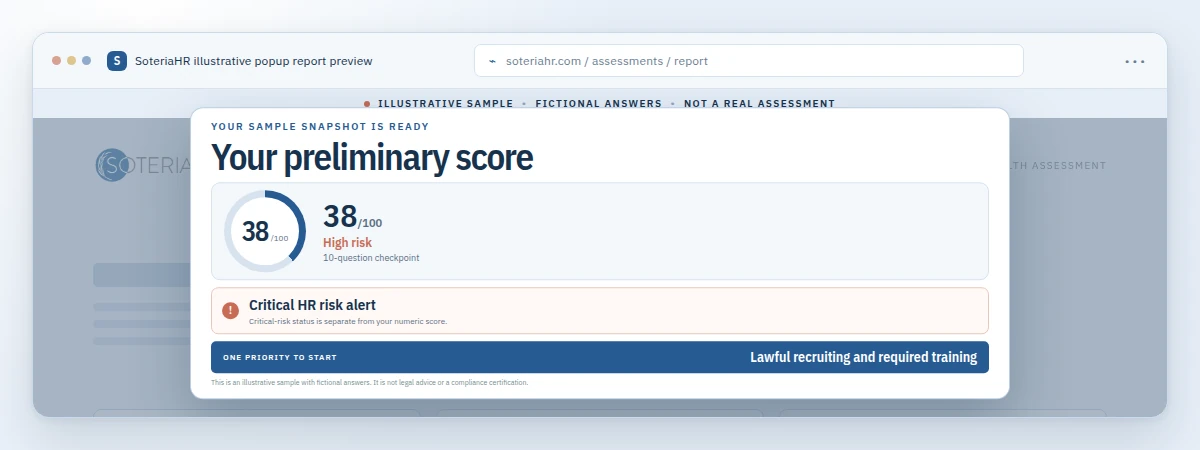
Finally, a number of leaders skip a baseline review entirely. The free HR Health Assessment at soteriahr.ai — a short, self-reported Quick HR Check or longer Complete HR Health Assessment — is designed to surface these gaps before they become expensive. It is worth noting that assessment results are preliminary and self-reported, not a certification of compliance or a substitute for professional legal review.
“We’ve got your back — so you can focus on growth.” That is the operating philosophy behind Soteria HR’s approach to outsourced HR administration, HR consulting, and benefits administration for growing employers.
HR Administration vs. HR Consulting vs. Benefits Administration vs. ASO
The table below compares the four core services at a glance, since side-by-side comparison is often the fastest way to see where an existing gap sits.
| Service | Best For | Key Activities | Typical Fit |
|---|---|---|---|
| HR Administration | Day-to-day execution | Records, onboarding, policies, leave coordination | Companies outgrowing informal processes |
| HR Consulting | Strategy and design | Workforce planning, culture, performance systems | Leadership facing growth decisions |
| Benefits Administration | Coverage and compliance | Enrollments, carrier coordination, ACA/COBRA support | Companies nearing 50+ employees |
| ASO Partnership | Full-scope support | All of the above, bundled, without co-employment | Teams ready for an ongoing HR partner |
Frequently Asked Questions
What does “scaling small teams” mean for HR purposes?
Scaling a small team means adding headcount quickly enough that informal HR processes stop working. In practice, this usually shows up as missed onboarding steps, inconsistent policies, or new compliance thresholds arriving faster than the company can track them.
Which HR and admin services are best for scaling small teams?
The combination of HR administration, HR consulting, and benefits administration — often delivered through an ASO — is generally best for scaling small teams. This pairing covers daily execution, strategic planning, and benefits compliance in a single, coordinated relationship.
What is the difference between HR administration and HR consulting?
HR administration handles ongoing execution, such as records and onboarding, while HR consulting focuses on designing processes like performance systems and workforce plans. In short, administration keeps things running; consulting decides how they should run.
How much does outsourced HR support typically cost for a small business?
Cost varies widely depending on headcount, scope, and whether benefits administration or payroll coordination is included. Because pricing depends on these specifics, the most accurate figures come from a direct consultation request rather than a general estimate.
How long does it take to set up an ASO relationship?
Setup timelines depend on current recordkeeping, existing benefits plans, and payroll systems that need to be connected. Generally, a focused onboarding period allows the core administration and consulting pieces to be active within a few weeks.
What is an ASO, and how is it different from a PEO?
An ASO (Administrative Services Organization) provides tailored HR support while the client remains the sole employer. In contrast, a PEO typically creates a co-employment arrangement, which shifts some employer responsibilities to the PEO itself.
When should a growing company add benefits administration support?
Benefits administration becomes especially important as a company approaches 50 full-time equivalent employees, the threshold tied to the ACA employer mandate. However, many companies add this support earlier simply to manage carrier coordination consistently.
What are common mistakes companies make when scaling HR without help?
Common mistakes include waiting until a compliance deadline forces action, buying a generic HR package instead of scoping to actual need, and skipping a baseline assessment of existing gaps before making changes.
Do we lose control of our business if we use outsourced HR administration?
No. Under an ASO model, the client organization remains the employer and keeps responsibility for employment decisions. The HR partner supports execution and guidance, not final authority over hiring or termination decisions.
What HR and admin services should come first when hiring employee number 10?
At this stage, HR administration is usually the first priority, since recordkeeping and onboarding typically break down before anything else. Light HR consulting can follow once basic policies and structure are in place.
How does payroll coordination differ from running payroll in-house?
Payroll coordination reviews and connects existing payroll workflows with HR systems, rather than processing payroll directly. As a result, it reduces duplicate data entry and improves accuracy without replacing the client’s chosen payroll provider.
What is the best way to know which HR services my company actually needs?
The most reliable starting point is a structured review of current HR gaps, such as the free HR Health Assessment at soteriahr.ai, followed by a direct conversation with an HR professional about priorities and timelines.
Is outsourced HR only for companies without any internal HR staff?
No. Outsourced HR support also complements existing internal HR teams by adding capacity for benefits administration, consulting projects, or payroll coordination during periods of rapid growth.
In the end, deciding which HR and admin services are best for scaling small teams comes down to matching support to actual headcount, risk, and internal capacity rather than buying a generic package. HR administration keeps daily operations consistent, HR consulting turns growth priorities into workable process, and benefits administration keeps coverage compliant as thresholds like the ACA employer mandate come into play. Above all, an ASO structure can bundle these services while leaving employment decisions with the client organization. For a practical next step, leaders can complete the free HR Health Assessment at soteriahr.ai or call Soteria HR at (800) 399-2458 to talk to an HR expert about the right mix for their current stage of growth.