How can compliance training support HR teams in small businesses? Compliance training is structured instruction that teaches managers and employees the legal, safety, and policy requirements that apply to their jobs, and for a small HR team it works as a force multiplier that turns scattered policy knowledge into consistent, defensible practice. In short, a well-built program helps a lean HR function catch gaps early, standardize onboarding, and respond the same way every time a question or incident comes up, instead of improvising case by case. This matters because most small businesses run HR with one generalist or a part-time team, so reusable training materials quietly do the work that a larger staff would otherwise handle by hand, one conversation at a time.
Key Takeaways
- Compliance training gives small HR teams repeatable systems instead of one-off explanations, saving time as the company grows.
- Core topics usually include anti-harassment, wage and hour rules, leave laws, workplace safety, and benefits compliance like ACA and COBRA.
- Some requirements are threshold-based; for example, California requires sexual harassment prevention training at five or more employees.
- A short, documented process — audit, schedule, deliver, track, review — keeps a program accurate without a full compliance department.
- Outsourced HR support, including an ASO (Administrative Services Organization) arrangement, can supplement an internal team without creating co-employment.
How Can Compliance Training Support HR Teams in Small Businesses?
Compliance training supports HR teams in small businesses in three concrete ways: it lowers legal and financial risk, it creates consistent documentation, and it frees HR staff from repeating the same policy explanations one employee at a time. This is exactly how compliance training can support HR teams in small businesses — by replacing improvised, person-by-person guidance with a repeatable system that works the same way every time. Because the materials are reusable, a single investment of design time pays off across every new hire and every policy update.
As a result, HR teams can spend more hours on strategic work, such as workforce planning or employee relations, and fewer hours answering the same compliance question repeatedly. For example, a documented harassment-prevention module means a manager does not need to improvise an explanation during a sensitive conversation; the expectations are already on record. In addition, training records double as a defense file. Therefore, if a dispute or agency inquiry arises later, the business can show what was taught, to whom, and when, rather than relying on memory.
Above all, consistency matters more than volume. A short, well-targeted program delivered to everyone beats a long program delivered inconsistently. For a deeper look at how training fits into broader risk management, see this complete guide to managing HR compliance risk, which walks through related policy and documentation practices.
What Is Compliance Training, and How Is It Different From Onboarding?
Compliance training is instruction tied to a specific legal, regulatory, or policy requirement — not a general orientation to company culture. General onboarding covers things like benefits enrollment and team introductions, while compliance training covers obligations such as harassment prevention, wage and hour rules, and workplace safety procedures. In other words, onboarding helps a new hire settle in; compliance training protects the business and the employee by documenting that specific required knowledge was delivered.
Benefits-related training often overlaps with compliance obligations as well. For instance, HR teams frequently need to explain ACA (Affordable Care Act) eligibility rules, COBRA (the federal law allowing continued health coverage after certain job changes), and Section 125 cafeteria plan rules during enrollment periods, since employees need accurate information to make decisions and the employer needs to show that disclosures were provided. Similarly, Form 5500 filing obligations for benefit plans are a compliance matter, not a cultural one, and training managers on the underlying rules reduces errors downstream.
Consequently, many small businesses find it useful to separate the two categories clearly in their HR calendar rather than bundling everything into a single new-hire packet. To understand how these obligations connect to a broader HR compliance function, review the role HR plays in compliance management within a growing organization.
Core Compliance Topics Small Business HR Teams Should Cover
Most small business compliance programs cover a similar core set of topics, though the exact scope depends on headcount, industry, and state. Specifically, these areas come up most often:
- Anti-harassment and discrimination: California law requires employers with five or more employees to provide sexual harassment prevention training to all staff every two years, under rules enforced by the state’s Civil Rights Department.
- Wage and hour basics: overtime, meal and rest breaks, and classification rules, which the U.S. Department of Labor oversees at the federal level.
- Leave laws: federal FMLA (Family and Medical Leave Act) and state-level equivalents like California’s CFRA, which apply once an employer crosses certain headcount thresholds.
- Workplace safety: hazard communication and injury-prevention training required by OSHA (the Occupational Safety and Health Administration).
- Benefits compliance: ACA eligibility, COBRA notices, and plan-document obligations tied to group benefits.
Notably, retaliation remains one of the most frequently alleged workplace issues nationwide, according to data published by the U.S. Equal Employment Opportunity Commission, which is one reason training on how to raise and handle complaints matters just as much as the harassment-prevention content itself. For a breakdown of resources that address these specific risk areas, see HR resources that reduce compliance risk in small companies.
Building a Compliance Training Program With Limited HR Staff
A lean HR team does not need an elaborate system to run effective compliance training. Instead, five repeatable steps keep a program accurate without constant manual effort:
- Audit current obligations. Start by auditing the specific federal, state, and local training and policy obligations that apply to your business based on employee count, industry, and location, since requirements like California’s harassment prevention training apply only above certain headcount thresholds.
- Set a training calendar. Build a recurring training calendar that assigns specific courses to new hires, annual refreshers, and manager-only sessions, so the schedule runs automatically instead of depending on someone remembering to launch it.
- Choose practical delivery formats. Select delivery formats that match how your team actually works, combining short e-learning modules for broad topics with live sessions for sensitive subjects like harassment prevention or workplace investigations.
- Document completion and track gaps. Track who has completed each course, store signed acknowledgments in each employee’s personnel file, and flag any gaps immediately so managers can follow up before compliance deadlines pass.
- Review and update content annually. Review training content at least once a year against current federal and state law changes, updating materials whenever thresholds, definitions, or required topics shift so the program stays accurate.
In particular, step four is where small teams most often fall behind, simply because tracking is tedious without a system. For that reason, many growing companies pair this process with broader HR support options for small businesses so tracking does not fall entirely on one person’s calendar reminders.
Common Mistakes That Undermine Employee Compliance Training
Even well-intentioned programs can fail in predictable ways. First, many businesses treat training as a one-time new-hire event rather than a recurring obligation, which means refresher requirements quietly lapse. Second, some rely on verbal reminders instead of signed, dated acknowledgments, leaving no record if a dispute arises later. Third, generic, off-the-shelf content sometimes skips jurisdiction-specific rules entirely, so an employer may believe a requirement is satisfied when it is not.
Above all, the most common mistake is assuming that because training happened once, it covers every current employee indefinitely. However, new hires, promoted managers, and law changes all reset the clock. Consequently, a short annual review of who still needs training — and what content needs updating — prevents most gaps before they become a problem.
“A compliance training program is only as strong as its weakest record. Documentation, not intention, is what protects a small business when questions come up later.”
In-House Training vs. Outsourced HR Support: Which Fits Your Business?
Some small businesses build and track compliance training entirely in-house, while others bring in outsourced HR support, including an ASO relationship, to supplement an internal team without creating co-employment. In contrast to a PEO (Professional Employer Organization) arrangement, an ASO leaves the client as the employer of record, fully responsible for employment decisions, while the HR provider delivers tailored administrative support. The table below compares the two approaches at a glance.
| Factor | Fully In-House | Outsourced / ASO Support |
|---|---|---|
| Setup time | Slower; staff build materials from scratch | Faster; tailored materials already exist |
| Jurisdiction expertise | Depends on internal staff knowledge | Specialists track changing state and federal rules |
| Record-keeping burden | Falls on one generalist or founder | Shared with a dedicated HR partner |
| Scalability | Harder to scale without adding headcount | Scope adjusts as the organization grows |
| Employment responsibility | Entirely with the business | Remains with the business under ASO support (no co-employment) |
How Soteria HR Helps Small Business HR Teams Build Compliance Training
Soteria HR, based in Pasadena, California, provides hands-on outsourced HR services to growing small and mid-sized employers across Los Angeles, Orange County, and nationwide. In particular, the company’s HR administration, HR consulting, and benefits administration services help internal teams design, schedule, and document compliance training without having to build that infrastructure alone. For employers that do not yet have a full HR department, as well as for existing internal HR teams that want additional support, Soteria’s ASO option provides tailored assistance while the client remains the employer of record.
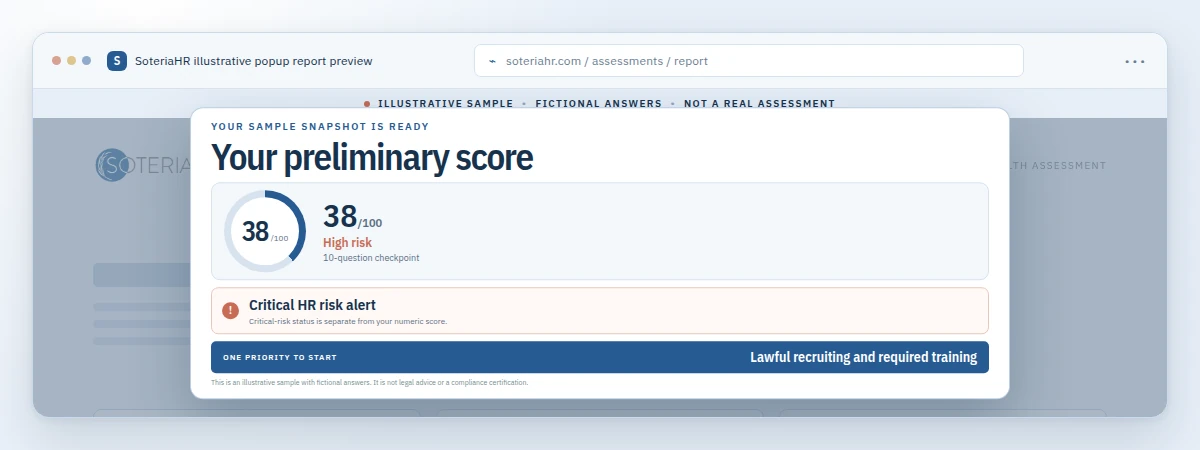
Founders, CEOs, presidents, COOs, CFOs, and HR or operations leaders typically reach out when training gaps surface during a hiring surge, a policy update, or after an employee relations issue. Therefore, a practical first step is reviewing where gaps currently exist. The free HR Health Assessment at soteriahr.ai offers a quick 10-question check or a more detailed 40-question review to surface potential priorities; note that results are self-reported and preliminary, not a certification of compliance or a formal legal audit.
For a direct conversation about building or strengthening a compliance training program, leaders can talk to an HR expert at Soteria HR by calling (800) 399-2458 or submitting a consultation request. Additional context on the resources available for ongoing compliance questions appears in this overview of HR compliance resources.
Frequently Asked Questions
What is compliance training in HR?
Compliance training in HR is instruction tied to a specific legal, safety, or policy requirement, such as harassment prevention or wage and hour rules. Unlike general onboarding, it is usually tracked and documented because a regulation or internal policy requires it.
How can compliance training support HR teams in small businesses?
Compliance training can support HR teams in small businesses by replacing repeated one-on-one explanations with a documented, repeatable process that applies the same way to every employee. As a result, lean HR teams spend less time on repetitive questions and more time on strategic work.
How often should small businesses provide compliance training?
Frequency depends on the specific requirement; some training is one-time at hire, while other training, like California’s harassment prevention course, must repeat every two years for qualifying employers. In general, reviewing the full training calendar annually catches most overdue items.
What topics are usually required in compliance training?
Common required topics include anti-harassment and discrimination prevention, wage and hour basics, leave law awareness, and workplace safety. Benefits-related compliance, such as ACA and COBRA notices, often overlaps with these core areas.
Does California law require sexual harassment prevention training?
Yes. California requires employers with five or more employees to provide sexual harassment prevention training to all staff every two years, under rules administered by the state’s Civil Rights Department. Specific exceptions and timing details should be verified against current state guidance.
How much does compliance training typically cost for a small business?
Cost varies widely based on format, headcount, and whether content is built in-house or delivered through an outside provider. In general, e-learning modules cost less per employee than live, instructor-led sessions, though sensitive topics often warrant the live format despite the added cost.
How long does it take to build a compliance training program?
A basic program covering core topics can often be assembled within a few weeks once obligations are audited and content is selected. However, ongoing maintenance, including annual reviews and tracking, is a continuous task rather than a one-time project.
What’s the difference between compliance training and general onboarding?
General onboarding introduces a new hire to culture, benefits, and team structure, while compliance training delivers specific legally or policy-required content that must be documented. In practice, the two are often scheduled together but tracked separately.
What are common mistakes companies make with compliance training?
Common mistakes include treating training as a one-time event, skipping signed acknowledgments, and using generic content that misses jurisdiction-specific rules. Consequently, gaps surface only when a dispute or audit forces a review.
Can outsourced HR support help with compliance training?
Yes. Outsourced HR support, including ASO arrangements, can help design, schedule, and track compliance training while the client remains the employer of record. This differs from a PEO model, which involves co-employment.
What happens if employees skip required compliance training?
Missed training can leave a business without documentation if an incident or dispute occurs later, and in some cases it may mean a specific legal requirement was not satisfied. Therefore, tracking completion closely is just as important as delivering the training itself.
How does Soteria HR support compliance training for small businesses?
Soteria HR provides HR administration, HR consulting, and benefits administration that help internal teams design and document training programs, with an ASO option available for businesses that need tailored support without co-employment. Interested leaders can call (800) 399-2458 to discuss specific needs.
What is the HR Health Assessment, and how does it relate to compliance training?
The free HR Health Assessment at soteriahr.ai is a self-reported questionnaire, available as a short 10-question version or a detailed 40-question version, designed to surface potential HR and compliance gaps, including training-related priorities. It is preliminary and not a substitute for a professional legal audit.
In summary, compliance training supports HR teams in small businesses by replacing one-off explanations with a documented, repeatable system that reduces legal risk and saves time. A lean program that audits obligations, sets a recurring calendar, delivers practical content, tracks completion, and gets reviewed annually can keep pace with a growing company. Where internal bandwidth is tight, outsourced HR support, including an ASO relationship, can fill that gap while the business remains the employer of record. For leaders ready to assess current gaps, starting with the free HR Health Assessment at soteriahr.ai or speaking directly with an HR expert at (800) 399-2458 is a practical next step toward a more consistent training program.