Hands-on outsourced HR service is day-to-day, relationship-based HR support delivered by a dedicated team that functions as an extension of your company, rather than a help-desk ticket queue or a self-service portal. For a growing small or mid-sized business (SMB), that usually means a named HR contact who already knows your people, your policies, and your pace of hiring. In practice, it looks like a proactive phone call about a tricky termination, not a three-day email chain. For founders juggling growth and compliance at the same time, the gap between reactive outsourcing and a genuinely hands-on partnership often decides whether HR becomes a growth enabler or one more fire to put out.
Key Takeaways
- Hands-on outsourced HR service pairs a growing SMB with a responsive HR team, not just software or a call center queue.
- It typically bundles HR administration, HR consulting, benefits administration, and payroll coordination into one ongoing relationship.
- An Administrative Services Organization (ASO) model lets a business keep full control as the employer of record while gaining expert support.
- According to SHRM research, smaller organizations average roughly 1.4 HR staff per 100 employees — often too thin for fast-growing headcount.
- A free HR Health Assessment is a low-commitment way to flag gaps before they turn into compliance risk.
What Is Hands-On Outsourced HR Service?
Hands-on outsourced HR service is HR administration, consulting, and benefits support delivered by a responsive outside team that proactively manages day-to-day employee matters alongside your leadership. Unlike basic outsourcing, which often means submitting a ticket and waiting, this model gives leaders direct access to people who already understand their handbook, their industry, and their team.
In particular, this approach blends several services under one relationship: onboarding and offboarding paperwork, leave coordination, policy updates, and benefits enrollment, for example. Consequently, a growing SMB gets continuity instead of hunting for a new vendor every time a new need appears. For instance, a 40-person logistics company might lean on this partner for FMLA (Family and Medical Leave Act) tracking one month, and for building a performance-review process the next. Similarly, a single point of contact usually coordinates with payroll providers and insurance carriers, so leaders are not translating between three vendors at once.
Soteria HR, based in Pasadena, California, structures this kind of support through its HR administration and HR consulting services, delivered through an ASO arrangement. Under an ASO, the client company remains the legal employer of record and keeps responsibility for employment decisions, while Soteria provides tailored administrative and advisory support — a structure that differs from the co-employment model used by some providers. As a result, leadership keeps control over hiring, firing, and culture, while gaining a team that absorbs the administrative weight behind those decisions. You can review a broader explanation of this model on the professional HR solutions for small businesses page.
How Hands-On HR Support Differs From Basic Outsourcing
Many SMB leaders have already tried at least one HR tool or payroll platform promising to “handle HR.” However, software alone rarely resolves a nuanced termination, a leave request overlapping with intermittent FMLA, or a looming benefits compliance deadline. In contrast, hands-on outsourced HR adds judgment and follow-through on top of the technology layer.
Specifically, three differences tend to stand out. First, responsiveness: a hands-on partner answers calls and emails within hours, not days, because the relationship is ongoing rather than transactional. Second, context: because the same HR professional stays engaged over time, recommendations reflect a company’s actual culture and risk tolerance instead of a generic template. Third, scope: a hands-on relationship typically bundles administration, consulting, and benefits support, so small issues get caught before they compound.
For example, the U.S. Department of Labor outlines specific requirements for classifying employees and tracking protected leave. A hands-on HR partner translates those requirements into daily practice — updating a handbook clause, training a manager, or flagging a misclassification risk — rather than simply pointing to the regulation. Furthermore, the Equal Employment Opportunity Commission (EEOC) enforces workplace discrimination laws that carry real financial exposure for employers who fall behind on policy updates. Therefore, ongoing guidance matters more as headcount grows past the point where one generalist can track everything manually. Growing SMBs weighing this decision often start by reviewing what full outsourcing can look like on the why outsource HR overview before choosing a model.
How a Hands-On Outsourced HR Partnership Typically Unfolds
A hands-on engagement generally follows a predictable sequence, even though the exact scope is tailored to each organization. Below is a typical path from first conversation to ongoing support.
- Initial assessment. The HR partner reviews current policies, employee records, and open risks, often starting with a short diagnostic such as a free HR Health Assessment to flag priority gaps before deeper work begins.
- Scope and plan. Leadership and the HR team agree on which services — administration, consulting, benefits, or payroll coordination — matter most right now, and in what order to tackle them.
- Onboarding the relationship. The HR partner sets up record systems, point-of-contact workflows, and a communication cadence, so the client always knows exactly who to call and what to expect next.
- Ongoing administration. Day-to-day tasks move forward continuously: onboarding new hires, coordinating leave, updating policies, and supporting benefits enrollment periods as they come up throughout the year.
- Periodic review and adjustment. As headcount or risk profile changes, the scope expands or narrows, keeping support proportional to the organization’s size instead of locking in a fixed, one-size package.
Throughout each stage, the client company remains the employer of record under an ASO structure, meaning it keeps authority over hiring, discipline, and termination decisions. Meanwhile, the outsourced team absorbs much of the administrative and advisory workload behind those decisions. As a result, growth moments — opening a new location, doubling a sales team — arrive with fewer HR surprises.
Core Services Inside a Hands-On Outsourced HR Relationship
HR Administration: The Daily Operational Layer
HR administration covers employee records, onboarding and offboarding, policy maintenance, leave coordination, unemployment support, and the payroll coordination that keeps everything connected. In a hands-on model, these tasks move without constant prompting from leadership. A fuller breakdown of what this term covers appears on the HR administration explainer.
HR Consulting: Turning Priorities Into Process
HR consulting addresses employee relations, workforce planning, culture, recruiting practices, and performance management. Rather than a one-time report, a hands-on consultant stays involved as priorities shift, helping leaders turn a vague concern into a workable process. For a closer look at how this works for growing companies, see human capital consulting for growing SMBs.
Benefits Administration: Enrollment, Compliance, and Carrier Coordination
Benefits administration includes enrollments, terminations, employee communications, and carrier coordination, along with support for applicable requirements under ACA, COBRA, Section 125, and Form 5500 filings. Specifically, Section 125 cafeteria plan rules and related filing obligations are detailed on IRS.gov, and applicability varies by plan design and headcount, so confirming scope with an advisor matters before assuming a requirement does or does not apply.
Payroll Coordination: Keeping Pay Accurate and On Time
Payroll coordination is not full payroll processing. Instead, the HR partner reviews workflows, liaises with the external payroll provider, and resolves information gaps so pay runs smoothly and records stay consistent across systems.
Hands-On Outsourced HR vs. DIY HR vs. Traditional Vendors
The table below compares three common approaches growing SMBs weigh when deciding how to handle HR.
| Aspect | DIY / In-House Generalist | Traditional Vendor or Software | Hands-On Outsourced HR (ASO) |
|---|---|---|---|
| Response time | Depends on one person’s bandwidth | Often ticket-based, multi-day | Direct contact, usually same-day |
| Relationship continuity | High, but limited expertise breadth | Low; rep or system changes often | High, consistent point of contact |
| Compliance guidance | Reactive, as issues surface | Generic templates and alerts | Proactive, tailored to the business |
| Scope of support | Whatever one generalist can cover | Narrow, often single-function | Administration, consulting, benefits together |
| Employer-of-record status | Client company | Varies by vendor type | Client company (ASO, no co-employment) |
“Growth exposes every gap in HR that used to be invisible. The goal of a hands-on partner isn’t to replace leadership’s judgment — it’s to make sure that judgment is backed by consistent administration and compliance follow-through, so the business can keep its promise: we’ve got your back, so you can focus on growth.”
Signs a Growing SMB Needs More Hands-On HR Support
Certain patterns tend to show up before leaders realize HR has outgrown the current setup. Recognizing them early usually costs far less than fixing a compliance problem later.
- A single person handles HR alongside other unrelated duties, and tasks slip when they are out sick or on vacation.
- Policy updates lag behind new hires, leaving gaps in documentation and inconsistent manager decisions across departments.
- Leave requests, benefits enrollment, and performance issues all land on the founder’s desk instead of a dedicated process.
- Headcount has crossed into the 10–250 employee range, where informal, ad hoc HR habits start creating real exposure.
- Nobody on the team feels confident explaining current wage, leave, or classification rules to a new manager.
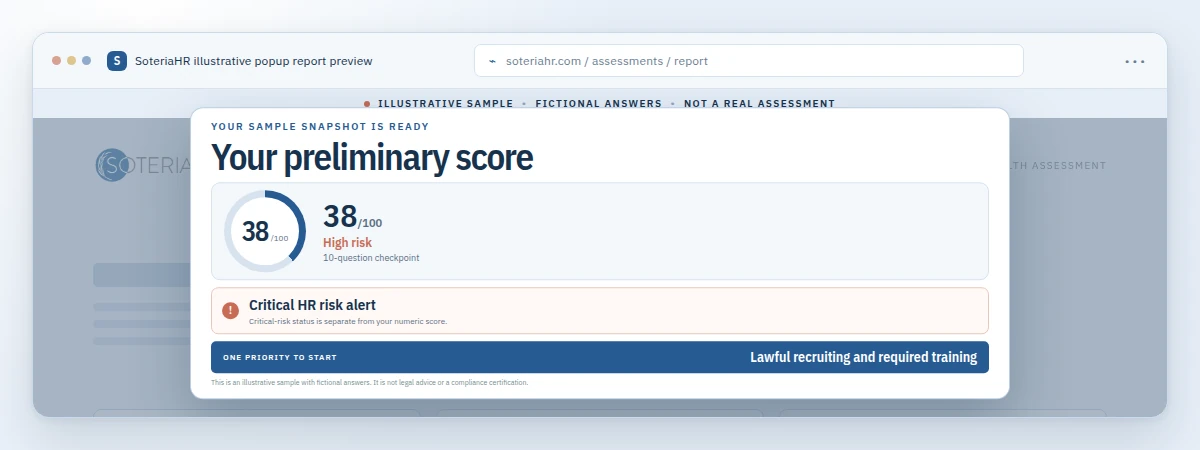
If two or more of these sound familiar, a short diagnostic is often a reasonable next step before committing to a full engagement. For instance, Soteria’s free HR Health Assessment at soteriahr.ai offers a 10-question Quick HR Check in roughly two minutes, or a more detailed 40-question Complete HR Health Assessment in about 10 to 12 minutes. Results are self-reported and preliminary — they introduce likely gaps and priorities, not a certification of compliance or a formal legal audit.
Frequently Asked Questions About Hands-On Outsourced HR Service
What does hands-on outsourced HR service mean?
Hands-on outsourced HR service means a dedicated outside team manages day-to-day employee administration, consulting, and benefits support with ongoing, proactive involvement, rather than handling requests only when a ticket is submitted. The client company stays the employer of record throughout.
How is hands-on outsourced HR different from a PEO?
A Professional Employer Organization (PEO) typically uses a co-employment structure, meaning the PEO becomes a joint employer of record. An ASO-based hands-on model, by contrast, leaves the client company as the sole employer while the provider delivers administrative and advisory support without co-employment.
How much does hands-on outsourced HR support typically cost?
Pricing varies based on headcount, scope, and how many services are bundled together, so there is no single standard rate. Most providers scope a quote after reviewing current policies, team size, and priority needs during an initial consultation.
How long does it take to onboard an outsourced HR partner?
Onboarding generally takes a few weeks, covering document review, system setup, and establishing communication workflows. Larger organizations or those with more compliance gaps may need additional time before the relationship is fully operational.
Can hands-on outsourced HR work alongside an existing internal HR person?
Yes. Many engagements support an existing internal HR team rather than replacing it, taking on overflow work, specialized compliance questions, or consulting projects the internal team does not have bandwidth to lead alone.
What size company benefits most from hands-on outsourced HR?
Organizations with roughly 10 to 250 employees are a common fit, since this is often where informal HR habits start creating real risk. That said, this is a priority range rather than a strict eligibility limit, and smaller or larger teams can still benefit.
Does outsourcing HR mean giving up control over employment decisions?
No, not under an ASO model. The client company remains the employer and retains authority over hiring, discipline, and termination decisions, while the outsourced team handles administration and offers guidance.
What is the difference between an ASO and co-employment?
An ASO provides HR administration and support without becoming a joint employer, so the client keeps sole legal employer status. Co-employment, used by many PEOs, splits certain employer responsibilities between the client and the provider.
What common mistakes do SMBs make when choosing an outsourced HR provider?
Common mistakes include choosing a provider based on price alone, assuming software replaces human judgment, and not clarifying upfront who remains the employer of record. Skipping an initial diagnostic also makes it harder to prioritize the right services first.
What should I expect in the first 90 days?
Expect a policy and records review, agreement on priority scope, and the setup of communication workflows during the first 90 days. Ongoing administrative work, such as onboarding support and leave coordination, typically starts in parallel once the basics are in place.
Does hands-on outsourced HR include payroll processing?
Usually not directly. Most providers offer payroll coordination — reviewing workflows and liaising with an external payroll provider — rather than running payroll processing and tax filings themselves. Scope should be confirmed with each provider.
How do I know if my business has HR gaps worth addressing?
A short diagnostic, such as a free HR Health Assessment, is often the fastest way to surface likely gaps across policies, compliance, and benefits. From there, a consultation call can clarify which gaps are most urgent.
In short, hands-on outsourced HR service gives a growing SMB a dedicated, responsive partner across HR administration, consulting, benefits administration, and payroll coordination, while leadership keeps full authority as the employer of record. As headcount climbs past the point where one generalist can track everything, that kind of ongoing, relationship-based support tends to matter more than another software login. Therefore, the most useful first step is usually a short conversation or a quick diagnostic rather than a long procurement process. Soteria HR supports employers in Los Angeles, Orange County, and nationwide through exactly this kind of hands-on outsourced HR service — to talk through current priorities, call (800) 399-2458 or submit a consultation request to speak with an HR expert.