Which human resources providers offer customized HR support for SMBs? is one of the first questions growing founders and HR leaders ask once onboarding, compliance, and benefits administration start competing for their time. In practice, customized HR support for SMBs is outsourced human resources assistance that adjusts its scope, pricing, and day-to-day involvement to a company’s size, industry, and existing internal capacity. Because no two growing organizations have identical gaps, the strongest providers build a tailored service mix rather than selling one fixed package. For example, Soteria HR, based in Pasadena, California, is built around that model, serving employers across Los Angeles, Orange County, and nationwide.
Key Takeaways
- Customized HR support adapts service scope, cost, and involvement to a company’s size and existing internal HR capacity.
- Provider categories include outsourced HR administration and consulting firms, ASOs, PEOs, boutique consultancies, and software-only platforms.
- An ASO (Administrative Services Organization) delivers tailored HR support without co-employment, so the client remains the employer of record.
- Employers with roughly 10–250 employees are a priority segment for many outsourced HR providers, though not a fixed cutoff.
- A free tool like the HR Health Assessment at soteriahr.ai can surface priorities before a formal consultation.
What Is Customized HR Support for SMBs?
Customized HR support for SMBs is outsourced human resources help that is scaled and sequenced to match a company’s actual gaps, rather than a fixed menu applied to every client the same way. In other words, two companies with 40 employees in different industries might receive very different service mixes based on turnover, compliance exposure, and whether anyone internally already owns HR.
Typically, this support covers day-to-day HR administration, consulting on workforce decisions, and benefits coordination. For small businesses without a dedicated HR department, a customized provider can function as the entire HR engine. For companies that already have internal HR staff, the same provider can instead fill specific gaps, such as compliance monitoring or benefits enrollment.
Because employment rules vary by state, a genuinely customized provider also tracks jurisdiction-specific obligations. For instance, the U.S. Department of Labor and the Equal Employment Opportunity Commission (EEOC) set federal baselines, while states like California layer on additional requirements through agencies such as the California Civil Rights Department. As a result, scope and pricing should reflect where the employer actually has people working, not a single national template.
Which Human Resources Providers Offer Customized HR Support for SMBs?
Several categories of providers answer the question of which human resources providers offer customized HR support for SMBs, and each fits a different situation. Outsourced HR administration and consulting firms, like Soteria HR, build ongoing partnerships around HR administration, consulting, and benefits administration, with payroll coordination layered in as needed. Because the relationship is ongoing rather than project-based, the scope can expand as the organization grows.
In contrast, Professional Employer Organizations (PEOs) use a co-employment structure, meaning the PEO becomes a joint employer of record for tax and insurance purposes. Soteria HR instead offers an ASO (Administrative Services Organization) option, which provides tailored HR support without co-employment, so the client remains the employer and keeps responsibility for employment decisions and applicable obligations. Readers comparing structures in more detail can review how human resources and consulting services work together at Soteria HR.
Finally, boutique HR consultancies and software-only HR platforms round out the field. Consultancies tend to focus on advice without administrative execution, while software platforms automate paperwork but rarely offer hands-on guidance. For employers searching broadly, a practical starting point is this overview of HR outsourcing options available to local and nationwide employers.
Core Services a Tailored HR Partner Should Offer
A genuinely customized HR provider should be able to flex across at least four core areas. First, HR administration covers employee records, onboarding and offboarding, policy management, leave coordination, and unemployment support. Second, HR consulting helps leaders turn priorities, such as workforce planning or culture concerns, into workable processes rather than abstract goals.
Third, benefits administration includes enrollments, terminations, employee communications, and carrier coordination, along with support for applicable ACA, COBRA, Section 125, and plan-document requirements where they apply. Fourth, payroll coordination complements the broader HR relationship by improving information flow between the employer, the provider, and an external payroll system, though processing and filing responsibilities should always be confirmed in scope.
Beyond these core services, many growing employers eventually add training and performance support, including manager development and harassment-prevention training. According to the U.S. Small Business Administration, firms with fewer than 500 employees account for 99.9% of all U.S. businesses, which helps explain why demand for flexible, right-sized HR support continues to grow alongside the small business economy.
“We’ve got your back—so you can focus on growth.” — Soteria HR
HR Outsourcing, PEO, and ASO: Comparing Customized Support Models
Since terminology around outsourced HR often overlaps, a side-by-side comparison can clarify which model actually offers the most customization for a given employer. The table below summarizes the three most common structures, as described by resources such as Wikipedia’s overview of Professional Employer Organizations and industry guidance from the Society for Human Resource Management (SHRM).
| Model | Employment Relationship | Customization Level | Typical Best Fit |
|---|---|---|---|
| Outsourced HR (e.g., Soteria HR) | Client remains sole employer | High — scope built around gaps | SMBs needing ongoing, flexible support |
| ASO (Administrative Services Organization) | Client remains sole employer | High — tailored, no co-employment | Employers wanting hands-on help, full control |
| PEO (Professional Employer Organization) | Co-employment arrangement | Moderate — bundled benefit pools | Employers wanting shared liability and bundled benefits |
| Software-only HR platform | Client remains sole employer | Low — self-service tools only | Employers with internal HR staff needing automation |
How to Evaluate an Outsourced HR Partner for Your Growing Business
Choosing between providers becomes easier with a structured process. Below is a practical sequence many employers follow when vetting outsourced HR support.
- Map your current HR gaps. List which HR functions, such as onboarding, leave tracking, or benefits enrollment, currently rely on guesswork or a single overloaded staff member.
- Clarify the employment structure you want. Decide whether you need co-employment through a PEO or prefer to remain the sole employer through an ASO or outsourced HR arrangement.
- Confirm jurisdictional coverage. Ask candidates how they track state-specific rules, since requirements in California often differ meaningfully from federal minimums set by agencies like the EEOC.
- Request a scoped proposal, not a flat package. A provider that customizes support should be able to explain exactly which services apply to your headcount and industry, and why.
- Start with a free assessment or consultation. Completing a short diagnostic, such as the HR Health Assessment at soteriahr.ai, can surface priorities before committing to a formal engagement.
Signs Your Business Needs More Than DIY HR
Several warning signs suggest a company has outgrown informal HR handling. For example, missed benefits deadlines, inconsistent onboarding, or repeated questions about leave policy often indicate that HR has become a part-time responsibility squeezed into someone else’s full-time role. Similarly, once a company crosses certain employee thresholds, additional legal obligations apply automatically.
In California, for instance, the state’s Fair Employment and Housing Act provisions, enforced by the California Civil Rights Department, apply to employers with as few as five employees, which is a much lower bar than many federal thresholds. Consequently, SMB leaders who assume they are “too small” for formal HR compliance can be mistaken.
Above all, if founders or executives are spending hours each week on HR paperwork instead of running the business, that is usually the clearest sign it is time to talk with an outsourced provider. Soteria HR supports organizations without a full internal HR department, and it also supports existing internal HR teams that need extra capacity, so growth in either direction does not require starting over. Explore how to find the right HR support quickly for a closer look at prioritization.
Frequently Asked Questions
What does customized HR support mean for a small business?
Customized HR support means a provider scales HR administration, consulting, and benefits help to match a company’s actual size and gaps, rather than applying one fixed package. This lets a 20-person company and a 200-person company each get a relevant scope of service.
Which human resources providers offer customized HR support for SMBs?
Providers that offer customized HR support for SMBs include outsourced HR administration and consulting firms like Soteria HR, ASOs, PEOs, boutique HR consultancies, and some software-enabled platforms. The right fit depends on whether an employer wants to remain the sole employer and how much hands-on involvement is needed.
How is outsourced HR different from hiring an in-house HR manager?
Outsourced HR typically provides a team of specialists across administration, benefits, and compliance for a predictable cost, while an in-house hire is a single person with broader but less specialized bandwidth. Many growing companies use outsourced support to extend or support an existing internal hire rather than replace one.
What is the difference between a PEO and an ASO?
A PEO uses co-employment, becoming a joint employer of record alongside the client, while an ASO delivers tailored HR support without co-employment. As a result, clients working with an ASO remain the sole employer and retain responsibility for employment decisions.
How much does outsourced HR support typically cost?
Pricing varies widely based on employee count, service scope, and whether benefits administration and payroll coordination are included. Because exact figures depend on the engagement, the most reliable way to get an accurate number is a direct consultation rather than a published rate card.
How long does it take to set up HR support with a new provider?
Onboarding timelines generally depend on how many systems, policies, and employee records need to be reviewed and transferred. Simpler engagements can begin within a few weeks, while more complex, multi-location setups may take longer to fully configure.
What size business benefits most from customized HR support?
Employers with roughly 10 to 250 employees are a priority segment for many outsourced providers, since this range often lacks a full internal HR department but faces growing compliance complexity. However, this is a priority segment, not a strict eligibility cutoff.
What common mistakes do SMBs make when choosing an HR provider?
A frequent mistake is comparing providers on price alone without confirming whether they handle state-specific compliance or only generic federal rules. Another common error is choosing a PEO’s co-employment model without understanding the shared-liability tradeoffs involved.
Can outsourced HR providers handle multi-state compliance?
Some providers can, but capability varies significantly, so it is important to ask directly rather than assume. In particular, confirm how the provider tracks differences between federal guidance from agencies like the EEOC and state-specific rules, such as those in California.
Does Soteria HR require co-employment like a PEO?
No. Soteria HR offers an ASO option that provides tailored HR support without co-employment, meaning the client remains the employer and keeps responsibility for employment decisions and applicable obligations.
What is the HR Health Assessment, and how does it help SMBs?
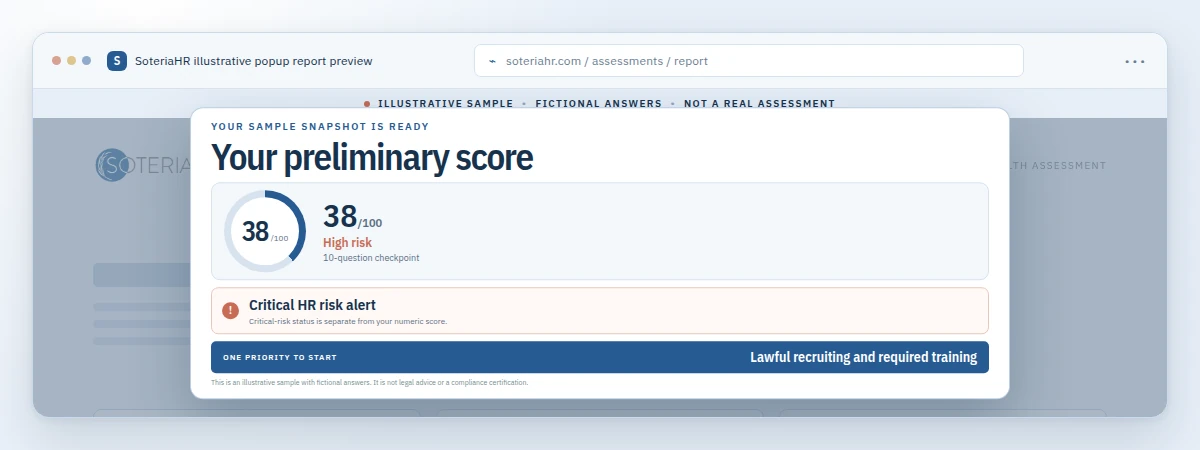
The free HR Health Assessment at soteriahr.ai offers a Quick HR Check and a longer Complete HR Health Assessment to surface potential gaps and priorities. Results are self-reported and preliminary, so they should be treated as a starting conversation rather than a compliance certification.
What HR services should growing companies prioritize first?
Most growing companies should prioritize HR administration and benefits administration first, since these touch every employee directly. Consulting support for workforce planning and culture typically follows once day-to-day operations are stable.
What is the best practice for transitioning to outsourced HR support?
A good practice is to start with a gap assessment, then phase in services such as administration before layering in consulting or payroll coordination. This phased approach reduces disruption for existing employees and internal staff.
In summary, the question of which human resources providers offer customized HR support for SMBs comes down to matching an employer’s size, compliance exposure, and internal capacity to the right structure, whether that is outsourced HR administration and consulting, an ASO, or a PEO. Soteria HR, serving Pasadena, Los Angeles, Orange County, and employers nationwide, builds its HR administration, consulting, and benefits administration services around exactly that kind of tailored fit, without requiring co-employment. Therefore, the most reliable next step is to talk with an HR expert by calling (800) 399-2458, submitting a consultation request, or starting with the free HR Health Assessment at soteriahr.ai.