Human capital management consulting firms help with talent management by combining structured HR expertise with hands-on support for hiring, developing, and retaining employees. Rather than handing an employer a generic binder of best practices, these firms typically diagnose gaps in recruiting, performance management, and retention, then help build practical processes an internal team can run day to day. For growing companies without a full HR department, this outside guidance often bridges the gap between ad hoc hiring decisions and a mature, repeatable talent strategy.
Key Takeaways
- Human capital management (HCM) consulting covers the full employee lifecycle, while talent management focuses specifically on attracting, developing, and keeping the right people.
- Consulting firms typically help with workforce planning, structured hiring, performance systems, benefits alignment, and manager training.
- Many small and mid-sized employers use HCM consulting instead of building a large internal HR department from scratch.
- An Administrative Services Organization (ASO) model lets an employer get tailored HR support without entering a co-employment arrangement.
- Employers remain the legal employer in these relationships and keep responsibility for employment decisions and compliance obligations.
What Is Human Capital Management Consulting?
Human capital management consulting is advisory and hands-on support that helps employers plan, organize, and improve how they manage employees across the entire employment lifecycle. In short, it treats people the way a finance team treats capital: as an asset that needs deliberate planning, not just paperwork.
The term itself, human capital, refers to the collective skills, knowledge, and experience employees bring to an organization. Consulting around this concept usually blends two layers of work. First, there is strategic guidance: workforce planning, organizational design, and compensation structure. Second, there is operational support: the day-to-day administration that keeps those strategies running, including onboarding, recordkeeping, and benefits coordination.
For a deeper walkthrough of this model, Soteria HR’s complete guide to human capital management consulting breaks down how the strategic and administrative pieces fit together. Similarly, the overview on what human capital firms do and why it matters explains how this differs from a traditional staffing agency or a payroll-only vendor.
How Do Human Capital Management Consulting Firms Help With Talent Management?
Human capital management consulting firms help with talent management by applying structured hiring, development, and retention processes that most growing companies have not had time to build on their own. In particular, they usually start by auditing current practices, then prioritize the gaps that create the most risk or turnover.
Below are the three areas where this support shows up most often.
Recruiting and Workforce Planning Support
Consultants typically help employers forecast staffing needs, write clearer job descriptions, and build consistent interview processes. As a result, hiring managers rely less on gut instinct and more on repeatable, defensible selection criteria. For manufacturing and other operations-heavy employers, this kind of structured workforce planning often matters even more because of shift coverage and seasonal demand; the overview on how HR consulting helps a manufacturing company walks through examples specific to that industry.
Performance Management and Employee Development
Beyond hiring, consulting firms commonly help design performance review cycles, manager coaching tools, and documented feedback practices. Consequently, performance conversations become less reactive and more tied to clear, written expectations. The Society for Human Resource Management (SHRM) has long noted that inconsistent performance documentation is a frequent source of employee relations disputes, which is one reason structured systems matter.
Benefits Alignment and Retention Strategy
Talent management rarely succeeds without competitive, well-administered benefits. Therefore, many consulting engagements include benefits administration: enrollments, terminations, carrier coordination, and support with applicable ACA, COBRA, Section 125, and plan-document requirements. In addition, consultants often review turnover data to flag which roles or departments need the most retention attention first.
Human Capital Management Consulting vs. ASO vs. In-House HR Only
Employers often confuse a few related options. The table below compares three common approaches to talent management support at a glance.
| Approach | Talent Management Support | Employment Responsibility | Best Fit |
|---|---|---|---|
| HCM Consulting (project or ongoing) | Strategic advice plus select implementation help | Client is the sole employer | Companies with some HR already in place |
| ASO Partnership (no co-employment) | Ongoing, hands-on HR administration and consulting | Client is the sole employer | Growing companies without a full HR department |
| In-House HR Only | Depends entirely on internal team bandwidth and experience | Client is the sole employer | Larger organizations with mature HR staff |
Notably, an ASO is different from a PEO because there is no co-employment relationship; the client remains the legal employer and keeps responsibility for employment decisions and applicable obligations. For a broader comparison of consulting formats, what to expect from human capital management consulting for SMBs covers typical engagement structures in more detail.
“Talent management is not a single project with a start and end date. It is a continuous cycle of hiring, developing, and retaining the right people, built on everyday HR fundamentals.”— Soteria HR Consulting Team
A Step-by-Step Approach to Building a Talent Management Program
Most human capital management consulting firms follow a similar sequence when they take on a talent management engagement. Below is a general outline of what that process typically looks like.
- Assess current state. The firm reviews existing job descriptions, hiring steps, performance tools, and turnover patterns to identify where talent is being lost or mismanaged across the lifecycle.
- Prioritize the highest-risk gaps. Rather than fixing everything at once, consultants typically rank issues by compliance risk, cost of turnover, and impact on daily operations.
- Build or update core processes. This often includes structured interview guides, onboarding checklists, performance review templates, and written policies that managers can actually follow consistently.
- Train managers on the new processes. Even a well-designed system fails if frontline managers do not understand how to apply it, so training and manager coaching typically follow implementation.
- Monitor and adjust over time. Ongoing consulting relationships usually include periodic check-ins to revisit turnover data, benefits satisfaction, and whether the program needs refinement as the company grows.
For employers building internal capability alongside outside support, resource management consulting to build a stronger team looks specifically at how to strengthen the team doing this work day to day.
Common Mistakes Employers Make With Talent Management
Even well-intentioned employers run into recurring problems. For example, some companies hire quickly to fill a seat, then skip structured onboarding entirely, which tends to increase early turnover.
Similarly, inconsistent performance documentation is a frequent issue. According to the U.S. Bureau of Labor Statistics’ Employee Tenure Summary (data collected January 2022), median employee tenure across the workforce was 4.1 years, a figure often cited to show how important early engagement and clear expectations are for retention. Inconsistent documentation, meanwhile, can also create exposure under federal nondiscrimination rules enforced by the U.S. Equal Employment Opportunity Commission, which is one reason written, consistent performance records matter.
Finally, many smaller employers treat benefits as a fixed cost rather than a retention tool. In contrast, aligning benefits communication with performance and career conversations tends to improve retention without necessarily increasing spend.
How Soteria HR Supports Talent Management for Growing Employers
Soteria HR, based in Pasadena, California, provides outsourced HR administration, HR consulting, and benefits administration for employers in Los Angeles, Orange County, and nationwide. Above all, the model is built for organizations without a full internal HR department, as well as companies that want extra support for an existing HR team.
Through the ASO option, employers get tailored HR support without entering a co-employment arrangement; the client remains the employer and keeps responsibility for employment decisions and applicable obligations. In practice, this often looks like ongoing talent management support: hiring and onboarding workflows, performance tools, benefits coordination, and payroll coordination alongside existing payroll providers.
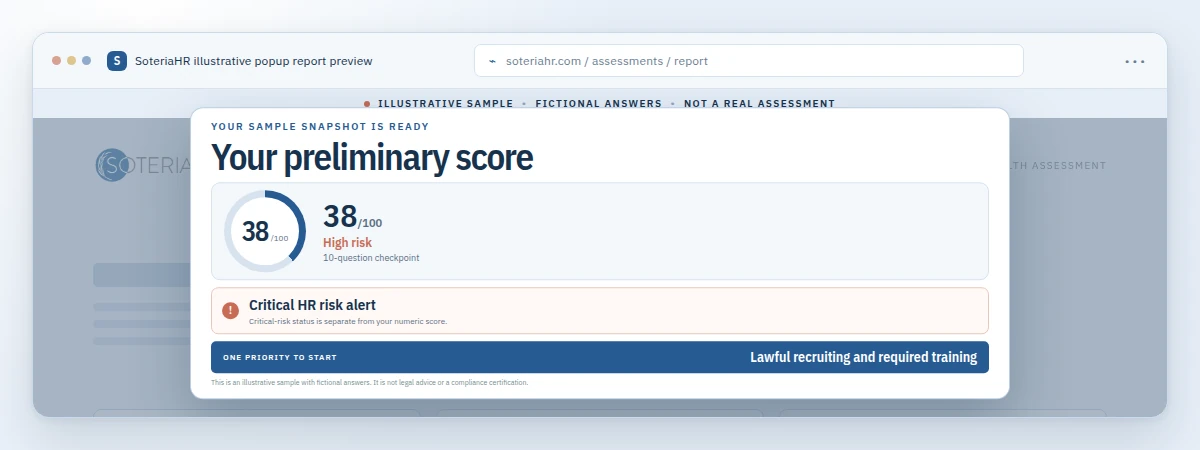
Employers who want a quick starting point can take the free HR Health Assessment at soteriahr.ai. The 10-question Quick HR Check takes about two minutes, while the 40-question Complete HR Health Assessment runs roughly 10 to 12 minutes; results are self-reported and preliminary, not a certification of compliance. From there, employers can discuss priorities directly with an HR professional.
To talk through a specific talent management challenge, call (800) 399-2458 or submit a consultation request through soteriahr.com to talk to an HR expert.
Frequently Asked Questions
What does human capital management consulting mean for talent management?
It means a consulting firm helps plan, structure, and administer the practices that attract, develop, and retain employees. In practice, this typically covers hiring workflows, performance systems, and benefits coordination together.
How do human capital management consulting firms help with talent management day to day?
Day to day, they typically manage or guide onboarding, employee records, performance check-ins, and benefits enrollment. As a result, managers get consistent tools instead of handling each situation from scratch.
How much does human capital management consulting typically cost?
Cost varies widely based on company size, scope, and whether the relationship is project-based or ongoing. Because of this variation, most firms provide a custom quote after an initial consultation rather than a fixed public price.
How long does it take to see results from a talent management overhaul?
Simple fixes, such as structured interview guides, can show results within weeks. However, deeper changes like retention and turnover improvement typically take several months to a year to measure reliably.
What is the difference between human capital management consulting and a PEO?
A PEO generally involves co-employment, where the PEO shares certain employer responsibilities. In contrast, HCM consulting and ASO models let the client remain the sole employer while still receiving hands-on HR support.
Can a human capital management consulting firm help a company with no HR department?
Yes, this is one of the most common reasons employers use these firms. Specifically, an ASO relationship can cover the HR functions a small team does not have time or expertise to build internally.
What are the most common talent management mistakes small employers make?
Common mistakes include skipping structured onboarding, documenting performance inconsistently, and treating benefits as a cost rather than a retention tool. Over time, these gaps tend to increase turnover and HR risk.
Do human capital management consultants handle payroll too?
Many consulting firms coordinate with existing payroll providers rather than processing payroll themselves. Therefore, scope and responsibilities should be confirmed in each engagement before assuming payroll filing is included.
How does benefits administration connect to talent management?
Benefits are a major factor in whether employees stay or leave. Consequently, aligning enrollment, communication, and plan compliance with the broader talent strategy helps retention efforts work as intended.
What size companies benefit most from human capital management consulting?
Employers with roughly 10 to 250 employees are a common fit, since they are often growing past founder-led HR but not yet large enough for a full internal department. That said, this is a priority range, not a strict eligibility rule.
What is the difference between talent management and HR administration?
Talent management focuses on attracting, developing, and retaining employees. HR administration, in comparison, covers the operational tasks, like recordkeeping and leave coordination, that keep those talent strategies running smoothly.
How do I know if my organization needs a talent management consultant?
Rising turnover, inconsistent hiring results, and manager complaints about unclear expectations are common signals. In particular, a short self-assessment, like a free HR Health Assessment, can help surface priorities before committing to a full engagement.
What is an ASO, and how does it relate to talent management support?
An Administrative Services Organization (ASO) provides tailored, ongoing HR support, including talent management help, without co-employment. The client stays the legal employer and keeps responsibility for employment decisions and applicable compliance obligations.
In summary, human capital management consulting firms help with talent management by turning scattered hiring, performance, and benefits practices into a structured, repeatable system. For most growing employers, the real value is not a single project but an ongoing partnership that adapts as headcount and risk change. Whether that support comes through project-based consulting or an ongoing ASO relationship, the goal remains the same: better hiring, fair and consistent performance management, and benefits that actually support retention. Employers who want help applying these ideas can call Soteria HR at (800) 399-2458, submit a consultation request to talk to an HR expert, or start with the free HR Health Assessment at soteriahr.ai.