ASO HR outsourcing lets growing companies hand off payroll coordination, benefits administration, and compliance monitoring to a specialized HR partner — without giving up control of their workforce. Unlike other outsourcing arrangements, an Administrative Services Organization (ASO) never becomes your employer of record, so you keep final say over hiring, firing, pay decisions, and company culture. This guide breaks down exactly how ASO HR outsourcing works, what it typically costs, how it stacks up against a PEO, and how to decide whether it fits your business in 2025.
According to SHRM, businesses that outsource HR administration can cut related overhead costs by as much as 27%. For a company stuck between the expense of a full HR department and the risk of managing everything alone, that number explains why the ASO model keeps gaining ground.
What Is ASO HR Outsourcing, Exactly?
ASO HR outsourcing is a specific type of HR outsourcing arrangement built around one core principle: administrative support without co-employment. The ASO handles payroll coordination, benefits enrollment, compliance tracking, and policy development — but your business stays the legal employer of record, meaning your company, not the outsourcing firm, is the one legally responsible for and in control of each employee.
In contrast, a Professional Employer Organization (PEO) enters a co-employment relationship, splitting employer responsibilities between your company and the PEO. An ASO skips that arrangement entirely. It works as a true service vendor, similar to how you’d hire an accounting firm or an IT provider — expert help, delivered on your terms.
How ASO HR Outsourcing Differs From Generic HR Outsourcing
“HR outsourcing” is a broad umbrella term. It can mean anything from hiring a freelance recruiter to signing with a full-service PEO. ASO HR outsourcing, however, describes one particular model within that umbrella: a dedicated administrative and strategic partner who never claims co-employer status. As a result, not every HR outsourcing provider technically operates as an ASO — and understanding that distinction helps you evaluate vendors accurately.
For a deeper structural breakdown of how these engagements are typically built, Soteria HR’s ASO overview walks through the mechanics in plain language, and the ASO business model resource from Soteria HR explains how this setup applies specifically to small and mid-sized companies.
ASO vs. PEO: The Difference That Actually Matters
The ASO-versus-PEO decision comes down to one word: co-employment. Under a PEO, your employees are legally employed by both your company and the PEO simultaneously. Consequently, the PEO controls certain decisions — including which benefits plans your team can access — because it shares legal liability for those employees.
An ASO never takes on that co-employer role. Therefore, you retain complete authority over hiring, firing, compensation, and culture, while still gaining expert administrative support behind the scenes. The table below summarizes the practical differences.
| Feature | ASO | PEO |
|---|---|---|
| Employer of record | Your company, always | Shared (co-employment) |
| Benefits sourcing | Your own plans, ASO-administered | Master group plans via PEO |
| Control over HR decisions | 100% yours | Shared with PEO |
| Best suited for | Companies wanting expert support with full autonomy | Companies prioritizing large-group benefits pricing |

ASO HR outsourcing gives business leaders expert HR guidance without the complexity of co-employment arrangements.
What Services Does ASO HR Outsourcing Include?
The scope of an ASO engagement varies by provider, but most cover a substantial range of HR functions. Specifically, you should expect support in these core areas:
- Payroll coordination — accurate, on-time processing integrated with your existing systems
- Benefits administration — enrollment management, carrier communication, and employee support
- Compliance monitoring — tracking federal, state, and local employment law changes
- Employee handbook creation — clear, compliant, culture-aligned policy documents
- Onboarding and offboarding — structured processes that protect both employee and employer
- Recruiting and hiring support — job descriptions, candidate screening, and onboarding coordination
- HR consulting and strategy — on-demand access to seasoned HR professionals
- Performance management frameworks — structured review cycles and manager coaching
- Risk assessments — proactive audits that flag compliance gaps before they become penalties
Beyond the Basics: Strategic ASO Services
Some ASOs go further, offering custom HR playbooks, leadership coaching, and workforce planning support. That level of strategic depth is what separates a great ASO partner from a basic administrative vendor. Soteria HR, for example, delivers all of the services above and more through its outsourced HR services, built specifically for growing SMBs that need real HR leadership rather than paperwork processing alone. You can also review the full breadth of offerings on the Soteria HR services page.
How Much Does ASO HR Outsourcing Cost?
Pricing for ASO HR outsourcing typically follows one of two structures. First, a flat monthly retainer covers a defined bundle of services regardless of headcount changes. Second, a per-employee-per-month (PEPM) rate scales directly with your team size, which many growing companies prefer because costs stay proportional to payroll.
- Flat monthly fee — predictable billing, ideal for stable headcounts
- Per-employee-per-month (PEPM) — scales with growth, common among ASOs
- Tiered packages — basic administrative support up through full strategic HR partnership
For comparison, building an in-house HR department typically costs $80,000 to $120,000 or more per year for a single experienced HR manager, before benefits, software, and overhead are added. An ASO arrangement generally delivers comparable — often broader — expertise at a fraction of that annual cost, which is precisely why the model appeals to companies between 10 and 250 employees.
How to Get Started With ASO HR Outsourcing
Transitioning to an ASO model does not have to be complicated. However, a structured approach makes the switch far smoother. Here is the step-by-step path most businesses follow:
- Audit your current HR functions. Document every HR task your team handles today — payroll, compliance, onboarding, benefits — and identify what is eating the most time or creating the most risk.
- Define your outsourcing goals. Decide whether you are trying to cut costs, reduce compliance exposure, or free up leadership bandwidth, since clear goals help you evaluate providers more effectively.
- Research and compare ASO providers. Review service scope, industry experience, compliance track record, and pricing, and ask specifically about experience with businesses your size.
- Review the service agreement carefully. Confirm which functions are included, how escalations are handled, and whether any co-employment language exists if that matters to you.
- Onboard and integrate with your ASO partner. Complete a joint HR audit, integrate systems, update your handbook, and brief leadership on the new support structure.
According to the U.S. Small Business Administration, small businesses that invest in structured HR processes early tend to experience fewer compliance issues and stronger employee retention over time. In other words, starting with the right partner matters as much as the decision to outsource itself.
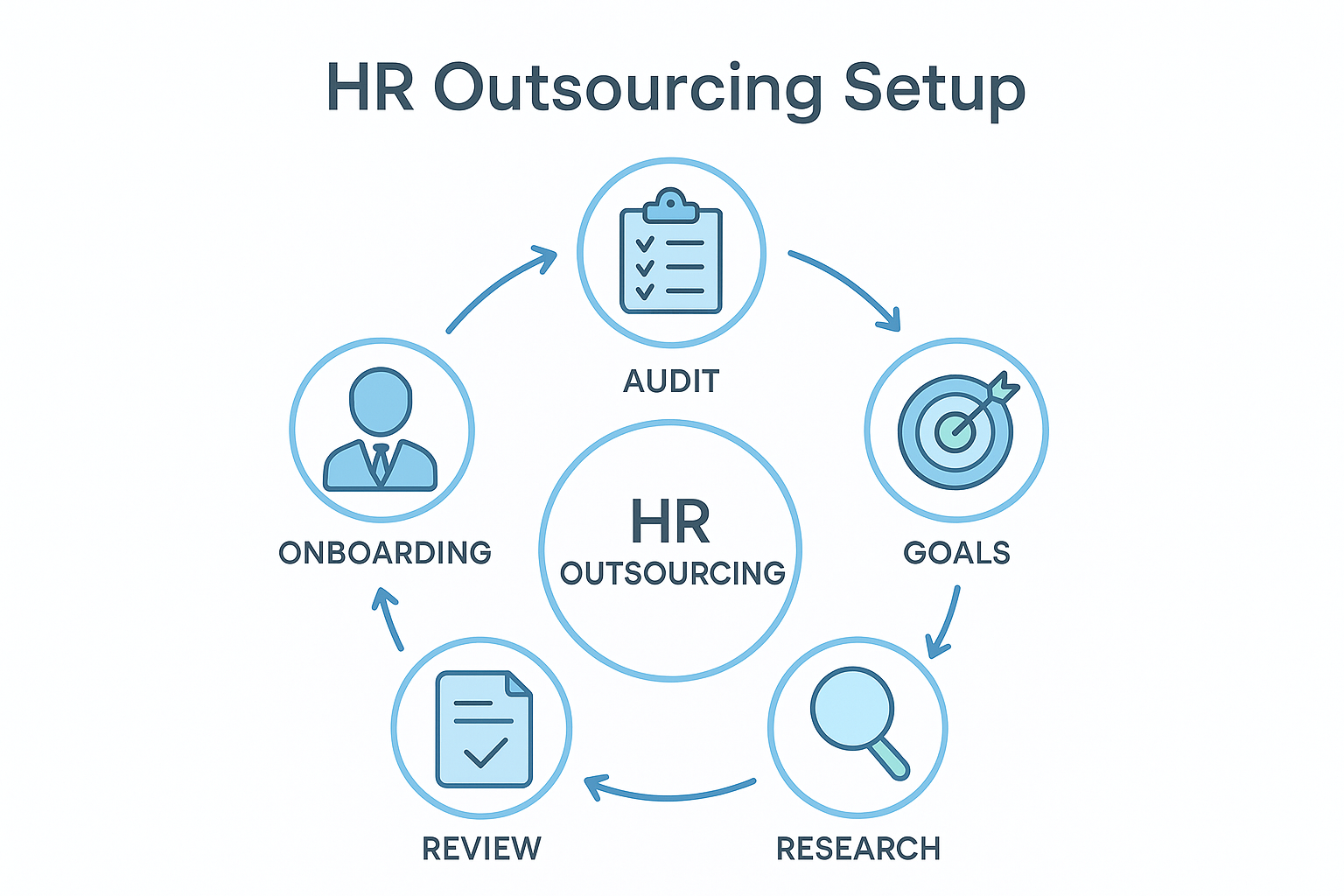
A structured onboarding process helps businesses transition smoothly into an outsourced HR model.
Key Benefits of Outsourcing HR Through an ASO
The advantages of ASO HR outsourcing go well beyond simple cost savings. For growing companies, the benefits compound quickly across several dimensions.
You Keep Full Employer Control
Because an ASO never co-employs your staff, every hiring, firing, and compensation decision remains entirely yours. Therefore, you gain expert HR support without any compromise to your authority or your company culture.
Compliance Risk Drops Significantly
Employment law changes constantly. Specifically, federal, state, and local regulations can shift multiple times per year, and missing an update can mean costly fines or lawsuits. An ASO tracks these changes proactively and updates your policies before problems arise. For a closer look at how strong HR administration reduces this exposure, the HR administration services guide from Soteria HR is a useful next read.
Scalable Support as You Grow
One of the most practical advantages is scalability. As your headcount grows, your ASO partner scales with you, so there is no need to hire additional HR staff, renegotiate contracts, or rebuild your compliance framework from scratch.
Strategic HR, Not Just Administration
The best ASO partners do not just process paperwork. Instead, they act as embedded HR advisors, helping you improve performance management, reduce turnover, and build a culture that attracts great people. Soteria HR’s approach to boosting HR through an Administrative Services Organization reflects exactly this philosophy — proactive, strategic, and tailored to your stage of growth.

Growing teams benefit most when their HR outsourcing partner brings both administrative precision and strategic thinking.
Is ASO HR Outsourcing the Right Fit for Your Business?
ASO HR outsourcing is generally the right fit if your business has between 10 and 250 employees, values control over HR decisions, and needs expert support without the overhead of a full HR department. It is also a strong choice for companies that have outgrown a PEO arrangement and want to bring more HR authority back in-house while keeping expert support intact.
When a PEO Might Serve You Better
If your primary goal is access to large-group benefits pricing and you are comfortable with a co-employment structure, a PEO might serve you better. The key is understanding your priorities before you choose a model. For a broader, neutral overview, Wikipedia’s overview of Administrative Services Organizations is a solid starting point for comparison.
When In-House HR Still Makes Sense
Very large enterprises with dedicated HR budgets and complex, highly specialized policy needs may still benefit from a fully in-house team. However, for most companies under a few hundred employees, ASO HR outsourcing delivers comparable expertise at a fraction of the cost — without sacrificing control.
Common Mistakes to Avoid When Choosing an ASO Provider
Even a strong ASO HR outsourcing strategy can go wrong if you rush the selection process. Watch for these pitfalls:
- Choosing a provider based solely on price rather than scope and expertise
- Failing to clarify exactly which HR functions are included in your agreement
- Not confirming the provider’s compliance expertise in your specific state or industry
- Skipping a detailed review of the service agreement before signing
- Overlooking how well the provider’s systems integrate with your existing payroll and HR software
Frequently Asked Questions About ASO HR Outsourcing
What is ASO HR outsourcing?
ASO HR outsourcing is a model where a third-party Administrative Services Organization manages HR tasks like payroll, compliance, and benefits administration on behalf of a business. Unlike a PEO, the employer retains full legal control over their workforce, making it ideal for companies that want expert HR support without entering a co-employment arrangement.
How does an ASO differ from a PEO?
A PEO enters a co-employment relationship, becoming the employer of record for tax and benefits purposes. An ASO does not co-employ your staff — you remain the sole employer of record, which gives you more control, though you also retain full liability.
What HR functions does an ASO typically handle?
An ASO typically handles payroll processing, benefits administration, compliance monitoring, employee handbook creation, onboarding, and HR policy development. Some also provide recruiting support, performance management guidance, and strategic HR consulting.
Is ASO HR outsourcing right for small businesses?
Yes, ASO HR outsourcing is well-suited for small businesses with 10 to 250 employees that need professional HR expertise without the cost of a full-time HR department. It provides scalable support as the business grows.
How much does ASO HR outsourcing cost?
Costs vary by provider and scope, but ASO arrangements are generally priced as a flat monthly fee or a per-employee-per-month (PEPM) rate. According to SHRM, outsourced HR solutions typically cost significantly less than hiring a full-time HR professional.
Do I lose control of my HR decisions with an ASO?
No. One of the key advantages of an ASO is that you retain full decision-making authority over your employees and HR policies. The ASO acts as an expert partner and administrator, not a co-employer.
What are the compliance benefits of using an ASO?
An ASO monitors federal, state, and local employment law changes on your behalf, helping you stay compliant and avoid costly penalties. They can update your employee handbook, manage required postings, and flag potential risk areas before they become problems.
Can an ASO help with recruiting and hiring?
Many ASO providers offer recruiting and hiring support as part of their service suite, including job description creation, candidate screening, interview guidance, and onboarding coordination.
What is the difference between HR outsourcing and an ASO?
HR outsourcing is a broad term covering any arrangement where an outside firm handles HR functions. An ASO is a specific type of HR outsourcing model characterized by administrative support without co-employment. Not all HR outsourcing providers operate as ASOs.
How long does it take to set up ASO HR outsourcing?
Setup timelines vary by provider and complexity, but most ASO engagements can be fully operational within two to six weeks. Initial onboarding typically involves an HR audit, system integration, and policy review.
What common mistakes should I avoid when choosing an ASO?
Common mistakes include choosing a provider based solely on price, failing to clarify which HR functions are included, and not confirming the provider’s compliance expertise in your specific state or industry. Always review the service agreement carefully before signing.
Can an ASO support remote or multi-state teams?
Yes, many ASO providers are equipped to support remote or multi-state workforces. They can help manage varying state compliance requirements, remote onboarding processes, and distributed payroll needs.
Does ASO HR outsourcing work for specific industries like healthcare or construction?
Yes. Most established ASO providers work across industries, but the strongest partners have specific experience with regulated fields such as healthcare, construction, and professional services, where compliance requirements are more demanding.
Is ASO HR outsourcing different from using a staffing agency?
Yes. A staffing agency typically supplies temporary or contract workers and often acts as their employer of record. An ASO, in contrast, supports your permanent employees administratively while your company remains the sole employer throughout.
Conclusion: Is ASO HR Outsourcing Worth It?
For most growing businesses, ASO HR outsourcing delivers a compelling combination of expert support, compliance protection, and cost efficiency — without the loss of control that comes with co-employment models. Specifically, it is the right move for companies that have outgrown ad-hoc HR but are not ready for a full in-house department. Above all, the value lies in having a knowledgeable partner who spots problems before they cost you time, money, or talent.
If that sounds like what your organization needs, Soteria HR is built exactly for this. We work with growth-minded SMBs to deliver hands-on, strategic HR — no jargon, no guesswork, just what works. Explore how Soteria HR can support your team today.