How does employee relations impact workplace culture in SMBs? In small and mid-sized businesses, employee relations shapes workplace culture directly, because the way managers and staff interact day to day sets the tone for trust, communication, and morale across the whole organization. When relations are handled well, employees feel heard and treated fairly. However, when relations break down through unresolved conflict, inconsistent policies, or poor communication, culture erodes quickly in a smaller company where every interaction is visible. This article explains that connection and offers practical steps founders and HR leaders can take to protect both relationships and culture as the company grows.
Key Takeaways
- Employee relations is the ongoing management of workplace relationships; it is one of the strongest predictors of workplace culture in SMBs.
- Small teams feel the effects of poor employee relations faster than large enterprises because fewer people absorb the friction.
- Consistent policies, fair conflict resolution, and open communication are the three pillars that connect employee relations to a healthy culture.
- Gallup’s long-running engagement research links strong relations and engagement to meaningfully lower turnover.
- Outsourced HR support, such as Soteria HR’s HR consulting and administration services, can help SMBs build these practices without hiring a full internal HR department.
What Is Employee Relations in an SMB?
Employee relations is the ongoing management of the relationship between an employer and its employees, covering day-to-day communication, conflict resolution, discipline, and the consistent application of workplace policies. In a small or mid-sized business, this function often falls to a founder, office manager, or a lean internal team rather than a dedicated specialist. Specifically, it includes handling grievances, guiding performance conversations, and making sure rules apply the same way to everyone on the team.
In contrast, workplace culture is the broader, shared set of values, norms, and behaviors that employees experience every day. Employee relations is one of the main inputs that produces that culture. For a deeper look at how culture forms and why it matters for growing teams, Soteria HR’s guide on the importance of company culture walks through the foundational concepts in more detail.
How Does Employee Relations Impact Workplace Culture in SMBs?
Direct answer: Employee relations impacts workplace culture in SMBs by setting the daily standard for trust, fairness, and communication; when relations are strong, employees cooperate, speak up about problems early, and stay longer, and when relations are weak, resentment and turnover spread quickly because small teams have fewer buffers to absorb conflict.
In a company with 500 employees, one difficult manager affects a small slice of the workforce. In a company with 25 employees, that same manager affects a fifth of the team. As a result, SMBs feel the ripple effects of poor employee relations far faster and more visibly than larger organizations do. Similarly, positive relations compound quickly in a small company, since trust built with one employee is often visible to the entire team within days.
Furthermore, consistent employee relations practices, such as documented onboarding, fair disciplinary steps, and clear leave coordination, reduce the ambiguity that often fuels workplace conflict. For example, an employee who understands exactly how a complaint will be handled is far less likely to escalate frustration into a formal dispute. Soteria HR’s related piece on building and sustaining a positive culture at work expands on several of these consistency practices.
“Culture is not built in the handbook. It is built in how a company responds the first time something goes wrong between an employee and a manager.”
Why Employee Relations Problems Hit Growing Companies Harder
Growing SMBs often add headcount faster than they add HR infrastructure. Consequently, the informal, founder-led approach to employee relationships that worked at ten employees starts to strain at fifty. Policies that once lived in a founder’s head need to become written, consistent practices. Otherwise, employees notice when similar situations get different outcomes, and perceived unfairness is one of the fastest ways to damage trust.
In addition, legal exposure grows with headcount. According to the U.S. Equal Employment Opportunity Commission, employers become subject to additional federal anti-discrimination requirements as their employee count crosses certain thresholds, which is one reason employee relations documentation matters more as a company scales. The EEOC’s employer guidance outlines these obligations in detail, and SMB leaders should confirm current thresholds before finalizing policy.
The Link Between Employee Relations and Retention
Retention is one of the clearest, most measurable outcomes of healthy employee relations. Specifically, Gallup’s long-running meta-analysis of workplace engagement has found that business units with highly engaged teams see substantially lower turnover than less engaged teams, with the gap reported at roughly 18 percent lower turnover in high-turnover industries and around 43 percent lower turnover in low-turnover industries. Because engagement is heavily influenced by day-to-day employee relations, this data point reinforces why the relationship between managers and staff matters so much.
Similarly, U.S. Bureau of Labor Statistics data has shown median employee tenure sitting around four years nationally, a figure that shifts meaningfully based on how well employers manage day-to-day relationships and expectations. For a closer look at retention strategy specifically, Soteria HR’s guide on improving employee retention rates covers proven strategies for growing businesses.
Building Strong Employee Relations: A Step-by-Step Process
Strengthening employee relations does not require a large HR department. Instead, it requires a consistent, repeatable process that leaders can apply every time a workplace issue arises. The following steps outline a practical approach for SMB leaders.
- Document core policies in writing. Put attendance, conduct, leave, and disciplinary procedures into a handbook so every employee and manager references the same standard instead of relying on memory or informal custom.
- Train managers on consistent application. Walk frontline managers through real scenarios so they apply policies the same way across employees, since inconsistent enforcement is one of the fastest ways to damage trust in a small team.
- Create a clear channel for concerns. Give employees a defined, confidential way to raise issues before they escalate, whether that is a direct manager conversation, an HR contact, or an anonymous submission option.
- Respond to issues quickly and document outcomes. Address complaints within a short, defined window and keep a written record of the issue, the investigation steps taken, and the resolution reached.
- Review patterns regularly. Periodically check whether certain departments, managers, or policies generate repeated complaints, since recurring patterns usually point to a process gap rather than isolated employee behavior.
Employee Relations vs. Workplace Culture: What’s the Difference?
Leaders sometimes use these terms interchangeably, but they describe different layers of the organization. The table below summarizes the distinction.
| Aspect | Employee Relations | Workplace Culture |
|---|---|---|
| Definition | Day-to-day management of employer-employee relationships | Shared values, norms, and behaviors across the organization |
| Primary Owner | HR, founders, or line managers | Leadership and every employee collectively |
| Measured By | Grievance counts, disciplinary consistency, turnover | Engagement surveys, retention, employer reputation |
| Timeframe | Reactive and ongoing, event by event | Builds gradually over months and years |
Common Employee Relations Mistakes Small Business Leaders Make
Even well-intentioned leaders fall into predictable traps. For instance, many founders avoid difficult conversations too long, hoping an issue resolves itself, which usually allows resentment to grow instead. Others apply policies inconsistently between a high performer and a struggling employee, which employees notice almost immediately in a small office.
Another common mistake is treating employee relations as purely reactive, only addressing it after a complaint arrives, rather than building proactive habits like regular check-ins and clear expectation-setting. Likewise, skipping documentation during a disciplinary process leaves the company exposed if a dispute later escalates. The U.S. Department of Labor’s Wage and Hour Division resources are a useful starting point for confirming recordkeeping obligations that intersect with employee relations documentation.
For a fuller explanation of how these relationships function from a legal and practical standpoint, see Soteria HR’s complete SMB guide to the definition of employment relations.
When to Bring in Outsourced HR Support for Employee Relations
Not every SMB needs a full-time HR department to manage employee relations well. However, there is usually a point where internal bandwidth runs out, typically once a company has enough employees that informal, memory-based management stops working. At that stage, outsourced HR administration and consulting can fill the gap without requiring a new full-time hire.
Soteria HR, based in Pasadena, California, works with employers across Los Angeles, Orange County, and nationwide, typically in the 10 to 250 employee range, to build these practices through HR administration, HR consulting, and benefits administration. The firm’s ASO option also provides tailored HR support without co-employment, meaning the client remains the employer and retains responsibility for employment decisions. Leaders who want a starting point before a conversation can review Soteria’s HR strategy insights on what HR strategies help small businesses build a positive workplace culture.
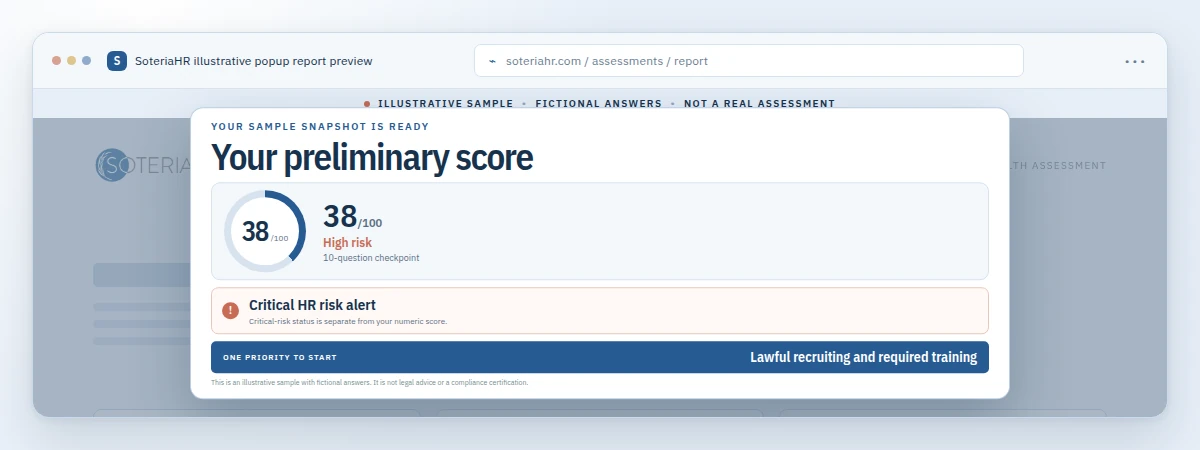
To identify specific gaps before that conversation, the free HR Health Assessment offers a short, self-reported starting point. It is not a certification of compliance or a substitute for a professional legal audit, but it can surface priorities worth discussing with an HR expert.
Frequently Asked Questions
How does employee relations impact workplace culture in SMBs?
Employee relations impacts workplace culture in SMBs by shaping how trusted, fairly treated, and heard employees feel on a daily basis. Because small teams have fewer buffers, strong or weak relations spread through the culture faster than in larger organizations.
What is employee relations, in simple terms?
Employee relations is the ongoing management of the relationship between an employer and its staff, including communication, conflict resolution, and consistent policy enforcement. It is a practice, not a one-time project.
Why does company size change how employee relations issues play out?
Smaller companies have fewer employees to absorb the ripple effects of a single conflict or inconsistent decision. As a result, problems become visible to the entire team much faster than in a large enterprise.
How is employee relations different from employee engagement?
Employee relations focuses on the mechanics of the employer-employee relationship, such as policy and conflict handling. Engagement is a measure of how motivated and committed employees feel, which is strongly influenced by the quality of relations.
What does it cost an SMB to ignore employee relations?
Costs typically show up as higher turnover, lower engagement, and increased legal exposure from inconsistent policy enforcement. Exact figures vary by industry, so leaders should treat this as a directional risk rather than a fixed dollar amount.
How long does it take to improve employee relations at a small business?
Written policies and training can be implemented within a few weeks. However, measurable culture improvement, such as lower turnover, typically takes several months of consistent application to appear.
What is the most common mistake SMB leaders make with employee relations?
The most common mistake is avoiding or delaying difficult conversations, which allows minor friction to grow into larger conflict. Inconsistent policy enforcement between employees is a close second.
Do small businesses need a written employee handbook?
A written handbook is strongly recommended once a business has more than a handful of employees. It gives managers a consistent reference point and reduces the ambiguity that fuels employee relations problems.
Can outsourced HR support actually improve workplace culture?
Outsourced HR support can improve culture indirectly by bringing consistency, documented policy, and fair process to employee relations. The client remains the employer and retains ultimate responsibility, but the structure itself tends to reduce friction.
How does employee relations connect to retention?
Strong employee relations builds the trust and fairness that employees look for before deciding to stay long-term. Research from Gallup links high engagement, which relations heavily influences, to substantially lower turnover.
What is an ASO, and how does it relate to employee relations?
An Administrative Services Organization (ASO) is a model that provides tailored HR support, including help with employee relations practices, without co-employment. The client company remains the legal employer and keeps responsibility for employment decisions.
Who is usually responsible for employee relations in a small business?
In most SMBs without a dedicated HR department, employee relations responsibility falls to the founder, an office manager, or operations leader. As the company grows, many bring in outsourced HR consulting to formalize the function.
What is a quick first step to assess current employee relations health?
A short self-assessment, such as Soteria HR’s free HR Health Assessment, is a practical first step for spotting obvious gaps. Results are self-reported and preliminary, so they should guide a conversation rather than serve as a final conclusion.
In summary, employee relations impacts workplace culture in SMBs in a direct and visible way, because small teams feel the effects of both strong and weak relations faster than larger organizations do. Consistent policies, fair conflict resolution, and quick responses to concerns are the practical levers that connect day-to-day employee relations to a healthier, more stable culture. Therefore, founders and HR leaders who invest in these habits early tend to see the payoff in lower turnover and stronger engagement over time. For SMBs that are ready to strengthen this foundation, Soteria HR offers hands-on HR administration, consulting, and benefits support, and leaders can call (800) 399-2458 or submit a consultation request to talk to an HR expert about building stronger employee relations and a healthier workplace culture.