How is a human resource administrator important for small company growth? This question comes up constantly as companies move past the stage where a founder or office manager can handle every personnel task alone. A dedicated human resource administrator (the person who manages day-to-day HR tasks like onboarding, recordkeeping, and policy enforcement) keeps the people side of a growing business organized, compliant, and ready to scale. Without that structure, small businesses often hit avoidable snags — missed filings, inconsistent onboarding, or confusion over leave and benefits — right at the moment they can least afford the distraction.
Key Takeaways
- A human resource administrator turns ad-hoc people management into consistent, repeatable processes that support growth.
- Core duties include employee records, onboarding and offboarding, policy enforcement, leave coordination, and payroll coordination.
- Gaps in HR administration create legal exposure — for example, Title VII of the Civil Rights Act applies once a company reaches 15 employees.
- Outsourced HR administration (an ASO model) lets a growing company get this structure without adding full-time headcount or co-employment.
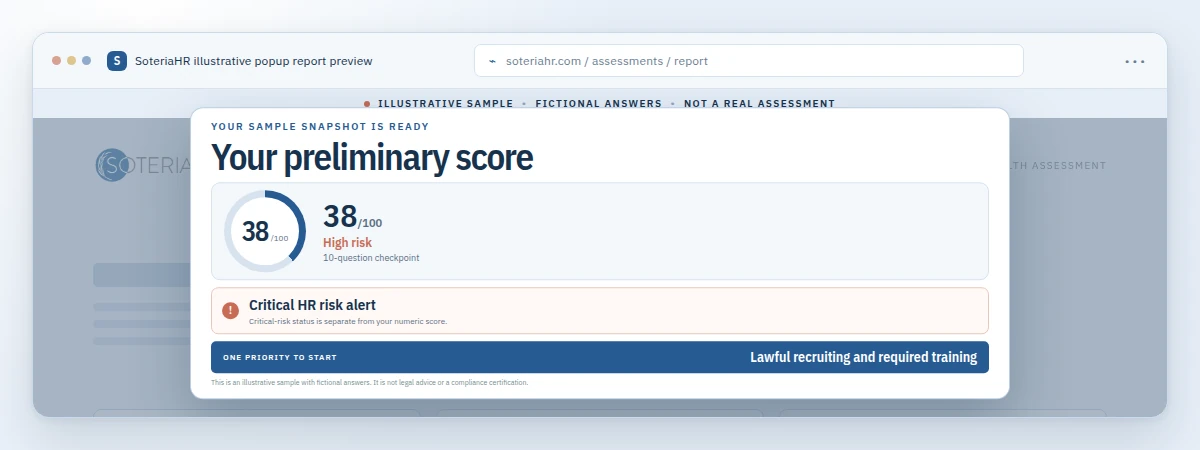
- Soteria HR’s free HR Health Assessment at soteriahr.ai is a quick way to see where gaps may exist.
What Is a Human Resource Administrator?
A human resource administrator is the person (or outsourced function) responsible for managing the daily operational side of employment — records, onboarding, policies, benefits paperwork, and compliance tracking. In short, this role keeps the mechanics of employing people running smoothly so leadership can focus on strategy.
Specifically, the role typically covers employee files, I-9 and new-hire paperwork, leave requests, unemployment claims support, and coordination with payroll. In a very small business, an owner or office manager often absorbs these tasks informally. However, as headcount grows, informal handling becomes risky because deadlines, recordkeeping rules, and benefits timelines multiply fast. For a deeper breakdown of the responsibilities involved, see this full role guide to the human resource administrator position.
How Is a Human Resource Administrator Important for Small Company Growth?
A human resource administrator is important for small company growth because growth itself creates new HR obligations, risks, and employee expectations all at once. As a company adds employees, it crosses legal thresholds, needs clearer policies, and must manage more onboarding and benefits activity — all without slowing down hiring.
Consider a company growing from 12 to 35 employees in a year. At 15 employees, Title VII protections under the Civil Rights Act begin to apply. Meanwhile, benefits enrollment volume rises, and onboarding has to happen faster without sacrificing accuracy. In contrast, a company with weak HR administration at this stage often experiences inconsistent offer letters, missed benefits deadlines, or unclear policy enforcement — all of which slow hiring and erode trust. As a result, growth stalls not because the business lacks customers, but because the people infrastructure can’t keep pace.
Furthermore, an HR administrator protects leadership time. Founders and operations leaders who spend hours each week chasing paperwork have less time for the work that actually drives revenue. To see this tension explained in more depth, this piece on why growing companies need an HR administrator walks through the tradeoffs in detail.
“Growth exposes every gap in HR administration at once — recordkeeping, compliance, and consistency all get tested the moment headcount climbs.”
Core Responsibilities That Directly Support Growth
The responsibilities of an HR administration function map directly onto the problems that slow growing companies down. Above all, consistency matters: the same onboarding steps, the same recordkeeping standards, and the same policy enforcement for every employee, regardless of who is hiring that week.
Onboarding and Offboarding
Consistent onboarding reduces new-hire confusion and speeds up time-to-productivity. Similarly, structured offboarding protects the company legally and ensures final pay, benefits termination, and equipment return happen correctly every time.
Leave Coordination and Benefits Administration
As benefits enrollment grows more complex, administrators coordinate enrollments, terminations, and carrier communications. In particular, employer obligations tied to ACA reporting apply once a company reaches 50 full-time-equivalent employees, according to IRS guidance on employer shared responsibility provisions. Missing this threshold without preparation can create costly surprises.
Recordkeeping and Policy Enforcement
Accurate personnel files and a written employee handbook reduce disputes and give managers clear, defensible ground rules. The U.S. Department of Labor’s recordkeeping requirements set minimum standards that growing employers must track consistently across every location and role.
Signs a Growing Company Needs Stronger HR Administration
Certain patterns tend to show up before HR gaps become serious problems. For instance, managers answering benefits questions inconsistently, onboarding paperwork arriving late, or no single source of truth for employee records are all early warning signs.
Likewise, if leadership cannot quickly answer how many employees are on a particular leave type, or whether a policy has been applied uniformly, that’s a sign the HR administration function needs reinforcement. This detailed look at what an HR administrator does in a growing company outlines these warning signs further.
HR Administrator vs. HR Consultant vs. ASO Partner
These three options are often confused, yet they solve different problems. The table below compares their typical focus so leaders can match the right support to their current stage of growth.
| Support Type | Primary Focus | Best Fit |
|---|---|---|
| HR Administrator | Daily operations: records, onboarding, leave, benefits paperwork | Companies needing consistent day-to-day execution |
| HR Consultant | Strategy: workforce planning, culture, performance systems | Leaders tackling a specific people challenge |
| ASO Partnership | Ongoing, tailored HR support without co-employment | Companies without a full internal HR department |
In many cases, growing companies need a blend of all three — which is exactly what an outsourced partnership can deliver. This comparison of HR and admin services that best support growing SMBs breaks down which combination fits different company stages.
How to Build HR Administration That Scales With Your Company
Building HR administration that holds up under growth does not require a large internal department from day one. Instead, it requires a deliberate sequence of steps, starting with an honest look at current gaps.
- Assess current HR gaps. Review recordkeeping, onboarding consistency, and policy enforcement to identify what is informal versus documented, and flag areas most likely to create legal or operational risk.
- Document core policies in a handbook. Put leave, conduct, benefits eligibility, and disciplinary procedures in writing so managers apply rules the same way across every department and location.
- Standardize onboarding and offboarding checklists. Create repeatable steps for paperwork, system access, and benefits enrollment so quality stays consistent even as hiring volume increases quickly.
- Coordinate benefits and payroll touchpoints. Align benefits administration with payroll coordination so enrollments, deductions, and terminations stay accurate and timely during busy growth periods.
- Decide between hiring internally and outsourcing. Compare the cost and speed of building an internal HR team against an ASO partnership that provides tailored support without adding full-time headcount.
According to research frequently cited by the Society for Human Resource Management, replacing an employee can cost from one-half to two times that employee’s annual salary once recruiting, training, and lost productivity are counted. Consequently, the consistency an HR administrator brings to onboarding and employee relations is not a minor convenience — it is directly tied to retention and cost control. For a practical walkthrough of day-to-day tasks, see what an HR administrator does for a growing small business.
Frequently Asked Questions
How is a human resource administrator important for small company growth?
A human resource administrator is important for small company growth because it keeps onboarding, compliance, and benefits consistent as headcount increases. Without this structure, growing companies often face avoidable legal exposure and slower hiring.
What does an HR administrator actually do day to day?
Day to day, an HR administrator manages employee records, processes onboarding and offboarding paperwork, tracks leave requests, and coordinates with payroll and benefits carriers. Tasks vary by company size but center on consistent execution of HR processes.
At what company size should a business hire or outsource an HR administrator?
Many companies feel the need between roughly 10 and 50 employees, though this varies by industry and complexity. Legal thresholds, such as Title VII applying at 15 employees, often mark a practical point to formalize HR administration.
How does an HR administrator differ from an HR consultant?
An HR administrator focuses on daily operational tasks like records and onboarding, while an HR consultant advises on strategy, such as workforce planning or performance systems. Many growing companies eventually need both types of support.
What is an ASO, and how does it relate to HR administration?
An ASO, or Administrative Services Organization, provides tailored HR support without co-employment, meaning the client remains the employer of record. This differs from a PEO model and lets companies outsource HR administration while keeping full control over employment decisions.
How much does outsourced HR administration typically cost?
Pricing depends on company size, service scope, and whether benefits administration or payroll coordination is included. Because scope varies widely, it is best to request a consultation for an accurate, tailored estimate rather than rely on a generic figure.
How long does it take to set up proper HR administration from scratch?
A basic handbook and onboarding checklist can often be built within a few weeks, while a fuller HR administration setup, including benefits coordination, may take one to three months depending on company complexity and existing documentation.
What common mistakes do growing companies make with HR administration?
Common mistakes include relying on verbal policies instead of a written handbook, inconsistent onboarding across hires, and missing benefits compliance deadlines. These gaps tend to surface quickly once hiring accelerates.
Why does inconsistent onboarding hurt small company growth?
Inconsistent onboarding slows new-hire productivity and increases early turnover, which is costly to replace. As a result, standardized onboarding directly supports faster, more reliable growth.
Can an internal employee handle HR administration alone for a growing company?
In small organizations, one person can often manage HR administration early on. However, as headcount and compliance complexity grow, most companies need either additional internal support or an outsourced partner to keep pace.
What best practices should a growing company follow for HR administration?
Best practices include documenting policies in writing, standardizing onboarding, tracking leave and benefits deadlines, and reviewing HR processes regularly as headcount changes. Consistency across every employee matters more than any single tool.
Does HR administration include payroll processing?
HR administration typically coordinates with payroll rather than processing it directly. Payroll coordination ensures information flows correctly between HR records and payroll providers, though specific processing responsibilities should be confirmed in any service agreement.
What is a free way to check for HR gaps before hiring an administrator?
The free HR Health Assessment at soteriahr.ai offers a quick, self-reported check of potential HR gaps and priorities. It is a preliminary tool, not a certification of compliance, but it is a useful starting point for a deeper conversation.
In summary, a human resource administrator is important for small company growth because growth creates new compliance obligations, more onboarding volume, and higher expectations from employees — all at once. Companies that build consistent HR administration early tend to hire faster, retain employees longer, and avoid costly compliance surprises. Whether that support comes from an internal hire or an outsourced ASO partnership, the goal is the same: steady, well-documented HR processes that scale alongside the business. For employers ready to evaluate where their own gaps may be, Soteria HR offers both a free HR Health Assessment at soteriahr.ai and a direct consultation. To talk through priorities with an HR expert, call (800) 399-2458 or submit a consultation request today.