How does outsourced HR solutions benefit growing organizations? In short, outsourced HR solutions give growing organizations dependable administrative support, specialized compliance guidance, and scalable systems without the cost of building a full internal HR department from day one. For founders and operations leaders juggling hiring, payroll, and compliance deadlines, this kind of support often becomes the difference between reactive firefighting and steady, confident growth. Soteria HR, based in Pasadena, California, works with employers across Los Angeles, Orange County, and nationwide to provide exactly this kind of hands-on HR partnership.
Key Takeaways
- Outsourced HR solutions reduce administrative burden, lower compliance risk, and provide access to specialized expertise all at once.
- An ASO (Administrative Services Organization) model, unlike a PEO, keeps the client as the sole employer of record.
- Organizations with roughly 10 to 250 employees are a priority segment, though scope can be tailored outside that range.
- SHRM benchmarking research suggests organizations typically need close to 1.4 HR staff per 100 employees, a cost many growing companies cannot yet justify internally.
- Outsourcing reduces risk but never removes an employer’s underlying legal responsibilities for employment decisions.
How Does Outsourced HR Solutions Benefit Growing Organizations?
Growing organizations benefit from outsourced HR solutions primarily through three outcomes: reduced administrative burden, lower compliance risk, and access to specialized expertise that would otherwise require several full-time hires. As a result, leadership teams can redirect their attention toward revenue-generating work instead of paperwork and policy updates.
For example, a forty-person company expanding into a second state suddenly faces new wage-and-hour rules, benefits eligibility questions, and onboarding volume it has never managed before. In this situation, an outsourced provider can step in to handle day-to-day administration, including employee records, leave coordination, and onboarding workflows, while a dedicated HR consultant helps the executive team plan ahead. Consequently, the business avoids both the expense of hiring an entire internal HR department and the risk of handling complex employment requirements without guidance.
In addition, outsourced HR arrangements typically scale with the organization. Therefore, a company with fifteen employees today does not need to renegotiate its entire HR structure once it reaches one hundred employees; the scope of support simply expands. This flexibility is one reason the approach appeals strongly to founders, COOs, and HR leaders at organizations in the 10 to 250 employee range, where internal HR capacity is often thin or nonexistent. For a closer look at how this works in practice, see the key advantages of outsourced HR administration for growing businesses.
What Is Outsourced HR, and How Does It Work?
Outsourced HR solutions are external, fee-based human resources services that handle administrative, compliance, and strategic HR functions on behalf of an employer, while the employer remains the legal employer of record. Unlike a Professional Employer Organization, commonly known as a PEO, which typically enters a co-employment arrangement, an ASO (Administrative Services Organization) model provides tailored HR support without shifting employment responsibilities away from the client.
In practice, outsourcing usually covers three core areas. First, HR administration manages the daily mechanics: employee records, onboarding and offboarding, policies, and payroll coordination. Second, HR consulting addresses the bigger picture, including workforce planning, employee relations, and performance systems. Third, benefits administration covers enrollments, terminations, carrier coordination, and support for applicable ACA, COBRA, and Section 125 requirements, in line with guidance published by the U.S. Department of Labor and the IRS.
Because these three areas connect closely, most growing organizations find it more efficient to manage them through a single outsourced partner rather than juggling separate vendors. For a deeper comparison of what outsourcing actually includes, Soteria’s guide on the key benefits of outsourcing HR and admin tasks walks through each service area in more detail.
ASO vs. PEO: Why the Distinction Matters
Many employers use the terms ASO and PEO interchangeably, but the distinction matters legally and operationally. A PEO, as described on Wikipedia, enters a co-employment relationship, meaning it becomes a joint employer of record for tax and insurance purposes. An ASO, in contrast, leaves the client as the sole employer of record while still delivering comprehensive administrative support. Consequently, organizations that want expert HR help without sharing employment liability often prefer the ASO structure. However, both models can work well depending on a company’s size and risk tolerance, so it is worth discussing the options directly with an HR advisor before choosing one.
Key Advantages of Outsourcing HR Services for Scaling Teams
According to SHRM benchmarking research, organizations typically need roughly 1.4 HR staff members for every 100 employees to manage HR functions adequately. For a sixty-person company, that math suggests close to one dedicated HR professional — a cost that is difficult to justify for many growing businesses, which is exactly where outsourcing HR services fills the gap.
Cost Control and Predictable Budgeting
Hiring a full internal HR team can mean multiple salaries, benefits, and training costs before the organization sees a single compliance issue prevented. In contrast, outsourced HR solutions are typically structured as a predictable monthly fee tied to the scope of service. As a result, finance leaders can budget HR costs the same way they budget other operating expenses, rather than absorbing the variable cost of expanding an internal department step by step.
Reduced Compliance Risk
Federal and state employment rules change often, and tracking every update across agencies such as the EEOC is time-consuming. Outsourced HR partners monitor these changes as part of their core service, which means fewer gaps in required notices, recordkeeping, and plan-document compliance. That said, outsourcing does not remove an employer’s legal responsibilities; the employer remains accountable for final decisions, so working with a knowledgeable partner is about reducing risk, not eliminating it entirely.
Faster Access to Specialized Knowledge
Few growing companies can justify hiring a benefits specialist, an employee-relations consultant, and a compliance expert all at once. Outsourced HR solutions, however, bundle this expertise into a single relationship. Therefore, a leadership team gains access to several specialties at once, without the overhead of separate full-time hires for each one.
More Time for Leadership to Focus on Growth
Perhaps most importantly, outsourcing routine HR administration frees up executive bandwidth. Above all, founders and operations leaders did not start their organizations to manage leave paperwork or benefits enrollment forms. Once that work moves to a dedicated partner, leadership time can shift toward sales, product, and culture — the areas that actually drive growth. For more on how this plays out for smaller teams specifically, see Soteria’s ideas for enhancing employee performance through outsourced HR.
“HR shouldn’t be something leaders worry about at midnight. A good outsourced partner should feel like an extension of the team — steady, responsive, and proactive.” — Soteria HR
Outsourced HR vs. In-House HR vs. PEO: Which Fits Your Growth Stage?
Choosing between a fully in-house HR team, an outsourced ASO model, and a PEO depends largely on company size, budget, and appetite for shared employment risk. In particular, the employer-of-record structure is often the deciding factor. Soteria’s overview of professional HR solutions for small businesses breaks down these options in further depth.
| Factor | Fully In-House HR | Outsourced HR (ASO) | PEO (Co-Employment) |
|---|---|---|---|
| Employer of record | Client company | Client company (sole employer) | Shared with PEO |
| Typical cost structure | Multiple salaries + benefits | Predictable monthly fee | Per-employee fee or % of payroll |
| Compliance monitoring | Internal responsibility | Provided by partner | Provided by PEO |
| Scalability | Requires rehiring to scale | Scope expands with growth | Scope expands with growth |
| Best fit | Large orgs with stable HR volume | Growing orgs wanting full control + support | Orgs comfortable with co-employment |
How to Transition to an Outsourced HR Partner: A Step-by-Step Process
Switching to outsourced HR solutions works best as a deliberate process rather than a rushed decision. The steps below reflect a typical sequence that growing organizations follow.
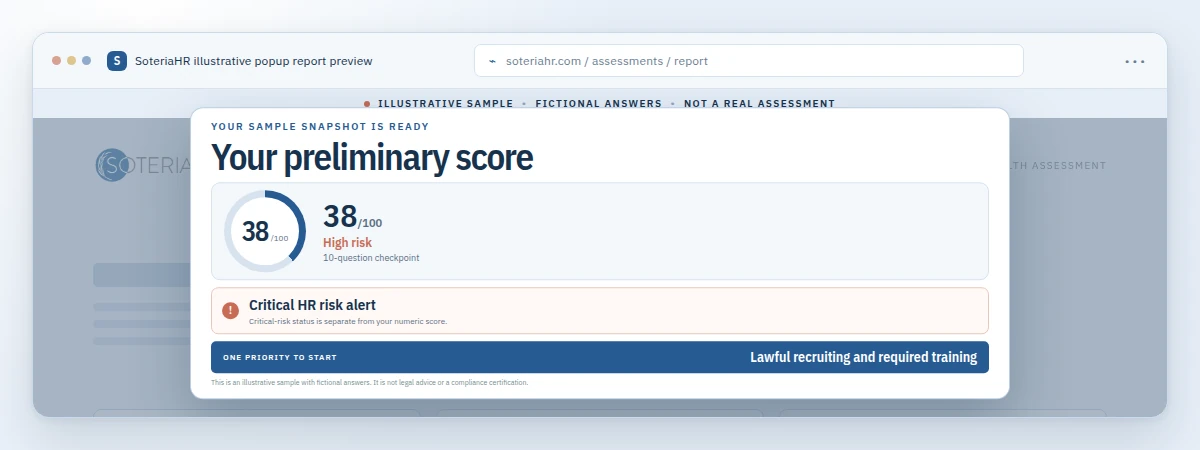
- Assess current HR gaps. Start by identifying which HR functions already work internally and which ones create the most risk or time drain, often through a structured review such as Soteria’s free HR Health Assessment, a short self-reported questionnaire covering common HR priorities.
- Define scope and priorities. Decide which combination of HR administration, consulting, benefits administration, and payroll coordination the organization actually needs before requesting proposals from providers.
- Compare providers and service models. Evaluate whether an ASO structure or a PEO structure fits better, paying close attention to employer-of-record responsibilities and pricing structure differences between candidates.
- Review contracts and responsibilities. Confirm exactly which tasks the provider will handle, which remain with internal staff, and how responsibilities for filings, deadlines, and recordkeeping are divided between both parties.
- Launch with a transition plan. Migrate employee records, communicate the change clearly to staff, and set a review checkpoint after the first ninety days to confirm the partnership is meeting expectations.
Common Mistakes When Choosing HR Outsourcing Services
Even organizations that recognize the value of outsourcing can stumble during the selection process. For instance, choosing a provider based on price alone often leads to thin service scope that does not actually cover compliance or benefits support. Similarly, some leaders wait until a compliance issue forces their hand, rather than exploring why outsource HR makes sense proactively.
In addition, failing to clarify the employer-of-record structure before signing a contract can create confusion later, especially around liability and benefits enrollment. Finally, organizations that already have internal HR staff sometimes assume outsourcing means replacing that team entirely, when in practice most providers are built to supplement existing staff rather than displace them. Addressing these points early, ideally during the consultation stage, helps avoid costly rework down the line.
Frequently Asked Questions About Outsourced HR Solutions
What are outsourced HR solutions?
Outsourced HR solutions are external human resources services — covering administration, consulting, and benefits — that a company pays a provider to manage on its behalf. The employer remains the legal employer of record, while the outsourced partner handles the day-to-day HR workload.
How does outsourced HR solutions benefit growing organizations?
Outsourced HR solutions benefit growing organizations by reducing administrative burden, lowering compliance risk, and providing access to specialized HR expertise without the cost of a full internal department. As the organization grows, the scope of support can expand with it, so the company avoids repeatedly rebuilding its HR structure.
How much does outsourced HR cost for a small business?
Pricing varies based on company size, services included, and the complexity of benefits and compliance needs, so costs should be confirmed directly with a provider. In general, outsourced HR is structured as a predictable recurring fee rather than the variable cost of multiple internal salaries.
How long does it take to transition to an outsourced HR provider?
Transition timelines typically depend on how many systems, policies, and employee records need to move, but many organizations complete initial setup within a few weeks. A phased rollout, starting with core administration before adding consulting or benefits support, often makes the transition smoother.
What is the difference between outsourced HR and a PEO?
Outsourced HR delivered through an ASO model keeps the client as the sole employer of record, while a PEO uses a co-employment structure that makes it a joint employer for tax and insurance purposes. Both models can work well, but the legal and risk implications differ, so it is worth discussing with an advisor first.
Is outsourced HR right for companies that already have an internal HR team?
Yes. Outsourced HR support can supplement an existing internal team by handling overflow administration, specialized compliance questions, or benefits administration, rather than replacing internal staff entirely.
What HR functions can be outsourced?
Commonly outsourced functions include HR administration, HR consulting, benefits administration, payroll coordination, employee training, and performance management support. Most providers tailor the exact scope to the organization’s size and priorities.
Does outsourcing HR remove an employer’s legal responsibilities?
No. The employer remains responsible for employment decisions and applicable legal obligations even when administrative tasks are outsourced. A knowledgeable HR partner reduces risk and improves consistency, but it does not eliminate the employer’s underlying accountability.
What size company benefits most from outsourced HR?
Organizations with roughly 10 to 250 employees are often a priority segment because they are too large to manage HR informally but not yet large enough to justify a full internal department. That said, outsourced HR can be scoped for organizations outside that range as well.
What is the difference between HR administration and HR consulting?
HR administration covers the daily mechanics, such as employee records, onboarding, and leave coordination, while HR consulting focuses on strategic guidance, including workforce planning, culture, and performance systems. Many organizations use both together for complete coverage.
What are common mistakes companies make when outsourcing HR?
Common mistakes include choosing a provider based on price alone, waiting until a compliance issue forces the decision, and failing to clarify the employer-of-record structure before signing a contract. Reviewing scope, responsibilities, and support channels in advance helps avoid these issues.
How do I know if my organization needs outsourced HR support?
Signs include frequent compliance questions without clear answers, inconsistent onboarding, benefits administration errors, or leadership spending excessive time on HR paperwork. A structured review, such as a free HR Health Assessment, can help clarify specific gaps.
What is an ASO, and how is it different from full HR outsourcing?
An ASO, or Administrative Services Organization, is a service model that provides tailored HR support without co-employment, meaning the client stays the sole employer of record. It is one way to structure outsourced HR, distinct from a PEO’s co-employment approach.
Can outsourced HR help with benefits administration specifically?
Yes. Outsourced HR providers commonly manage benefits enrollments and terminations, employee communications, carrier coordination, and support for applicable ACA, COBRA, and Section 125 requirements. Scope and applicability should be confirmed based on the plans involved.
In summary, outsourced HR solutions give growing organizations a practical way to manage compliance, administration, and employee support without the cost of building an entire internal department at once. Because the support scales alongside headcount, a company can move from ten employees to two hundred without needing to repeatedly restructure its HR function from scratch. For leaders ready to explore what this could look like, Soteria HR offers a free HR Health Assessment, or a direct conversation by calling (800) 399-2458 to Talk to an HR Expert.