How can I build a positive workplace culture as my company grows? In short, you build it by writing down your core values early, backing those values with consistent HR practices, and revisiting both every time headcount jumps. Growing companies that skip this step often watch a once-friendly culture fragment into confusion, inconsistent management, and rising turnover. Therefore, culture deserves the same deliberate planning that hiring plans and revenue targets already receive.
◆ Key Takeaways
- A positive workplace culture survives growth only when it runs on written systems, not founder memory.
- Clear values, consistent management, and feedback loops are the three pillars that scale alongside headcount.
- Gallup’s 2023 State of the Global Workplace report estimates low employee engagement costs the global economy roughly $8.8 trillion a year.
- A documented onboarding, training, and recognition process keeps culture consistent as a team moves from 25 to 250 employees.
- Many growing companies partner with an outsourced HR team, such as Soteria HR, to build the infrastructure that keeps culture steady during rapid growth.
◆ What Is Workplace Culture?
Workplace culture is the shared set of values, expectations, and everyday behaviors that shape how people treat each other and get work done inside an organization. It is, in other words, the unwritten rulebook that guides decisions when no one is watching. According to the general concept of organizational culture, this includes everything from how feedback is delivered to how mistakes are handled.
In a company of ten people, culture usually lives in the founder’s habits. Everyone sees how the founder treats a late deadline or a client complaint, so norms spread naturally. However, that model breaks down fast. Once a company adds a second office, a night shift, or a layer of middle managers, employees stop observing the founder directly. As a result, culture either gets documented on purpose or it drifts, department by department, into something inconsistent.
◆ How Can I Build a Positive Workplace Culture as My Company Grows?
You build a positive workplace culture as your company grows by writing your values down, training managers to model them, and installing HR systems that reinforce them at every stage of the employee lifecycle. Specifically, that means consistent onboarding, regular feedback, fair policies, and benefits that employees can actually understand. Culture that depends only on word-of-mouth will not survive rapid hiring.
Above all, consistency matters more than perfection. For example, a mid-sized employer that documents its PTO policy, communicates it clearly, and applies it the same way across every department will build more trust than one with generous but unevenly enforced benefits. In particular, SHRM research has repeatedly linked strong, consistent HR practices to lower voluntary turnover, which in turn protects the culture that remaining employees experience every day.
◆ Core Pillars of a Strong Company Culture
Most durable cultures rest on a few repeatable foundations rather than one big initiative. In particular, four pillars tend to matter most as headcount increases:
- Written values. A short, specific list of behaviors the company rewards, not vague slogans.
- Manager consistency. Supervisors who apply policy and feedback the same way across teams.
- Transparent communication. Regular updates on company direction, not just top-down announcements.
- Reliable HR infrastructure. Onboarding, benefits, and records that work the same way for employee one and employee one hundred.
For a closer look at how these pillars connect, Soteria HR’s guide to building and sustaining a positive culture at work walks through each one in more detail.
◆ Common Mistakes Growing Companies Make With Culture
Even well-intentioned leaders stumble in predictable ways. For instance, many assume culture will “just continue” without anyone managing it, which rarely holds true past 25 or 30 employees. Similarly, some companies hire quickly without updating onboarding, so new employees absorb inconsistent norms from whichever manager trains them first.
Another frequent mistake is treating culture as a one-time event, such as a kickoff retreat, rather than an ongoing system. In contrast, companies that sustain a strong culture treat it like payroll: recurring, scheduled, and owned by someone specific. For three concrete fixes leaders can apply this quarter, see Soteria HR’s three tips to maintain positive company culture.
◆ A Step-by-Step Process for Scaling Your Culture
Because culture rarely scales on instinct alone, a repeatable process helps. The following six steps give growing employers a practical sequence to follow.
- Define your core values in writing. Document three to five specific behaviors, not abstract words, so every manager can explain what each value looks like in a real situation.
- Build a consistent onboarding process. Create a standard first-week experience, including introductions, expectations, and documentation, so culture is taught deliberately rather than absorbed randomly.
- Train managers as culture carriers. Equip supervisors with specific coaching and feedback scripts, since employees typically experience company culture through their direct manager first.
- Install regular feedback loops. Use short pulse surveys or stay interviews every quarter to catch culture problems while they are still small and easy to correct.
- Formalize HR policies and benefits. Put handbooks, leave policies, and benefits administration in writing so every employee, regardless of hire date, receives the same treatment. For additional tactics, review Soteria HR’s list of best ways to build a positive workplace culture.
- Measure culture metrics on a schedule. Track turnover, engagement scores, and manager feedback quarterly, then adjust programs before small cracks turn into larger retention problems.
“Culture does not scale on its own. It scales when leaders build the onboarding, feedback, and recognition systems that carry the company’s values from the first ten hires to the two hundredth.”
◆ How an HR Partner Helps Sustain a Positive Workplace Culture
Many founders reach a point where building culture infrastructure competes directly with running the business. In that case, an outsourced HR partner can help without taking over employment decisions. Soteria HR, based in Pasadena, California, provides hands-on HR administration, HR consulting, and benefits administration for employers in Los Angeles, Orange County, and nationwide, typically for organizations with roughly 10 to 250 employees.
One option within that relationship is an Administrative Services Organization, or ASO, which is a structure that delivers tailored HR support without co-employment. Under an ASO arrangement, the client remains the legal employer and keeps responsibility for employment decisions and applicable obligations, while the HR partner builds the systems, such as onboarding, policy documentation, and feedback processes, that keep culture consistent. Consequently, leaders gain HR capacity without giving up control of how their business is run. To discuss whether an ASO or HR consulting relationship fits your situation, you can talk to an HR expert or call (800) 399-2458.
◆ Signs It May Be Time for HR Support
Several warning signs tend to appear before culture problems become serious. In particular, watch for:
- New hires receive inconsistent onboarding depending on which manager trains them.
- Managers apply policies, such as PTO or performance expectations, differently across teams.
- Exit interviews repeatedly mention confusion about expectations or inconsistent treatment.
- Leadership has no written documentation of values, policies, or onboarding steps.
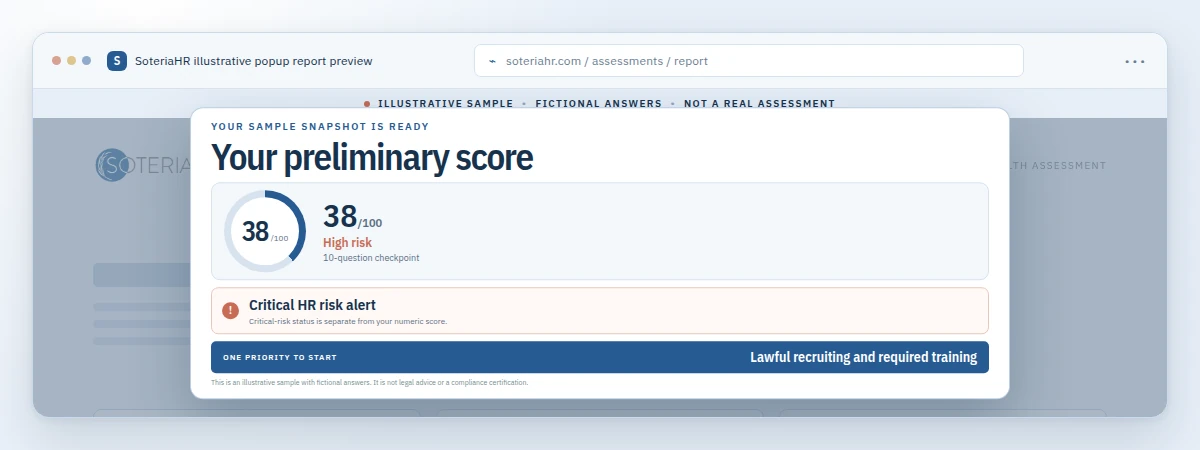
If several of these sound familiar, Soteria HR’s guide on how to create and sustain a positive workplace culture as you grow offers a useful next step, as does the broader overview of creating positive workplace culture. As a lower-commitment starting point, the free HR Health Assessment at soteriahr.ai offers a short self-assessment that highlights potential gaps; note that results are self-reported and preliminary, not a certification of legal compliance.
◆ Frequently Asked Questions About Building a Positive Workplace Culture
What is workplace culture, and why does it matter during growth?
Workplace culture is the shared values and everyday behaviors that shape how employees treat each other and do their work. It matters during growth because informal norms that once spread naturally stop reaching everyone once headcount increases.
How can I build a positive workplace culture as my company grows?
Many leaders ask, “how can I build a positive workplace culture as my company grows?” The practical answer is to document your values, train managers to apply them consistently, and install HR systems, such as onboarding and feedback loops, that scale with headcount.
How long does it take to build a strong workplace culture?
There is no fixed timeline, since culture is a continuous process rather than a project with an end date. However, most companies notice meaningful improvement within two to three quarters once consistent onboarding and feedback systems are in place.
How much does a poor workplace culture cost a growing business?
Poor culture is costly, largely through turnover and lost productivity. Gallup’s 2023 State of the Global Workplace report estimated that low employee engagement costs the global economy roughly $8.8 trillion annually, a figure that illustrates the stakes at the company level too.
What is the difference between company culture and company values?
Company values are the stated principles a business claims to hold, while company culture is what employees actually experience day to day. In other words, values are the intention; culture is the result of how consistently those values are practiced.
What are the most common mistakes companies make when scaling culture?
The most common mistakes are treating culture as a one-time event, hiring faster than onboarding can keep up, and allowing managers to apply policy inconsistently. Each mistake tends to compound as headcount increases.
How do managers influence workplace culture as a company grows?
Managers become the primary way employees experience culture once a company grows beyond direct founder contact. Consequently, how a manager gives feedback, enforces policy, and handles conflict often matters more to an employee’s daily experience than any company-wide statement.
What HR systems support a positive workplace culture?
Standard onboarding, documented policies, regular feedback surveys, and clear benefits administration are the core systems. Together, these reduce the inconsistency that erodes trust as a company adds new employees and new managers.
Can a small HR team maintain culture without outside help?
Yes, many small HR teams do, particularly under roughly 25 employees. Beyond that point, however, administrative workload often grows faster than internal HR capacity, which is when some employers choose to supplement their team with outside HR consulting or administration support.
How does an ASO or outsourced HR partner support company culture?
An ASO, or Administrative Services Organization, provides tailored HR support without co-employment, meaning the client remains the employer of record. In this model, the HR partner helps build onboarding, policy, and feedback systems while the client keeps responsibility for employment decisions.
What is the Soteria HR Health Assessment, and how does it relate to culture?
The free HR Health Assessment at soteriahr.ai is a short self-reported questionnaire that surfaces potential HR and policy gaps, which often underlie culture problems. It is a starting point for conversation, not a compliance certification or formal legal audit.
How often should a company reassess its workplace culture?
Most growing companies benefit from a quarterly review of engagement metrics, exit interview themes, and manager feedback. In addition, a more thorough annual review of policies and benefits helps catch gaps before they affect retention.
In the end, learning how to build a positive workplace culture as your company grows comes down to replacing instinct with infrastructure. Written values, consistent managers, reliable feedback loops, and formal HR systems carry a culture that once lived only in a founder’s habits into a company of fifty, one hundred, or two hundred employees. As the comparison above shows, the risks and priorities shift at each stage, so culture work should be revisited, not set once and forgotten. If your organization is approaching one of these turning points, a conversation with an HR professional, or a short self-assessment at soteriahr.ai, can clarify exactly where to focus next. For a direct conversation about your specific situation, you can talk to an HR expert by calling (800) 399-2458.