Outsourcing HR cost-effectiveness depends on handing part or all of your HR administration to an outside partner, which lets your leaders stop firefighting and start planning. For growing small and mid-sized organizations, it can ease compliance workload, benefits administration, and employee questions without hiring a full-time HR person. However, it is not right for every task or every company; the right scope matters. This guide explains how outsourced HR works, where it helps, where it falls short, and how to choose a provider.
Quick Answers
- What it is: an outside partner handles defined HR services, such as HR administration, benefits administration, HR consulting, or compliance support.
- Who it suits: growing teams that need more HR depth than one generalist can offer.
- What to keep in-house: culture, employee relations, and final employment decisions.
- Biggest tradeoffs: less day-to-day control, possible add-on fees, and the need to manage the relationship well.
What Is HR Outsourcing?
HR outsourcing (often shortened to HRO, for human resources outsourcing) is an arrangement where a specialist provider manages specific HR functions for your business. Typically, the provider takes on administrative work. As a result, your team gains time for strategic work like hiring plans, manager coaching, and culture.
In practice, outsourced HR is a spectrum. You can hand off one task, such as benefits administration, or build a broader partnership. It also overlaps with the study of human resource management, since the aim is the same: align people practices with business goals.
Common Models of Outsourced HR
- Hands-on HR partner or HR consulting: advisors support your leaders with policies, employee questions, and HR administration. Your business stays the employer.
- ASO (Administrative Services Organization): a provider administers payroll, benefits, and compliance tasks. Importantly, ASO clients keep their employer obligations.
- PEO (professional employer organization): a co-employment model where the PEO shares certain employer responsibilities, often with pooled benefits. It suits some companies well, and it works differently from the models above.
- Project-based help: a one-time handbook rewrite, policy review, or HR Health Assessment.
For a closer look at the range of services in these engagements, see this overview of professional HR solutions for small businesses. You can also read about which human resource functions companies outsource.
A Hypothetical Example
Picture a regional design firm that grows from a small team to several locations. Its office manager now spends most weeks on benefits enrollment, handbook updates, and leave questions. Meanwhile, hiring slows down. The firm brings in an outsourced HR partner for HR administration and compliance support. The office manager returns to recruiting and manager coaching. This example is hypothetical, and results always depend on scope and execution.
10 Benefits of Outsourcing HR
The benefits below are possibilities, not promises. Specifically, they depend on the provider, the scope, and how well you manage the partnership.
- Stronger compliance support. A provider tracks changing employment rules and flags updates to review. Even so, you still need to confirm requirements with current official sources.
- More predictable costs. A flat or per-employee fee can replace salary, benefits, and software costs for a new hire.
- Access to specialists. One generalist cannot know every niche, such as multi-state leave rules or benefits design.
- Better use of leadership time. Founders and managers spend fewer hours on paperwork.
- Faster, more consistent employee support. Questions get clear answers, which helps people feel supported.
- Improved efficiency. Providers bring tested processes for onboarding, offboarding, and recordkeeping.
- Lower risk of avoidable mistakes. Documented policies and consistent practices reduce the chance of errors. No provider can remove risk entirely.
- Focus on core business. Your in-house team can work on hiring strategy, development, and growth.
- Smoother benefits administration. Enrollment, renewals, and employee questions become easier to manage.
- Better HR data. Centralized records make turnover, headcount, and time-off trends easier to see.
For cost-focused detail, this complete guide to the benefits of outsourced HR for small businesses goes further. In addition, this overview of the benefits of outsourced HR covers extra readiness points.
Is Outsourcing HR Cost-Effective? In-House vs. Outsourced
Often, yes, but it depends on your size and needs. The fair comparison is the fully loaded cost of an in-house hire against the total outsourced fee. Fully loaded cost includes salary, payroll taxes, benefits, software, and training. For current wage data, check the U.S. Bureau of Labor Statistics.
| Factor | In-House HR Generalist | Outsourced HR Partner |
|---|---|---|
| Cost structure | Fixed salary, benefits, and taxes | Retainer, per-employee, or scoped fee |
| Expertise | Depth of one person | A team with varied specialties |
| Compliance monitoring | Depends on one person’s time | Usually part of the service scope |
| Scalability | Requires hiring as you grow | Scope adjusts with headcount |
| Control and culture | Close, daily presence | Depends on partner and communication |
Pricing varies widely, so get written quotes. This guide to outsourced HR costs for mid-sized companies explains what drives the price. Also see how outsourcing HR can reduce the cost of HR per employee.
How Outsourced HR Is Priced
Providers commonly use one of three structures. First, a flat monthly retainer. Second, a per-employee-per-month fee. Third, a tiered package based on services. Therefore, a business needing only handbook and compliance help will usually pay less than one handing over broad HR administration. Always ask what is included and what is billed separately.
When Should You Consider Outsourcing HR?
Companies at any stage can benefit, but certain signals show up again and again.
Rapid Growth or New Locations
More employees mean more questions, more paperwork, and more rules. Hiring in a new state adds new requirements as well. Consequently, a lean team can fall behind quickly.
Limited In-House HR Knowledge
Leaders who handle HR on the side often lack time to keep policies current. For example, a handbook that has not been reviewed in years is a common warning sign.
Leaders Stuck in HR Tasks
If managers spend more hours on HR issues than on strategy, support may pay for itself in time. Similarly, frequent turnover or unclear policies point to gaps worth addressing.
Rising HR Costs
As HR needs expand, so does the cost of software, training, and staff. In that case, scoped services can help you control spending. Still, compare the total cost of both options before you decide. You can also read how HR and admin services support growing companies.
How to Choose an HR Outsourcing Provider
Rather than starting with a vendor list, start with your own needs. Follow these steps.
- Define your pain points. List the tasks that drain time or create risk, such as payroll coordination, benefits administration, compliance questions, or onboarding.
- Match the model to the need. Decide whether you want advisory support, an ASO, or a co-employment PEO. Remember that your business keeps its employer obligations under an ASO.
- Test service quality. Ask about response times, who your contact will be, and how issues get escalated. Then ask for references from similar organizations.
- Check data privacy and integrations. Confirm how employee data is stored and accessed, and whether the provider works with your payroll and HR tools.
- Compare itemized proposals. Request written scopes from two or three providers, then review fees, exclusions, contract length, and exit terms.
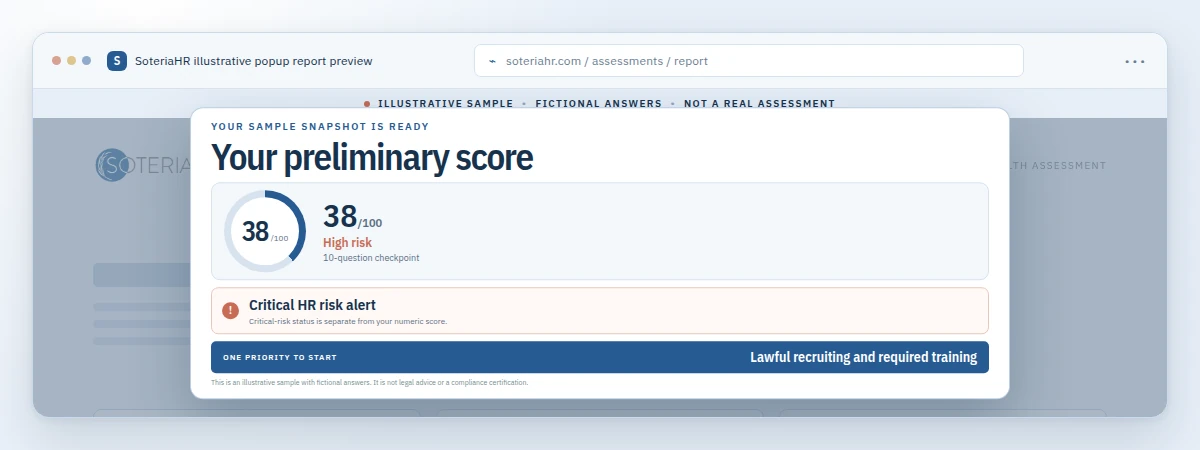
One useful option is an HR Health Assessment, which highlights gaps in your current practices. Note that assessment scores are a planning tool. They do not certify compliance, and they are not a legal audit.
What Should You Not Outsource? Risks and Drawbacks
Honest planning includes limits. Outsourced HR works best for administration and expertise. By contrast, some work belongs with people who know your team.
HR Work Best Kept In-House
- Culture-building and everyday employee relations
- Strategic workforce decisions
- Final decisions on hiring, discipline, and termination
Possible Drawbacks of Outsourcing HR
- Less direct control over how issues are handled
- Slower responses if the provider is stretched
- Add-on fees if scope is unclear
- Sensitive data shared with a third party
- Extra effort to rebuild in-house capability later
Careful selection and clear contracts reduce these issues. For compliance topics, rules change often. The U.S. Department of Labor and the Society for Human Resource Management (SHRM) are good places to verify current guidance. To weigh the risk side, read whether it is worth hiring an external HR partner for compliance.
This content is for general information and is not legal or tax advice. Requirements vary by location, employer size, and circumstances. Consult qualified counsel or an appropriate advisor for guidance on your situation.
Outsourced HR With Soteria HR
Soteria HR works as a hands-on HR partner for growing small and mid-sized organizations. Services include HR administration, HR consulting, benefits administration, and compliance support. Your business remains the employer, and you keep the decisions that matter. Because needs differ, the right scope depends on your team. Our perspective on moving past 2020 shows how HR needs have changed.
Frequently Asked Questions About Outsourcing HR
What does HRO stand for?
HRO stands for human resources outsourcing. It means partnering with a third party to handle some or all of your HR tasks.
How much does outsourcing HR cost?
Cost depends on workforce size and scope. Common structures are a flat retainer, a per-employee fee, or tiered packages. Request itemized written quotes to compare.
Why do small businesses outsource HR?
Small businesses outsource HR to access expertise, manage compliance tasks, and save leadership time. Many lack the need or budget for a full HR department.
What HR functions should not be outsourced?
Culture, employee relations, and final employment decisions are usually best kept in-house. Outside partners can advise on them.
What are the disadvantages of outsourcing HR?
Drawbacks include less control, possible slower responses, extra fees, and data privacy concerns. Clear scopes and careful provider selection help manage them.
What is the difference between a PEO and an ASO?
A PEO shares certain employer responsibilities through co-employment. An ASO provides administrative services while the client keeps its employer obligations.
How long does it take to start outsourcing HR?
Timelines vary with the complexity of your systems and the scope of services. Many companies phase the work, starting with compliance support and administration.
Can I outsource HR if I already have an HR person?
Yes. A hybrid model lets your in-house person focus on people and culture while a partner handles specialized administration and compliance support.
The Bottom Line on Outsourcing HR
In summary, outsourcing HR can give growing teams expert support, steadier costs, and more time for strategic work. However, it works best when you define your needs, keep culture and key decisions in-house, and compare providers in writing. The right model depends on your size, locations, and goals.
If you are weighing your options, talk to an HR expert at Soteria HR about what your business needs.