Management tips for new managers in small companies make the difference between a rocky first year and a confident, capable leader who keeps a team engaged. In many small organizations, a newly promoted supervisor inherits the role without formal training, a dedicated coaching budget, or a deep bench of peers to call for advice. As a result, the fastest wins usually come from clear communication, consistent expectations, and knowing when to bring in outside HR support. This guide from Soteria HR explains what effective management looks like for first-time supervisors and where leaders can get hands-on help along the way.
Key Takeaways
- New managers in small companies succeed faster when expectations, feedback, and documentation are consistent from day one.
- According to Gallup’s research, managers account for roughly 70% of the variance in employee engagement scores across a team.
- A simple 90-day plan helps first-time supervisors build trust, set priorities, and avoid common missteps.
- Outsourced HR consulting can fill training gaps that small companies rarely have the budget to build internally.
- Legal and documentation mistakes, more than people-skills gaps, tend to create the costliest outcomes for untrained managers.
What Makes Management Tips for New Managers in Small Companies Different?
Management tips for new managers in small companies are the specific habits, communication patterns, and support systems that help a newly promoted supervisor succeed despite limited formal training and a small internal team. In small organizations, these tips differ from generic leadership advice because employers rarely have a dedicated human resources department, a structured onboarding budget, or a layer of middle managers to model good behavior. As a result, new supervisors usually learn policy, performance management, and interpersonal skills largely on the job, while managers at larger firms often receive structured onboarding and HR backup from day one.
Small company management also means wearing several hats at once. A first-time supervisor might approve a time-off request in the morning, mediate a scheduling conflict at lunch, and evaluate a probationary employee’s performance by the end of the day. Consequently, the learning curve is steep, and mistakes tend to surface quickly because there is no buffer layer to absorb them.
For founders and operations leaders, this reality creates both risk and opportunity. If a new manager gets consistent coaching early, the whole team benefits from clearer expectations and fewer misunderstandings. However, if a new manager is left to guess, inconsistent discipline, missed documentation, and employee turnover often follow. That is why many small employers pair a newly promoted supervisor with practical HR advice for small businesses rather than leaving the manager to build every process alone.
Why New Managers in Small Businesses Need Extra Support
New managers in small businesses need extra support because their decisions carry outsized weight. In a ten-person company, one supervisor’s communication style can shape morale for the entire office. Specifically, research backs this up: according to Gallup’s State of the American Manager report, managers account for at least 70% of the variance in employee engagement scores across a team. Furthermore, engagement gaps rarely stay hidden in a small company, since every employee notices when leadership is inconsistent.
In addition, first-time managers often inherit responsibilities that used to belong to an owner or founder, including performance reviews, scheduling, and conflict resolution. Without a playbook, they tend to default to whatever style they experienced from their own previous managers, good or bad. Similarly, many new supervisors avoid difficult conversations altogether, which allows small performance issues to grow into larger disputes.
The Society for Human Resource Management (SHRM) has long noted that manager-effectiveness training correlates with lower voluntary turnover, particularly in organizations with fewer than 250 employees. Consequently, investing in even a short orientation for new supervisors can pay for itself quickly through reduced hiring and training costs. This is one reason small employers increasingly treat a practical manager’s guide as a required part of onboarding rather than an optional extra.
Core People-Management Skills Every First-Time Supervisor Needs
Several core skills show up again and again in management tips for new managers in small companies, regardless of industry. Above all, new supervisors need to set expectations, communicate consistently, and keep a written record of key decisions.
Setting Clear Expectations Early
A new manager should define what success looks like for each role within the first two weeks. For example, that might mean documenting attendance expectations, quality standards, or communication norms in writing rather than relying on memory. Therefore, employees know exactly what is expected before a problem ever arises. Clear expectations also protect the manager later, since written standards make performance conversations far less personal and far more objective.
Communicating Consistently
Consistency matters more than charisma in small-team management. A supervisor who holds brief, regular check-ins, whether weekly or biweekly, builds trust faster than one who only speaks up when something goes wrong. In contrast, sporadic feedback leaves employees guessing about where they stand. Simple habits, such as a short recap email after each check-in, create a lightweight paper trail that helps everyone stay aligned.
Documenting Decisions
Documentation protects both the employee and the company. Specifically, a brief written note after a coaching conversation, a missed deadline, or a policy exception creates a record that can matter later, including during a wage dispute. The U.S. Department of Labor maintains recordkeeping guidance that applies to many employment actions, so new managers should learn their company’s documentation process early rather than improvising it under pressure.
Common First-Year Mistakes New Managers Make
Even well-intentioned new managers repeat the same mistakes in their first year. Avoiding them early prevents larger problems later.
- Avoiding difficult conversations. Many first-time supervisors delay feedback because it feels uncomfortable. However, delayed feedback rarely resolves an issue; it usually lets the issue grow.
- Treating every employee identically. Consistency in policy matters, but flexibility in communication style matters too. For instance, one employee may need detailed written instructions while another prefers a quick verbal check-in.
- Skipping documentation. As mentioned above, undocumented coaching conversations are difficult to defend later, particularly if a termination or complaint follows.
- Making promises outside their authority. New managers sometimes promise raises, schedule changes, or promotions without checking policy or budget first, which creates problems for ownership later.
- Ignoring legal boundaries. Wage and hour rules, leave entitlements, and anti-discrimination protections apply in many cases regardless of company size. The U.S. Equal Employment Opportunity Commission enforces federal workplace discrimination law, and a manager unaware of these protections puts the company at risk without realizing it.
In particular, that last mistake is the costliest. Therefore, most small employers find it worthwhile to confirm management decisions against current policy, rather than relying on instinct alone, especially for discipline, leave requests, and terminations.
“New managers rarely fail because they lack good intentions. They fail because no one ever handed them a playbook.”
— Soteria HR, HR Consulting Team
How to Build a 90-Day Management Plan
A simple 90-day plan gives new managers structure during the highest-risk stretch of their transition. Consequently, following a short checklist reduces guesswork and builds credibility with the team faster than improvising week by week. The five steps below work for most small company settings, though the timeline can flex depending on team size and complexity.
- Meet individually with every direct report. In the first two weeks, hold a one-on-one conversation with each employee to learn their role, goals, and current concerns before making any changes.
- Review existing policies and documentation. Read the employee handbook, past performance notes, and any open disciplinary issues so decisions build on accurate history rather than assumptions.
- Set two or three team priorities. Choose a small number of clear goals for the next 90 days and communicate them in writing so the whole team understands what matters most right now.
- Schedule recurring check-ins. Put brief weekly or biweekly one-on-one meetings on the calendar for every direct report to create a predictable rhythm of feedback and support.
- Confirm escalation paths with ownership or HR. Before day 90, clarify who to contact for policy questions, legal concerns, or disciplinary decisions, whether that is the owner, an internal HR lead, or an outsourced HR partner.
DIY Management vs. HR-Supported Management
The table below illustrates how outcomes often differ depending on whether a new manager operates alone or with structured HR support behind them.
| Factor | DIY Management | HR-Supported Management |
|---|---|---|
| Onboarding structure | Informal, varies by manager | Documented plan with milestones |
| Policy consistency | Prone to inconsistency across managers | Standardized policies and templates |
| Legal risk exposure | Higher, due to limited compliance awareness | Lower, with ongoing HR guidance |
| Time to confidence | Often 6+ months of trial and error | Typically around 90 days with a plan |
| Documentation quality | Inconsistent, often missing | Consistent, defensible records |
When Small-Company Managers Should Call in HR Expertise
Not every management question needs an HR department on staff. However, certain situations call for outside expertise right away: terminations, leave requests, harassment complaints, and wage disputes top the list. In these moments, a manager’s instinct matters less than a documented, defensible process.
Soteria HR works with founders, CEOs, and operations leaders who need hands-on HR support without the cost of a full internal team. Through HR administration, HR consulting, and an Administrative Services Organization (ASO) option that does not involve co-employment, Soteria helps growing companies build the structure new managers need, while the client remains the employer of record and keeps responsibility for employment decisions.
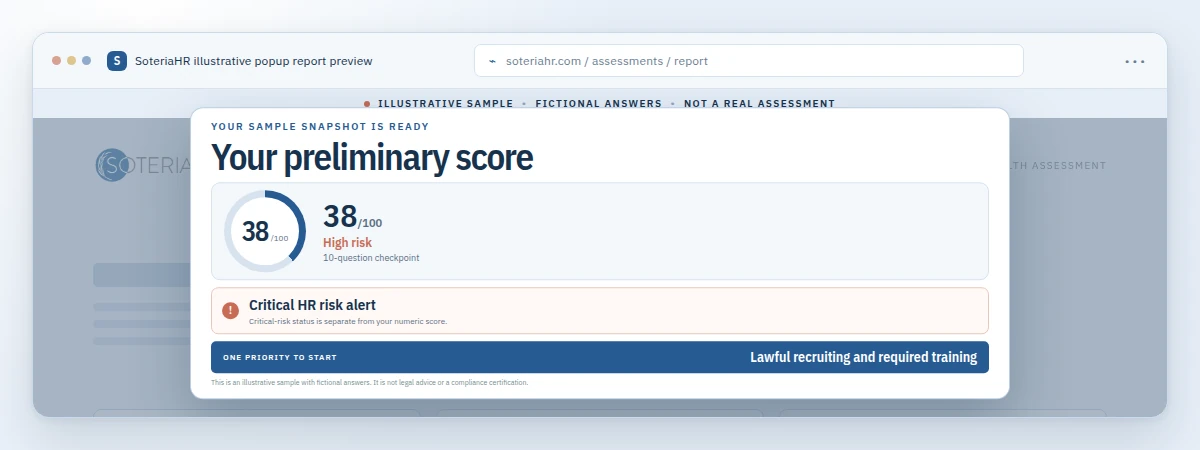
For leaders who want to see where gaps might exist before a problem arises, the free HR Health Assessment at soteriahr.ai offers a short starting point; a 10-question Quick HR Check takes about two minutes, and the fuller 40-question version takes roughly 10 to 12 minutes. Results are self-reported and preliminary, not a certification of compliance, but they often highlight where a new manager’s training or documentation is thin.
In addition, reviewing strategies that improve employee retention in small businesses and understanding the benefits of structured performance management can round out a new manager’s toolkit. For a broader list of practical habits, see these ten tips for managing employees effectively. For direct support, call Soteria HR at (800) 399-2458 or submit a consultation request to talk with an HR expert through soteriahr.com.
Frequently Asked Questions About Management Tips for New Managers in Small Companies
What are management tips for new managers in small companies?
Management tips for new managers in small companies include setting clear expectations early, communicating consistently, documenting decisions, and knowing when to escalate legal or policy questions to HR support. These habits matter more in small companies because there is rarely a buffer team to catch mistakes.
How long does it take a new manager to feel confident in a small business role?
Most first-time supervisors need about 90 days to build basic confidence, assuming they receive structured feedback and a clear set of priorities. Without that structure, the adjustment period often stretches well beyond six months.
What is the biggest mistake new managers make in their first year?
The most common and costly mistake is skipping documentation, particularly around coaching conversations, attendance issues, and disciplinary actions. Undocumented decisions are difficult to defend later if a dispute or complaint arises.
How do new managers in small companies differ from managers at large corporations?
New managers in small companies typically handle a wider range of responsibilities with far less formal training or HR backup than their counterparts at large corporations. As a result, they often learn policy and compliance requirements on the job rather than through structured onboarding.
Why do small companies promote employees into management without training?
Small companies often promote their strongest individual performer into a management role simply because that person is available and trusted, not necessarily because a training budget exists. Consequently, the new manager inherits authority before receiving the tools to use it well.
What should a new manager do in their first week on the job?
A new manager should meet individually with each direct report, review existing policies and open issues, and avoid making major changes before understanding the team’s current dynamics. This groundwork makes every later decision easier to explain.
How much does outsourced HR support cost for a small company?
Outsourced HR costs vary based on company size, scope of services, and whether the arrangement includes an ASO option, so pricing is best confirmed directly with a provider like Soteria HR. In general, outsourced support costs far less than building a full internal HR department.
What skills matter most for first-time managers?
Clear communication, consistent follow-through, and a willingness to document decisions matter more than natural charisma for first-time managers. Above all, employees respond best to predictability, even when a decision is unpopular.
How can a new manager handle conflict between coworkers?
A new manager should meet with each person separately first, then bring both parties together for a structured conversation focused on specific behaviors rather than personalities. Documenting the resolution afterward helps prevent the same conflict from resurfacing.
What legal responsibilities should new managers understand?
New managers should understand basic wage and hour rules, leave entitlements, and anti-discrimination protections that apply under federal and applicable state law, including guidance from the U.S. Department of Labor and the EEOC. Specific obligations vary by jurisdiction and company size, so confirming current requirements with HR or legal counsel is important.
How often should new managers check in with their team?
Weekly or biweekly one-on-one check-ins work well for most small teams, since they create a predictable rhythm without overwhelming a manager’s schedule. Less frequent check-ins tend to let small issues grow before anyone addresses them.
What is the difference between managing and leading in a small company?
Managing generally refers to coordinating tasks, schedules, and performance, while leading involves setting direction and inspiring commitment to it. In a small company, one person usually has to do both, often without a formal title change to mark the shift.
How can HR consulting help new managers succeed?
HR consulting gives new managers access to policy guidance, documentation templates, and an outside perspective on difficult employee situations. This support often replaces the mentorship a new manager would otherwise be missing in a small, flat organization.
What mistakes do new managers make with documentation?
New managers often skip written records for verbal coaching conversations, assuming memory will be enough if a problem resurfaces later. Over time, this gap makes it much harder to demonstrate a consistent, defensible pattern of management decisions.
In summary, management tips for new managers in small companies come down to a few repeatable habits: set clear expectations, communicate on a consistent schedule, document decisions, and know when to bring in outside expertise. Therefore, a first-time supervisor does not need to have every answer on day one; they need a reliable process and the willingness to ask for help when a situation calls for it. Soteria HR supports founders, CEOs, and operations leaders through HR administration, HR consulting, and ASO partnerships built for growing organizations. To talk through specific management or compliance questions, call (800) 399-2458 or submit a consultation request, or start with the free HR Health Assessment at soteriahr.ai to see where priorities might lie.