Organization Development Framework: The Complete Practitioner’s Guide
An organization development framework is a structured, repeatable system that guides how a business diagnoses problems, plans and implements change, and sustains improvement across its people, culture, processes, and strategy. Without one, change is reactive and inconsistent. With one, it becomes a disciplined, measurable organizational capability — and a lasting competitive advantage.
McKinsey research consistently finds that roughly 70% of organizational change programs fail to achieve their goals — and the single most cited reason is the absence of a coherent guiding structure. An organization development (OD) framework exists precisely to close that gap: it turns good intentions into executed, evaluated, and sustained outcomes.
This guide covers everything practitioners, HR leaders, and executives need to know — from foundational definitions and proven OD models to a step-by-step build process, key metrics, real-world OD interventions, and the most common failure modes to avoid.
What Is an Organization Development Framework?
An organization development framework is a deliberate, structured blueprint for improving organizational effectiveness. It defines the sequence of activities — from diagnosing problems to designing interventions, implementing changes, and evaluating outcomes — that a company follows when it wants to grow, adapt, or fundamentally transform.
Critically, an OD framework is not a one-time change management project. It is an ongoing management discipline. It connects strategy, people, culture, and operations into a coherent, self-correcting system that evolves with the organization’s needs. Think of it as the scaffolding that holds every change effort together — preventing initiatives from collapsing into disconnected, short-lived programs.
The field of organizational development itself — rooted in behavioral science, systems thinking, and applied research — provides the intellectual foundation for any solid OD framework. Practitioners draw on decades of accumulated knowledge about how organizations learn, resist, and sustain change.
OD Framework vs. Change Management Plan: Key Distinctions
These two terms are often conflated, but they serve fundamentally different purposes:
- A change management plan addresses a single, specific transition — such as a system migration or restructuring. It has a defined start and end date.
- An organization development framework is broader and permanent. It governs multiple change initiatives over time and continuously improves based on feedback and outcomes.
- Change management is often contained within an OD framework — one of many interventions the framework oversees and evaluates.
Understanding this distinction prevents organizations from treating OD as a project rather than a permanent organizational capability.
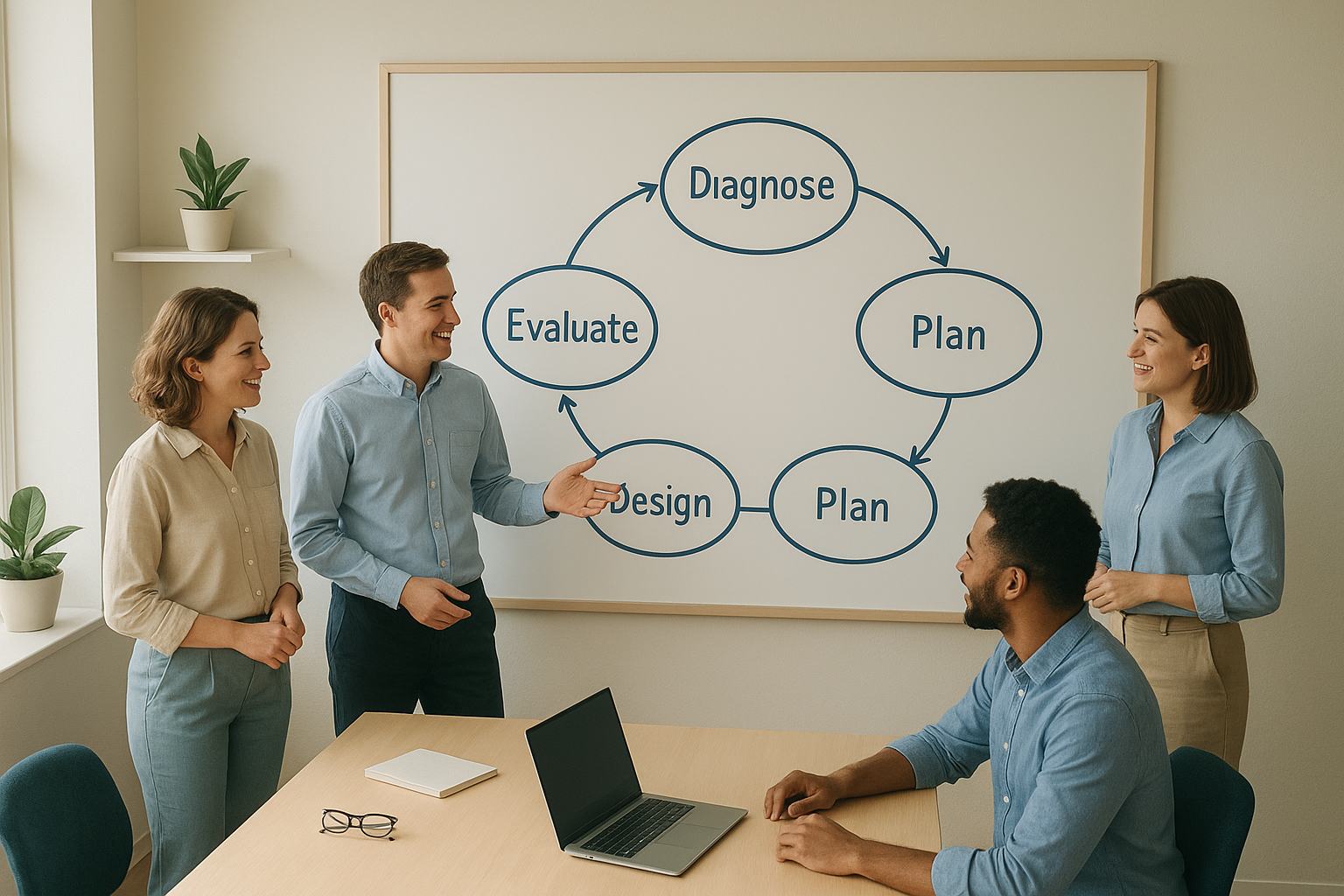
A well-designed organization development framework maps out each phase of change clearly, giving teams a shared language, direction, and accountability structure.
The Goals of Organizational Development
Before building any framework, it helps to be explicit about what OD is trying to achieve. The overarching goals of organizational development — which your framework should be designed to serve — include:
- Improving organizational effectiveness: Helping the organization perform at a higher level by aligning strategy, people, and operations.
- Enhancing employee wellbeing and engagement: Creating conditions where people can do their best work and feel invested in organizational outcomes.
- Building adaptive capacity: Developing the organizational muscle to respond quickly and confidently to disruption, opportunity, and complexity.
- Strengthening culture and values alignment: Closing the gap between stated values and lived culture — the single biggest driver of trust and retention.
- Increasing leadership capability: Developing leaders who can navigate ambiguity, inspire commitment, and drive results in complex environments.
- Driving continuous learning: Creating feedback loops that institutionalize learning at every level — individual, team, and organizational.
Why Your Business Needs a Structured OD Approach
Without a structured approach, change efforts tend to be reactive and inconsistent. Teams work in silos, initiatives overlap, and results are nearly impossible to measure with confidence. As a result, organizations often spend enormous resources on programs that produce little lasting impact — and breed employee cynicism about the next initiative.
A proper organization development framework solves this through three core mechanisms: clarity of purpose (everyone knows what you’re trying to achieve), alignment across functions (HR, operations, leadership, and finance are moving in the same direction), and accountability for outcomes (success metrics are defined before interventions begin, not after).
Beyond these immediate benefits, a structured OD approach builds long-term organizational resilience. When the next disruption arrives — a market shift, a merger, a talent crisis, or a technology disruption — organizations with a mature framework respond faster and more effectively than those improvising in real time.
Key Benefits of an Organization Development Framework
- Aligns people strategy directly with business goals
- Eliminates wasted effort on uncoordinated, overlapping initiatives
- Creates measurable, repeatable improvement cycles
- Builds a culture of continuous learning and psychological safety
- Strengthens leadership capability at every organizational level
- Increases employee engagement and reduces turnover
- Provides a shared language for talking about change across functions
- Makes the organization more attractive to high-caliber talent
Core Components of an Effective Organization Development Framework
While specific frameworks vary in complexity and emphasis, every effective OD model shares five foundational components. Together, they form a closed feedback loop — preventing organizations from treating change as a linear, one-and-done event.
1. Organizational Diagnosis
Diagnosis is the non-negotiable foundation of any credible OD effort. This phase involves systematically collecting both qualitative and quantitative data — through employee surveys, leadership interviews, focus groups, performance analytics, exit interviews, and organizational network analysis — to understand where the organization stands today.
The goal of diagnosis is not just to surface symptoms but to identify root causes. Is low engagement driven by poor management, unclear career paths, misaligned values, or a toxic subculture in one division? Without this distinction, interventions are expensive guesswork.
Common diagnostic tools include the Organizational Effectiveness Survey, 360-degree feedback assessments, culture audits, and process mapping exercises. Many organizations also use the McKinsey 7-S Model or Weisbord’s Six-Box Model as diagnostic lenses.
2. Strategic Goal Alignment
Once diagnosis is complete, findings must be translated into OD goals that connect directly to the company’s broader business strategy. This alignment is what separates strategic OD from well-meaning but disconnected HR programming.
Effective goal-setting at this stage uses SMART criteria (Specific, Measurable, Achievable, Relevant, Time-bound) and involves senior leadership sign-off. Goals should explicitly name the business outcomes OD work is intended to support — for example, “reduce voluntary turnover by 20% over 18 months to protect revenue continuity.”
3. Intervention Design
OD interventions are the specific actions taken to close the gap between the current state and the desired future state. They fall into three broad categories:
- Human process interventions: Team building, conflict resolution, leadership coaching, communication training, process consultation
- Technostructural interventions: Job redesign, organizational restructuring, process reengineering, technology adoption programs
- Human resource management interventions: Performance management redesign, total rewards restructuring, talent development programs, succession planning
- Strategic interventions: Culture change programs, merger and acquisition integration, diversity and inclusion strategy, organizational transformation
Critically, interventions must be tailored to the specific root causes identified during diagnosis — not borrowed wholesale from another organization or copied from a trends report. Each intervention should have a named owner, a defined timeline, and measurable success criteria.
4. Implementation and Change Communication
Implementation is where most OD frameworks live or die. Even a perfectly designed intervention can fail if communication is insufficient, timing is poor, or frontline managers are not prepared to support their teams through the transition.
A robust implementation plan includes a multi-channel communication strategy, manager enablement resources, a cadence for leadership visibility, and clear escalation paths for issues. Employees need to understand why change is happening, what it means for them personally, and how they can participate. Transparency at this stage dramatically increases buy-in and reduces resistance.
5. Evaluation, Feedback, and Iteration
Evaluation is the component that transforms a one-time program into a living organizational capability. It involves measuring outcomes against pre-defined metrics, gathering qualitative feedback from stakeholders, and using findings to refine and improve the framework for the next cycle.
Effective OD evaluation uses a layered measurement approach: leading indicators (early signals like survey response rates, training completion) alongside lagging indicators (ultimate outcomes like retention improvements, productivity gains, or culture survey shifts). Without this feedback loop, organizations are flying blind.
How to Build an Organization Development Framework: Step-by-Step
Building your own framework does not require a consulting engagement. A clear, disciplined sequence makes the process manageable for teams of any size. Below is a practical five-step process you can adapt immediately.
- Conduct a Thorough Organizational Diagnosis. Gather qualitative and quantitative data through employee surveys, leadership interviews, focus groups, and performance analytics. Your goal is to identify the root causes of performance gaps — not just surface symptoms. Use an established diagnostic model (Weisbord’s Six-Box, McKinsey 7-S, or Burke-Litwin) to structure your analysis and ensure you’re examining all relevant organizational systems simultaneously. This data becomes the evidentiary foundation for every decision that follows.
- Define Strategic OD Goals and Priorities. Work collaboratively with senior leadership to set clear, measurable OD objectives that connect directly to the company’s business strategy. Avoid vague aspirations — define success in concrete, time-bound terms. For example: “Reduce voluntary turnover in the engineering function by 20% within 18 months” or “Increase manager effectiveness scores by 15 points on the annual engagement survey by Q4.” Each goal should also identify a senior sponsor who is accountable for resourcing and championing the effort.
- Design Targeted Interventions Matched to Root Causes. Select and design specific programs, structural changes, or process redesigns that directly address the root causes identified in your diagnosis. Resist the temptation to run the same popular workshop your industry peers are running. Each intervention must have a clear owner, an explicit timeline, a budget estimate, and pre-agreed success metrics. Consider sequencing: some interventions are prerequisites for others (e.g., manager capability development before launching a new performance management system).
- Implement with a Structured Communication and Enablement Plan. Roll out interventions with a multi-channel communication strategy that reaches employees at every level. Prepare managers specifically — they are the primary channel through which employees experience organizational change. Include a feedback mechanism (e.g., pulse surveys, open Q&A sessions, manager briefings) that allows you to detect and respond to resistance or confusion in real time. Transparency about timelines, rationale, and expected impact dramatically increases voluntary participation and trust.
- Evaluate Results, Report Progress, and Iterate. Measure outcomes against your defined metrics at predetermined intervals — not just at the end of a program. Share results openly with senior leadership and, where appropriate, with the broader employee population. Use what you learn to refine both the current interventions and the overall framework design. This continuous iteration is what transforms an OD framework from a static document into a dynamic organizational capability that gets stronger with every cycle.
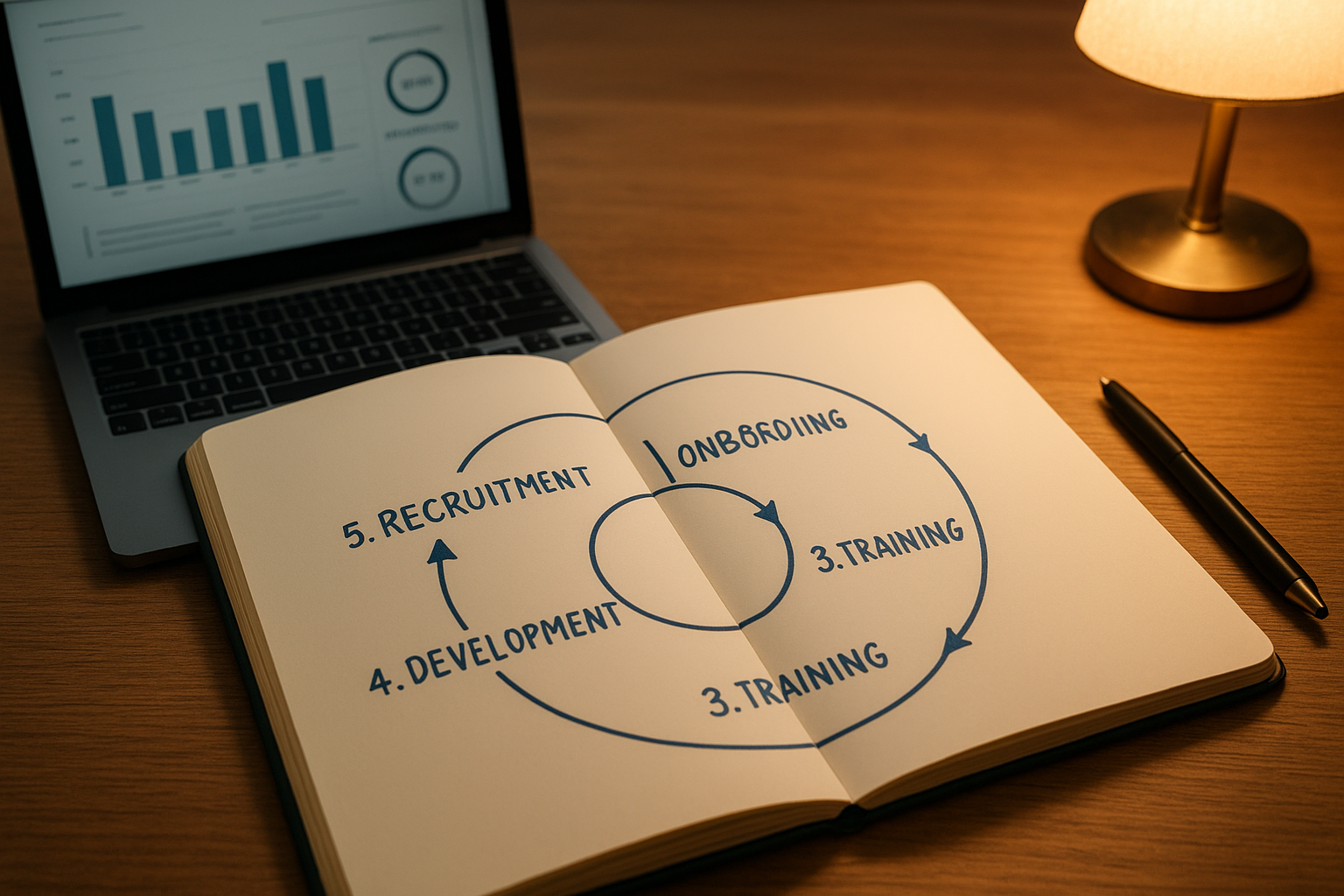
Tracking metrics at each stage of the development process keeps the framework grounded in real outcomes and enables confident iteration rather than guesswork.
Proven OD Models That Inform Modern Frameworks
You don’t need to invent your framework from scratch. Several well-established OD models provide proven structural logic you can adopt, adapt, or combine. Understanding these models deeply helps practitioners make informed design choices rather than following trends.
Kurt Lewin’s Unfreeze-Change-Refreeze Model
One of the oldest and most cited frameworks in organizational development, Lewin’s three-stage model argues that successful change requires first destabilizing the status quo (unfreezing), executing the transition (changing), and then reinforcing and stabilizing the new state (refreezing). The model’s enduring relevance is its recognition that people’s natural resistance must be actively addressed before change can take root — not after. It is particularly effective as a conceptual anchor for culture change efforts where behavior inertia is the primary obstacle.
McKinsey’s 7-S Framework
The 7-S Framework examines seven interdependent organizational elements: Strategy, Structure, Systems, Shared Values, Style, Staff, and Skills. Its core insight is that these elements are not independent levers — they form a web of mutual influence. Changing one inevitably affects the others. Practitioners use this model primarily for diagnostic purposes, mapping the current alignment between all seven elements before deciding where to intervene. It is especially valuable when diagnosing complex, systemic dysfunction that resists simple explanations.
The Burke-Litwin Model of Organizational Performance and Change
The Burke-Litwin Model distinguishes between transformational factors (external environment, mission and strategy, leadership, and organizational culture) and transactional factors (structure, management practices, systems and policies, work unit climate, individual motivation). This distinction matters enormously: transformational factors drive deep culture change, while transactional factors govern day-to-day performance. For organizations undergoing significant reinvention, this model provides a more nuanced and actionable lens than simpler frameworks.
Weisbord’s Six-Box Model
Weisbord’s model organizes organizational diagnosis into six key areas: Purposes, Structure, Relationships, Rewards, Leadership, and Helpful Mechanisms. It is particularly accessible for organizations beginning their OD journey, as it provides a manageable diagnostic framework that doesn’t require deep behavioral science expertise to apply. The model’s emphasis on the “gap between formal and informal systems” is especially useful for surfacing cultural dysfunction that doesn’t appear in traditional performance data.
Kotter’s 8-Step Change Model
John Kotter’s model provides a sequential eight-step process for leading large-scale organizational change: (1) Create urgency, (2) Form a powerful coalition, (3) Create a vision for change, (4) Communicate the vision, (5) Remove obstacles, (6) Create short-term wins, (7) Build on the change, and (8) Anchor the changes in culture. While primarily a change management model, Kotter’s framework integrates naturally into an OD framework’s implementation phase and is particularly effective for enterprise-wide transformation programs.
Types of OD Interventions: What Goes Inside the Framework
The interventions you place inside your OD framework are its active ingredients. Selecting the right intervention type for the right problem is one of the most consequential decisions in the entire OD process. Below are the four primary intervention categories, with concrete examples of each:
Human Process Interventions
These target the interpersonal and group dynamics that govern how people work together. They are most appropriate when diagnostic data reveals communication breakdowns, conflict, poor collaboration, or leadership behavior gaps.
- Team development and team building programs
- Executive coaching and leadership development
- Process consultation (helping teams observe and improve their own group dynamics)
- Intergroup conflict resolution
- Large-group interventions (e.g., Future Search, Open Space Technology)
Technostructural Interventions
These address organizational design, work processes, and technology systems. They are most appropriate when diagnosis reveals structural inefficiencies, misaligned roles, or technology barriers to performance.
- Organizational redesign and restructuring
- Job enrichment and job redesign
- Business process reengineering
- Self-managed team implementations
- Technology and digital transformation integration
Human Resource Management Interventions
These focus on the formal systems that shape employee behavior, development, and career progression. They include performance management redesign, total rewards strategy, talent management and succession planning, diversity, equity, and inclusion (DEI) programs, and employee wellness initiatives.
Strategic Interventions
These address the organization’s relationship with its external environment and its fundamental direction. Examples include culture transformation programs, merger and acquisition integration, strategic alliance development, organizational learning systems (building learning organizations in the Senge tradition), and corporate social responsibility strategy.
Connecting the OD Framework to Performance Management
An organization development framework does not operate in isolation from other HR and management systems. One of its most important connections is to performance management — the system that translates strategic goals into individual accountability and daily behavior.
When these two disciplines are tightly aligned, employees understand exactly how their daily work contributes to the organization’s larger direction. Performance goals cascade directly from the strategic priorities surfaced during the OD diagnosis phase. Feedback and development conversations reflect the capabilities the organization is building toward. And performance data becomes one of the richest inputs for the next OD diagnostic cycle.
For a deeper exploration of this connection, read more about what performance management involves and how it reinforces organizational growth. Resources from Soteria HR also provide practical tools for integrating OD and performance management into a unified people strategy.
How to Measure the Success of Your OD Framework
Measurement is not an afterthought — it is built into the framework from the beginning. Effective OD measurement combines quantitative metrics with qualitative indicators, and tracks both leading and lagging signals.
Quantitative OD Metrics
- Employee engagement scores (measured through annual surveys and quarterly pulse checks)
- Voluntary turnover rate (especially in targeted roles or functions)
- Internal promotion rate (an indicator of talent pipeline health)
- Time-to-fill and time-to-productivity for key roles
- Absenteeism and presenteeism rates
- Training completion and knowledge retention rates
- Revenue per employee and productivity metrics
Qualitative OD Indicators
- Culture survey themes and sentiment trends
- 360-degree feedback patterns for leadership populations
- Stakeholder interviews and focus group themes
- Behavioral observation data from OD practitioners embedded in teams
- Exit interview themes tracked over time
The most sophisticated OD practitioners build a measurement dashboard that combines multiple data sources and reviews it quarterly — enabling rapid course corrections before small misalignments become major failures.
The Role of OD in Specific Business Contexts
An OD framework is not a generic tool applied uniformly. Its application looks different depending on the specific organizational context. Understanding these variations helps practitioners design frameworks that fit their reality rather than a textbook ideal.
OD in Mergers and Acquisitions
M&A integration is one of the most demanding OD contexts. Cultural incompatibility is cited as a primary driver of M&A failure in research from both McKinsey and Deloitte. An OD framework in an M&A context must address cultural due diligence before the deal closes, rapid cultural integration planning post-close, and the psychological safety needs of employees navigating significant uncertainty.
OD for Rapid Growth and Scale
Organizations scaling rapidly face a specific OD challenge: the informal structures, cultures, and processes that worked at 50 people often break at 500. OD frameworks in this context prioritize role clarity and accountability structures, leadership development at pace, culture codification, and management system design that can scale without losing the agility that drove early success.
OD in Digital Transformation
Technology transformation fails far more often due to human and cultural factors than technical ones. An OD framework in a digital transformation context must address change readiness assessment, capability building at scale, psychological safety for learning new tools, and culture change toward data-driven decision-making.
OD for Small and Mid-Sized Businesses
Small businesses benefit from even a simplified OD framework. It doesn’t need to be complex to be effective — a three-step diagnostic, goal-setting, and evaluation cycle can create enormous clarity in an organization of 20 people. The key is applying the discipline consistently, not building an elaborate structure. SMBs often find that a lightweight OD framework is their most valuable tool for sustaining the culture and performance of their early days as they grow.
Common Pitfalls That Derail OD Frameworks
Even well-designed OD frameworks can stall or fail. Most failures share recognizable root causes — and all of them are avoidable with the right awareness and discipline.
Skipping or shortcutting the diagnosis phase is perhaps the most costly mistake. Without accurate data about root causes, organizations design expensive interventions for the wrong problems. When the interventions don’t produce results, leadership loses confidence in OD as a discipline — making future investment harder to justify.
Failing to involve employees throughout the process — not just at the communication stage — creates resistance that undermines even the best-designed programs. People do not resist change itself; they resist being changed. Participatory approaches (co-design workshops, employee advisory groups, pilot programs with frontline teams) significantly reduce resistance and improve implementation quality.
Treating the framework as a one-time project with a fixed end date is a structural mistake. OD is an ongoing discipline. When organizations declare success and dismantle the framework infrastructure, they lose the institutional knowledge and momentum required to sustain improvements through inevitable disruptions.
Operating without clear success metrics is a failure mode that makes course corrections impossible. When nobody agreed at the start what success looks like, every result is subject to political interpretation. Metrics must be defined, baseline data collected, and reporting cadences established before interventions begin.
Underestimating the role of middle management is a frequently overlooked failure mode. Most OD frameworks focus intently on executive sponsorship (rightly so) but neglect the manager layer that actually delivers change to employees. Managers who don’t understand, believe in, or know how to support the change become accidental saboteurs — not through malice but through confusion and overload.
Copying frameworks from other organizations without contextualizing them to your specific culture, industry, and workforce creates a mismatch between the framework’s embedded assumptions and your organizational reality. Every effective OD framework is built from a mix of proven models and original diagnosis — not wholesale adoption of another company’s playbook.
Frequently Asked Questions About Organization Development Frameworks
What is an organization development framework?
An organization development framework is a structured, repeatable system that guides how an organization diagnoses problems, designs and implements interventions, and evaluates outcomes across its people, culture, processes, and strategy. It provides an ongoing management discipline for continuous organizational improvement — not a one-time project.
Why does every business need an organization development framework?
Without a structured OD framework, change efforts tend to be reactive, inconsistent, and short-lived. A framework ensures improvements are intentional, measurable, and aligned with long-term strategy — and builds the organizational resilience needed to navigate future disruption effectively.
How is an OD framework different from a change management plan?
A change management plan addresses a single, specific transition with a defined start and end date. An organization development framework is broader and permanent — it governs multiple change initiatives over time and continuously improves based on feedback loops. Change management is often one intervention within a larger OD framework.
What are the core components of an OD framework?
The five core components are: (1) organizational diagnosis, (2) strategic goal alignment, (3) intervention design, (4) implementation and communication, and (5) evaluation, feedback, and iteration. Together they form a closed improvement loop that enables sustainable organizational effectiveness.
What OD models are most commonly used?
Widely used models include Kurt Lewin’s Unfreeze-Change-Refreeze model, McKinsey’s 7-S Framework, the Burke-Litwin Model of Organizational Performance and Change, Weisbord’s Six-Box Model, and Kotter’s 8-Step Change Model. Each provides a different lens for diagnosis, design, or implementation — and many practitioners combine elements from multiple models.
How long does it take to implement an organization development framework?
Implementation timelines vary significantly. Small teams operating a simplified three-step OD cycle can see initial results in three to six months. Enterprise-wide frameworks — particularly those involving culture transformation — typically require one to three years to fully embed. The framework itself, by design, never fully “finishes” — it evolves continuously.
What is the role of leadership in an OD framework?
Leadership commitment is the single most critical success factor in any OD initiative. Leaders must actively model desired behaviors, allocate adequate resources, communicate the vision consistently, and hold themselves accountable to the same standards they’re asking of others. Without visible, authentic leadership commitment, employees quickly conclude the effort is performative.
What are the four types of OD interventions?
The four primary OD intervention types are: (1) human process interventions (team building, coaching, conflict resolution), (2) technostructural interventions (redesign, restructuring, process reengineering), (3) human resource management interventions (performance management, talent development, total rewards), and (4) strategic interventions (culture transformation, M&A integration, organizational learning systems).
How do you measure the success of an organization development framework?
Success is measured through a combination of quantitative metrics (employee engagement scores, voluntary turnover rate, internal promotion rate, productivity) and qualitative indicators (culture survey themes, 360-degree feedback patterns, stakeholder interviews). The most effective approach uses a multi-source measurement dashboard reviewed on a quarterly cadence.
What are common mistakes when building an OD framework?
The most common mistakes include: skipping or shortcutting the diagnostic phase, failing to involve employees participatively (not just informationally), treating the framework as a one-time project, operating without pre-defined success metrics, neglecting the middle management layer, and copying frameworks from other organizations without contextualizing them to your own culture and workforce.
Can small businesses benefit from an organization development framework?
Absolutely. Small businesses benefit significantly from even a simplified OD framework. A lightweight three-step cycle — diagnose, intervene, evaluate — creates clarity, reduces wasted effort, and builds the culture of continuous improvement that enables sustainable growth. Complexity is not a prerequisite for effectiveness.
How does performance management connect to an organization development framework?
Performance management is one of the key HR management interventions within an OD framework. It translates strategic OD goals into individual accountability, and performance data serves as one of the richest inputs for the next diagnostic cycle. When aligned, the two systems create a virtuous loop: OD informs performance standards, and performance data improves OD diagnosis.
What is the best first step when starting an OD framework?
The best first step is always a thorough organizational diagnosis. Use multiple data sources — employee surveys, leadership interviews, performance analytics, and a structured diagnostic model like Weisbord’s Six-Box or McKinsey’s 7-S Framework. Diagnosis that identifies root causes rather than surface symptoms is what makes every subsequent decision evidence-based rather than assumption-driven.
Conclusion: Building Change That Lasts
An organization development framework is ultimately about building the organizational capacity to change well — not just once, but repeatedly, and with increasing speed and confidence. When designed thoughtfully and maintained consistently, it gives every leader, manager, and employee a shared map for navigating complexity and driving meaningful, measurable progress.
The most effective frameworks combine rigorous diagnosis, clear strategic alignment, evidence-matched interventions, transparent communication, disciplined execution, and honest evaluation. They are treated as living systems rather than static documents. They get stronger with every cycle of use because every cycle produces better data, deeper organizational learning, and greater stakeholder trust.
Whether you are formalizing your approach for the first time or strengthening a mature practice, the principles in this guide provide a solid, evidence-based foundation. The goal is never a perfect framework on paper — it is a healthier, more capable, and more resilient organization in practice.
To explore the broader context behind this practice, read more about what organizational development means and how it shapes modern HR strategy. For practical tools and integrated OD and performance management resources, visit Soteria HR.