The best HR resources for managing compliance risks combine three things working together: authoritative government guidance, well-maintained internal policies, and experienced outsourced HR support. For growing companies without a dedicated compliance specialist, knowing where to look first can mean the difference between catching a small problem early and facing a costly violation later. This guide walks through the government agencies, internal tools, and professional HR partners that help employers in Los Angeles, Orange County, and across the country stay ahead of shifting employment law.
Key Takeaways
- ✓No single document or checklist covers every compliance risk; layering resources works best.
- ✓Federal agencies such as the DOL, EEOC, and IRS set the baseline rules every employer must follow.
- ✓Internal resources, including an updated handbook and documented training, reduce exposure day to day.
- ✓Outsourced HR consulting and ASO support fill gaps that internal teams often lack time to address.
- ✓A free HR Health Assessment is a low-commitment way to spot priorities before investing further.
What Are the Best HR Resources for Managing Compliance Risks?
The best HR resources for managing compliance risks are the ones that give an employer accurate rules, a documented process, and someone accountable for following through. In practice, that usually means a mix of government sources, internal policy documents, and outside HR expertise. No single resource does everything well, so the strongest approach treats compliance as a system rather than a one-time checklist.
For example, government agencies publish the actual rules, but they rarely explain how those rules apply to a specific 40-person company in Pasadena. Therefore, most growing organizations also need internal documentation and professional guidance to translate regulation into daily practice. The sections below break down each category in more detail.
Why Workplace Compliance Risk Management Matters for Growing Companies
Compliance risk management refers to the ongoing process of identifying, documenting, and correcting gaps between what the law requires and what a company actually does. In particular, growing companies are vulnerable because they often add employees, states, and benefit obligations faster than their HR processes can keep up.
According to the U.S. Equal Employment Opportunity Commission, the agency received approximately 81,055 workplace discrimination charges in fiscal year 2023 alone, underscoring how often employment disputes reach a federal agency. As a result, a company without current policies, training records, or documented procedures is far more exposed if a complaint is ever filed. Similarly, wage and hour claims, leave disputes, and benefits errors can all trigger investigations even at companies with good intentions. Consequently, treating compliance as a background task rather than an active priority tends to be the costliest mistake growing employers make.
Government and Regulatory Resources for HR Compliance
Official government sources remain the foundation of any compliance program because they set the actual legal requirements. The U.S. Department of Labor’s Wage and Hour Division publishes guidance on minimum wage, overtime, and leave rules, while the EEOC covers anti-discrimination and harassment law at the federal level.
In addition, benefits-related obligations such as ACA reporting, COBRA, and Form 5500 filings fall under IRS and Department of Labor guidance, so employers offering group benefits should review the IRS Form 5500 Corner directly. California employers have an extra layer of requirements through the California Civil Rights Department and the California Department of Industrial Relations, which cover wage statements, meal and rest breaks, and workplace safety. However, these sources describe what the law requires; they do not tell an employer whether its current practices actually comply, which is where internal and professional resources come in.
Internal HR Resources Every Growing Company Needs
Beyond government guidance, every company needs internal documents that translate those rules into daily operations. An updated employee handbook, written job descriptions, and documented disciplinary procedures form the backbone of this layer. For example, a handbook that has not been reviewed in several years is one of the most common gaps our team at Soteria HR sees when working with growing employers; see our overview of why HR compliance matters for more context on this risk.
Recordkeeping is equally important. Specifically, employers should retain accurate files for hiring, payroll, leave requests, and training completion, since these records are often the first thing requested during an audit or complaint investigation. Similarly, harassment-prevention training documentation protects both employees and the company when questions arise later. Our guide to legal compliance for HR teams walks through which internal documents matter most at different company sizes.
Professional and Outsourced HR Compliance Support
Even with strong internal documents, most growing companies eventually need outside expertise to interpret changing law and apply it consistently. HR consulting provides practical advice on employee relations, performance management, and workforce planning, helping leaders turn priorities into repeatable processes rather than one-off fixes.
For companies that need more hands-on help, an Administrative Services Organization (ASO) delivers tailored HR administration, benefits coordination, and payroll support without creating a co-employment relationship; the client remains the employer of record and keeps responsibility for employment decisions. This differs from a traditional HR department in that the support scales up or down with the organization rather than requiring a full internal hire. Soteria HR, based in Pasadena, serves employers across Los Angeles, Orange County, and nationwide through exactly this kind of customized ASO, consulting, and benefits administration relationship, with support designed for organizations roughly in the 10–250 employee range. For a deeper look at the process, see our complete guide to managing compliance risks in HR.
How to Build a Compliance Risk Management Process in 5 Steps
Turning the resources above into an actual process does not require a large budget, but it does require a plan. Here is a straightforward sequence most growing companies can follow.
- Audit current practices. Audit current HR policies, employee handbooks, and recordkeeping practices against federal and state requirements to identify gaps before an agency or employee does.
- Assign clear ownership. Assign clear ownership for compliance monitoring to a specific person or outsourced HR partner so deadlines, filings, and policy updates do not fall through the cracks.
- Update core policies. Update the employee handbook and core policies to reflect current wage, leave, safety, and anti-discrimination requirements, then document when each policy was last reviewed.
- Train managers and staff. Train managers and employees on harassment prevention, wage and hour rules, and reporting procedures so compliance becomes part of daily operations rather than an afterthought.
- Schedule recurring reviews. Schedule a recurring review, at least annually, to reassess risk areas, incorporate regulatory changes, and confirm that practices still match written policy.
“Compliance risk is rarely a single missing document. It is usually a gap between what the handbook says and what actually happens on a Tuesday afternoon.” — Soteria HR team insight
Comparing HR Compliance Resources at a Glance
Because each resource type serves a different purpose, it helps to compare them side by side before deciding where to invest time and budget.
| Resource Type | Best For | Typical Cost | Key Limitation |
|---|---|---|---|
| Government agencies (DOL, EEOC, IRS, DIR) | Authoritative rules and filing requirements | Free | No tailored guidance for your company |
| HR associations and industry publications | General education and emerging trends | Free to low membership fee | Not jurisdiction-specific |
| HR software and compliance checklists | Tracking deadlines and documentation | Low to moderate subscription | Still requires human judgment |
| Outsourced HR consulting and ASO support | Ongoing, tailored compliance management | Scales with company size | Requires an external relationship |
Common Mistakes When Managing HR Compliance Risks
Even well-intentioned companies tend to repeat the same errors. For instance, many rely on a handbook template downloaded years ago and never revisit it after state law changes. Others assume that because they have not received a complaint, nothing is wrong, when in reality undocumented practices simply have not been tested yet.
Misclassifying workers as independent contractors is another frequent issue, particularly as companies scale quickly and prioritize speed over process. Likewise, inconsistent recordkeeping across departments can make it difficult to respond confidently if a wage claim or discrimination charge is filed. Our HR compliance best practices guide covers these pitfalls in more depth, and our article on HR resources for reducing compliance risk in small companies breaks down lower-cost starting points for smaller teams.
Frequently Asked Questions About the Best HR Resources for Managing Compliance Risks
What are the best HR resources for managing compliance risks?
The best HR resources for managing compliance risks combine official government guidance from agencies like the DOL and EEOC, internal policies such as an updated employee handbook, and ongoing support from HR consultants or outsourced HR partners. Together, these resources help growing companies catch gaps before they become costly violations.
Why does HR compliance risk management matter for small businesses?
Small businesses face many of the same employment law requirements as larger companies but often without a dedicated compliance team. As a result, a single missed deadline or outdated policy can lead to fines, lawsuits, or damaged employee trust.
How often should a company review its HR compliance resources?
Most growing companies benefit from reviewing policies and compliance resources at least once a year, or whenever a relevant law changes. In addition, major milestones such as crossing a new headcount threshold should trigger an immediate review.
What government agencies regulate workplace compliance?
Key federal agencies include the U.S. Department of Labor, the Equal Employment Opportunity Commission, and the IRS for benefits-related rules. California employers must also follow guidance from the California Civil Rights Department and the California Department of Industrial Relations.
What is the difference between HR consulting and an ASO?
HR consulting provides advice and project-based support, while an Administrative Services Organization (ASO) delivers ongoing, hands-on HR administration without creating a co-employment relationship. The client remains the employer of record in both arrangements.
How much does outsourced HR compliance support typically cost?
Costs vary based on company size, scope of services, and whether support includes HR administration, benefits, or consulting. Most providers scale pricing to the number of employees, so it is best to request a consultation for an accurate estimate.
Can an internal HR team handle compliance without outside help?
An internal HR team can manage many day-to-day tasks, but keeping up with changing federal and state law across multiple jurisdictions is difficult without additional support. Consequently, many internal HR teams partner with outsourced specialists for the areas that carry the most legal risk.
What is an HR Health Assessment, and how does it relate to compliance?
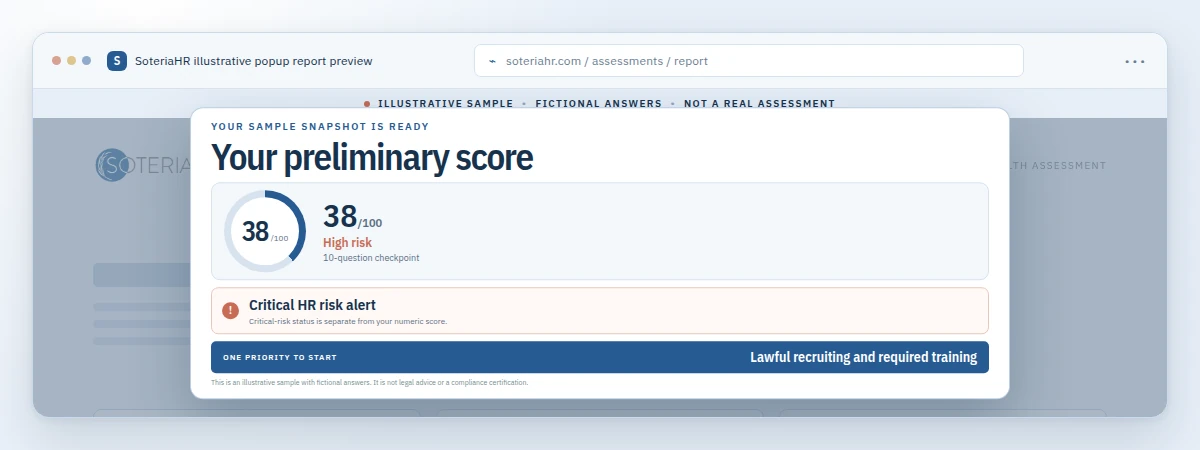
An HR Health Assessment is a self-reported questionnaire that helps employers identify potential gaps in HR practices, including compliance-related areas. It is a starting point for conversation, not a certification of compliance or a professional legal audit.
What are the most common HR compliance mistakes growing companies make?
Common mistakes include outdated employee handbooks, missing required postings, inconsistent recordkeeping, and misclassifying employees as independent contractors. These errors often go unnoticed until an audit, complaint, or lawsuit brings them to light.
How long does it take to build an effective compliance program?
Building a solid foundation, such as an updated handbook and documented policies, can often be done within a few weeks. However, true compliance risk management is an ongoing process rather than a one-time project.
What HR policies are most often missing in growing companies?
Growing companies frequently lack clear leave policies, documented disciplinary procedures, and written harassment-prevention training records. Each of these gaps can increase exposure during an employee complaint or government inquiry.
How do I know if my company needs outsourced HR compliance support?
If your company lacks a dedicated HR compliance specialist, has grown quickly, or operates in multiple states, outsourced support can close gaps that internal staff may not have time to address. A free HR Health Assessment can help clarify specific priorities before committing to a service.
What is the first step to reducing HR compliance risk?
The first step is typically an honest audit of current policies, recordkeeping, and training against applicable federal and state requirements. From there, companies can prioritize the highest-risk gaps and build a plan to address them.
Not sure where your company stands? Take the free HR Health Assessment or call (800) 399-2458 to talk to an HR expert at Soteria HR.
Ultimately, the best HR resources for managing compliance risks are not a single tool but a layered system: government guidance for the rules, internal policy work for daily practice, and experienced outside support to fill the gaps in between. Growing companies that combine these resources are far better positioned to turn compliance from a reactive scramble into a manageable, ongoing part of running the business. If your organization is ready for a clearer picture of where it stands, take the free HR Health Assessment at soteriahr.ai or call (800) 399-2458 to talk with an HR expert who can help prioritize next steps.