Trusted human resources providers for growing small companies typically combine hands-on HR administration, practical HR consulting, and compliant benefits administration so leaders can scale headcount without building a full internal HR department from scratch. For founders, CEOs, and operations leaders juggling rapid growth, choosing the right outsourced HR partner protects the business, the budget, and the people doing the work. In particular, employers in the roughly 10-to-250-employee range often hit a tipping point where informal HR habits quietly create legal and financial exposure.
Key Takeaways
- Trusted HR providers blend HR administration, consulting, and benefits support under one accountable relationship.
- Common outsourcing models include HR consulting, ASOs (Administrative Services Organizations), and PEOs — each with different employment and liability structures.
- An ASO lets a company stay the legal employer while receiving tailored HR support, unlike co-employment arrangements.
- Vet providers on experience, scope clarity, communication cadence, and how they handle compliance changes.
- A free HR Health Assessment can surface gaps before committing to a provider or service scope.
What Are Trusted Human Resources Providers for Growing Small Companies?
Trusted human resources providers for growing small companies are outsourced HR partners that take on day-to-day administration, policy guidance, and benefits coordination so internal leaders can focus on running the business. In short, they act as an extension of the company rather than a replacement for leadership decisions. Consequently, the employer of record stays the same — the company, not the provider — which matters for liability and control.
These providers generally fall into a few categories: HR consulting firms, Administrative Services Organizations (ASOs), Professional Employer Organizations (PEOs), and full-service outsourced HR departments. Each model structures the employment relationship differently, according to the Wikipedia overview of professional employer organizations. As a result, the right fit depends heavily on how much control a company wants to retain versus how much it wants to hand off.
Why Growing Small and Mid-Sized Employers Need Reliable HR Support
Growth exposes gaps fast. A company that managed fine at 8 employees with a spreadsheet often struggles at 40, when onboarding, leave tracking, and benefits enrollment multiply at once. Therefore, many leaders turn to outsourced HR not because they lack talent internally, but because HR work has simply outpaced available hours.
For example, the U.S. Small Business Administration Office of Advocacy has repeatedly reported that small businesses employ a substantial share of the private-sector workforce, which underscores why scalable, compliant HR infrastructure matters at this size. In addition, the U.S. Department of Labor and the Equal Employment Opportunity Commission enforce wage, leave, and anti-discrimination rules that apply regardless of company size once certain employee thresholds are met. Specifically, missing a leave notice or misclassifying an employee can trigger penalties that far outweigh the cost of outside HR help. Above all, reliable HR support reduces the odds of a small, avoidable mistake becoming a costly legal problem.
Types of Outsourced HR Partners for Scaling Businesses
Not every outsourced HR partner works the same way. In particular, the structure of the relationship changes who is legally considered the employer and how liability is shared.
HR consulting firms advise on strategy, policy, and problem-solving but typically don’t handle day-to-day administration. ASOs, by contrast, deliver tailored administrative and compliance support while the client remains the sole employer — no co-employment involved. PEOs use a co-employment model, which can simplify payroll tax filing but also means sharing certain employer responsibilities with the PEO. Meanwhile, full-service outsourced HR departments blend administration, consulting, and benefits coordination into one ongoing relationship, which is often the most practical fit for companies without any internal HR function yet.
To compare how these approaches differ, see the breakdown at which human capital consulting firms best serve growing small businesses, or review options at this guide to HR providers for growing SMBs.
How to Evaluate an HR Outsourcing Partner in 5 Steps
Choosing a provider shouldn’t be rushed. The following steps give leaders a structured way to compare candidates before signing an agreement.
- Define your current gaps. List the HR tasks that are falling behind today, such as onboarding paperwork, leave tracking, or benefits enrollment, so you can match scope to actual need rather than guessing.
- Clarify the employment structure. Ask whether the provider uses a co-employment model (PEO) or a non-co-employment model (ASO or consulting), since this changes who retains legal responsibility for employment decisions.
- Check compliance depth. Confirm how the provider tracks changing federal and state requirements, including wage, leave, and benefits rules, and ask for examples of how they’ve handled recent regulatory updates.
- Review communication and response time. Ask how quickly the team responds to urgent employee issues, because slow answers during a termination or leave dispute can turn a small problem into a legal one.
- Start with a low-commitment assessment. Use a short diagnostic, such as a free HR health check, to surface priority gaps before negotiating full scope and pricing with any provider.
“We’ve got your back — so you can focus on growth.” — Soteria HR
PEO vs. ASO vs. HR Consulting: Comparing Your Options
Because terminology in this space overlaps, a side-by-side view helps leaders see the practical differences quickly.
| Model | Legal Employer | Typical Scope | Best Fit |
|---|---|---|---|
| HR Consulting | Client company | Advisory on policy, culture, workforce planning | Companies with some internal HR capacity |
| ASO | Client company (no co-employment) | Administration, benefits, compliance support, tailored scope | Growing companies without a full HR department |
| PEO | Shared via co-employment | Payroll tax filing, benefits pooling, HR administration | Companies comfortable sharing employer status |
| Full-Service Outsourced HR | Client company | Administration + consulting + benefits, customized | Companies with no internal HR function yet |
What to Look for in a Reliable HR Partner
Beyond pricing, the strongest signal of a reliable HR partner is how clearly they explain scope, responsibility, and limits. For instance, a provider should be upfront about what is included in administration versus consulting, and what remains the client’s responsibility as the employer of record.
Similarly, look for experience across the specific areas most likely to create risk: benefits compliance (including ACA, COBRA, and Section 125 considerations where applicable), leave administration, and employee relations. Furthermore, ask how the provider handles growth — a partner who can scale support as headcount climbs from 15 to 150 avoids a disruptive provider switch later. If you’re still researching options broadly, the overview at where small businesses can find reliable HR resources and support and the comparison at the best HR consulting services for small businesses are useful starting points, as is the practical checklist in how to find the right HR support fast.
How Soteria HR Supports Growing Companies
Soteria HR, based in Pasadena, California, provides hands-on outsourced HR services for employers in Los Angeles, Orange County, and nationwide, with a priority focus on organizations in roughly the 10-to-250-employee range. The core services are HR administration, HR consulting, and benefits administration, with payroll coordination supporting the broader relationship. Notably, Soteria’s ASO option delivers tailored HR support without co-employment, meaning the client stays the employer and retains responsibility for employment decisions and applicable obligations.
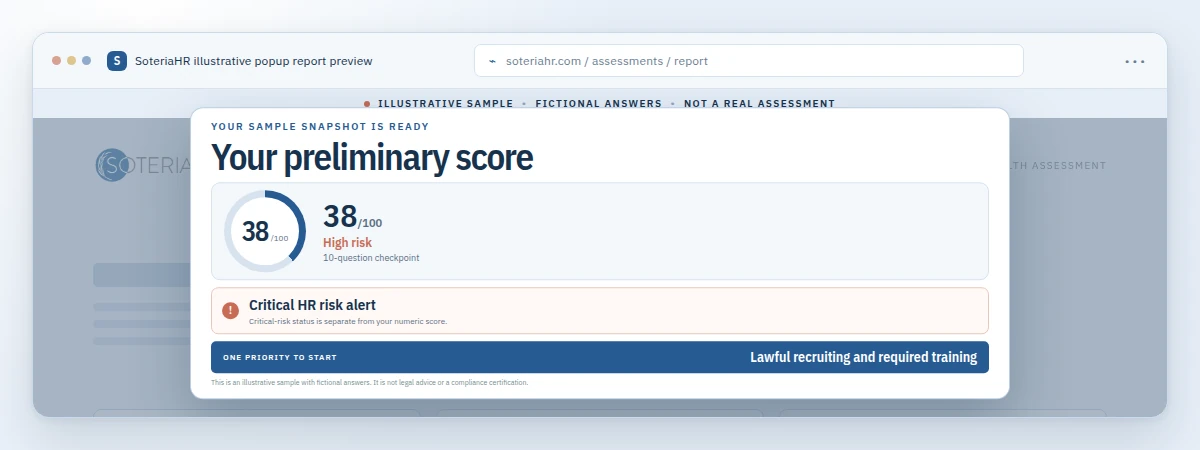
Whether a company has no internal HR department yet or wants to support an existing HR team, the scope is built around the engagement rather than a fixed package. For a low-commitment starting point, the free HR Health Assessment at soteriahr.ai offers a 10-question Quick HR Check (about two minutes) or a more thorough 40-question Complete HR Health Assessment (about 10–12 minutes) to surface gaps and priorities. Keep in mind that results are self-reported and preliminary — not a certification of compliance or a substitute for a professional legal audit. To discuss results or any HR priority directly, call (800) 399-2458 or submit a consultation request to talk to an HR expert at soteriahr.com.
Frequently Asked Questions About Trusted HR Providers for Growing Small Companies
What are trusted human resources providers for growing small companies?
Trusted human resources providers for growing small companies are outsourced partners that handle HR administration, consulting, and benefits support while the client remains the legal employer. They typically offer flexible scope that expands as headcount grows, rather than a fixed, one-size package.
How do I choose the right outsourced HR partner?
Start by listing your current HR gaps, then compare providers on employment structure, compliance depth, and response speed. In addition, a short diagnostic assessment can help confirm priorities before you negotiate scope.
Why do growing companies need outsourced HR support?
As headcount rises, onboarding, leave tracking, and benefits administration quickly outpace what a small team can manage manually. Consequently, outsourced support helps prevent missed deadlines and compliance mistakes that get more expensive at scale.
What is the difference between a PEO and an ASO?
A PEO uses co-employment, sharing employer status between the PEO and the client. An ASO, by contrast, provides tailored HR support without co-employment, so the client company remains the sole legal employer.
How much does outsourced HR cost for small companies?
Pricing varies based on scope, headcount, and whether services include administration, consulting, benefits, or all three. Because of this variation, it’s best to request a scoped quote after discussing current gaps rather than relying on generic estimates.
How long does it take to onboard an HR outsourcing partner?
Onboarding timelines depend on scope, but many engagements begin with a diagnostic phase of a few weeks before full administration transitions over. Simpler consulting-only arrangements can often start faster than full benefits administration takeovers.
What mistakes do small companies make when choosing HR support?
A common mistake is choosing based on price alone without clarifying who remains legally responsible for employment decisions. Another frequent error is underestimating how quickly benefits and compliance complexity grows past 20 or 30 employees.
What should an HR service agreement include?
A solid agreement should clearly define scope, response times, employment structure, and which compliance areas the provider covers versus the client’s own responsibilities. Furthermore, it should specify how pricing adjusts as the company grows.
Does outsourced HR replace an internal HR team?
Not necessarily. Outsourced HR can fully handle administration for companies with no internal HR function, or it can supplement an existing internal team during periods of rapid growth or specialized project work.
What size company benefits most from outsourced HR?
Companies with roughly 10 to 250 employees tend to benefit most, since this range often outgrows informal HR habits but may not yet need a large internal department. That said, this is a common sweet spot rather than a strict eligibility rule.
What does benefits administration support typically include?
Benefits administration generally covers enrollments, terminations, employee communications, and carrier coordination, along with support for applicable requirements such as ACA, COBRA, and Section 125 rules where relevant. Specific scope should always be confirmed with the provider for your plan setup.
How can a free HR assessment help before hiring a provider?
A short assessment can highlight gaps in onboarding, compliance, or benefits before you commit to a scope or price. However, results are self-reported and preliminary, so they work best as a conversation starter rather than a final diagnosis.
Can an HR consulting firm guarantee legal compliance?
No reputable provider can guarantee full legal compliance, since the client remains the employer and responsible for applicable obligations. Instead, a good partner helps reduce risk through current guidance and consistent processes.
How do I get started with Soteria HR?
You can call (800) 399-2458 or submit a consultation request to talk to an HR expert. Alternatively, start with the free HR Health Assessment at soteriahr.ai to identify priorities before your first conversation.
In the end, finding trusted human resources providers for growing small companies comes down to matching scope to actual need, understanding who remains the legal employer, and verifying compliance depth before signing anything. Whether a company needs full administration, focused consulting, or benefits support alone, the right partner should grow alongside the business rather than forcing a rigid package. For leaders ready to take the next step, a free HR Health Assessment or a direct call to an HR expert at (800) 399-2458 is a practical, low-pressure way to start the conversation.