0.5 FTE meaning is a phrase every growing business runs into once staffing gets more complex than a simple full-time or part-time label. In short, a 0.5 FTE role represents half of a standard full-time position, whether that’s 20 hours out of a 40-hour week or a role split between two people. For founders and operations leaders juggling budgets, benefits, and compliance, understanding this calculation matters more than it seems. Below, we’ll break down what 0.5 FTE really means, how to calculate it correctly, and why it plays a bigger role in workforce planning than most leaders realize.
What Does 0.5 FTE Meaning Really Mean?
The 0.5 FTE meaning refers to a position that equals half the hours of a full-time employee, typically 20 hours per week when full-time is defined as 40 hours. This measurement, known as full-time equivalent (a standard way to compare part-time and full-time work on the same scale), helps HR and finance teams line up staffing plans with actual budget impact.
In practice, FTE is calculated with a simple formula: actual hours worked, divided by your company’s full-time hour standard. For instance, if your organization defines full-time as 40 hours weekly, an employee working 20 hours is a 0.5 FTE. However, if your standard is 37.5 hours, the math shifts slightly, which is exactly why consistency matters across departments.
Furthermore, this figure isn’t just a payroll detail. It shapes benefits eligibility, headcount reporting, and even how you plan for growth. Consequently, getting the 0.5 FTE meaning right from the start prevents confusion down the road.

A simple visual breakdown of the 0.5 FTE meaning compared to a standard full-time schedule.
Why Companies Use Half-Time FTE Roles in Workforce Planning
Growing organizations often turn to half-time roles because they need coverage without the full cost of a permanent hire. For example, a small nonprofit might need a grant writer for 20 hours a week rather than 40, and a 0.5 FTE arrangement fits that need precisely.
In addition, fractional roles allow leaders to test new functions before scaling them. A marketing director hired at 0.5 FTE, for instance, can prove the value of the position before a company commits to a full-time salary and benefits package.
Similarly, many businesses use 0.5 FTE structures for shared roles, where two people split one job to cover more hours of availability or bring complementary skills to the same seat. This is common in customer support, HR administration, and clinical settings. As a result, workforce planning becomes more flexible, and payroll stays aligned with actual demand rather than guesswork. If you want a deeper look at how fractional structures work at the leadership level, our guide on fractional HR leadership covers this in more detail.
How to Calculate a 0.5 FTE Position: A Step-by-Step Guide
Calculating FTE correctly protects you from compliance headaches and budgeting surprises. Here is the process most HR teams follow, step by step.
- Set your full-time baseline. Define the number of hours your organization considers a standard full-time workweek, typically 40 hours, since every FTE calculation depends on this baseline being consistent.
- Measure weekly hours. Track the actual or scheduled weekly hours for the role in question, including any variation across weeks, so you have an accurate average to work from.
- Calculate the FTE ratio. Divide the role’s weekly hours by your full-time baseline to get the FTE ratio; for example, 20 hours divided by 40 hours equals 0.5 FTE.
- Apply the ratio to planning. Use the calculated FTE ratio to inform budgeting, staffing headcount reports, and benefits eligibility decisions across your organization’s workforce planning process.
- Document the classification. Record the FTE classification in the employee’s file, payroll system, and relevant handbook policies so the designation stays consistent and auditable over time.
Notably, the IRS uses a related but distinct threshold for ACA employer mandate purposes, defining full-time as an average of 30 hours per week, according to IRS guidance. Therefore, businesses should track both their internal FTE standard and the federal compliance threshold separately to avoid confusion.
0.5 FTE vs Full-Time and Other Part-Time Classifications
It’s worth clarifying how 0.5 FTE compares to other common classifications, since these terms often get mixed up. Full-time typically means 1.0 FTE, or 100% of standard hours. Part-time is a broader employment category that can range anywhere from 0.1 FTE to 0.9 FTE, depending on the actual schedule.
In contrast, 0.5 FTE is a precise figure that sits exactly at the midpoint. This distinction matters most when calculating paid time off accrual, retirement contributions, or benefits tiers, because many policies scale proportionally to FTE rather than treating all part-time roles the same way. For a broader framework on aligning these classifications with your growth stage, review our workforce planning framework.
Common Mistakes When Applying the 0.5 FTE Meaning to Staffing Decisions
One frequent mistake is using inconsistent full-time baselines across departments, which quietly distorts your entire staffing report. If one team calculates FTE based on 40 hours and another uses 37.5, your organization-wide numbers won’t line up.
Another common error is forgetting to update FTE records when an employee’s schedule changes. For example, if a 0.5 FTE employee picks up extra shifts and moves closer to 0.75 FTE, but payroll and benefits systems aren’t updated, compliance risk builds quietly in the background.
Likewise, some companies assume all part-time roles automatically qualify or disqualify for benefits at the same rate, without checking their own policy language or applicable law. This kind of oversight is exactly the type of issue that a fractional HR leader is trained to catch before it becomes a costly problem.
Benefits and Risks of Hiring at 0.5 FTE
Hiring at 0.5 FTE offers real advantages. Above all, it lowers fixed payroll costs while still covering essential work, which is especially valuable for small teams stretching a tight budget. It also gives leaders flexibility to test roles, cover seasonal spikes, or bring in specialized skills without a full-time commitment.
That said, there are risks worth weighing. Two 0.5 FTE hires can sometimes cost more in total overhead than one full-time employee, since onboarding, software licenses, and management time don’t scale down proportionally. In addition, split roles can create communication gaps if handoffs between people aren’t managed carefully.
According to research summarized by the Society for Human Resource Management, businesses that clearly define fractional roles and track performance consistently see better retention outcomes than those that treat part-time staffing as an afterthought. Pairing clear expectations with regular check-ins, similar to what’s outlined in our piece on the benefits of performance management, helps close that gap.

Teams often revisit FTE calculations when balancing growth against budget constraints.
How Soteria HR Helps You Navigate 0.5 FTE Staffing Decisions
Figuring out the 0.5 FTE meaning is only the first step; applying it correctly across payroll, benefits, and compliance is where things get complicated. Soteria HR works with growth-minded small to mid-sized organizations to design staffing structures that fit their stage of growth, whether that means a fractional leadership hire, a shared role, or a full-time build-out.
Specifically, our team helps you build custom HR playbooks that document FTE classifications clearly, manage benefits eligibility with confidence, and stay ahead of compliance changes before they become costly mistakes. Rather than generic templates, we tailor every recommendation to your business, culture, and industry. To see how a hands-on, embedded HR partner can support your next staffing decision, visit Soteria HR.
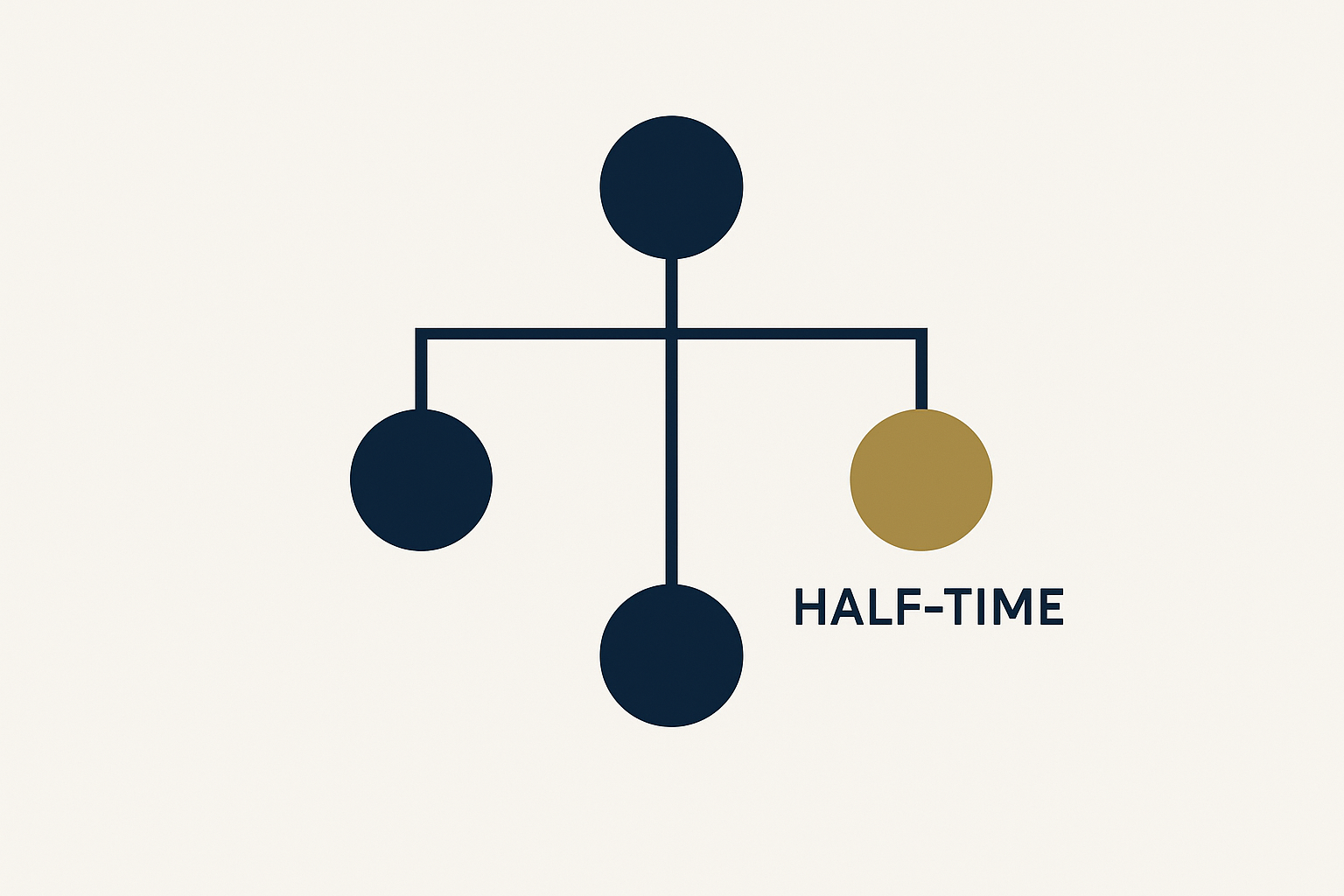
Visualizing where a 0.5 FTE role fits within a broader organizational structure.
Frequently Asked Questions About 0.5 FTE Meaning
What is the 0.5 FTE meaning in HR terms?
The 0.5 FTE meaning refers to a role staffed at half the hours of a standard full-time position. If full-time is 40 hours per week, a 0.5 FTE role covers about 20 hours weekly, whether filled by one person or split between two.
How do you calculate a 0.5 FTE position?
You calculate FTE by dividing the actual hours worked by your organization’s full-time hour standard. For example, 20 hours worked divided by a 40-hour full-time week equals 0.5 FTE.
Why do companies hire employees at 0.5 FTE instead of full-time?
Companies use 0.5 FTE roles to control payroll costs while still filling essential functions. It also allows flexibility for seasonal work, shared roles, or testing new positions before committing to full-time headcount.
What is the difference between 0.5 FTE and part-time employment?
Part-time is a general employment status, while 0.5 FTE is a specific measurement showing exactly how much of a full-time role that part-time schedule represents. Not all part-time roles are 0.5 FTE; some may be 0.25 FTE or 0.75 FTE depending on hours.
Does a 0.5 FTE employee qualify for benefits?
Eligibility depends on your company policy and applicable law, since there is no universal rule requiring benefits at exactly 0.5 FTE. Many employers set their own thresholds, and some benefits, such as ACA coverage, follow separate hour-based rules.
How many hours is 0.5 FTE per week?
If your organization defines full-time as 40 hours weekly, 0.5 FTE typically equals 20 hours. However, this changes if your company defines full-time differently, such as 37.5 or 35 hours.
What are common mistakes when calculating FTE?
The most common mistake is using an inconsistent full-time hour baseline across departments, which skews budgeting and staffing reports. Another frequent error is forgetting to update FTE calculations when an employee’s schedule changes.
How does 0.5 FTE affect ACA compliance?
Under the Affordable Care Act, the IRS defines full-time as an average of 30 hours per week for employer mandate purposes, which is a separate threshold from a company’s internal 40-hour FTE standard. Employers should track both definitions to avoid compliance gaps.
Can a 0.5 FTE role become full-time later?
Yes, many 0.5 FTE roles are structured as growth positions that expand to full-time as business needs increase. Documenting this possibility in the offer letter helps set clear expectations from the start.
How much does hiring a 0.5 FTE employee cost compared to full-time?
Base wages for a 0.5 FTE role are roughly half of a comparable full-time salary, but fixed costs like onboarding, software licenses, and management time do not scale down proportionally. As a result, two 0.5 FTE hires can sometimes cost more overall than one full-time employee.
What industries commonly use 0.5 FTE roles?
Human services, healthcare, education, and professional services frequently use 0.5 FTE roles to cover specialized functions without full-time overhead. Growing tech and manufacturing companies also use this structure for fractional leadership positions.
How long does it take to onboard a 0.5 FTE employee?
Onboarding timelines are similar to full-time hires, typically one to two weeks, even though the employee works fewer hours. Compressed schedules sometimes require spreading training over more calendar days to fit within reduced weekly hours.
What is the best practice for documenting 0.5 FTE roles in an employee handbook?
Best practice is to clearly define your full-time hour standard, then explain how FTE percentages like 0.5 FTE affect benefits, accrual, and eligibility. A well-written handbook removes ambiguity and reduces disputes later, and a solid detailed breakdown of FTE calculations can serve as a helpful reference when drafting policy language.
Bringing the 0.5 FTE Meaning Into Your Staffing Strategy
Understanding the 0.5 FTE meaning gives growing businesses a clearer, more consistent way to plan staffing, budgets, and benefits. In summary, a 0.5 FTE role represents half of your organization’s full-time hour standard, and calculating it correctly protects you from compliance mistakes and budgeting surprises down the road. Whether you’re testing a new role, splitting responsibilities between two people, or filling a specialized need part-time, applying this measurement consistently keeps your workforce plan accurate and defensible. Above all, the goal isn’t just getting the math right; it’s using that clarity to make smarter decisions about how your team grows. If you’d like hands-on help translating FTE calculations into a staffing strategy built for your business, the team at Soteria HR is ready to help you plan with confidence.