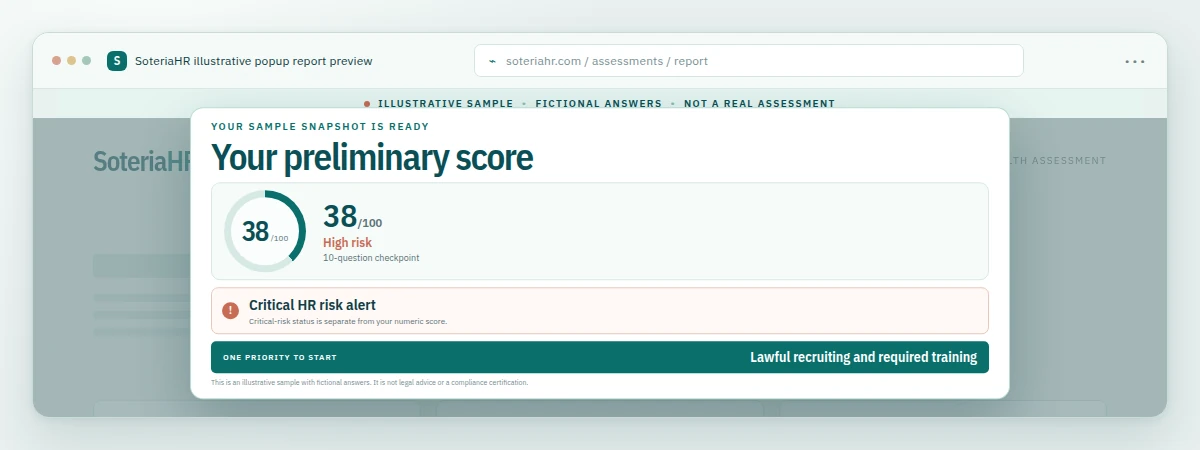
The short answer: Company culture assessment tools are structured instruments — surveys, frameworks, and analytics platforms — that measure how employees experience your workplace values, leadership alignment, and team cohesion. They replace guesswork with data so you can take targeted action. If your organization is dealing with rising turnover, disengagement, or post-growth culture drift, the right company culture assessment tool is the fastest way to find out exactly where the problem lives — and what to do about it.
You can feel when culture is off. Turnover creeps up, engagement drops, and people start quietly checking out. However, “feeling it” isn’t enough to fix it. That’s where company culture assessment tools come in — they give you real, structured data on what’s working, what isn’t, and where your team’s values actually align. For growing organizations without a dedicated HR team, these tools can be the difference between guessing and knowing.
At Soteria HR, we help small to mid-sized companies build workplaces that attract and keep great people. A big part of that work starts with understanding the culture you already have before you can shape the one you want. We’ve seen firsthand how the right assessment surfaces blind spots that no amount of gut instinct will catch — and how acting on that data prevents the turnover and disengagement that quietly drains growing businesses.
Below, we break down seven company culture assessment tools that measure values fit, employee sentiment, and organizational alignment. Each serves a different need and budget. In addition, we cover what to look for when choosing a tool, how to actually use the data, and what mistakes to avoid — so you walk away with more than just a list.
What Are Company Culture Assessment Tools — and Why Do They Matter?
Company culture assessment tools are structured methods for measuring the invisible forces that drive employee behavior: shared values, leadership trust, psychological safety, communication norms, and how closely day-to-day reality matches your stated mission. Specifically, they translate subjective experience into quantifiable data you can act on.
Culture is not abstract. Research consistently links strong cultural alignment to measurable business outcomes. For example, companies with highly engaged cultures report up to 23% higher profitability (Gallup, 2023), 41% lower absenteeism, and significantly reduced voluntary turnover. Furthermore, in tight labor markets, culture is often the deciding factor for candidates choosing between comparable offers.
Consequently, organizations that assess culture regularly — rather than reactively — are far better positioned to catch drift early, respond to leadership changes, and sustain the values that make them competitive employers.
The Four Core Dimensions Most Tools Measure
While specific frameworks vary, most company culture assessment tools measure some combination of these four dimensions:
- Values alignment — Do employees experience the values leadership espouses, or is there a gap between stated and lived culture?
- Engagement and belonging — Do people feel connected to their work, their team, and the organization’s mission?
- Leadership effectiveness — Do managers and executives model the culture and build trust at every level?
- Structural and behavioral norms — Do your processes, policies, and day-to-day behaviors reinforce the culture you want — or undermine it?
Understanding which dimensions a tool emphasizes will help you choose the right one for your situation. Therefore, before reviewing specific tools, it’s worth clarifying your primary goal.
How to Choose the Right Company Culture Assessment Tool
Not every company culture assessment tool fits every organization. In fact, choosing the wrong one wastes both money and employee trust — especially if you survey your team and don’t act on the results. Before committing, ask yourself these five questions.
1. What is your primary diagnosis question?
Are you trying to understand what type of culture you have (use OCAI), how culture affects performance (use Denison), or how employees feel right now (use Culture Amp or Glint)? Similarly, if you want both diagnosis and a concrete action plan, an expert-guided engagement like Soteria HR’s approach is far more efficient than a self-serve platform.
2. Do you have internal capacity to act on data?
Enterprise platforms like Qualtrics and Culture Amp generate sophisticated data. However, that data only creates value if someone with HR expertise translates it into decisions. Consequently, smaller companies without a dedicated people team often get more ROI from a guided engagement than from a software subscription they can’t fully leverage.
3. Is this a one-time assessment or ongoing listening?
One-time diagnostic tools (OCAI, Denison, Soteria HR) are ideal when you need a clear baseline or are navigating a specific change. In contrast, continuous listening platforms (Culture Amp, Viva Glint, Qualtrics) are built for organizations that want to track culture trends over time.
4. What is your realistic budget — including implementation?
A free or low-cost tool that requires a consultant to interpret costs more in the end than a structured engagement that includes interpretation upfront. Above all, factor in the cost of not acting — a single mis-hire or preventable resignation typically costs 50–200% of that employee’s annual salary.
5. What does success look like after the assessment?
Define what you’ll do differently once you have results. Specifically, if you can’t name two or three decisions that the data will inform, you may not be ready to run the assessment — or you need a tool that comes with built-in guidance rather than raw data alone.
7 Company Culture Assessment Tools Compared
The following breakdown covers seven of the most widely used and respected company culture assessment tools available today. For each, we cover what it measures, how it works, who it fits best, its genuine strengths, and its real trade-offs.
1. Soteria HR Culture Assessment and Action Roadmap
Most company culture assessment tools hand you a report and leave you to figure out the rest. Soteria HR takes a fundamentally different approach — pairing structured data collection with hands-on HR expertise so you walk away knowing exactly where your culture stands and what to do next. For growing companies that can’t afford to guess, that combination is what actually drives change.
What This Approach Measures
This assessment measures values alignment between leadership and employees, team cohesion, communication effectiveness, and the gap between your stated culture and the one people actually experience day to day. It also surfaces retention risks and engagement barriers that standard pulse surveys tend to miss — because those surveys only ask surface-level questions.
How the Process Works
Soteria HR starts with structured employee surveys and leadership interviews, then layers in a review of your existing policies, onboarding materials, and any available feedback data. Our HR consultants synthesize all of that into a findings report paired with a prioritized action roadmap — one that tells you which issues to tackle first and exactly why.
The action roadmap is what turns culture data into culture change. Without it, a report just confirms what you already suspected — and nothing moves.
Best Fit
This option works best for organizations between 10 and 250 employees that sense culture drift but can’t pinpoint the cause. It also fits companies navigating rapid hiring, leadership transitions, or post-merger integration, where values alignment becomes urgent quickly.
Strengths and Trade-Offs
The core strength is embedded HR expertise. You work with consultants who understand your business context — not an algorithm generating generic insights. The trade-off is that this is a collaborative engagement, not a self-serve platform. It requires scheduling and active participation from your leadership team. However, the output is significantly more actionable than most off-the-shelf tools provide.
Pricing
Pricing is customized based on your company’s size and scope. Reach out directly to receive a tailored quote built around your specific goals.
2. Organizational Culture Assessment Instrument (OCAI)
The Organizational Culture Assessment Instrument (OCAI) is one of the most widely cited company culture assessment tools in organizational research. Developed by researchers Kim Cameron and Robert Quinn, it’s built on the Competing Values Framework — a model that maps culture across four quadrants: Clan (collaborative, people-first), Adhocracy (innovative, risk-taking), Market (results-driven, competitive), and Hierarchy (structured, process-oriented).
What This Tool Measures
The OCAI measures your current culture type versus your preferred culture type, generating a visual gap analysis across all four quadrants. Specifically, it helps organizations see where culture is already strong and where it needs to shift to support business goals.
How It Works
Respondents complete a six-question survey, distributing 100 points across statements that reflect different culture types. Results generate a profile showing your dominant culture quadrant and how it compares to where your team wants to be. Consequently, the gap between the two profiles often reveals more than the profile itself.
The gap between your current and preferred culture profile often reveals more than the profile itself — it shows the direction your people already want to move.
Best Fit
OCAI works best for leaders and HR teams who want a research-backed framework to guide culture conversations. It’s a solid starting point for companies planning strategic change or meaningful culture realignment. For a deeper walkthrough, see our Change Management Consulting Services: SMB Buyer’s Guide.
Strengths and Trade-Offs
The OCAI is grounded in decades of academic research and straightforward to administer. However, it produces a broad culture-type profile, not a deep operational diagnostic. As a result, you’ll likely need an HR consultant or internal lead to convert the findings into a concrete action plan.
Pricing
OCAI offers a free basic version online. More detailed reporting and team-level breakdowns require a paid upgrade, with pricing available directly through the OCAI platform.
3. Denison Organizational Culture Survey (DOCS)
The Denison Organizational Culture Survey (DOCS) is a well-established assessment built around four core cultural traits: involvement (employee participation and capability), consistency (core values and agreement), adaptability (organizational learning and change), and mission (strategic direction and intent). Developed by Daniel Denison, the model directly connects these traits to business performance outcomes like revenue growth, profitability, and employee satisfaction.
What This Tool Measures
DOCS measures how effectively your culture supports business performance and long-term growth. It goes beyond surface sentiment by mapping culture across the four traits and 12 underlying culture indices. Furthermore, it benchmarks your results against a global database of thousands of companies, giving you an external reference point most frameworks lack.
How the Survey Works
Employees complete a 60-item survey, rating statements about workplace practices and behaviors. Results are displayed on a circular benchmark report that shows exactly how your scores compare to similar organizations globally — so leadership can clearly see where you stand rather than interpreting raw numbers in isolation.
The direct link between culture traits and business outcomes is what sets DOCS apart from frameworks that treat culture as separate from performance.
Best Fit
DOCS works well for mid-sized to larger organizations that want benchmarked data and a performance-linked framework. It’s especially useful when leadership needs to make a case for culture investment using external comparisons and concrete ROI data.
Strengths and Trade-Offs
The global benchmarking database is a genuine differentiator. In contrast, the trade-off is cost and complexity — interpreting results typically requires a certified Denison consultant, which adds to the overall investment and timeline.
Pricing
Pricing is available through certified Denison partners. Contact Denison Consulting directly for a quote based on your organization’s size and scope.
4. Culture Amp — Employee Experience Platform
Culture Amp is a dedicated employee experience platform built around continuous listening and data-driven culture management. It stands apart from one-time company culture assessment tools by giving HR teams ongoing visibility into engagement, inclusion, and team health across the entire organization.
What This Platform Measures
Culture Amp focuses on employee engagement, manager effectiveness, inclusion, and belonging. Its survey library covers onboarding experience, exit feedback, and leadership effectiveness — giving you a multi-angle view of your workplace culture at any point in time.
How It Works
You deploy science-backed survey templates — or build custom ones — and Culture Amp collects responses through an analytics dashboard. The platform benchmarks your results against industry peers so you can see exactly how your culture scores compare to similar organizations. As a result, leadership has external context — not just internal data — when making culture decisions.
Benchmarked data removes the guesswork from interpreting your results and helps you build the case for culture investment with leadership.
Best Fit
This option fits people-first companies with 50 or more employees that want to run regular pulse surveys alongside deeper engagement cycles. It works well for HR teams who need structured tools to track culture trends over time, rather than capture a single snapshot.
Strengths and Trade-Offs
The platform’s survey science and benchmarking database are genuine strengths. However, it requires internal HR capacity to analyze results and drive action. Consequently, smaller companies without a dedicated people team may not extract full value from the data.
Pricing
Culture Amp uses tiered subscription pricing based on employee count. Request a demo and custom quote directly through their website.
5. Qualtrics Employee Experience
Qualtrics Employee Experience is an enterprise-grade listening platform built to capture employee feedback at scale. Unlike simpler company culture assessment tools, Qualtrics connects culture data to broader business outcomes using its experience management (XM) framework — making it particularly well-suited for organizations that need sophisticated analytics alongside structured survey programs.
What This Platform Measures
Qualtrics measures employee engagement, well-being, manager effectiveness, and organizational culture health. It also captures signals around diversity, equity, and inclusion, giving you a comprehensive picture of how different employee groups experience your workplace.
How It Works
You build and deploy surveys through a drag-and-drop interface, then analyze results through dashboards that surface trends, sentiment scores, and predictive analytics. Furthermore, the platform uses AI-powered text analysis to interpret open-ended responses — capturing nuance that standard multiple-choice surveys miss entirely.
Predictive analytics help you identify which cultural factors most directly drive retention — before attrition becomes a serious problem.
Best Fit
Qualtrics fits large organizations and enterprise teams that need robust data infrastructure and advanced reporting. It also works well for companies already running multiple listening programs and looking to consolidate them into a single platform.
Strengths and Trade-Offs
The platform’s analytical depth and AI capabilities are significant strengths. In contrast, smaller organizations without dedicated HR or data analyst resources often find the platform more powerful than they can practically use — and consequently don’t realize the full ROI.
Pricing
Qualtrics uses custom enterprise pricing based on your organization’s size and program scope. Contact their sales team directly for a tailored quote.
6. Microsoft Viva Glint
Microsoft Viva Glint is an employee engagement and feedback platform built directly into the Microsoft 365 ecosystem. For organizations already running on Microsoft tools, it stands out among company culture assessment tools by reducing integration friction while delivering structured listening programs at scale.
What This Platform Measures
Viva Glint measures employee engagement, well-being, team effectiveness, and organizational culture signals across your workforce. It captures both sentiment trends and specific driver data — helping you understand not just how employees feel, but which workplace factors are most responsible for those feelings.
How It Works
You deploy pre-built survey programs or custom pulse surveys through the Viva Glint admin interface. Results surface in real-time dashboards, and the platform uses AI-assisted analytics to highlight key themes and flag areas of concern before they escalate into larger issues.
When culture data lives inside the same ecosystem your team already uses daily, adoption rates improve — and response quality tends to follow.
Best Fit
Viva Glint fits mid-sized to enterprise organizations already invested in Microsoft 365. It works especially well for IT-aligned HR teams that want seamless data connectivity across tools like Teams and Outlook.
Strengths and Trade-Offs
The native Microsoft integration is a clear strength for existing customers. However, organizations outside the Microsoft ecosystem will face setup complexity that likely outweighs the platform’s benefits.
Pricing
Viva Glint is available as part of Microsoft Viva suite licensing. Pricing depends on your existing Microsoft 365 plan and employee count — contact Microsoft directly for a tailored quote.
7. Barrett Values Centre — Cultural Values Assessment (CVA)
The Barrett Values Centre Cultural Values Assessment (CVA) is a values-first company culture assessment tool built on Richard Barrett’s Seven Levels of Consciousness model. Unlike performance- or engagement-focused tools, the CVA specifically measures the alignment between personal values, current culture, and desired culture — making it particularly valuable when values drift is the core problem.
What This Tool Measures
The CVA measures three separate sets of values: personal values (what each employee personally prioritizes), current culture values (what the organization actually rewards and reflects), and desired culture values (what employees want the culture to become). The gap between current and desired is called the “cultural entropy” score — a measure of dysfunction-generating misalignment. Higher entropy scores directly correlate with higher turnover and lower performance.
How It Works
Participants select values from a predefined list across three prompts. Results generate a values report showing alignment gaps at the individual, team, and organizational level. Furthermore, the tool can segment results by department, tenure, or leadership level — giving you a layered picture of where values misalignment is most acute.
Best Fit
The CVA is ideal for organizations that have identified a values alignment problem specifically — for example, after a merger, leadership change, or rapid growth phase. It’s also well-suited to companies engaged in purpose-driven culture initiatives where understanding the gap between stated and lived values is central to the work.
Strengths and Trade-Offs
The cultural entropy concept is a powerful, immediately actionable metric. However, the model’s philosophical grounding means it requires a skilled facilitator to use effectively — particularly when presenting results to senior leadership teams who are more comfortable with performance-linked frameworks.
Pricing
Pricing is available through certified Barrett practitioners. Contact Barrett Values Centre directly for options based on your organization’s size and assessment scope.
Company Culture Assessment Tool Comparison: Side-by-Side Summary
To help you quickly match each tool to your situation, the table below summarizes the key differences across all seven options.
| Tool | Best For | Type | Starting Cost | Action Guidance |
|---|---|---|---|---|
| Soteria HR | 10–250 employees, no HR team | Guided engagement | Custom quote | ✅ Built-in roadmap |
| OCAI | Strategy & change planning | Research framework | Free (basic) | ⚠️ Requires interpretation |
| Denison DOCS | Mid-large, benchmarking | Survey + benchmark | Custom quote | ⚠️ Consultant required |
| Culture Amp | 50+ employees, HR team | Continuous platform | Subscription | ⚠️ Needs HR capacity |
| Qualtrics | Enterprise, analytics-heavy | Enterprise platform | Enterprise pricing | ⚠️ Analyst resources needed |
| Viva Glint | Microsoft 365 orgs | Integrated platform | M365 plan add-on | ⚠️ Needs HR capacity |
| Barrett CVA | Values alignment focus | Values framework | Custom quote | ⚠️ Facilitator required |
How to Actually Use Culture Assessment Data: 5 Steps That Drive Real Change
Running a company culture assessment is only half the work. In fact, the most common failure mode isn’t choosing the wrong tool — it’s collecting data and not doing anything meaningful with it. Specifically, employees who complete a culture survey and see no response are more disengaged afterward than if you’d never asked at all. Therefore, follow this five-step approach to ensure your assessment drives real change.
- Share results transparently. Within two to three weeks of completing your assessment, share a summary of findings with your entire team — not just leadership. Employees who contributed deserve to know what emerged. Furthermore, transparency builds the trust required to take action together.
- Prioritize ruthlessly. Don’t try to fix everything at once. Instead, identify the top two or three issues with the highest impact on retention and engagement. Consequently, you’ll make visible progress faster — which in turn sustains organizational momentum for deeper change.
- Assign clear ownership. Every action item needs a named owner and a deadline. Culture change doesn’t happen by committee. Above all, leadership must visibly model the changes they’re asking employees to make — otherwise, no initiative will gain traction.
- Build culture into existing processes. Rather than creating a separate “culture program,” embed your improvement actions into hiring, onboarding, performance reviews, and team meetings. Similarly, reinforce desired behaviors in the rituals and systems your team already uses.
- Reassess within six to twelve months. Culture change is iterative. Therefore, plan a follow-up assessment to measure progress, adjust your approach, and demonstrate to employees that leadership takes the data seriously over time — not just in the immediate aftermath of a survey.
Common Mistakes to Avoid When Running a Culture Assessment
Even well-intentioned culture assessments can backfire. Specifically, these are the mistakes we see most often — and how to avoid them.
Surveying Without Psychological Safety
If employees don’t believe their responses are truly anonymous, they’ll self-censor. As a result, you’ll receive skewed data that overstates satisfaction and misses the most important problems. Before running any assessment, communicate explicitly how responses are collected, who has access to data, and what level of anonymity is guaranteed.
Choosing the Wrong Tool for Your Stage
An enterprise platform built for 5,000-person organizations will overwhelm a 40-person company — and vice versa. Similarly, a broad culture-type framework like OCAI won’t serve an organization that needs detailed engagement analytics. Match the tool’s design to your actual situation, not to what sounds most sophisticated.
Treating the Report as the Finish Line
A culture assessment report is a starting line, not a trophy. However, many organizations invest in the assessment, review the report in a leadership meeting, and then move on without implementing a single change. Consequently, the next survey generates even lower response rates — because employees have learned that nothing will change regardless of what they say.
Ignoring Qualitative Data
Numbers tell you where the problem is. Open-ended responses, interviews, and focus groups tell you why. Therefore, don’t rely solely on quantitative scores. The most valuable cultural insights often come from what employees say in their own words — not from how they scored a five-point scale.
Frequently Asked Questions About Company Culture Assessment Tools
What is a company culture assessment tool?
A company culture assessment tool is a structured instrument — survey, framework, or analytics platform — that measures how employees experience your organization’s values, leadership, communication norms, and behavioral expectations. These tools convert subjective cultural experience into data you can act on to improve retention, engagement, and organizational performance.
How often should you run a culture assessment?
For most organizations, a comprehensive culture assessment once every 12–18 months provides a meaningful baseline and tracks progress between cycles. However, shorter pulse surveys — typically 5–10 questions — can run quarterly or monthly to monitor specific engagement signals between full assessments. The right frequency depends on your rate of organizational change.
Can small companies use culture assessment tools?
Absolutely. In fact, small companies often benefit more from structured culture assessments because they lack the HR infrastructure to detect problems informally. Tools like the OCAI have a free basic version suitable for small teams. Furthermore, guided engagements like Soteria HR’s approach are specifically designed for organizations without a dedicated HR team.
What is the difference between a culture survey and a culture assessment?
A culture survey is a data-collection instrument — it captures employee responses to structured questions. A culture assessment is broader: it typically combines surveys with qualitative interviews, policy reviews, and expert analysis to produce a full diagnostic picture. Consequently, assessments generate deeper insights and are better suited to driving structural change, whereas surveys are useful for tracking specific metrics over time.
How do you measure the ROI of a culture assessment?
ROI from culture assessments typically shows up in three ways: reduced voluntary turnover (tracked against pre-assessment baseline), improved engagement scores in follow-up surveys, and reduced time-to-fill for open roles. In addition, organizations that act on culture data report improvements in manager effectiveness and internal promotion rates. A single prevented resignation in a mid-level role typically saves 50–150% of that employee’s annual salary in replacement costs alone.
What’s the best free company culture assessment tool?
The OCAI online offers the most accessible free option — it’s research-backed, quick to administer, and produces an immediately useful culture-type profile. However, the free version has limited team-level reporting. For organizations that need deeper analysis, the free version works best as a starting conversation rather than a complete diagnostic.
Conclusion: Choose the Tool That Matches Your Capacity to Act
The seven company culture assessment tools above cover a wide range of organizational needs — from research-backed frameworks like OCAI and Denison to enterprise platforms like Qualtrics and Viva Glint. Each offers real value in the right context. However, the best company culture assessment tool isn’t necessarily the most sophisticated one — it’s the one that fits your organization’s size, budget, and genuine capacity to act on the data.
If you run a growing company without a dedicated HR team, starting with an expert-guided culture assessment makes more sense than purchasing a platform you won’t fully use. Soteria HR’s approach pairs structured data collection with hands-on consulting — so you receive a clear picture of where your culture stands and a prioritized roadmap to improve it, without having to interpret a complex report on your own.
Ready to stop guessing and start building? Schedule a consultation with Soteria HR to find out where your culture stands — and what specific steps to take next.