HR strategy for scaling businesses is the deliberate planning that helps a growing company build the people systems, compliance safeguards, and leadership structure it needs as headcount increases. As a company moves from 10 employees to 50, 100, or beyond, the informal habits that worked early on — a shared spreadsheet, a founder handling every hire personally — start to create real gaps. Therefore, leaders need a deliberate approach before growth outpaces their HR infrastructure.
In short: HR strategy for scaling businesses means building HR administration, compliance, benefits, and workforce planning systems proactively — not reactively — so headcount growth does not create legal exposure, culture drift, or operational bottlenecks.
What Is HR Strategy for Scaling Businesses?
HR strategy for scaling businesses is a documented plan that aligns people operations with a company’s growth trajectory. In particular, it connects workforce planning, compliance, and benefits decisions to business goals, instead of treating HR as an afterthought handled between other duties.
Consequently, a well-built strategy answers practical questions before they become urgent: Who owns onboarding once hiring doubles? Which compliance deadlines apply at 25 employees versus 75? How will benefits scale without ballooning costs? Without these answers in place, growth itself becomes the risk factor.

Leadership teams often revisit their HR strategy for scaling businesses when hiring accelerates faster than internal systems can keep up.
Why HR Planning Matters as Your Business Grows
Growth changes a company’s legal and operational obligations, often faster than founders expect. For example, under Title VII of the Civil Rights Act, employers with 15 or more employees become subject to federal anti-discrimination protections, according to the U.S. Equal Employment Opportunity Commission.
Similarly, once a company reaches 50 employees within a 75-mile radius, it must comply with the Family and Medical Leave Act, as outlined by the U.S. Department of Labor. And under the Affordable Care Act’s employer shared responsibility provisions, businesses with 50 or more full-time equivalent employees face specific coverage requirements enforced by the IRS.
As a result, HR planning for business growth is not optional once these thresholds approach. Instead, it becomes a practical safeguard against penalties, complaints, and reactive scrambling.
Core Pillars of a Growth-Ready HR Strategy
A growth-ready HR strategy generally rests on four connected pillars. First, HR administration covers the daily mechanics: employee records, onboarding, offboarding, and leave coordination. Second, compliance ensures policies and documentation keep pace with employee-count thresholds.
Third, benefits administration manages enrollments, carrier coordination, and applicable ACA or COBRA requirements as the workforce expands. Fourth, workforce planning aligns hiring timelines with budget and org design, so leadership is not caught reacting to growth after it happens.
For a deeper breakdown of which services matter most at each stage, this guide to HR services during growth phases walks through priorities by company size.
How to Build an HR Growth Strategy Step by Step
Building an HR strategy for a scaling organization does not require a complex overhaul overnight. Instead, it works best as a sequence of deliberate steps:
- Assess current HR gaps and compliance exposure. Review existing employee records, policies, and benefits structures to identify missing documentation or compliance thresholds already crossed.
- Define workforce planning priorities. Map projected hiring over the next 12 to 24 months against the current org structure so leadership can plan roles and reporting lines ahead of time.
- Build core HR infrastructure. Update employee handbooks, onboarding workflows, and record-keeping systems so every hire receives consistent, compliant treatment.
- Formalize benefits and compensation strategy. Establish clear enrollment procedures and carrier coordination so compensation stays competitive as headcount grows.
- Choose an ongoing HR support model. Decide between in-house hires, outsourced HR administration, or an ASO partnership based on budget and complexity.
- Monitor, measure, and adjust. Review turnover, compliance deadlines, and employee feedback on a regular schedule so the strategy evolves with the company.
For a more detailed walkthrough of scaling HR operations day to day, see this practical guide to scaling HR operations.

Reviewing documentation is often the starting point for any practical HR strategy for scaling businesses.
Common HR Mistakes Growing Companies Make
Even well-intentioned leaders stumble in predictable ways while scaling. In particular, delaying written policies until a dispute forces the issue is one of the most frequent errors, since verbal agreements rarely hold up under scrutiny.
Misclassifying employees as contractors to avoid payroll complexity is another common pitfall, as is assuming benefits compliance deadlines will simply resolve themselves. Above all, relying on a single person — often the founder — to manage every HR task creates a bottleneck that growth quickly exposes.
This practical guide to HR leadership for growing companies covers how to avoid these patterns before they compound.
In-House HR vs. Outsourced HR Support for Growing Teams
Choosing between in-house and outsourced HR support depends on budget, complexity, and how quickly the company is hiring. The table below outlines the general tradeoffs.
| Factor | In-House HR | Outsourced HR / ASO |
|---|---|---|
| Upfront cost | Salary, benefits, training for new hire | Service fee scaled to scope |
| Expertise breadth | Limited to one hire’s background | Access to a team of specialists |
| Employer of record | Company remains sole employer | Company remains sole employer under an ASO model |
| Scalability | Requires additional hires as volume grows | Flexible support that adjusts with the organization |
Many organizations land on a hybrid approach, keeping a small internal team while leaning on outside expertise for specialized compliance or benefits work. This overview of essential HR administration services breaks down which functions are commonly outsourced first.
When to Bring in Outsourced HR Support
Generally, companies benefit from outside HR support once internal bandwidth cannot keep up with hiring, compliance deadlines, or benefits administration. Soteria HR, based in Pasadena, California, provides outsourced HR administration, consulting, and benefits administration for employers in Los Angeles, Orange County, and nationwide, with an ASO option that supports growing teams without co-employment.
Clients remain the employer and retain responsibility for employment decisions, while Soteria’s team handles the day-to-day administrative and compliance workload. For organizations without a dedicated HR department, or those supporting an existing internal team, this partnership model fills gaps without requiring a full internal build-out.
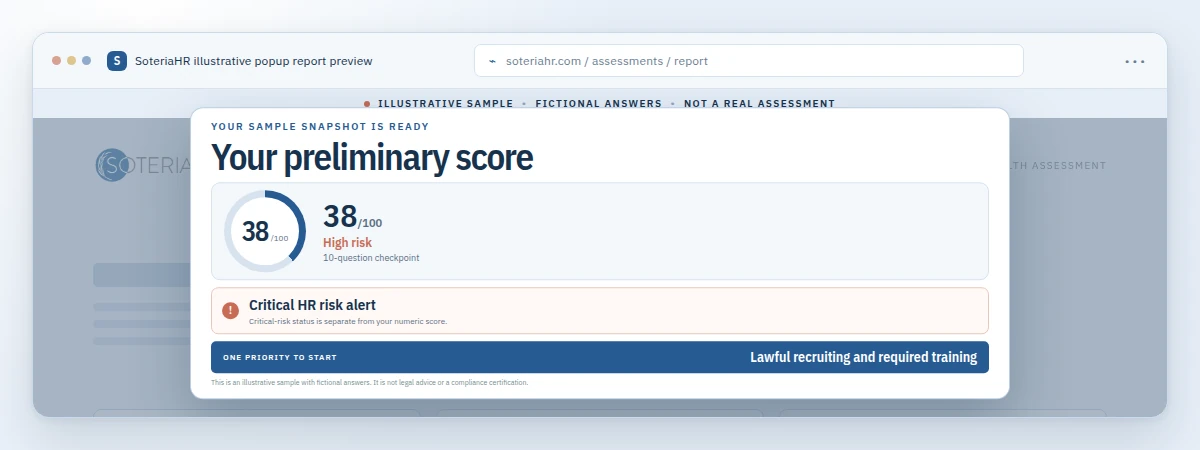
Those who want a starting point can explore the free HR Health Assessment at soteriahr.com before scheduling a conversation. Results are self-reported and preliminary, so they work best as a discussion starter rather than a formal audit. For more background on available support options, this resource roundup for growing companies is a useful next stop.

Many growing companies bring in outsourced HR support once internal capacity can no longer keep pace with compliance and benefits demands.
Frequently Asked Questions About HR Strategy for Scaling Businesses
What is HR strategy for scaling businesses?
HR strategy for scaling businesses is a deliberate plan for building HR administration, compliance, benefits, and workforce planning systems ahead of growth. It helps a company avoid legal exposure and operational chaos as headcount increases.
Why does HR strategy matter when a business grows?
As headcount grows, informal people-management habits break down and compliance obligations increase. A documented HR strategy keeps policies consistent and protects the company legally at every stage.
How many employees before a business needs a formal HR strategy?
There is no single magic number, but several federal thresholds make formal planning important sooner than expected. For instance, Title VII protections apply at 15 employees and FMLA applies at 50, per the Department of Labor.
What is the difference between outsourced HR and in-house HR for growing companies?
In-house HR means hiring internal staff to manage HR functions directly, while outsourced HR means partnering with an external provider for administration and consulting. Many growing companies combine both in a hybrid model.
What does an ASO do differently than a PEO?
An Administrative Services Organization (ASO) provides HR support while the client remains the sole employer of record, unlike a PEO, which typically involves co-employment. This distinction affects liability and control over employment decisions.
How much does outsourced HR cost for a small or mid-sized business?
Pricing varies based on company size, scope of services, and whether support includes benefits or payroll coordination. Most providers quote custom pricing after an initial consultation.
How long does it take to build an HR strategy?
A basic framework can often be outlined within a few weeks, though full implementation of policies and systems typically takes several months. Timelines depend on existing gaps and growth speed.
What are common mistakes when scaling HR?
Common mistakes include delaying written policies, misclassifying employees, missing benefits compliance deadlines, and relying on one person for all HR tasks. These gaps often surface only after a complaint or audit.
What HR compliance requirements apply as headcount grows?
Compliance obligations expand at several thresholds, including anti-discrimination laws, leave requirements, and ACA employer shared responsibility provisions. Employers should track these as part of growth planning.
What is the first step in creating an HR strategy for scaling businesses?
The first step is an honest assessment of current HR gaps, including documentation, compliance exposure, and benefits structure. This reveals priorities before new policies are built.
Can a growing company use an HR health assessment to find gaps?
Yes, a self-guided assessment can highlight potential gaps in policies, compliance, and benefits administration before a deeper review. Results are preliminary and work best as a discussion starter with an HR professional.
What HR services should growing businesses prioritize first?
Most growing businesses should prioritize HR administration, basic compliance documentation, and benefits administration before investing in advanced programs. These core services reduce risk early on.
Does Soteria HR provide ASO support without co-employment?
Yes, Soteria HR offers an ASO option that provides tailored HR administration and consulting support while the client remains the employer of record. This lets growing companies access hands-on HR help without a co-employment arrangement.
Key Takeaways
Ultimately, a sound HR strategy for scaling businesses is not a one-time project but an ongoing discipline. As headcount grows, compliance thresholds, benefits complexity, and workforce planning needs grow with it, and waiting until a problem surfaces almost always costs more than planning ahead.
Whether a company builds internal HR capacity, partners with an outsourced provider, or blends both approaches, the goal remains the same: supporting growth without sacrificing compliance or culture. Leaders ready to evaluate their own gaps can start with the free HR Health Assessment, then talk to an HR expert at (800) 399-2458 to turn findings into a workable plan.