HR policy development for compliance is the process of writing, reviewing, and updating workplace rules so they hold up against current federal, state, and local employment laws. For small and mid-sized employers, this work often gets pushed aside until a complaint, audit, or lawsuit forces the issue. As a result, many companies operate for years on outdated templates that no longer reflect their actual size, state footprint, or risk exposure.
In particular, companies that grow quickly tend to outpace their own paperwork. A handbook written for 15 employees in one state rarely covers the obligations that appear once headcount climbs or operations expand elsewhere. Consequently, HR policy development for compliance becomes less of an administrative chore and more of a strategic safeguard for the business.
Direct Answer
HR policy development for compliance means creating and maintaining written workplace policies that accurately reflect applicable employment laws, are communicated clearly to staff, and are enforced consistently. Done well, it reduces legal risk, clarifies expectations, and supports fair, repeatable decision-making across the company.
What Is HR Policy Development for Compliance?
HR policy development for compliance is the structured process of translating legal requirements into written workplace rules that a company actually follows. It includes everything from anti-harassment language to overtime rules, leave procedures, and disciplinary steps.
Specifically, this process has two halves. First, someone has to research which laws apply based on company size, state, and industry. Second, someone has to turn that research into plain-language policies that managers and employees can follow day to day. Skipping either half tends to produce handbooks that look thorough but fail under scrutiny.

Reviewing current documents is the starting point for HR policy development for compliance.
Why Compliant HR Policies Matter for Growing Businesses
As companies add employees, they also add legal obligations. For example, the Family and Medical Leave Act applies once an employer reaches 50 employees within a 75-mile radius, while many California leave and sick-time rules apply at far lower thresholds. Therefore, a policy set that worked fine at ten employees can become a liability at fifty.
Furthermore, enforcement activity is not theoretical. According to the U.S. Equal Employment Opportunity Commission, the agency received more than 81,000 workplace discrimination charges in fiscal year 2023, underscoring how often employment disputes reach a federal agency. (EEOC) In light of that volume, having documented, consistently applied policies gives a company a defensible position if a complaint arises.
In addition, compliant HR policies support everyday management. Clear rules around attendance, performance, and conduct give managers a consistent framework, which reduces the kind of inconsistent treatment that often triggers claims in the first place.
Core Components of a Compliant Employee Handbook
A compliant handbook is not a single document copied from a template. Rather, it is a collection of policies that each address a specific legal or operational need. The following areas typically require careful attention:
- At-will employment language and disclaimers appropriate to the employer’s state
- Anti-harassment, discrimination, and retaliation policies with a clear complaint process
- Leave policies covering FMLA, state sick leave, and accommodation procedures under the ADA
- Wage and hour rules, including overtime eligibility and meal or rest break requirements where applicable
- Workplace safety expectations and incident reporting procedures
- Signed acknowledgment forms confirming employees received and reviewed the handbook
Our team at Soteria HR regularly sees handbooks that address most of these areas but miss state-specific details. For instance, California employers face additional requirements from the California Civil Rights Department that do not appear in generic national templates. Related guidance on building these documents correctly is available in our article on building compliant company HR policies.
How to Build HR Policies That Meet Compliance Standards
Although every company’s situation differs, the underlying process for HR policy development for compliance follows a fairly consistent sequence. The following steps outline that approach.
- Conduct an HR compliance audit. Review existing policies, employee classifications, wage practices, and leave procedures against current federal, state, and local requirements to find gaps before writing anything new.
- Identify applicable regulations. Determine which federal laws and state-specific rules apply based on employee count, location, and industry, since requirements vary significantly across jurisdictions.
- Draft clear, specific policy language. Write each policy in plain language that explains expectations, procedures, and consequences so employees and managers can apply it consistently.
- Review policies with legal or HR counsel. Have qualified employment counsel or an experienced HR consultant review every draft policy before rollout to reduce legal exposure.
- Communicate and train on new policies. Distribute the updated handbook, collect signed acknowledgment forms, and train managers so enforcement stays consistent.
- Monitor, update, and re-audit regularly. Schedule an annual policy review and make immediate updates whenever laws change or the business grows into new states.
For a closer look at ongoing compliance resources beyond this process, see our guide to managing compliance risks and available resources for HR compliance issues.

Reviewing drafts together helps catch gaps before HR policy development for compliance reaches final sign-off.
Common Mistakes That Undermine HR Compliance Efforts
Even well-intentioned employers make avoidable errors. Specifically, many companies copy a generic template without adjusting it for their actual state or industry. Others write strong policies but never train managers on how to apply them, which leads to inconsistent enforcement.
Similarly, some businesses update policies once and then forget them for years, even as laws change around leave, pay transparency, and harassment prevention. Consequently, by the time a claim arises, the handbook no longer matches current law or current practice, which weakens the company’s position.
How Soteria HR Supports HR Policy Development for Compliance
Soteria HR, based in Pasadena, California, works with employers across Los Angeles, Orange County, and nationwide on exactly this kind of work. Our HR administration and HR consulting services include reviewing existing policies, identifying gaps, and building handbooks suited to each client’s size and footprint.
Importantly, clients remain the employer at all times and retain responsibility for employment decisions. Our ASO option provides tailored HR support without co-employment, which means growing companies get hands-on policy guidance while keeping full control of their workforce decisions. For more detail on how these services apply across industries, see how HR consulting supports manufacturing companies and our overview of HR policies and procedures.
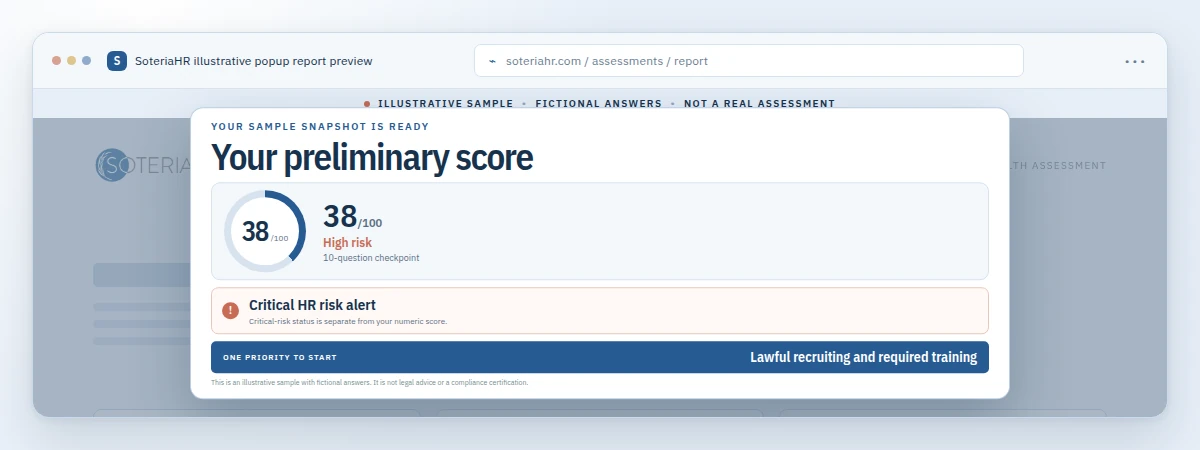
If you are unsure where your current policies stand, the free HR Health Assessment at soteriahr.ai offers a quick starting point. The Quick HR Check takes about two minutes, while the Complete HR Health Assessment runs closer to ten to twelve minutes and covers more ground. Results are self-reported and preliminary, not a certification of compliance, but they can highlight priorities worth discussing with an HR expert. Visit Soteria HR or call (800) 399-2458 to talk through your specific situation.

A structured checklist supports consistent HR policy development for compliance across departments.
Frequently Asked Questions About HR Policy Development for Compliance
What is HR policy development for compliance?
HR policy development for compliance is the process of writing, reviewing, and updating workplace rules so they align with current federal, state, and local employment laws. It covers areas like hiring, leave, pay, discipline, and safety.
Why does HR policy development for compliance matter for small businesses?
Small businesses face the same legal obligations as larger employers once they cross certain headcount thresholds, so outdated or missing policies create real legal exposure. Clear, compliant policies also reduce confusion and inconsistent treatment of employees.
How long does it take to develop compliant HR policies?
A focused policy review and handbook update typically takes four to eight weeks, depending on company size and the number of states involved. Complex multi-state employers or those with significant gaps may need longer.
What are the core components of a compliant employee handbook?
A compliant handbook generally includes at-will employment language, anti-harassment and discrimination policies, leave and accommodation procedures, pay practices, and safety rules. It should also include acknowledgment forms that employees sign and date.
How much does HR policy development cost?
Costs vary widely based on company size, number of locations, and whether the work is done internally, through counsel, or with an outsourced HR partner. Many growing employers find ongoing HR support more cost-effective than one-time legal reviews alone.
What federal laws should HR policies address?
At minimum, policies should reflect the Fair Labor Standards Act, Title VII of the Civil Rights Act, the Family and Medical Leave Act, and the Americans with Disabilities Act. Employers should verify current thresholds and requirements with the U.S. Department of Labor and the EEOC.
How often should HR policies be reviewed for compliance?
Most employers should review policies at least once a year and immediately after any significant law change or business event, such as expanding to a new state. Annual review also catches policies that no longer match actual practice.
What is the difference between HR policy development and an employee handbook?
HR policy development is the broader process of creating and maintaining workplace rules, while the employee handbook is simply the document where many of those policies are communicated to staff. Not every policy needs to live in the handbook, but all handbook content should come from a documented policy process.
What are common mistakes companies make with HR policy compliance?
Common mistakes include copying generic templates without adjusting for state law, failing to update policies after growth or expansion, and inconsistent enforcement across managers. Another frequent issue is never training managers on how to apply the policies correctly.
Can outsourced HR providers handle HR policy development for compliance?
Yes, outsourced HR providers and ASO partners can draft, review, and maintain compliant policies while the client company remains the legal employer. This arrangement gives growing companies HR expertise without building a full internal department.
What happens if a company doesn’t have compliant HR policies?
Without compliant policies, companies face higher risk of discrimination claims, wage and hour disputes, and inconsistent discipline decisions that can lead to costly litigation. Missing or outdated policies also make it harder to defend employment decisions if challenged.
Do California employers have additional HR policy compliance requirements?
Yes, California employers must address state-specific requirements such as paid sick leave, meal and rest break rules, and harassment prevention training that go beyond federal minimums. Employers should confirm current requirements with the California Civil Rights Department and the Department of Industrial Relations.
How does HR consulting support ongoing compliance?
HR consulting helps leaders interpret new regulations, update policies proactively, and build consistent processes for hiring, discipline, and performance management. Consultants also help translate legal requirements into practical, everyday management practices.
Key Takeaways
HR policy development for compliance is not a one-time task; it is an ongoing process of auditing, drafting, training, and updating policies as laws and headcount change. Companies that treat it as a strategic priority reduce legal risk and give managers a consistent framework for fair decisions. For growing organizations without a full HR department, or those looking to strengthen an existing team, Soteria HR provides hands-on support through HR administration, HR consulting, and ASO partnerships that keep policies current without creating co-employment. Call (800) 399-2458 or submit a consultation request to talk to an HR expert, or start with the free HR Health Assessment at soteriahr.ai to see where your current policies stand.