An HR administrator is the operational core of any human resources department — the professional responsible for maintaining employee records, coordinating onboarding, managing benefits, supporting payroll, and keeping the entire organization compliant with employment law. Without this role, even the most ambitious HR strategy collapses in execution.
Whether you are a business owner assessing your HR needs, a professional exploring a career path, or an HR leader building your department, understanding the HR administrator role is the essential starting point. In this guide, we cover everything — duties, salary, career path, required skills, and how this role compares to other HR titles — so you leave with no questions unanswered.
What Is an HR Administrator?
An HR administrator — also called a human resources administrator — is a professional who manages the administrative processes that keep an HR department functioning. Specifically, this means maintaining accurate employee data, processing employment documentation, coordinating benefits, and ensuring the organization follows applicable labor laws.
Think of this role as the connective tissue of the HR function. The HR administrator ensures that every process — from a new hire’s first day to an employee’s final paycheck — happens correctly, on time, and in compliance with the law.
According to the Society for Human Resource Management (SHRM), HR administration is one of the foundational pillars of effective people management. Furthermore, the U.S. Bureau of Labor Statistics (BLS) projects 6% employment growth for HR professionals through 2032 — faster than the national average for all occupations.
In short, the HR administrator role is both stable and growing in demand. It is also one of the most accessible entry points into a long-term HR career.

An HR administrator keeps employee records accurate, onboarding smooth, and compliance on track — every single day.
What Does an HR Administrator Do? Core Job Duties
The daily responsibilities of an HR administrator vary by company size and industry. However, several core duties appear consistently across organizations of every type. Below is a thorough breakdown of what this role involves.
1. Employee Records Management
HR administrators are responsible for maintaining accurate, current employee records. This includes personal information, employment contracts, performance reviews, disciplinary records, and termination documentation. Accurate record-keeping is not just best practice — it is a legal requirement in most jurisdictions.
Most organizations use an HRIS (Human Resource Information System — software that centralizes employee data and automates administrative tasks) to manage these records. Popular platforms include BambooHR, Workday, ADP, and Gusto. The HR administrator is typically the primary user and gatekeeper of this system.
2. Onboarding and Offboarding Coordination
From the moment a new hire accepts an offer to their last day of employment, the HR administrator manages the paperwork and process flow. This includes preparing offer letters, collecting required tax forms (W-4, I-9), scheduling orientation, and processing exit documentation.
This duty has measurable business impact. Research from SHRM shows that effective onboarding improves new hire retention by up to 82%. Therefore, the HR administrator’s onboarding process directly affects whether new employees stay or leave.
3. Benefits Administration
HR administrators coordinate benefits enrollment, manage changes triggered by qualifying life events (such as marriage, the birth of a child, or loss of other coverage), and serve as the liaison between employees and benefits providers. This is one of the most detail-intensive areas of the role.
Getting benefits administration right is critical to both compliance and employee satisfaction. For growing businesses, Soteria HR provides dedicated support for employee healthcare management and handles the complexity of benefits enrollments and terminations so business owners don’t have to manage it alone.
4. Payroll Support
While HR administrators are not always the primary payroll processor, they play an essential supporting role. They gather timekeeping data, verify accuracy, and coordinate with payroll providers to ensure employees are paid correctly and on time. Payroll errors — even minor ones — erode employee trust quickly and may trigger regulatory scrutiny.
5. Compliance and Policy Management
Employment law changes constantly. HR administrators track those changes, update internal policies, maintain required documentation, and ensure the organization avoids costly violations. This is especially critical for small to mid-sized businesses that lack a dedicated legal team.
Key federal laws an HR administrator must understand include the FLSA (Fair Labor Standards Act — sets minimum wage and overtime rules), FMLA (Family and Medical Leave Act), the ADA (Americans with Disabilities Act), and EEOC (Equal Employment Opportunity Commission) regulations. State-level laws add another layer of complexity.
6. Recruitment and Hiring Support
In many organizations, the HR administrator supports the recruiting function by posting job openings, tracking applicants in an ATS (Applicant Tracking System — software that organizes candidate applications), scheduling interviews, and preparing offer letters. While they may not lead the hiring decision, they keep the process moving efficiently.
7. Employee Relations and Communication
HR administrators are often the first point of contact when employees have questions about pay, leave, benefits, or company policy. As a result, strong communication skills and genuine approachability are as important as technical knowledge. They also help document and process formal grievances or disciplinary actions, ensuring proper procedures are followed.
8. Training and Development Coordination
HR administrators frequently coordinate employee training programs — scheduling sessions, tracking completions, and maintaining records of required certifications. This is particularly important for compliance training (such as harassment prevention or safety protocols) where documentation of completion is legally significant.

Effective onboarding — a key HR administrator responsibility — sets the tone for long-term employee engagement and retention.
HR Administrator Salary: What to Expect
Compensation for an HR administrator varies based on experience, company size, industry, and location. Here is what the data shows:
- Median annual salary: Approximately $67,650 (BLS, 2023 data for HR specialists, which includes HR administrators)
- Entry-level range: $42,000 – $52,000 per year
- Mid-career range: $55,000 – $75,000 per year
- Senior / specialized range: $75,000 – $95,000+ per year
- Top-paying states: California, New York, Massachusetts, Washington, and New Jersey consistently rank highest for HR administrator compensation
- Top-paying industries: Finance, technology, healthcare, and professional services typically offer above-average HR salaries
In addition to base salary, many HR administrator positions include benefits packages covering health insurance, retirement contributions, paid leave, and professional development stipends. Certifications such as the SHRM-CP or PHR can meaningfully boost earning potential at every career stage.
HR Administrator Qualifications and Education
Most organizations look for specific educational backgrounds and credentials when hiring an HR administrator. Here is what is typically required:
Education
- Bachelor’s degree in Human Resources, Business Administration, Psychology, or a related field (most common requirement)
- Associate’s degree combined with relevant work experience (acceptable at many small to mid-sized employers)
- Master’s degree in HR or MBA (advantageous for advancement to senior roles)
Professional Certifications
Certifications demonstrate commitment to the profession and validate knowledge of HR standards. The most recognized include:
- SHRM-CP (Society for Human Resource Management – Certified Professional) — widely recognized and respected across industries
- PHR (Professional in Human Resources) — offered by HRCI, focuses on technical HR knowledge and U.S. employment law
- aPHR (Associate Professional in Human Resources) — entry-level certification, no prior HR experience required
- SHRM-SCP (Senior Certified Professional) — for experienced HR leaders moving into strategy and management
According to HRCI (Human Resource Certification Institute), certified HR professionals earn measurably higher salaries and advance more quickly than uncertified peers. Consequently, pursuing certification early in your HR career is a sound investment.
Key Skills Every HR Administrator Needs
The HR administrator role demands a specific blend of technical knowledge and interpersonal ability. Specifically, the skills below consistently separate effective HR admins from average ones.
Organizational Ability
Managing multiple concurrent processes — records, payroll, benefits, compliance — without errors or delays.
Attention to Detail
Errors in HR documents can trigger compliance violations, legal disputes, or payroll mistakes that damage trust.
Employment Law Knowledge
Working understanding of FLSA, FMLA, ADA, EEOC rules, and applicable state-specific regulations.
HRIS Proficiency
Comfort with BambooHR, Workday, ADP, Gusto, or similar platforms for data management and reporting.
Communication Skills
Translating complex HR policies into plain language for employees, managers, and leadership teams.
Discretion and Confidentiality
HR admins handle sensitive personal, medical, and financial data daily. Trust is the foundation of the role.
Problem-Solving
HR issues rarely arrive in neat packages. Effective administrators adapt quickly when situations are ambiguous or urgent.
Data Literacy
Reading HR reports, tracking workforce metrics, and generating data-driven insights for management.
HR Administrator Career Path: Where This Role Leads
The HR administrator role is not a dead end — it is a launchpad. In fact, most senior HR professionals began their careers in an administrative capacity. Here is how a typical HR career progression looks:
- HR Administrator / HR Coordinator — Entry point. Focus on operational tasks: records, onboarding, benefits, payroll support, compliance documentation.
- HR Generalist — Broader scope. Handles employee relations, recruitment, policy development, and performance management in addition to administrative duties.
- HR Business Partner (HRBP) — Strategic alignment. Works directly with business unit leaders to align HR strategy with operational goals.
- HR Manager — Leadership role. Manages HR teams, sets department priorities, and drives policy at an organizational level.
- HR Director / VP of HR — Executive level. Oversees the entire HR function and serves as a key voice in organizational strategy.
- Chief Human Resources Officer (CHRO) — C-suite leadership. Responsible for the full people strategy across the organization.
Some HR administrators choose to specialize rather than move into management. Common specialization paths include Compensation and Benefits, Talent Acquisition, HR Compliance, Learning and Development, and HR Information Systems (HRIS). Each of these tracks offers strong career prospects and competitive salaries.
For a deeper look at how the HR administration function fits within a growing organization, the HR administration services guide from Soteria HR offers a practical overview for business leaders and HR professionals alike.
HR Administrator vs. HR Manager vs. HR Generalist: Key Differences
These three titles are frequently confused. In reality, they represent distinct levels of scope, responsibility, and seniority. Here is a clear comparison:
| Role | Primary Focus | Typical Responsibilities | Level |
|---|---|---|---|
| HR Administrator | Operational execution | Records, onboarding, payroll support, benefits, compliance documentation | Entry to mid-level |
| HR Generalist | Broad HR functions | Recruiting, employee relations, policy implementation, admin tasks | Mid-level |
| HR Manager | Strategic leadership | Policy direction, team management, business alignment, org strategy | Senior / management |
In smaller organizations, one person may fill all three roles simultaneously. However, as businesses grow, separating these functions becomes essential for scalability and quality. For businesses not yet ready to hire a full HR team, working with an HR manager consultant is an effective way to bridge the gap between day-to-day administrative support and higher-level strategic guidance.
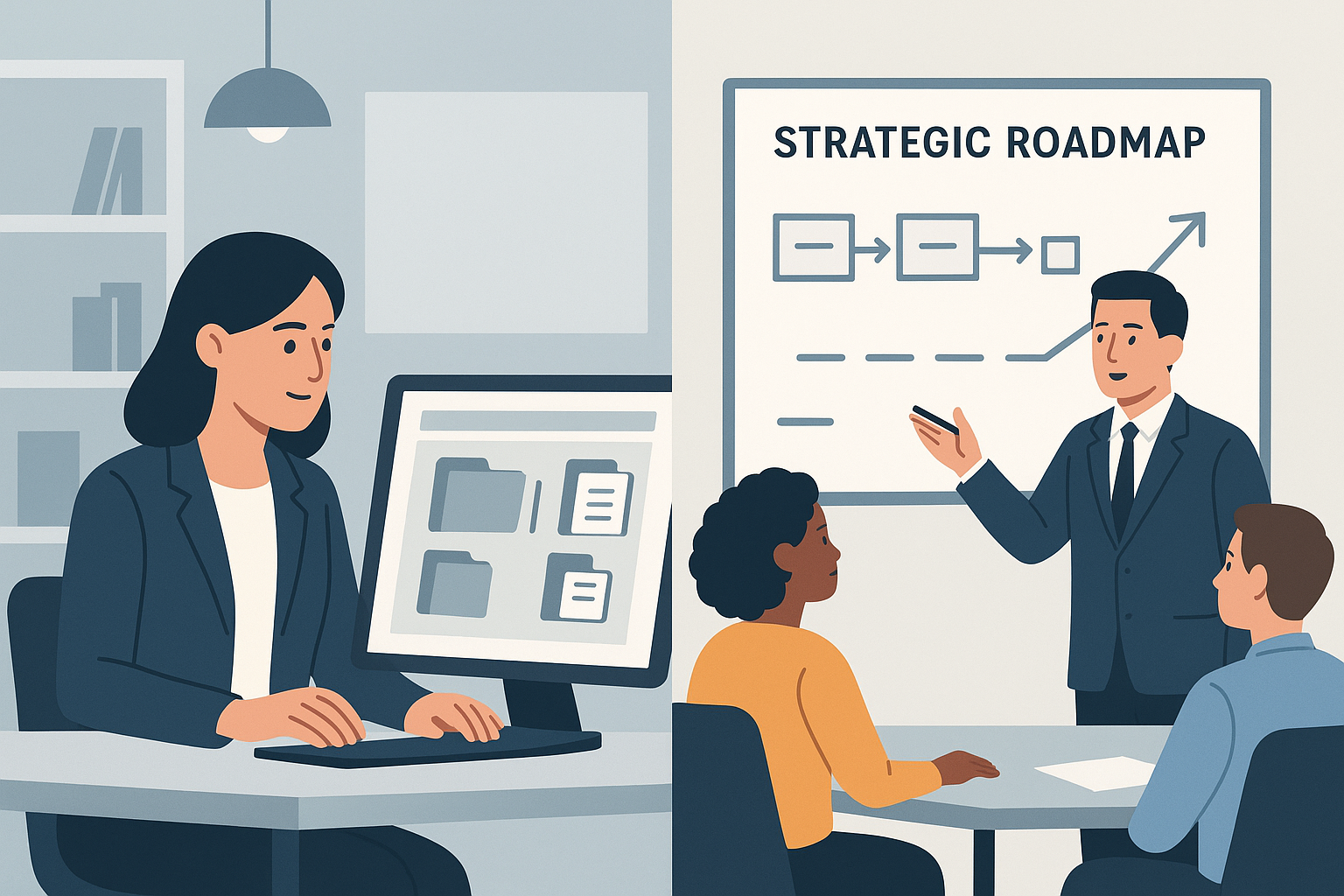
Understanding the distinction between HR administrator duties and HR manager responsibilities helps businesses build the right team structure.
How to Execute the Core Duties of an HR Administrator: A Step-by-Step Process
For businesses building or refining their HR function, here is a practical, sequential approach to executing the core responsibilities of an HR administrator effectively:
- Audit and Organize Employee Records: Collect all employee files — contracts, personal data, performance reviews, and disciplinary notes — and migrate them into a secure HRIS platform. Update records immediately whenever changes occur to avoid data drift.
- Design a Consistent Onboarding Workflow: Create a repeatable checklist that covers required paperwork (I-9, W-4, direct deposit), system access provisioning, orientation scheduling, and manager introductions. Complete all tasks before the employee’s first day when possible.
- Establish a Benefits Administration Calendar: Map out open enrollment windows, qualifying life event deadlines, and carrier communication timelines. Notify employees in advance, facilitate elections, and confirm processing with brokers or carriers after each enrollment period.
- Build a Payroll Accuracy Checklist: Gather and cross-verify timekeeping data before each pay run, flag discrepancies early, and coordinate directly with payroll providers to resolve issues. Document every correction for audit purposes.
- Create a Compliance Monitoring System: Subscribe to federal and state employment law update services, set calendar reminders for policy review cycles, and maintain a documentation library that includes current employee handbook versions, required notices, and training records.
- Establish a Communication Protocol for Employee Inquiries: Define expected response times for HR questions, create an FAQ resource employees can self-serve, and use your HRIS ticketing system (if available) to track and close requests systematically.
Biggest Challenges HR Administrators Face
The HR administrator role is rewarding but demanding. Several recurring challenges consistently affect professionals in this position:
Keeping Up With Changing Employment Laws
Federal, state, and local labor laws change frequently. Consequently, HR administrators must actively monitor regulatory updates rather than waiting for compliance issues to surface. Missing a change — such as a minimum wage increase or a new leave requirement — can expose the organization to significant liability.
Managing Data Volume and Accuracy
Even in a mid-sized company, HR administrators manage hundreds or thousands of data points across multiple systems. Keeping all of this accurate — and synchronized across payroll, benefits, and HRIS platforms — requires rigorous processes and consistent attention.
Balancing Administrative Work with Employee-Facing Responsibilities
HR administrators often serve as the primary employee contact for HR questions while simultaneously managing back-office administrative tasks. Balancing responsiveness with deep-focus work (such as auditing records or processing payroll) is an ongoing challenge that requires strong time management.
Data Security and Privacy
HR administrators handle sensitive personal, financial, and medical information. As a result, data security is a serious responsibility. Organizations must ensure that HRIS platforms are properly secured, access is role-restricted, and data handling practices comply with applicable privacy laws such as HIPAA (Health Insurance Portability and Accountability Act) for benefits-related medical data.
Do Small Businesses Need a Dedicated HR Administrator?
Not always — but they absolutely need the function covered. Many small to mid-sized businesses (typically 10 to 250 employees) find that hiring a full-time HR administrator is not cost-effective at their current stage. Nevertheless, the work still needs to happen. Compliance does not pause because you are busy growing.
This is precisely where outsourced HR solutions prove their value. Soteria HR provides growing businesses with full-service HR administration — from onboarding to offboarding, benefits management to compliance monitoring — without the overhead of a full-time hire. The result is professional, scalable HR coverage that grows with your business.
Furthermore, outsourcing HR administration gives business owners access to seasoned professionals who stay current on employment law changes — significantly reducing the risk of costly compliance failures. According to SHRM, HR outsourcing is increasingly common among small businesses that want to manage risk without expanding headcount.
To explore what comprehensive HR administration looks like in practice — and whether outsourcing fits your organization — Soteria HR’s full-service overview is an excellent starting point.
Frequently Asked Questions About the HR Administrator Role
What does an HR administrator do on a daily basis?
On a typical day, an HR administrator handles employee record updates, responds to HR-related employee inquiries, coordinates new hire paperwork, processes benefits changes, reviews timekeeping data for payroll, and monitors for compliance issues. They are frequently the first point of contact when employees have questions about pay, leave, or company policy.
What qualifications does an HR administrator need?
Most positions require a bachelor’s degree in Human Resources, Business Administration, or a related field. Professional certifications such as SHRM-CP or PHR are highly valued, along with hands-on experience in HRIS platforms and a working knowledge of employment law fundamentals like FLSA, FMLA, and ADA.
How much does an HR administrator earn?
According to the U.S. Bureau of Labor Statistics, the median annual salary for HR specialists — a category that includes HR administrators — was approximately $67,650 in 2023. Entry-level positions typically range from $42,000 to $52,000, while experienced administrators in high-demand markets can earn $75,000 to $95,000 or more.
What is the difference between an HR administrator and an HR manager?
An HR administrator focuses primarily on operational and administrative execution — records, onboarding, payroll, benefits, and compliance. An HR manager, in contrast, takes on a strategic leadership role: setting department policy, managing teams, and aligning the HR function with broader organizational goals. In small businesses, one person may handle both responsibilities.
Is an HR administrator the same as an HR generalist?
Not exactly. An HR generalist typically handles a broader range of functions — including recruiting, employee relations, and policy development — while an HR administrator focuses primarily on administrative processes, record-keeping, and compliance documentation. In smaller organizations, however, the two roles often overlap significantly.
What software tools does an HR administrator typically use?
HR administrators commonly work with HRIS platforms such as BambooHR, Workday, ADP, or Gusto to manage employee data, payroll, and benefits. They may also use Applicant Tracking Systems (ATS) for recruiting support and compliance management tools to monitor labor law changes across federal, state, and local jurisdictions.
What is the career path for an HR administrator?
Most HR administrators advance to roles such as HR Generalist, HR Business Partner, or HR Manager with experience and additional credentials. Some choose to specialize in areas like Compensation and Benefits, Talent Acquisition, HR Compliance, or HRIS Management. With further advancement, senior roles include HR Director, VP of HR, and Chief Human Resources Officer (CHRO).
Can a small business outsource HR administration instead of hiring an HR administrator?
Yes — and many do. Outsourcing HR administration to a firm like Soteria HR gives small to mid-sized businesses access to experienced HR professionals without the cost of a full-time hire. This approach works particularly well for businesses with 10 to 250 employees navigating compliance requirements and rapid growth simultaneously.
What are the biggest challenges HR administrators face?
The most common challenges include keeping pace with rapidly changing employment laws, managing large volumes of employee data accurately across multiple platforms, balancing administrative workloads with employee-facing responsibilities, and maintaining data security for sensitive personal and medical information.
How does an HR administrator support employee benefits?
HR administrators coordinate open enrollment, process elections, communicate plan details clearly to employees, handle qualifying life event changes, and manage benefits terminations when employees leave. They also serve as the primary liaison between employees and insurance carriers or brokers — translating complex plan information into accessible language.
How does an HR administrator help maintain compliance?
HR administrators maintain compliance by keeping complete and accurate employee records, ensuring proper documentation for all hires, terminations, and disciplinary actions, tracking required training completions, updating employee handbooks to reflect current law, and monitoring for federal, state, and local regulatory changes that affect the organization.
What is the job outlook for HR administrators?
The U.S. Bureau of Labor Statistics projects 6% employment growth for HR specialists through 2032 — above the average for all occupations. Demand is driven by growing organizational complexity, expanding employment law requirements, and an increasing recognition that strong HR administration directly impacts business performance and risk management.
Conclusion: Why the HR Administrator Role Matters
The HR administrator is far more than a title on an org chart. This role is the operational engine of any effective human resources function — ensuring that employees are supported, records are accurate, compliance is maintained, and the organization is protected from costly mistakes. Above all, without strong HR administration, even the best people strategy fails in execution.
For professionals, the HR administrator path offers a meaningful, stable, and growing career with clear advancement opportunities. For businesses, it represents a critical function that must be covered — whether by an in-house hire, a shared service, or an outsourced partner.
For growing businesses that are not yet ready for a full-time HR hire, outsourcing this function is a proven, cost-effective approach. Soteria HR serves as an embedded partner for small to mid-sized organizations — handling the full spectrum of HR administration so business leaders can focus on what they do best: growing their companies. If you are ready to get HR right without the overhead, explore what Soteria HR can do for your team.