An organizational development framework is the structured, repeatable system that separates companies that scale with confidence from those that scale into chaos. It defines exactly how your organization diagnoses gaps, designs improvements, aligns leadership, and measures whether those efforts actually move the needle. For growing businesses — typically those with 10 to 250 employees — this kind of deliberate structure is not optional. In fact, it is one of the highest-leverage investments a leadership team can make.
Without a framework, even talented teams react to problems instead of preventing them. As a result, growth becomes unpredictable, expensive, and exhausting. However, with the right organizational development framework in place, your people strategy finally runs parallel to your business strategy — not three steps behind it.
This guide covers everything you need: what an organizational development framework actually is, where the concept came from, which models matter most, how to build one step by step, what it looks like in practice, and exactly how to prove it is working. By the end, you will know more about building a working OD framework than most consultants charge thousands of dollars to explain.
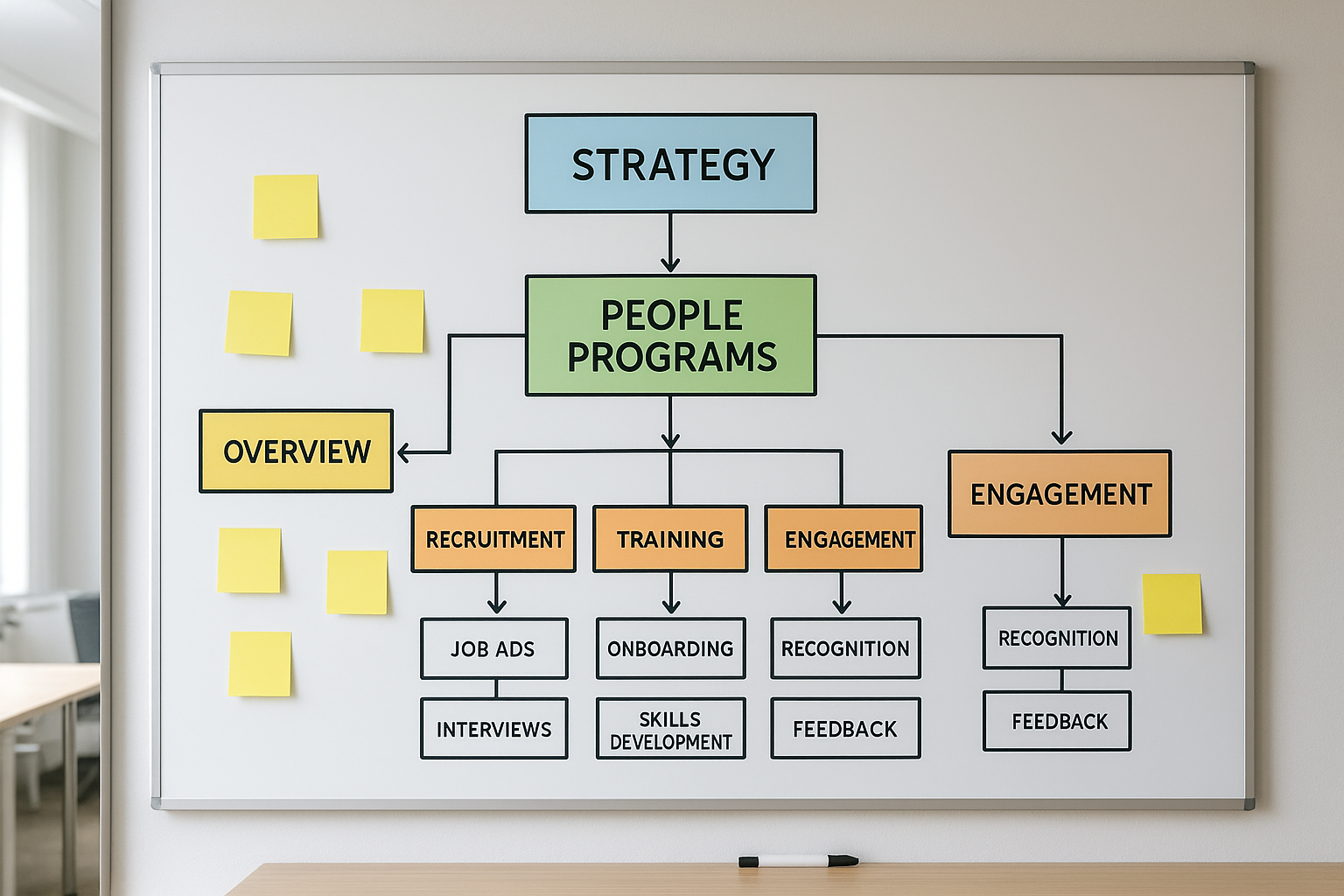
A well-mapped organizational development framework turns strategic intent into coordinated action across every team and level.
What Is an Organizational Development Framework?
An organizational development framework is a deliberate, systemic blueprint for improving your company’s people, culture, processes, and structure. According to Wikipedia’s overview of organization development, OD as a discipline draws directly on behavioral science — the study of how people actually think and act, rather than how org charts assume they should — to improve organizational effectiveness and health, not just operational efficiency.
Think of it this way: your business plan tells you where you want to go. Your organizational development framework tells you how your people, structure, and culture need to evolve to actually get there. These two documents are not competitors. Instead, they are partners that should be reviewed side by side every planning cycle.
Specifically, a strong organizational development framework answers four core questions:
- Where are we now? — A clear, data-driven diagnosis of current organizational health
- Where do we need to be? — Specific, measurable improvement goals tied to business strategy
- How do we get there? — Targeted interventions with clear ownership and timelines
- How do we know it worked? — Leading and lagging metrics reviewed on a regular cadence
For a deeper starting point, Soteria HR’s guide on what organizational development actually means provides a thorough foundation before you build your own framework.
A Brief History of the Organizational Development Framework
Understanding where the organizational development framework came from makes it far easier to apply correctly today. The discipline traces back to the 1940s and 1950s, when researchers such as Kurt Lewin began studying group dynamics and discovered that lasting change required more than a memo from leadership — it required a structured process involving the people affected by the change.
Throughout the 1960s and 1970s, OD matured into a formal management discipline as consultants and academics developed survey-feedback methods, team-building techniques, and early diagnostic models. By the 1980s, strategy consultancies had folded systemic thinking into frameworks like McKinsey’s 7-S model, pushing OD beyond individual behavior and into full organizational alignment.
Today’s organizational development framework blends all of that history: behavioral science, systems thinking, and modern data analytics. Consequently, a current-day framework is far more measurable than its 1950s predecessor — and far more accessible to a 40-person company than it once was to anyone outside a Fortune 500 boardroom.
Organizational Development vs. Related Disciplines: Clearing Up the Confusion
Many people conflate organizational development with change management, HR, or training. In reality, each is a distinct discipline — and understanding the differences helps you build a sharper, more effective framework.
| Discipline | Primary Focus | Time Horizon |
|---|---|---|
| Organizational Development | Systemic improvement of people, culture, structure | Long-term, ongoing |
| Change Management | Managing transitions and minimizing disruption | Project-based |
| Human Resources | People operations, compliance, recruiting | Daily to annual |
| Training & Development | Building skills and knowledge in individuals | Short to medium-term |
In short, change management is one component within a broader organizational development framework. OD encompasses the full lifecycle of organizational improvement, while change management specifically addresses how transitions are planned and communicated. Similarly, training is a tool OD uses — not OD itself.
Why Growing SMBs Need a Structured OD Framework
Small and mid-sized businesses often hit a wall somewhere between 30 and 75 employees. Processes that worked at 15 people begin to break down. Communication gaps widen. Managers struggle without clear development. Voluntary turnover ticks upward. This is not bad luck — it is a predictable structural problem, and it is exactly what a well-designed organizational development framework is built to prevent.
Research from McKinsey & Company consistently shows that organizations in the top quartile of organizational health outperform peers by two to three times on total shareholder returns. Organizational health does not happen by accident — it is built intentionally through structured frameworks.
Furthermore, the Society for Human Resource Management (SHRM) reports that companies with proactive people strategies see voluntary turnover 25% to 40% lower than reactive counterparts. For a 50-person business losing just two employees per year at $15,000 replacement cost each, that difference can exceed $150,000 over five years.
In other words, an organizational development framework is not a luxury reserved for Fortune 500 companies. It is, in fact, most valuable for growing businesses that cannot afford to make expensive people mistakes at scale.
The Real Cost of Operating Without a Framework
Companies without a structured OD approach tend to experience recurring patterns: the same people problems reappear quarterly, managers are promoted without development, culture erodes during rapid hiring, and leadership spends time firefighting instead of building. As a result, growth stalls — not from lack of market opportunity, but from organizational drag.
Core Components of an Effective Organizational Development Framework
Every strong organizational development framework shares six non-negotiable building blocks. Specifically, these elements ensure that improvement efforts are coordinated, measurable, and sustainable — not just well-intentioned.
The Six Core Components
- Needs Assessment — Diagnose current gaps in performance, culture, and structure using real data before designing any solutions. This is the most skipped and most critical step.
- Goal Definition — Translate findings into specific, measurable improvement targets that are tied directly to business strategy and have clear success criteria.
- Leadership Alignment — Secure active commitment — not just passive approval — from senior leaders. Assign ownership for each initiative so accountability is unambiguous.
- Intervention Design — Build targeted programs (leadership development, culture initiatives, process redesign, compensation review) that address root causes, not symptoms.
- Communication and Implementation — Roll out changes with a transparent, multi-channel communication plan so employees at every level understand the why, the what, and the what-next.
- Measurement and Iteration — Track results using both leading and lagging indicators. Hold regular reviews. Adjust the framework as business conditions and organizational needs evolve.
Each component builds on the one before it. Therefore, skipping the needs assessment — the most common mistake — almost guarantees that interventions designed later will miss the actual problem entirely.
Established OD Framework Models Worth Knowing
You do not need to adopt one model wholesale. Instead, use them as lenses that sharpen your thinking about diagnosis, design, and change leadership. Here are the models most relevant to a growing organizational development framework.
McKinsey’s 7-S Framework
McKinsey’s 7-S Framework examines seven interconnected organizational elements: strategy, structure, systems, shared values, style, staff, and skills. The core insight is that all seven must be aligned — changing one element without considering the others creates new problems. This model is particularly useful for diagnosing misalignment during rapid growth or restructuring.
Lewin’s Change Model
Lewin’s three-stage model — unfreeze, change, refreeze — is one of the oldest and most practical frameworks for managing transitions. Unfreezing disrupts the status quo and creates readiness for change. The change stage introduces new behaviors or structures. Refreezing stabilizes the new state so it becomes the default. This model is especially relevant for significant cultural or structural shifts.
Kotter’s 8-Step Change Model
Kotter’s model provides a more detailed roadmap for large-scale transformation, emphasizing urgency, coalition building, and short-term wins as momentum builders. Its eight steps are: create urgency, build a guiding coalition, form a strategic vision, enlist volunteers, enable action, generate short-term wins, sustain acceleration, and institute change. For SMBs, a simplified version is often the most practical entry point.
The Burke-Litwin Model of Organizational Change
The Burke-Litwin model — less commonly discussed but highly practical — distinguishes between transformational factors (external environment, leadership, mission and strategy, culture) and transactional factors (structure, systems, climate, task requirements, and individual skills). It is particularly valuable for understanding why some OD interventions produce lasting change while others fade quickly.
Nadler and Tushman’s Congruence Model
The Congruence Model treats the organization as a system of four components — work, people, structure, and culture — that must fit together tightly. According to this model, performance problems almost always stem from misalignment between two or more of these components. As a result, it is an excellent diagnostic tool when the root cause of an organizational problem is unclear.
For a more comprehensive look at how these models translate into real-world strategy, see Soteria HR’s practical guide to organization development strategy.
How to Build an Organizational Development Framework: Step by Step
Building a framework does not have to be overwhelming. In fact, the process becomes manageable when broken into clear, sequential steps. Here is a practical approach designed specifically for growing organizations — one you can begin implementing this quarter.
Step 1: Conduct a Thorough Needs Assessment
Start by gathering honest, multi-source data. Use employee engagement surveys, manager interviews, exit interview trends, and HR metrics — including turnover rate, time-to-fill open roles, absenteeism, and internal promotion rates. The goal is to identify where the organization is underperforming and why, not just what the surface symptoms look like.
Specifically, group your findings into three diagnostic categories: performance gaps (what people are not doing well), capability gaps (what people do not yet know how to do), and structural gaps (where processes, roles, or systems create friction regardless of individual effort).
Step 2: Define Specific, Measurable Goals
Once you understand the gaps, translate them into specific goals with clear success criteria. Rather than “improve culture,” aim for “reduce voluntary turnover by 20% within 12 months” or “increase manager effectiveness scores from 3.4 to 4.1 on the next 360-degree cycle.”
Additionally, prioritize goals by impact and feasibility. Not every gap can be addressed simultaneously — therefore, sequence your priorities so early wins build momentum and credibility for deeper changes.
Step 3: Secure Leadership Alignment and Ownership
Leadership alignment is arguably the most critical success factor in any organizational development framework. Present your needs assessment findings and proposed goals to senior leaders with data, not anecdotes. Secure their active commitment, not just passive approval.
Assign a named owner for each initiative and define accountability checkpoints. Without this, even excellent programs quietly die when competing priorities appear — which they always do.
Step 4: Design Targeted Interventions
Now design the actual programs and changes. These might include leadership development training, a revised performance management process, updated compensation structures, a structured onboarding program, or a culture initiative with defined behavioral standards.
Importantly, every intervention must connect directly to a specific goal from Step 2. If you cannot draw a clear line from the intervention to a measurable goal, reconsider whether it belongs in the framework at all. This discipline keeps the framework focused and avoids the common trap of activity without impact.
Step 5: Implement with a Deliberate Communication Plan
Roll out your initiatives with structured, multi-channel communication. Employees at every level should understand why changes are happening, what to expect in the next 30 to 90 days, and how they can contribute. Use all-hands meetings, manager briefings, written updates, and one-on-one conversations — not just a single email announcement.
Transparency reduces resistance and builds the trust that sustained change requires. Furthermore, consistent communication signals that leadership is serious — which matters enormously to employees who have seen initiatives abandoned before.
Step 6: Measure Progress, Review Quarterly, and Adjust
Track progress using both leading indicators — engagement scores, training completion rates, participation in culture programs — and lagging indicators — voluntary turnover, productivity, promotion rates. Hold formal quarterly reviews with leadership and compare actual results against your goals from Step 2.
Adjust the framework as business conditions and organizational needs shift — because they always do. A framework that is never updated is a framework that stops being useful. Above all, treat your OD framework as a living document, not a one-time deliverable.

Regular quarterly reviews keep your organizational development framework aligned with real-world business conditions and evolving team needs.
OD Framework Applications: What Interventions Actually Look Like
Many guides describe frameworks in abstract terms. Consequently, practitioners are left wondering what these interventions look like in a real 50-person company. Here is a practical breakdown by category.
Human Process Interventions
These focus on improving how people work together. Examples include team-building workshops, conflict resolution processes, leadership coaching programs, and structured feedback mechanisms like 360-degree reviews. For growing companies, improving team dynamics and manager capability typically delivers the fastest ROI.
Techno-Structural Interventions
These address how work is designed and how the organization is structured. Specifically, they include role redesign, reporting structure changes, workflow process improvements, and technology implementations that reduce manual friction. For example, redesigning the onboarding workflow can reduce time-to-productivity for new hires by 30% or more.
Human Resource Management Interventions
These align people systems with organizational goals. They include compensation redesign, performance management process overhaul, career pathing programs, and succession planning. Similarly, updated job architecture — clear role definitions with growth paths — significantly reduces ambiguity-driven turnover.
Strategic Interventions
Strategic interventions address the organization as a whole system — culture transformation, merger integration, large-scale restructuring, and organizational design. These are the highest-stakes interventions and require the most rigorous planning, communication, and executive commitment.
The Role of Organizational Culture in Your OD Framework
Culture is not a soft add-on to an organizational development framework. It is, in fact, the environment in which every other intervention either thrives or dies. A technically perfect performance management process will fail in a culture where honest feedback is punished. A compensation restructure will not retain people in a culture where they do not feel respected.
Therefore, every organizational development framework should explicitly define the target culture — the specific behaviors, norms, and values the organization wants to embed — and then design interventions that reinforce that culture consistently. Culture change is slow, but it is measurable and manageable when approached systematically.
How to Define Your Target Culture
Start with behaviors, not slogans. “We value integrity” is not a cultural standard. “We raise concerns directly with the person involved before escalating” is a behavioral standard that can be modeled, hired for, and reinforced in performance reviews. Specifically, identify five to eight behavioral standards that define how your organization operates at its best, then embed them into hiring, onboarding, recognition, and performance management.
How to Measure the Impact of Your Organizational Development Framework
A framework without measurement is just a document. Consequently, defining success metrics upfront is non-negotiable. Effective OD measurement uses a combination of leading and lagging indicators — and connects them to business outcomes, not just HR activity.
Key OD Metrics to Track
- Employee engagement score — measured quarterly via pulse surveys; target a directional increase of 5+ points per year
- Voluntary turnover rate — compared year-over-year by department and tenure cohort
- Time-to-productivity for new hires — reflects onboarding effectiveness and role clarity
- Internal promotion rate — signals whether talent development programs are working
- Manager effectiveness scores — gathered through 360-degree feedback cycles twice per year
- Compliance incident rate — tracks risk reduction over time as policies and accountability improve
- Training completion and application rates — measures whether learning translates into behavior change
- Culture alignment scores — periodic assessments of how well employee behaviors match the target culture
Above all, the goal is not perfection on every metric. Rather, it is consistent, directional improvement over time. Even a 10% improvement in voluntary turnover can translate into tens of thousands of dollars in saved recruitment and onboarding costs annually — a return that is easy to quantify for leadership.
Connecting OD Metrics to Business ROI
HR metrics only earn executive attention when they connect to business outcomes. For example, link your turnover rate improvement to reduced time-to-fill and lower recruitment spend. Connect engagement score increases to productivity and customer satisfaction data. Similarly, frame internal promotion rate improvements as reduced reliance on costly external hiring. This translation from HR data to business impact is what elevates OD from a cost center to a strategic function.
Common Mistakes Companies Make When Building an OD Framework
Understanding what goes wrong is just as valuable as knowing what to do right. Here are the most common failure patterns — and how to avoid them.
- Skipping the needs assessment. The most common mistake. Companies jump straight to solutions — training programs, engagement initiatives, new tools — without understanding root causes. As a result, the intervention addresses the wrong problem.
- Treating OD as an HR-only initiative. Organizational development fails when it is delegated entirely to HR without executive ownership. In contrast, successful frameworks have visible leadership sponsorship at every stage.
- Setting vague goals. “Improve culture” and “build a better team” are not goals. They are hopes. Consequently, they cannot be measured or held accountable.
- Designing for the org chart, not the actual organization. Formal structures rarely reflect how work actually gets done. Therefore, OD interventions must account for informal networks, influence patterns, and the way decisions are really made.
- Communicating once and assuming it landed. Research consistently shows that major change initiatives require seven or more communication touchpoints before employees genuinely internalize the message. One email is not a communication plan.
- Abandoning the framework during business pressure. Ironically, OD efforts are most often paused exactly when organizational stress makes them most valuable. Build in explicit checkpoints that survive leadership transitions and business turbulence.
Build, Buy, or Blend: Choosing the Right Team for Your OD Framework
Most growing businesses do not have the internal bandwidth to design and manage a full organizational development framework on their own. That is not a weakness — it is simply a resource reality. As a result, many SMBs partner with outsourced HR providers to fill the strategic gap without the overhead of a full internal department.
In practice, there are three paths: build an internal OD function from scratch, buy a fully outsourced solution, or blend the two by pairing an internal champion with outside expertise. For companies under 250 employees, the blended model consistently delivers the best balance of cost, speed, and institutional knowledge.
Soteria HR works specifically with growth-minded organizations — typically between 10 and 250 employees — to design and implement OD frameworks that fit their stage of growth, culture, and industry. Rather than offering cookie-cutter solutions, Soteria builds custom HR playbooks and OD strategies tailored to each client’s specific goals and pain points.
This kind of embedded partnership means you get strategic HR leadership without the cost of a full-time department. Furthermore, you get a team that spots problems before they escalate — saving time, money, and leadership energy. Explore Soteria HR’s organizational development consulting services to see exactly how this works in practice.
If you are also exploring the broader landscape of development approaches, this overview of organizational development strategies covers the full range of options available to growing companies. And if your focus right now is specifically on scaling without losing cohesion, this growth-stage guide to strategic organizational development walks through the sequencing decisions that matter most during rapid headcount expansion.
Your Organizational Development Framework Implementation Checklist
Before you close this guide, use the checklist below to confirm your organizational development framework has every essential piece in place. If you can check every box, your framework is ready for its first quarterly review.
- A completed needs assessment built on survey data, interviews, and HR metrics — not assumptions
- Written, measurable goals with named owners and target dates
- Documented, visible executive sponsorship — not just HR buy-in
- A defined target culture with five to eight observable behavioral standards
- Interventions that each map to a specific goal, with no orphaned initiatives
- A multi-channel communication plan covering at least the first 90 days
- A dashboard of leading and lagging indicators reviewed on a quarterly cadence
- A clear decision on whether the framework is built, bought, or blended — and by whom
Frequently Asked Questions About Organizational Development Framework
What is an organizational development framework?
An organizational development framework is a structured, repeatable system that guides how a company plans, implements, and sustains improvements in performance, culture, and structure. It includes defined goals, diagnostic processes, targeted interventions, clear accountability, and a measurement system that ensures change is intentional and measurable — not reactive.
How is an organizational development framework different from change management?
Change management is one component within a broader OD framework. Change management specifically addresses how transitions are planned and communicated. In contrast, an organizational development framework encompasses the full lifecycle of organizational improvement — from diagnosis through goal-setting, intervention design, implementation, and ongoing measurement.
Why does a small business need an organizational development framework?
Small businesses benefit most because the framework replaces reactive decision-making with a proactive, structured approach to growth. It helps leaders align people strategy with business goals, reduce costly turnover, develop managers before they struggle, and scale operations without creating chaos. The return on investment is often highest for companies between 30 and 100 employees.
What are the core components of an OD framework?
Core components include a needs assessment, specifically defined and measurable goals, leadership alignment with named ownership, targeted interventions tied directly to those goals, a structured communication and implementation plan, and a measurement system using both leading and lagging indicators reviewed on a regular cadence.
Which organizational development framework models are most commonly used?
The most widely used models include McKinsey’s 7-S Framework, Lewin’s Change Model (unfreeze, change, refreeze), Kotter’s 8-Step Change Model, the Burke-Litwin Model of Organizational Change, and the Nadler-Tushman Congruence Model. Each offers a different lens — diagnostics, change sequencing, or systemic alignment — and most practitioners combine elements from multiple models.
What historical models influenced today’s organizational development framework?
Kurt Lewin’s mid-20th-century work on group dynamics and planned change laid the groundwork for modern OD. Survey-feedback methods and team-building techniques developed through the 1960s and 1970s, while later systemic models like McKinsey’s 7-S introduced whole-organization alignment thinking that still shapes frameworks used today.
How long does it take to implement an organizational development framework?
Most organizations see measurable initial results within 90 to 180 days. Full embedding of the framework into culture and operations typically takes 12 to 24 months, depending on company size, complexity, and the scope of change required. Quick wins in the first quarter are important — they build momentum and demonstrate value to leadership.
What is the biggest mistake companies make when building an OD framework?
The most common mistake is skipping the needs assessment phase and jumping directly to solutions. Without understanding root causes — the real reasons performance gaps exist — even well-designed programs will address the wrong problems. The second most common mistake is treating OD as an HR-only initiative without genuine executive ownership and visible leadership commitment.
Should a small business build its OD framework internally or hire outside help?
For most companies under 250 employees, a blended approach works best: an internal champion who owns day-to-day execution, paired with outside OD expertise for diagnostics and design. This balances cost against speed and avoids the common trap of an internal team that lacks bandwidth or an outside firm that lacks context.
Can an outsourced HR partner help build an organizational development framework?
Yes. Outsourced HR firms like Soteria HR specialize in designing and implementing OD frameworks tailored to growing businesses. They bring strategic expertise, diagnostic tools, and hands-on implementation support without the overhead of a full internal HR department — making them especially valuable for companies between 10 and 250 employees.
How do you measure the success of an organizational development framework?
Success is measured through leading indicators — engagement scores, training completion rates, participation in culture programs — and lagging indicators — voluntary turnover, productivity, and internal promotion rates. The most effective measurement approach connects HR metrics directly to business outcomes, translating people data into revenue and cost impact that resonates with executive teams.
What role does leadership play in an organizational development framework?
Leadership alignment is the single most critical factor in OD success. Leaders must model desired behaviors, communicate the vision consistently across all channels, allocate resources to support the framework, and maintain commitment when business pressure mounts. Without visible executive ownership, even the best-designed frameworks stall quickly — often within the first quarter of implementation.
What industries benefit most from an organizational development framework?
Virtually every industry benefits, but companies in human services, professional services, technology, and manufacturing see especially strong returns. These sectors typically face rapid change, intense talent competition, and complex compliance requirements — all of which a well-designed OD framework directly addresses.
How does an organizational development framework support compliance?
A well-designed OD framework builds compliance into its structure by establishing clear policies, documented role accountability, and regular internal audits. This proactive approach reduces legal risk and ensures the organization stays current with changing employment laws — rather than discovering gaps during an investigation or employee complaint.
Conclusion: Build Your Organizational Development Framework Before You Need It
An organizational development framework is not something you build after things go wrong — it is precisely what prevents things from going wrong in the first place. For growing businesses navigating hiring pressures, compliance complexity, and cultural growing pains, a structured OD approach is one of the highest-leverage investments a leadership team can make. Furthermore, the cost of not having one — in turnover, management failures, and culture drift — compounds quietly until it becomes a crisis.
The key takeaways are straightforward. Start with an honest needs assessment. Set specific, measurable goals. Secure genuine leadership ownership. Design interventions that address root causes, not symptoms. Communicate thoroughly and repeatedly. Measure results and adjust as you go. Above all, treat the framework as a living system, not a one-time project.
The good news is that you do not have to figure it out alone. Whether you are starting from scratch or strengthening an existing approach, Soteria HR’s complete guide to organization development frameworks walks you through the full picture. And when you are ready for hands-on support, Soteria HR’s team of embedded HR professionals is ready to help you build and execute an organizational development framework that actually fits your business — not someone else’s template.
Above all, remember: great organizations are built on purpose. Start building your organizational development framework today.