HR BPO providers give growing companies access to professional human resources support without the cost of building an in-house team. If you’re a founder, COO, or office manager juggling payroll, compliance, and hiring on top of everything else, understanding how these providers work can save you time, money, and a few gray hairs. This guide breaks down what HR BPO providers actually do, how they differ from PEOs and HROs, what they typically cost, and how to choose one that fits your stage of growth.
Quick answer: HR BPO providers are third-party firms that manage HR administrative and strategic functions — like payroll, benefits, compliance, and recruiting — so internal teams can focus on running the business. Costs typically range from $50 to $1,500+ per employee per month depending on scope.
What Are HR BPO Providers, Exactly?
HR BPO providers — short for HR business process outsourcing providers — are companies that take on defined HR responsibilities so you don’t have to manage them internally. Instead of hiring a full HR department, you contract with a provider that already has the systems, expertise, and staff in place.
According to Wikipedia’s overview of business process outsourcing, this model lets organizations delegate non-core, repeatable processes to specialists while keeping strategic decisions in-house. For HR specifically, that often means payroll coordination, benefits administration, and compliance tracking move to the provider, while leadership retains control over culture and people strategy.
Unlike hiring a single HR generalist, HR BPO providers give you access to a whole team — compliance specialists, benefits experts, and recruiters — for a fraction of the cost of building that bench internally.

Choosing among HR BPO providers starts with understanding exactly what each one covers.
How HR Outsourcing Partners Support Growing Companies
As companies scale past 10, 50, or 100 employees, HR complexity grows faster than most leaders expect. Suddenly there are multi-state compliance rules, benefits renewals, and performance issues that need documentation. This is exactly where an HR outsourcing partner earns its keep.
For example, a manufacturing company adding a second location may face new state-specific leave laws overnight. Similarly, a tech startup scaling from 20 to 80 employees often needs formal onboarding and handbook policies it never required before. In both cases, an experienced partner spots the gap before it becomes a lawsuit or a resignation letter.
Above all, the right partner acts proactively — flagging risk before it costs you time, money, or good employees. That proactive posture is the difference between HR that protects your business and HR that simply reacts to problems after they’ve already happened.
Key Services HR BPO Companies Provide
Most HR BPO companies offer a similar core menu, though depth and quality vary significantly. In particular, look for coverage across these areas:
- Full-service HR administration, from onboarding to offboarding
- Benefits management and vendor negotiation
- Compliance and risk management across jurisdictions
- Employee handbook creation and policy updates
- Recruiting and hiring support
- Payroll coordination with your existing systems
You can review a more detailed full list of HR consulting services to see how these categories typically break down in practice.
HR BPO vs. PEO vs. HRO: What’s the Difference?
These acronyms get used interchangeably, but the models differ in important ways. A PEO (Professional Employer Organization) enters a co-employment arrangement, meaning your employees technically sit on the PEO’s payroll and benefits plans. An HRO (HR Outsourcing) provider, in contrast, delivers services without co-employment, leaving your business as the sole legal employer.
HR BPO providers generally fall under the HRO umbrella — they handle defined processes without absorbing employer-of-record responsibility. Consequently, businesses that want more control over their benefits plans and systems often prefer this model over a PEO. For a deeper comparison, see this breakdown of HRO providers explained, including services and costs.
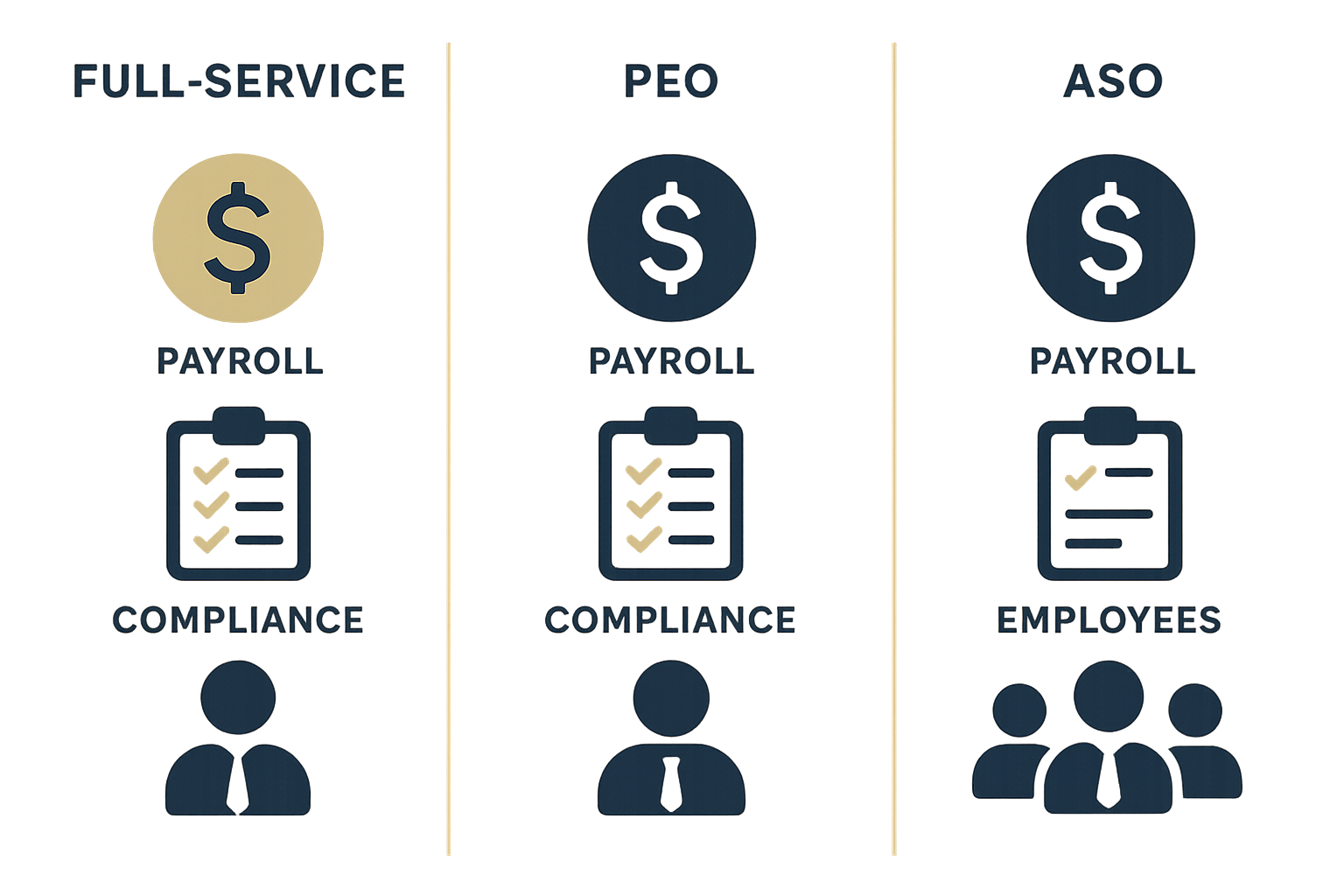
Understanding these distinctions helps you compare hr bpo providers against PEOs and consultants accurately.
How to Choose the Right HR BPO Provider
Selecting a provider is easier when you follow a structured process rather than comparing brochures side by side. Here’s a practical sequence to follow:
- Audit your current HR needs. Review payroll, benefits administration, compliance tracking, and recruiting workload to identify exactly where you need outside support.
- Compare service models. Evaluate whether a full-service HR BPO, a PEO, or a hybrid consulting model fits your headcount, budget, and growth trajectory.
- Vet compliance expertise. Ask providers how they track changing employment laws across the states where your employees work, since compliance gaps create legal risk.
- Request transparent pricing. Get a detailed breakdown of per-employee fees, setup costs, and any add-ons before signing a contract.
- Check culture fit and communication style. Talk to references and ask how quickly the provider responds to urgent HR issues, since responsiveness matters as much as expertise.
If you’re comparing local options, this guide to HR outsourcing near me can help you narrow the field by region and specialty.
What Do HR BPO Providers Typically Cost?
Pricing depends heavily on scope. Basic payroll-only coordination might run $50 to $150 per employee per month, whereas full-service packages — including compliance, benefits, and strategic HR leadership — can range from $300 to $1,500 or more.
For context, SHRM’s benchmarking research puts the average cost-per-hire in the U.S. at roughly $4,700, a figure that climbs quickly when turnover is high or hiring is rushed. In other words, the cost of not having strong HR support often exceeds the cost of the outsourcing contract itself. Similarly, the U.S. Department of Labor notes that wage and hour violations alone can trigger significant back-pay liability, which is exactly the kind of risk a good provider helps you avoid.
Common Mistakes to Avoid When Vetting Providers
Many businesses choose based on price alone, which can backfire quickly. A cheaper provider that misses a filing deadline or mishandles a termination can cost far more in fines and legal fees than it ever saved in monthly fees.
Another common mistake is failing to check industry experience. Human services, tech, and manufacturing companies each face different compliance rules, so a provider unfamiliar with your industry may miss critical details. Therefore, always ask for client references in your specific sector before signing anything.
Finally, some companies skip checking scalability. As your headcount grows, your provider should be able to expand services without forcing you into a painful re-negotiation or provider switch. You can browse examples of companies that outsource HR to see how this plays out at different growth stages.
Why Soteria HR Is a Smart Alternative to Traditional HR BPO Providers
Soteria HR takes a hands-on approach that many traditional HR BPO providers skip. Instead of handing you a generic portal, Soteria pairs full-service HR administration, benefits management, and compliance monitoring with proactive leadership that flags issues before they escalate.
In particular, growing companies with 10 to 250 employees benefit from Soteria’s custom HR playbooks, employee handbook support, and recruiting help — all delivered without the bloated overhead of traditional firms. You can explore Soteria’s full-service HR outsourcing approach or visit soteriahr.com to see how the model compares to other HR BPO providers on the market.

A proactive HR partner reviews compliance risks with your team, not just at renewal time.
Frequently Asked Questions About HR BPO Providers
What are HR BPO providers?
HR BPO providers are third-party companies that manage human resources functions — like payroll, benefits, and compliance — on behalf of another business. They act as an extension of your team, handling day-to-day HR administration and strategic support.
How do HR BPO providers differ from a PEO?
A PEO enters a co-employment relationship and typically moves employees onto its own payroll system. HR BPO providers, by contrast, deliver services without co-employment, giving businesses more flexibility over benefits and systems.
How much do HR BPO providers cost?
Pricing varies widely, but most HR BPO providers charge between $50 and $1,500 or more per employee per month depending on scope. Full-service packages that include compliance, benefits, and strategic consulting sit at the higher end.
How long does it take to onboard an HR BPO provider?
Most companies fully onboard within 30 to 90 days, depending on the complexity of existing systems. Simpler engagements, like payroll coordination alone, often move faster.
What services do HR BPO providers typically include?
Common services include payroll coordination, benefits administration, compliance monitoring, recruiting support, employee handbook creation, and onboarding or offboarding administration. Many providers also offer strategic consulting for growing leadership teams.
Why do small businesses use HR BPO providers?
Small and mid-sized businesses use HR BPO providers to access professional HR expertise without hiring a full internal department. This helps them stay compliant, reduce legal risk, and free up leadership time for growth.
What’s the biggest mistake companies make when choosing HR BPO providers?
The biggest mistake is choosing based on price alone without checking compliance expertise or responsiveness. A cheap provider that misses a compliance deadline can cost far more in fines than it saved in fees.
Can HR BPO providers handle payroll and compliance together?
Yes, most HR BPO providers bundle payroll coordination with compliance monitoring since the two are closely linked. This integrated approach helps reduce errors and ensures deadlines aren’t missed.
Is outsourcing HR to a BPO provider safe for sensitive employee data?
Reputable HR BPO providers use secure, encrypted systems and follow data protection best practices to safeguard employee information. Always ask providers about their data security certifications and protocols before signing a contract.
What size company benefits most from HR BPO providers?
Companies with roughly 10 to 250 employees tend to benefit most, since they’re often too large for informal HR handling but not yet ready for a full internal department. This is the sweet spot where outsourced HR delivers the strongest return.
How do I know if I need an HR BPO provider or just a consultant?
If you need ongoing administrative support like payroll, benefits, and compliance tracking, an HR BPO provider is usually the better fit. A consultant is better suited for one-time projects like a handbook rewrite or a single policy review.
What questions should I ask HR BPO providers before signing a contract?
Ask about pricing transparency, compliance expertise across your operating states, response times, and whether services scale as you grow. It’s also wise to ask for client references in your industry.
Final Thoughts on Choosing HR BPO Providers
Choosing among HR BPO providers doesn’t have to feel overwhelming once you know what to look for. In short, focus on compliance expertise, transparent pricing, and a partner who acts proactively rather than reactively. Whether you compare traditional HR BPO providers or a hands-on partner like Soteria HR, the goal stays the same: protect your people, reduce your risk, and free up your time to grow the business you actually set out to build.