The best HR site for your business is not one single website — it is the right combination of trustworthy resources you can turn to for accurate answers, practical tools, and, when a situation gets complicated, a human being who knows your company. Many founders and operations leaders start their search with a quick Google query and end up overwhelmed by government pages, software ads, and generic blog posts that do not quite fit their situation. Therefore, this guide breaks down what actually makes an HR resource worth trusting, how to compare the main types of sites available, and how to decide when it is time to bring in a dedicated partner instead of relying on search results alone.
Quick answer: The best HR site for most growing companies is a layered approach — an official government resource (DOL, EEOC, or state agency) for the legal baseline, plus a dedicated HR consulting or outsourcing partner who applies that guidance to your actual policies and employees. No single free website can replace that applied judgment.

Finding the best HR site often starts with a simple online search, but comparing sources matters just as much as finding one.
What Is the Best HR Site, Exactly?
The best HR site is the resource that gives you accurate, current, and applicable guidance for the specific HR question in front of you. In practice, that rarely means one bookmark does everything. Instead, it usually means knowing which type of site to trust for which kind of question. For example, a wage-and-hour rule is best verified on a government page, while a question about structuring a new performance review process is better answered by a consultant who has handled that exact situation before. Consequently, the search for a single “best” website often misses the point — the real goal is building a short list of dependable sources you return to again and again.
Key Features That Separate a Reliable HR Resource From the Rest
Before trusting any HR website, it helps to check a short list of signals. In particular, look for clear sourcing, update dates, and jurisdiction-specific detail. A page that mentions California law but does not note that rules differ in other states, for instance, could lead you to apply the wrong standard outside Los Angeles or Orange County.
- Sourcing: Does the page cite the Department of Labor, EEOC, IRS, or a state agency rather than just another blog?
- Recency: Is there a visible update or publish date, and does the content reflect current thresholds and rules?
- Jurisdiction clarity: Does it specify which state or locality the guidance applies to?
- Practical next steps: Does it tell you what to actually do, not just what the law says?
- Human access: Can you reach a real person if your situation does not fit the general example?
Comparing the Main Types of HR Websites
Most HR-related websites fall into three broad categories, and each one serves a different purpose. Understanding the strengths and limits of each category is the fastest way to stop wasting time on the wrong resource.
Government and Compliance Sites
Sites run by the U.S. Department of Labor, the Equal Employment Opportunity Commission, and California’s Department of Industrial Relations publish the legal baseline for wage, leave, and anti-discrimination rules. These are the most authoritative sources available, but above all, they describe general law rather than your specific policy, and they rarely explain how a rule interacts with your other obligations.
HR Software and Industry Association Sites
Industry associations such as SHRM and major HR software vendors publish helpful articles, templates, and benchmarking data. In addition, these sites often summarize research well, but their content is frequently written for a general audience and may not reflect your company’s size or state-specific requirements.
Outsourced HR and Consulting Partner Sites
Finally, outsourced HR providers combine published guidance with direct support from HR professionals who can review your handbook, answer a specific employee relations question, or help you structure benefits administration. For many growing employers, this is where theory turns into a working process. You can review the range of hands-on support on the HR outsourcing services page, or compare local options through HR consulting firms near me.

Government sites set the legal baseline, while a consulting partner applies it to your actual workforce.
How to Choose the Best HR Website for Your Company
Rather than bookmarking the first result that ranks well, follow a simple process to build your short list of dependable HR resources. The steps below work whether you manage HR yourself or support an internal team.
- Identify your immediate HR question. Pin down whether you are dealing with leave, termination, benefits, or a policy update before you start searching.
- Check the source and jurisdiction. Confirm the site is a government agency, association, vendor, or consulting firm, and that the guidance matches your state and employee count.
- Compare at least two resources. Cross-check a government page against a second reliable source to confirm consistency.
- Apply the guidance to your specific policies. Turn the general rule into an actual handbook entry or workflow, and keep a record of the decision.
- Get a second opinion from an HR professional. Before finalizing anything tied to pay, leave, or termination, have it reviewed by someone who knows employment law and your company.
Why Growing Employers Pair Websites With a Dedicated HR Partner
According to the U.S. Bureau of Labor Statistics, employment of human resources specialists is projected to keep growing through the early 2030s as companies continue to formalize their people practices — a sign that HR complexity is not shrinking. For companies between roughly 10 and 250 employees, this often means the gap between “what the website says” and “what our company actually does” becomes expensive to ignore. Soteria HR was built for exactly this stage of growth. Based in Pasadena, California, and serving employers across Los Angeles, Orange County, and nationwide, the team provides HR administration, HR consulting, and benefits administration through a tailored ASO (Administrative Services Organization) relationship. Unlike a PEO, this structure does not involve co-employment — clients remain the employer of record and retain responsibility for their own employment decisions, while Soteria provides the hands-on support behind the scenes. If you are weighing whether a website is enough or whether you need that kind of partnership, the HR company for small business overview walks through how that support typically works.
A Simple Starting Point: The Free HR Health Assessment
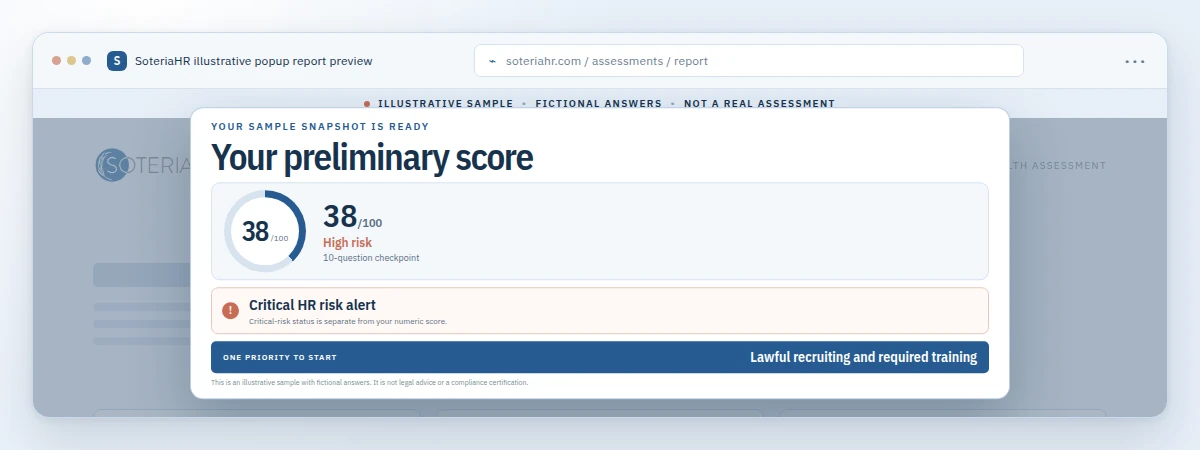
If you are not sure where your biggest gaps are, Soteria HR offers a free HR Health Assessment at soteriahr.ai. The site describes a shorter 10-question Quick HR Check that takes about two minutes, along with a more detailed 40-question Complete HR Health Assessment that runs roughly 10 to 12 minutes. The results are self-reported and preliminary — they are meant to surface priorities for a conversation, not to serve as a certification of compliance or a formal legal audit. Even so, for many leaders it is a faster way to see where to focus than scanning through a dozen separate articles on their own. For background on building out broader workforce practices once you have a sense of your gaps, see optimizing workforce HR best practices and development.
Common Mistakes When Relying on HR Websites Alone
Even well-intentioned research can go wrong. In particular, three mistakes show up again and again among growing companies.
First, treating a single blog post as the final word, rather than cross-checking it against an official source. Second, applying guidance written for one state to a workforce spread across several states or countries. Third, assuming that a free downloadable template is automatically compliant, when in reality it may need adjustment for your industry, location, or employee count. For employees who want a trustworthy starting point of their own, pointing them toward a curated page like HR resources for employees can also reduce confusion and repeated questions to your team.

Turning general guidance from a website into a written policy is the step most companies skip.
Frequently Asked Questions About the Best HR Site
What is the best HR site for a small business?
The best HR site for a small business is usually a combination of a reliable compliance resource, like the Department of Labor, and a hands-on partner who can apply that guidance to your specific situation. Many growing companies pair government resources with an outsourced HR provider such as Soteria HR for ongoing support.
How do I know if an HR website is trustworthy?
Check whether the site cites official sources, states the jurisdiction and effective date of any rule, and discloses that it is general information rather than legal advice. Trustworthy HR sites also update content when regulations change.
Are government HR websites enough for compliance?
Government sites like the DOL and EEOC are accurate starting points, but they describe the law in general terms without applying it to your workforce. Most employers still need a consultant to translate that guidance into policies and practices.
What is the difference between an HR software site and an outsourced HR provider?
HR software sites typically sell tools for tracking data, payroll, or benefits, while an outsourced HR provider offers people who manage HR tasks and decisions on your behalf. Many businesses use both together.
How much does outsourced HR cost compared to free HR websites?
Free HR websites cost nothing but require your own staff time to research and apply guidance. Outsourced HR has a monthly fee, but it typically saves leadership hours and reduces the risk of costly missteps.
Can I use multiple HR resources at once?
Yes, most employers layer resources, using government sites for baseline rules, software for data management, and a consulting partner for judgment calls. This combination is often how a company finds its best HR site strategy.
What is an HR Health Assessment and how does it help?
An HR Health Assessment is a short self-reported questionnaire that highlights potential gaps in policies, compliance, and processes. Soteria HR offers a free version at soteriahr.ai as a starting point for a deeper conversation.
How often should HR policies be reviewed using these resources?
Most employers review core policies at least once a year and sooner whenever a law changes. Checking a trusted HR site regularly, or working with a consultant who tracks updates, keeps reviews on schedule.
What mistakes do companies make when picking an HR resource?
A common mistake is relying only on generic search results without checking the source or the jurisdiction. Another is assuming free templates are automatically compliant for every state.
Does the best HR site replace an in-house HR team?
No single website replaces a person who understands your company. The best HR site supports an internal team or an outsourced partner; it does not substitute for applied judgment.
What is an ASO and how is it different from a PEO?
An ASO, or Administrative Services Organization, provides HR support while the client remains the sole employer of record. A PEO typically involves co-employment, which shifts some employer responsibilities to the provider.
How long does it take to see results from improved HR practices?
Some improvements, like updated onboarding paperwork, show results within weeks. Larger changes, such as a new performance process, often take a full review cycle of several months to show measurable impact.
Is Soteria HR a good option for companies without an HR department?
Yes, Soteria HR is built for employers who do not have a full internal HR department, as well as those who want to support an existing team. The company offers HR administration, consulting, and benefits administration through a customized ASO relationship.
Not sure where your HR gaps actually are? Start with the free HR Health Assessment, then talk it through with a real person.
Visit Soteria HR or call (800) 399-2458 to talk to an HR expert.
Final Thoughts on Finding the Best HR Site
In the end, there is no single best HR site that answers every question for every employer. Instead, the strongest approach combines official government guidance for the legal baseline, a software or association resource for templates and benchmarking, and a dedicated HR partner who can apply all of it to your actual team. As your company grows past the point where a quick search feels sufficient, that last piece — a consultant who knows your business — tends to matter most. Soteria HR supports employers across Los Angeles, Orange County, and nationwide with HR administration, HR consulting, and benefits administration built around that kind of ongoing relationship. Whether you start with a government page, a free assessment, or a direct call, the goal is the same: trustworthy guidance you can actually act on, backed by the promise that someone has your back so you can focus on growth.