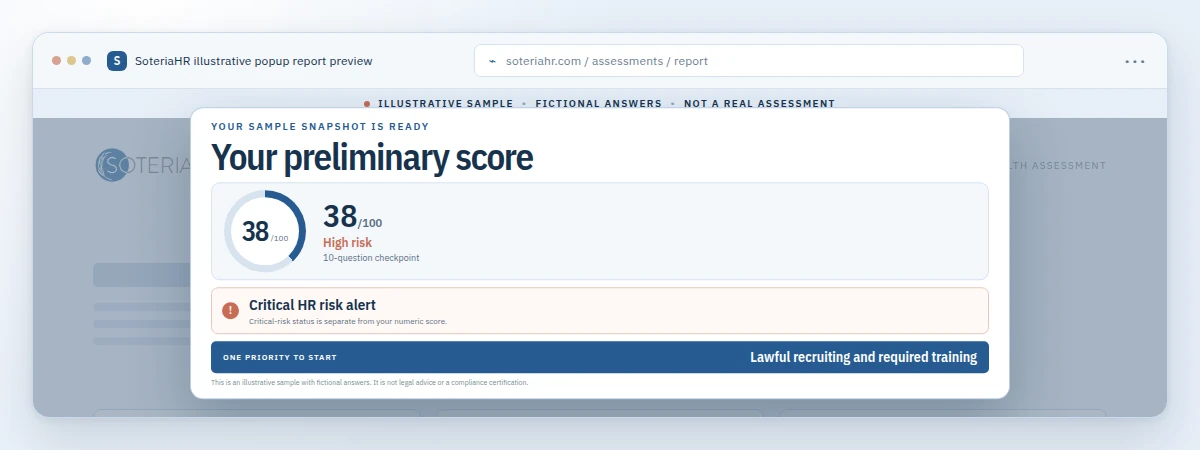
HR risk assessment services help growing companies spot compliance gaps, policy weaknesses, and liability exposure before they turn into costly claims. For founders, CEOs, and HR leaders juggling day-to-day operations, these organized reviews surface practical risk and point toward a clear fix. Soteria HR, based in Pasadena, California, works with employers across Los Angeles, Orange County, and nationwide to find these gaps and build processes that scale with the business.
Quick answer: HR risk assessment services are structured reviews of an organization’s HR practices, documentation, and policies that identify compliance gaps and liability exposure, then prioritize fixes by urgency. They are typically delivered by an outsourced HR consultant or firm, not an internal employee alone.
What Are HR Risk Assessment Services?
HR risk assessment services are, at their core, a diagnostic process. A consultant reviews documents such as employee handbooks, classification records, benefits files, and leave policies, then compares current practices against federal and state requirements. As a result, leadership receives a clear picture of where the organization stands and which issues deserve attention first.
Unlike a one-time compliance checklist, a thorough assessment also weighs likelihood and severity. For instance, a single outdated job posting is a minor issue, while systemic employee misclassification across a department carries far greater exposure. Consequently, a good risk assessment does not just list problems; it ranks them.

HR risk assessment services typically begin with a document and policy review.
Why Growing Businesses Need HR Risk Management Reviews
Informal HR practices often work fine for a ten-person team. However, as headcount grows past 20 or 50 employees, those same shortcuts can quietly become liabilities. New hires, new locations, and new benefits plans each introduce fresh compliance obligations.
According to the U.S. Department of Labor’s Wage and Hour Division, enforcement efforts recovered more than $273 million in back wages for over 200,000 workers in fiscal year 2022 alone. That figure illustrates how frequently wage and hour errors occur, even among employers who believe they are following the rules. In addition, the U.S. Equal Employment Opportunity Commission (EEOC) continues to receive tens of thousands of workplace discrimination charges every year, many tracing back to thin documentation or inconsistent policy enforcement.
Therefore, an HR risk management review is less about catching one big mistake and more about reducing the accumulated small gaps that create exposure over time. Readers who want a deeper foundation on this topic can review what HR risk management actually involves before moving into a formal assessment.
Key Areas Covered by HR Risk Assessment Services
Most assessments are organized around a handful of core categories. Specifically, reviewers typically examine the following areas in sequence.
Employee Classification and Wage Practices
Reviewers check whether employees are properly classified as exempt or non-exempt and whether independent contractor arrangements meet applicable tests. Misclassification remains one of the most common and expensive HR risks small employers face.
Policies, Handbooks, and Documentation
An outdated handbook or missing acknowledgment forms can weaken an employer’s position during a dispute. As a result, reviewers verify that policies reflect current law and that documentation is complete and consistently applied.
Benefits and Leave Compliance
Benefits administration touches ACA reporting, COBRA notices, Section 125 plans, and state leave laws. Each carries its own deadlines and penalties, so this area often surfaces during an HR compliance audit.
How the HR Risk Assessment Process Works
While every engagement is tailored to the organization, most HR risk assessment services follow a similar sequence of steps.
- Gather current HR documents. Collect existing employee handbooks, policies, job descriptions, and classification records so reviewers can compare current practices against legal requirements.
- Review classification and wage practices. Examine employee classifications, overtime calculations, and wage records to confirm they align with federal and state wage and hour rules.
- Audit benefits and leave compliance. Check benefits enrollment records, leave policies, and required notices against ACA, COBRA, and applicable state leave law obligations.
- Identify documentation gaps. Flag missing or outdated documentation, such as incomplete personnel files or expired required postings, that could create liability during an audit or claim.
- Build a prioritized action plan. Translate findings into a prioritized action plan with timelines, assigning responsibility for fixing the highest-risk issues first.
For a more detailed breakdown of tactics beyond the initial review, see these HR risk management strategies that organizations use once an assessment is complete.
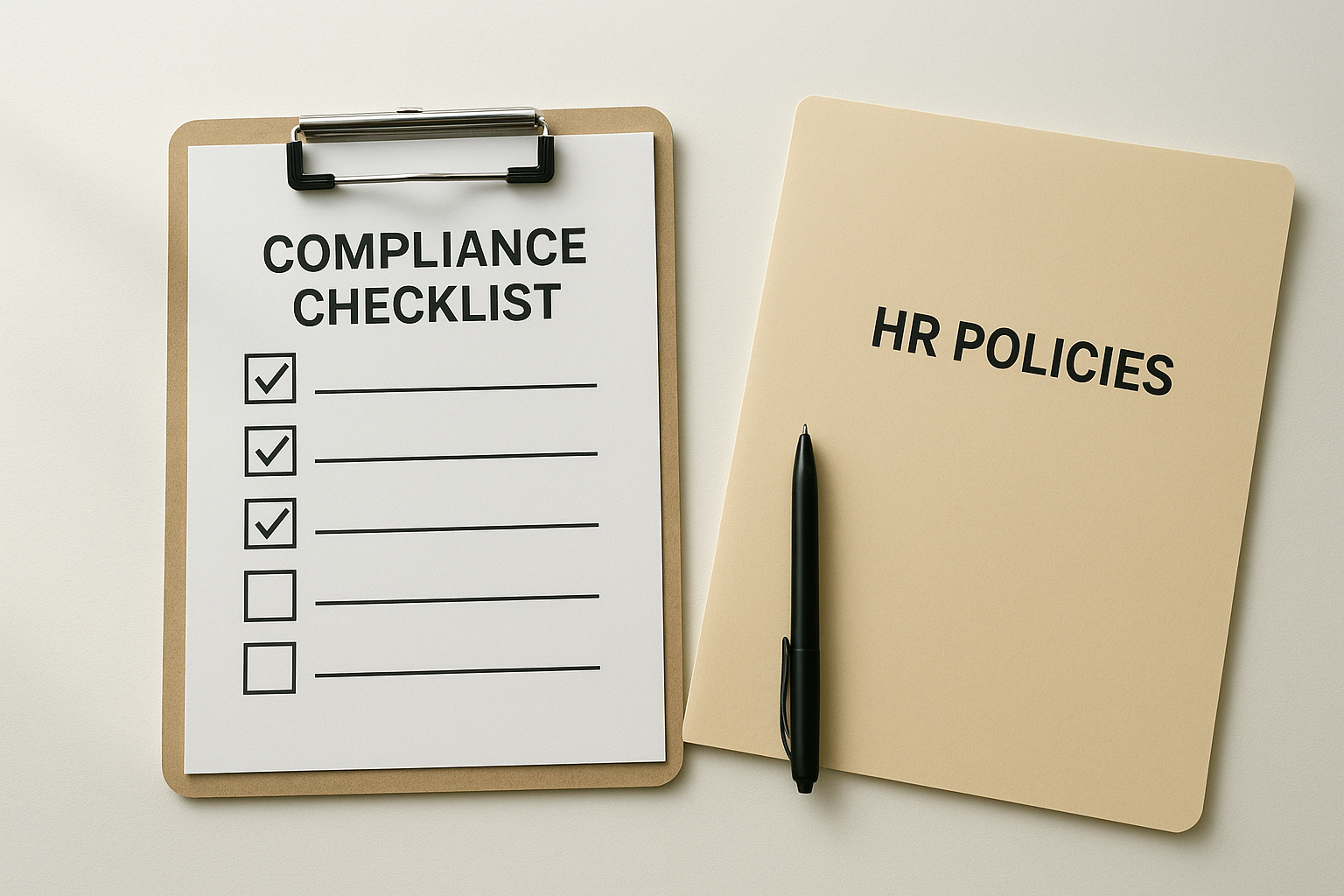
A written checklist keeps an HR risk assessment organized from start to finish.
HR Risk Assessment vs. HR Due Diligence: What’s the Difference?
These two terms overlap but are not identical. An HR risk assessment is typically an ongoing or periodic review of an operating business. HR due diligence, in contrast, usually happens during a specific event, such as a merger, acquisition, or major contract decision.
For example, a buyer evaluating a target company would use a HR due diligence checklist to confirm obligations before signing. Meanwhile, an existing employer runs a risk assessment simply to keep current practices aligned with changing law. Both processes share similar categories, but the triggering event and timing differ.
Signs Your Organization Needs an HR Risk Review
Certain situations tend to signal that a formal review is overdue. Rapid hiring, a recent complaint, expansion into a new state, or simply never having had an outside party review HR files are all common triggers.
Similarly, companies without a full-time HR department often carry more undetected risk, since compliance tasks get split across several roles without a single owner. This guide on managing compliance risks in HR walks through additional warning signs worth watching for.
How Soteria HR Supports HR Risk Assessment Services
Soteria HR delivers hands-on, outsourced HR support for small and mid-sized employers, generally those with roughly 10 to 250 employees, though that range is not a strict cutoff. Through HR administration, HR consulting, and benefits administration, the team identifies gaps and builds practical processes that grow with the organization.
For companies that prefer tailored support without co-employment, Soteria’s ASO (Administrative Services Organization) option provides HR guidance while the client remains the employer of record and retains responsibility for employment decisions. In addition, smaller organizations without an internal HR department can review these HR resources that reduce compliance risk as a starting point.
Before committing to a full engagement, leaders can take the free HR Health Assessment at soteriahr.ai, which includes a short Quick HR Check and a longer Complete HR Health Assessment. Results are self-reported and preliminary rather than a certification of compliance, but they help prioritize where a deeper conversation is worth having. Visit soteriahr.com to learn more, or call (800) 399-2458 to talk with an HR expert directly.

Sharing findings clearly is a core part of effective HR risk assessment services.
Frequently Asked Questions About HR Risk Assessment Services
What are HR risk assessment services?
HR risk assessment services are structured reviews of an organization’s HR practices, policies, and documentation that identify compliance gaps and liability exposure. They give leaders a prioritized list of risks and practical next steps to address them.
How do HR risk assessment services work?
An HR professional reviews documents such as handbooks, classification records, and leave policies, then compares current practices against applicable federal and state requirements. The result is a report that ranks issues by urgency and recommends fixes.
Why do growing businesses need HR risk assessment services?
As headcount grows, informal HR practices often cannot keep pace with legal requirements, creating blind spots. A risk assessment catches these gaps before they turn into claims, audits, or costly penalties.
What is the difference between an HR risk assessment and an HR audit?
An HR audit typically verifies that specific records and processes exist and are accurate, while a risk assessment also evaluates the likelihood and potential severity of exposure. Many engagements blend both approaches into one review.
How much do HR risk assessment services cost?
Cost varies based on company size, number of locations, and scope, so there is no universal flat rate. Many providers, including Soteria HR, start with a free preliminary assessment before scoping a paid, in-depth review.
How long does an HR risk assessment take?
A preliminary self-reported check can take as little as two minutes, while a full consultant-led assessment often takes one to three weeks depending on document availability and company complexity.
What common HR risks does an assessment uncover?
Common findings include misclassified employees, outdated handbooks, missing required notices, inconsistent leave administration, and incomplete personnel files. Benefits compliance gaps involving COBRA or ACA reporting also appear frequently.
What mistakes do companies make when skipping HR risk assessments?
Companies that skip regular reviews often rely on outdated templates or assume compliance without verification. This frequently leads to discovering problems only after a complaint, audit, or lawsuit has already started.
Who should conduct an HR risk assessment?
An experienced HR consultant or outsourced HR partner familiar with federal, state, and local requirements should lead the review. Internal teams can also participate, but an outside perspective often catches issues insiders overlook.
How often should a company repeat an HR risk assessment?
Most growing organizations benefit from a full review annually, with a lighter check after major changes such as rapid hiring, new locations, or benefits plan changes. Regulatory updates can also trigger an earlier review.
Can HR risk assessment services replace legal counsel?
No. HR risk assessment services identify and prioritize operational and compliance gaps, but they are not a substitute for legal advice on specific claims or disputes. Employers should involve qualified counsel for legal questions.
How does Soteria HR’s free HR Health Assessment relate to a full HR risk assessment?
The free HR Health Assessment at soteriahr.ai is a self-reported starting point that highlights potential gaps in minutes. It is not a certification of compliance, but it helps leaders decide where a deeper, consultant-led review is worth the investment.
Final Thoughts on Choosing HR Risk Assessment Services
In the end, HR risk assessment services give growing organizations something hard to build on their own: an objective, prioritized view of where compliance gaps actually sit. Rather than guessing which policy needs updating first, leaders get a clear roadmap tied to real exposure. Above all, the goal is not perfection but steady, informed progress toward lower risk.
If your organization has never had a formal review, or it has been more than a year since the last one, now is a reasonable time to start. You can call (800) 399-2458 to talk to an HR expert at Soteria HR, or begin with the free HR Health Assessment at soteriahr.ai to see where your priorities lie before committing to a deeper engagement.