HR compliance support is the practical help growing businesses need to keep up with federal, state, and local employment rules that govern hiring, pay, benefits, and workplace conduct. For founders and operations leaders juggling growth and daily operations, a single missed deadline can trigger fines, back-pay claims, or an unwanted lawsuit. Soteria HR, based in Pasadena and serving employers across Los Angeles, Orange County, and nationwide, works alongside leadership teams to close these gaps before they become expensive. This article explains what HR compliance support includes, why it matters, and how to tell when your organization needs more structured help.
What Is HR Compliance Support?
HR compliance support is the ongoing guidance, documentation, and administrative work that helps an employer meet its legal obligations under employment law. It covers areas such as wage and hour rules, anti-discrimination requirements, leave laws, benefits regulations, and recordkeeping. For small and mid-sized businesses without a dedicated compliance team, this support often comes from an outsourced HR partner, consultant, or an ASO (Administrative Services Organization) relationship, where the client remains the employer of record.
In practice, HR compliance support touches nearly every part of the employee lifecycle. For example, it includes classifying workers correctly under the Fair Labor Standards Act (FLSA), the federal law that sets minimum wage and overtime rules. It also includes maintaining documentation that would hold up if the Equal Employment Opportunity Commission (EEOC), the federal agency that investigates workplace discrimination complaints, ever opened an inquiry. According to the EEOC, more than 81,000 workplace discrimination charges were filed nationwide in a recent fiscal year, which shows just how common these disputes remain for employers of every size.

Reviewing policies regularly is a core part of ongoing HR compliance support.
Why Compliance Guidance Matters for Growing Businesses
As companies hire beyond the first 10 to 20 employees, informal processes stop working. Consequently, policies that worked fine for a five-person team can quietly create legal exposure once a business crosses certain headcount thresholds. For instance, many leave laws and reporting obligations only apply once a company reaches a specific employee count, so growth itself can trigger new requirements overnight.
In addition, growing businesses often expand into new states or cities, each with its own wage, leave, and notice requirements. Therefore, what satisfies California law may not satisfy requirements in another state where a remote employee lives. This is precisely where structured HR legal compliance guidance becomes valuable, since it helps leaders see the full picture instead of reacting to one issue at a time.
Common HR Compliance Risks for Small and Mid-Sized Employers
Several recurring risks show up across industries. Understanding them is the first step toward reducing exposure.
- Worker misclassification: Treating employees as independent contractors, or misclassifying exempt versus non-exempt status, can trigger back-pay and penalty claims.
- Outdated handbooks: Policies that do not reflect current leave, harassment, or wage laws leave gaps during disputes or audits.
- Benefits administration errors: Missed deadlines for COBRA (Consolidated Omnibus Budget Reconciliation Act) notices or ACA (Affordable Care Act) reporting can result in IRS penalties.
- Inconsistent recordkeeping: Missing personnel files, incomplete I-9 forms, or poor leave tracking make it hard to defend a claim later.
For a deeper breakdown of these risks, Soteria’s complete guide to managing HR compliance risks walks through practical mitigation steps for growing teams. Similarly, the U.S. Department of Labor publishes current wage and hour guidance that is worth bookmarking for quick reference.
How to Build a Strong HR Compliance Program
Building reliable compliance support does not happen overnight, but a structured process makes it manageable. Below is a general sequence many organizations follow.
- Audit current policies. Review existing handbooks, job descriptions, and classification records to identify outdated language or missing required policies before making any changes.
- Map applicable requirements. Identify which federal, state, and local employment laws apply based on employee count, location, and industry, since thresholds vary significantly by jurisdiction.
- Update handbooks and policies. Revise employee handbooks, leave policies, and benefit documents to reflect current legal requirements, then distribute updated versions with signed acknowledgment forms.
- Train managers and staff. Provide training on updated policies, harassment prevention, and reporting procedures so the workforce understands new expectations clearly.
- Monitor and review regularly. Schedule periodic reviews, at least annually, to catch new legal changes and adjust HR compliance support before small issues grow into larger legal risks.

A structured, step-by-step process makes HR compliance support repeatable instead of reactive.
HR Compliance Support vs. Managing Compliance Alone
Some leaders try to manage compliance internally using templates found online. However, this approach often misses jurisdiction-specific nuances, especially in states like California where requirements change frequently through the Civil Rights Department and Department of Industrial Relations. In contrast, outsourced support brings ongoing monitoring, so updates happen proactively rather than after a complaint arrives.
As a result, many growing employers find it more efficient to combine internal oversight with outside expertise. This is explored further in Soteria’s article on human resource management as an ally for small businesses, which outlines how outsourced partnerships complement, rather than replace, internal leadership.
Signs Your Business Needs HR Compliance Support
Certain signals suggest it is time to get outside help. Specifically, watch for frequent employee complaints, recent rapid headcount growth, multi-state hiring, or an upcoming benefits renewal with unclear compliance obligations. Above all, if no one on staff can confidently answer a basic wage-and-hour question, that is a clear sign HR compliance support is overdue.
How Soteria HR Delivers HR Compliance Support
Soteria HR provides hands-on outsourced HR services built specifically for growing small and mid-sized organizations. Core offerings include HR administration, HR consulting, and benefits administration, each tailored to the size and needs of the client. For businesses that want dedicated support without co-employment, the ASO option keeps the client as the employer while Soteria handles the administrative heavy lifting.
Furthermore, Soteria supports both companies without an internal HR department and those with an existing team that needs extra capacity. This flexible model has proven useful for employers in varied sectors, including the specific challenges covered in how HR consulting helps a manufacturing company manage shift-based compliance issues. Employees themselves also benefit from clearer policies, a topic explored in Soteria’s piece on human resources for employees.
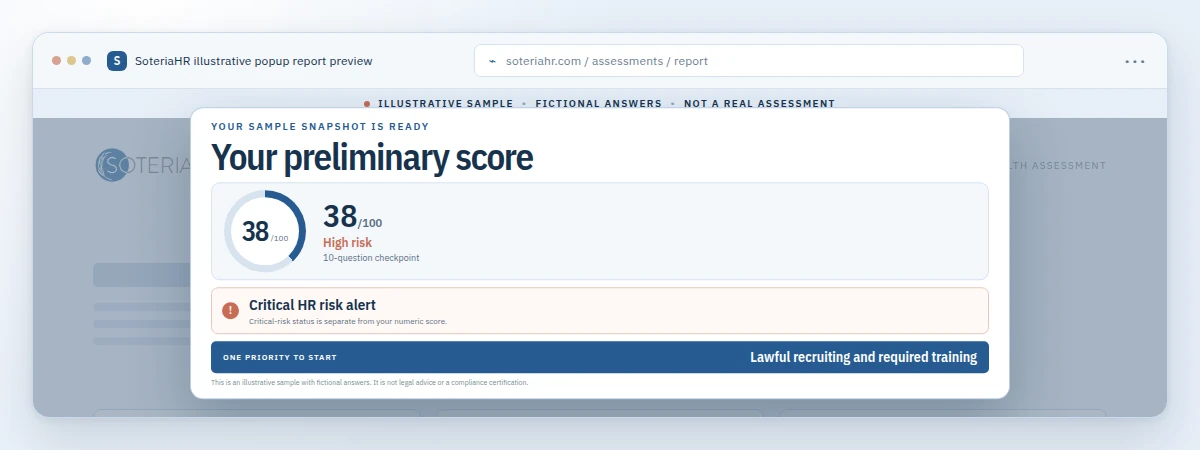
For organizations unsure where to start, Soteria offers a free HR Health Assessment at soteriahr.ai, including a quick 10-question check and a more detailed 40-question version. Results are self-reported and preliminary, not a certified compliance audit, but they help identify priorities worth discussing. To move forward, visit Soteria HR or call (800) 399-2458 to talk with an HR expert about a tailored plan.
Frequently Asked Questions About HR Compliance Support
What is HR compliance support?
HR compliance support is the ongoing guidance, documentation, and administrative work that helps an employer meet legal obligations tied to employment, such as wage and hour rules, anti-discrimination laws, leave requirements, and benefits regulations. It is often delivered by an outsourced HR partner, consultant, or ASO relationship.
How does HR compliance support differ from general HR administration?
HR administration covers day-to-day tasks like onboarding and recordkeeping, while HR compliance support focuses specifically on meeting legal and regulatory requirements. In practice, the two overlap because compliant recordkeeping is part of daily HR administration.
Why do small businesses need HR compliance support?
Small businesses often lack a dedicated compliance specialist, which increases the risk of missed deadlines, outdated policies, and legal exposure. HR compliance support helps close these gaps without requiring a full internal HR department.
How much does HR compliance support cost?
Cost varies based on company size, scope, and whether support is bundled with broader HR administration or consulting services. Most outsourced providers tailor pricing to the engagement, so a consultation is the best way to get an accurate estimate.
How long does it take to set up HR compliance support?
An initial compliance review typically takes a few weeks, depending on company size and how many policies need updating. Ongoing support then continues as laws change and the business grows.
What are common HR compliance mistakes employers make?
Common mistakes include misclassifying employees as independent contractors, relying on outdated handbooks, and failing to track required leave and overtime records. These errors often surface during an audit, complaint, or lawsuit.
What federal laws are most relevant to HR compliance?
Key federal laws include the Fair Labor Standards Act for wage and overtime rules, Title VII enforced by the EEOC for anti-discrimination protections, and COBRA for continued health coverage. State and local laws often add further requirements on top of these.
Does HR compliance support replace an internal HR team?
No, HR compliance support is designed to complement existing teams or fill gaps for businesses without a dedicated HR department. Many organizations use outsourced support alongside an internal HR generalist or office manager.
What is the difference between an ASO and a PEO for compliance purposes?
An Administrative Services Organization (ASO) provides HR support while the client remains the employer of record and keeps responsibility for employment decisions. A PEO typically involves co-employment, which shifts certain employer responsibilities to the PEO.
How often should HR policies be reviewed for compliance?
Most employers should review handbooks and core policies at least once a year, and sooner whenever a significant law changes. California employers, for example, frequently need updates due to the state’s active legislative calendar.
Can HR compliance support help with state-specific laws like California’s?
Yes, HR compliance support can address state-specific requirements, including those from California’s Civil Rights Department and Department of Industrial Relations. This is especially useful for multi-state employers managing varying rules.
What happens if a business ignores HR compliance requirements?
Ignoring compliance requirements can lead to government fines, back-pay claims, employee lawsuits, and reputational damage. In some cases, penalties accrue per violation or per affected employee, which can escalate quickly.

A consistent partnership makes HR compliance support sustainable as the business grows.
Key Takeaways
In summary, HR compliance support gives growing businesses the structure needed to meet wage, leave, benefits, and anti-discrimination requirements without building a full internal compliance team. As companies add employees or expand into new states, the risks of outdated policies and missed deadlines grow alongside them. Therefore, a proactive approach, whether through an internal review process or an outsourced ASO partnership, tends to cost far less than reacting to a complaint or audit after the fact. Soteria HR works with founders, operations leaders, and existing HR teams across Pasadena, Los Angeles, Orange County, and nationwide to provide this kind of ongoing HR compliance support. To find out where your organization stands, consider starting with the free HR Health Assessment at soteriahr.ai, or call (800) 399-2458 to talk with an HR expert directly.