Compliance-driven HR practices are the foundation that keeps growing businesses out of legal trouble while they scale. Rather than reacting to a complaint or a government notice after the fact, employers who build compliance into everyday HR operations catch problems early and apply policies consistently. For founders, CEOs, and operations leaders juggling dozens of priorities, this distinction often determines whether HR becomes a liability or a growth enabler.
Quick answer: Compliance-driven HR practices are HR policies and procedures designed around current employment law requirements, documented consistently, and monitored over time. They differ from reactive HR management, which only addresses problems after they surface. Organizations without a full HR department are especially exposed to gaps, which is why many partner with an outsourced HR team to build and maintain this kind of structure.
What Are Compliance-Driven HR Practices?
Compliance-driven HR practices are HR policies and procedures built around applicable federal, state, and local employment laws from the start, rather than assembled after an audit or complaint forces the issue. In practice, this means handbooks, pay practices, hiring workflows, and leave policies are written to reflect current legal requirements and applied the same way for every employee.
For example, a compliance-driven approach to overtime means job classifications are reviewed against U.S. Department of Labor wage and hour standards (dol.gov) before a position is filled, not after a worker files a wage claim. Similarly, anti-discrimination policies are drafted with current Equal Employment Opportunity Commission guidance in mind (eeoc.gov), instead of being rewritten only after a charge is filed.

Reviewing policy documents regularly is a core habit behind compliance-driven HR practices.
Why Compliance-Focused HR Strategies Matter for Growing Employers
As a company grows past 10, 50, or 100 employees, new legal thresholds often apply automatically. Consequently, policies that worked fine for a 10-person team can become liabilities once headcount increases. For instance, certain federal leave and reporting obligations only apply once an employer reaches specific employee counts, and missing that transition point is a common and costly mistake.
Furthermore, inconsistent enforcement of existing policies creates risk even without new legal thresholds. If one manager disciplines an employee for an infraction while another lets it slide, the company has effectively created an unwritten, inconsistent policy that can be used as evidence in a discrimination claim. Therefore, compliance-focused HR strategies are not just about knowing the law; they are about applying it the same way, every time, across every department.
Growing organizations without a dedicated internal HR department face this risk most acutely, since no one owns the job of tracking regulatory change full time. As a result, many turn to outsourced HR administration and consulting to fill that gap before it becomes expensive.
Core Elements of Compliance-Driven HR Practices
In particular, five areas consistently separate compliant HR operations from reactive ones:
| Element | Why It Matters |
|---|---|
| Updated employee handbooks | Reflects current law and sets clear, documented expectations |
| Accurate worker classification | Prevents overtime and benefits eligibility disputes |
| Consistent leave tracking | Supports obligations under applicable leave laws |
| Documented performance records | Provides evidence of fair, consistent treatment |
| Benefits plan compliance | Addresses ACA, COBRA, and plan-document requirements |
Each of these elements connects to a broader HR compliance management system. For a deeper look at practical tools that reduce exposure, Soteria’s guide on HR resources that reduce compliance risk outlines specific resources small companies can use right away.
How to Build Compliance-Driven HR Practices in 5 Steps
Building this kind of structure does not happen overnight, but it also does not require a massive internal department. The following sequence reflects the general process many growing employers follow:
- Audit current HR policies. Review existing employee handbooks, job classifications, and pay practices against current federal and state requirements to identify specific gaps and outdated language.
- Update documentation. Revise employee handbooks, offer letters, and leave policies so they reflect current law and apply consistently across every department and location.
- Train managers on consistent application. Teach frontline managers and supervisors how to apply updated policies consistently during hiring, discipline, and termination decisions to avoid uneven enforcement.
- Monitor regulatory changes. Assign ongoing responsibility for tracking new federal, state, and local employment law changes so policies can be updated before deadlines take effect.
- Partner with HR experts for ongoing review. Work with an outsourced HR consultant or administrator to periodically review processes, catch emerging risks, and keep compliance-driven HR practices current as the business grows.
Notably, step five is where many growing companies get stuck, simply because tracking changing laws is a full-time job on its own. Soteria’s overview on how HR ensures compliance with changing laws explains what this monitoring work actually involves day to day.

A structured review process helps leaders put compliance-driven HR practices into action step by step.
Common HR Compliance Mistakes That Put Businesses at Risk
Even well-intentioned employers fall into predictable traps. Specifically, the most common mistakes include outdated handbooks that reference repealed laws, misclassifying workers as exempt when their duties do not qualify, and allowing managers to apply discipline inconsistently across similar situations.
In addition, many companies treat benefits administration as a one-time setup task rather than an ongoing responsibility. However, requirements tied to ACA reporting, COBRA notices, and Section 125 plan documents require continuous attention as employee counts and plan years change. Similarly, businesses that scale quickly across state lines often fail to adjust policies for jurisdiction-specific rules, such as California’s distinct wage and leave requirements, which are tracked by the California Department of Industrial Relations (dir.ca.gov).
According to the U.S. Chamber of Commerce, small businesses are disproportionately affected by employment-related litigation costs because they often lack dedicated compliance staff. For a broader list of risk areas, Soteria’s resource on managing HR compliance risks breaks down additional blind spots worth checking.
Compliance-Driven HR Administration vs. Reactive HR Management
The core difference comes down to timing. Compliance-driven HR administration builds review and monitoring into daily operations before a problem occurs, while reactive HR management waits for a complaint, audit, or lawsuit to trigger action. Both approaches eventually address the same issues, but the cost difference is significant.
For example, updating an outdated leave policy proactively might take a few hours of review time. In contrast, correcting the same gap after a denied-leave complaint can involve legal fees, back pay, and reputational damage. As a result, most HR professionals recommend treating compliance as an ongoing process rather than an annual checklist item. Soteria’s comparison of available support options at what resources are available for HR compliance issues covers this distinction in more detail.
How Soteria HR Supports Compliance-Driven HR Practices
Soteria HR, based in Pasadena, California, works with employers across Los Angeles, Orange County, and nationwide to build compliance-driven HR practices without requiring a full in-house HR department. Core services include HR administration for daily workflows like onboarding and leave coordination, HR consulting for policy and workforce planning decisions, and benefits administration for enrollment and plan-document support.
For organizations that want tailored HR support without co-employment, Soteria also offers an Administrative Services Organization (ASO) option, where the client remains the employer of record and retains responsibility for employment decisions. This structure allows growing companies to access dedicated HR expertise while keeping full control over their workforce. More detail on this model is available on Soteria’s HR compliance services page.
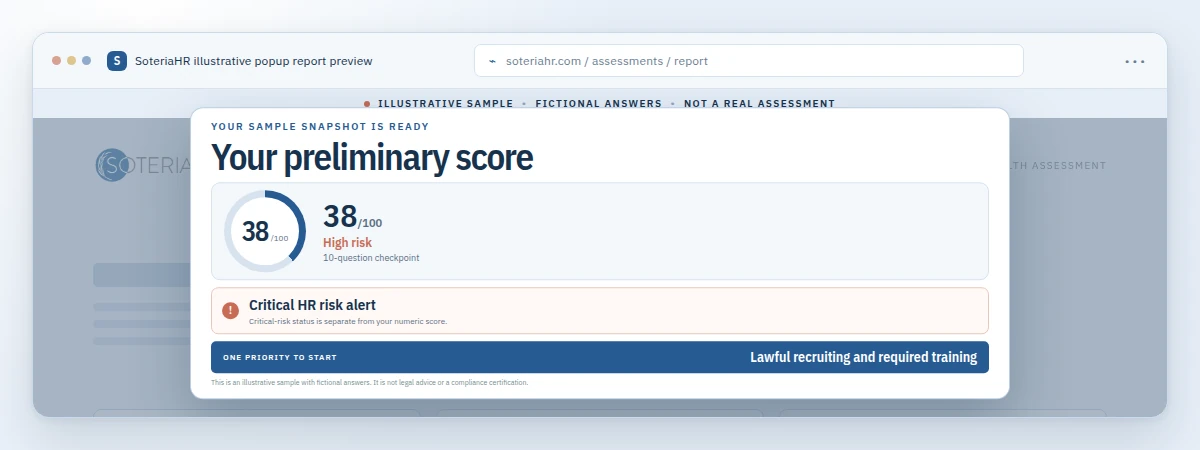
Above all, Soteria’s goal is a supportive, ongoing partnership. As the team puts it, “We’ve got your back—so you can focus on growth.” A good starting point for any leader unsure where their current gaps lie is the free HR Health Assessment, which includes a 10-question Quick HR Check and a longer Complete HR Health Assessment. Results are self-reported and preliminary, not a certification of compliance, but they offer a useful starting point for a deeper conversation. You can also learn more about the company’s full range of services at soteriahr.com.

Up-to-date documentation is the backbone of compliance-driven HR practices at any growing company.
Frequently Asked Questions About Compliance-Driven HR Practices
What are compliance-driven HR practices?
Compliance-driven HR practices are HR policies and procedures built around applicable federal, state, and local employment laws rather than created after a problem occurs. They cover hiring, pay, leave, safety, and termination decisions, and they are documented so the organization can show consistent application.
How do compliance-driven HR practices reduce legal risk?
They reduce risk by catching gaps, such as outdated handbook language or missing wage notices, before a regulator or employee raises a complaint. Consistent documentation also gives an employer evidence of good-faith effort if a dispute does arise.
What laws should compliance-driven HR practices address?
At minimum, employers should address wage and hour rules, anti-discrimination requirements, leave entitlements, workplace safety, and benefits regulations that apply in their jurisdiction. Requirements vary by state and employee count, so thresholds should be confirmed against current official sources.
How much does it cost to implement compliance-driven HR practices?
Costs vary widely depending on company size, existing HR infrastructure, and whether the work is handled internally or through an outsourced partner. Many growing employers find that outsourced HR administration and consulting cost less than the fines, turnover, or litigation tied to unresolved compliance gaps.
How long does it take to build compliant HR processes?
A focused HR audit and handbook update can often be completed within a few weeks, while fully embedding compliance-driven HR practices across hiring, pay, and performance management typically takes a few months. The timeline depends on company size and how many policies need revision.
What is the difference between compliance-driven HR and reactive HR management?
Compliance-driven HR builds policies and monitoring into everyday operations before issues arise, while reactive HR management addresses problems only after a complaint, audit, or lawsuit surfaces them. The first approach is proactive and preventive; the second is responsive and typically more costly.
What are common mistakes businesses make with HR compliance?
Common mistakes include using outdated employee handbooks, misclassifying workers, inconsistent disciplinary documentation, and failing to track leave or overtime accurately. Many of these mistakes happen simply because no one owns compliance monitoring as an ongoing responsibility.
Do small businesses need compliance-driven HR practices?
Yes, small businesses are often held to many of the same wage, safety, and anti-discrimination requirements as larger employers once they cross certain employee-count thresholds. Growing organizations without a dedicated HR department are especially exposed because no one is monitoring regulatory changes full time.
How can an outsourced HR partner help with compliance?
An outsourced HR partner brings dedicated expertise to monitor regulatory changes, update policies, and manage day-to-day HR administration so internal leaders can focus on running the business. This support can be delivered through an Administrative Services Organization, or ASO, model where the client remains the employer of record.
What is an HR Health Assessment?
An HR Health Assessment is a self-reported questionnaire that helps employers identify potential gaps in their current HR practices and priorities for improvement. It is a preliminary screening tool, not a certification of legal compliance or a substitute for a professional audit.
How often should HR policies be reviewed for compliance?
Most employers should review core HR policies at least annually, with additional reviews whenever a significant law changes or the company grows past a new employee-count threshold. Handbooks, pay practices, and leave policies are the areas most frequently affected by new regulations.
What happens if a business ignores HR compliance requirements?
Ignoring HR compliance requirements can lead to government fines, back-pay liability, employee lawsuits, and reputational damage that affects hiring and retention. In many cases, the cost of correcting a violation after the fact is significantly higher than the cost of preventing it.
Can compliance-driven HR practices improve employee retention?
Yes, employees tend to trust employers who apply policies consistently and communicate expectations clearly, which supports engagement and retention. Compliance-driven HR practices also reduce the workplace tension that often comes from inconsistent discipline or unclear leave handling.
Is HR compliance the same in every state?
No, HR compliance requirements vary significantly by state and even by city or county in some cases, particularly around minimum wage, paid leave, and anti-discrimination protections. Employers with workers in multiple states need policies that account for each applicable jurisdiction.
How do I get started with compliance-driven HR practices at my company?
A good starting point is an honest review of current policies, documentation, and known gaps, which a free HR Health Assessment can help surface. From there, a consultation with an HR expert can turn the findings into a practical action plan.
Final Thoughts
Ultimately, compliance-driven HR practices are less about avoiding worst-case scenarios and more about building a stable foundation that supports growth. Companies that document policies clearly, apply them consistently, and monitor regulatory changes put themselves in a far stronger position than those scrambling to react after a complaint arrives. Whether a business is managing its first 10 hires or scaling past 250 employees, the principle stays the same: proactive HR structure costs less than reactive cleanup.
If your organization is unsure where its current gaps lie, Soteria HR’s free HR Health Assessment at soteriahr.ai is a practical first step, and the team is ready to talk through the results. To speak with an HR expert directly, call (800) 399-2458 or submit a consultation request through soteriahr.com.