The employee onboarding definition matters more than most growing companies realize, because it shapes whether a new hire becomes a confident contributor or a confused, disengaged risk within the first 90 days. At Soteria HR, we work with small and mid-sized teams every day who assume onboarding simply means “paperwork and a laptop.” However, that narrow view leaves compliance gaps, cultural misalignment, and turnover on the table. This guide breaks down what employee onboarding truly means, how it differs from orientation, and how you can build a definition that actually protects your business.
Quick answer: Employee onboarding is the structured process of integrating a new hire into an organization, covering compliance paperwork, job training, and cultural alignment, and it typically runs from the offer stage through the first 90 days or longer.
What Is the Employee Onboarding Definition?
The employee onboarding definition is best understood as the standard description HR professionals use for how a company structures the integration of a new hire. Specifically, it covers four connected pieces: legal paperwork, role training, performance expectations, and cultural orientation. In contrast to a single first-day event, onboarding is a process that stretches over weeks or months.
According to research from Gallup, only 12% of employees strongly agree that their organization does a great job of onboarding new employees. Therefore, most companies are working with an incomplete or outdated definition, even when they believe their process is solid. Above all, a written definition forces leaders to agree on what “done” looks like, rather than relying on tribal knowledge that disappears when a manager leaves.
For growing businesses without a dedicated HR department, this gap is especially risky. As a result, tasks like benefits enrollment deadlines or handbook acknowledgment sometimes fall through the cracks entirely.

A clear employee onboarding definition turns a vague first day into a guided process both parties understand.
Onboarding vs. Orientation: Why the Definitions Get Confused
Many leaders use “onboarding” and “orientation” interchangeably, which muddies the real employee onboarding definition. In particular, orientation is a single event, usually the first day or two, focused on paperwork, building access, and introductions. Onboarding, meanwhile, is the longer process that wraps around orientation and continues for months.
| Aspect | Orientation | Onboarding |
|---|---|---|
| Duration | One day or less | 90 days to a year |
| Focus | Paperwork, logistics | Training, culture, performance |
| Owner | HR or office manager | HR and hiring manager together |
Consequently, when a company’s onboarding process definition stops at orientation, new hires are left to figure out expectations on their own. For a deeper look at how these terms differ in practice, our team explores the topic further in this companion breakdown of what onboarding really means.
Why a Clear Onboarding Definition Matters for Compliance and Risk
A precise employee onboarding definition is not just an HR nicety; it is a risk management tool. Every new hire triggers legal deadlines, including federal Form I-9 verification through the U.S. Citizenship and Immigration Services, Form W-4 tax withholding, and state new-hire reporting requirements. Missing these steps can expose a company to fines regardless of its size.
The Legal Building Blocks Inside Every Onboarding Plan
In addition to I-9 and W-4 forms, many states require specific wage or benefits notices at hire, and multi-state employers must track different rules for each location. Similarly, employee handbook acknowledgment should be documented in writing to reduce disputes later. As a result, treating these steps as part of the core onboarding definition, rather than an afterthought, protects the business from avoidable legal exposure.
For companies without in-house compliance expertise, this is exactly where an outsourced HR partner like Soteria HR adds value, tracking deadlines and building compliant checklists so nothing is left to memory.
The Stages of Employee Onboarding: A Practical Timeline
Understanding the onboarding timeline helps turn an abstract definition into daily action. Most HR professionals break the process into four stages, each building on the last.
- Pre-boarding: Everything between the signed offer and day one, including paperwork, equipment setup, and a welcome message.
- Orientation: Day one activities covering policies, introductions, and workspace setup.
- Role integration: The first 30 to 60 days of hands-on training, shadowing, and skill building.
- Performance alignment: The 90-day mark, where managers confirm expectations are clear and goals are on track.
Notably, some organizations extend a fifth stage through the one-year anniversary to reinforce retention. Our detailed new-hire onboarding checklist walks through each of these stages task by task.
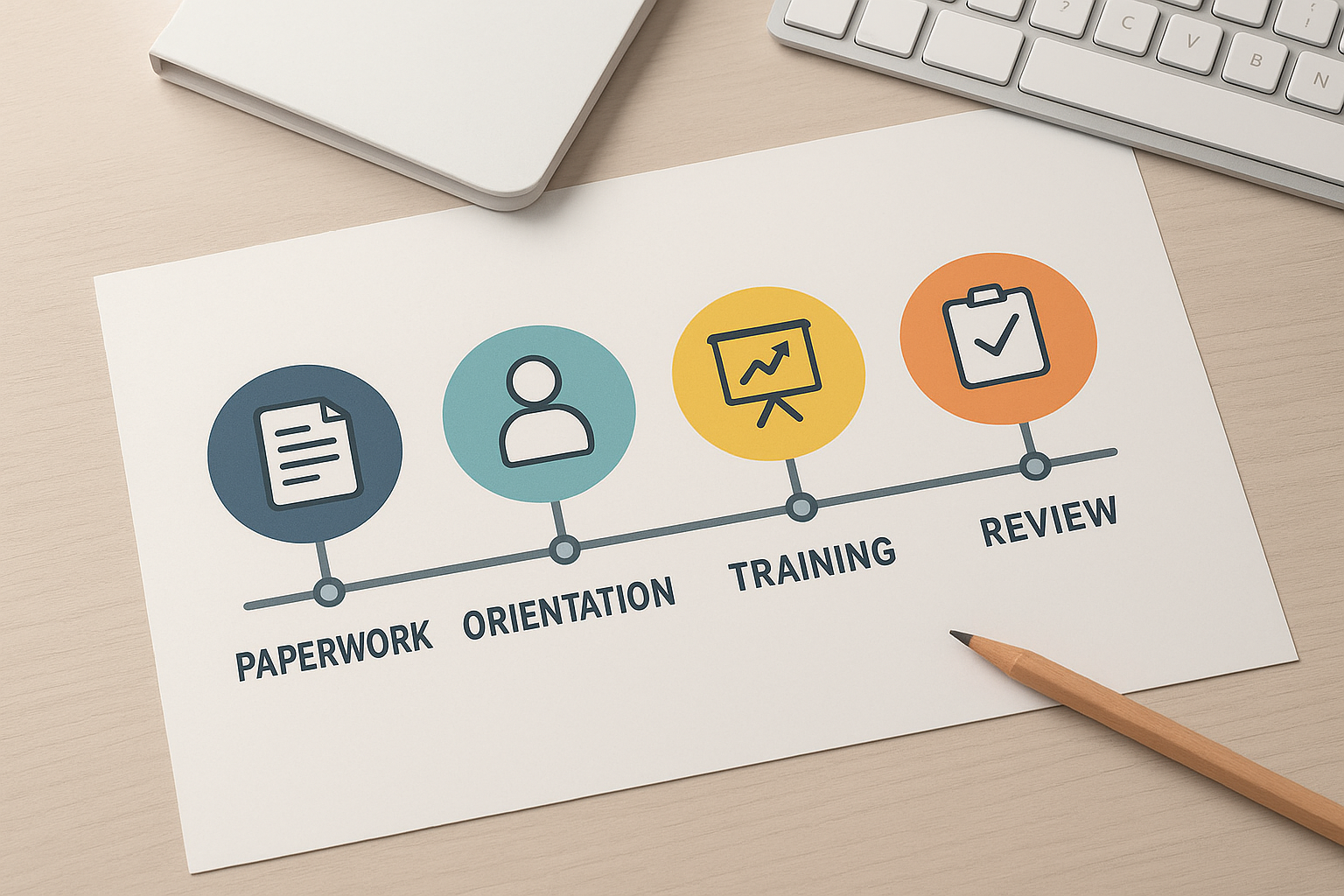
Breaking the onboarding process into stages makes the abstract definition measurable and repeatable.
How to Build Your Own Employee Onboarding Definition
Rather than borrowing a generic template, growing companies get the best results by writing an onboarding definition tailored to their own compliance obligations and culture. The following steps outline a practical path.
1. Map the full timeline
Outline every stage from the signed offer letter through the first 90 days, including who is responsible for each task and when it must be completed.
2. List every compliance requirement
Identify federal forms like the I-9 and W-4, plus state-specific new-hire reporting and notices, and assign firm deadlines so nothing is missed after the start date.
3. Document role-specific training
Write down the skills, systems, and shadowing sessions each role requires during the first 30 to 60 days so training stays consistent no matter who is hired.
4. Build in culture and connection
Schedule introductions, mentor pairings, and team touchpoints so new hires understand company values and feel connected beyond their immediate task list.
5. Set check-in points and metrics
Plan structured feedback conversations at 30, 60, and 90 days, and track retention and productivity metrics to confirm the onboarding definition works in practice. For a broader framework, review our full employee onboarding process guide.
Common Mistakes That Blur the Onboarding Definition
Even well-intentioned teams fall into predictable traps. For instance, treating onboarding as a one-day event is the single most common mistake, since it skips role training and cultural context entirely. Similarly, failing to assign clear ownership between HR and the hiring manager often leads to dropped tasks.
In addition, many companies never revisit their onboarding definition as they grow, so a process built for five employees breaks down at fifty. Our article on avoiding an onboarding wipeout covers several of these warning signs in more detail. Above all, skipping structured feedback check-ins leaves managers unaware that a new hire is struggling until it is too late to course-correct.
Measuring Whether Your Onboarding Definition Works
A definition only matters if it produces results. Therefore, track a handful of core metrics: 90-day retention rate, time to full productivity, and new-hire satisfaction survey scores. Research referenced by the Society for Human Resource Management suggests structured onboarding programs can meaningfully improve both retention and productivity compared to informal approaches.
Consequently, if turnover spikes within the first six months, that is a strong signal the written onboarding process definition and the lived experience have drifted apart. Reviewing these numbers quarterly, rather than annually, helps growing teams catch problems while they are still easy to fix. Our overview of what employee onboarding really involves includes additional benchmarks worth tracking.
Frequently Asked Questions About Employee Onboarding Definition
What is the employee onboarding definition in simple terms?
The employee onboarding definition describes the structured process of integrating a new hire into a company, covering paperwork, compliance, job training, and culture. It typically runs from the offer stage through the first 90 days or longer, not just the first day.
How is onboarding different from orientation?
Orientation is usually a single event covering paperwork and introductions, while onboarding is an extended process that includes training, mentorship, and performance check-ins. Orientation is one piece inside the broader onboarding timeline.
How long should employee onboarding last?
Most HR experts recommend onboarding last at least 90 days, with many organizations extending structured check-ins through the first year. Shorter onboarding tends to leave compliance gaps and lower long-term retention.
What are the main phases of onboarding?
Onboarding typically includes pre-boarding before day one, orientation on day one, role-specific training through the first 30 to 60 days, and integration or performance review by day 90. Some companies extend a final phase through the one-year mark.
Why does a clear onboarding definition matter for small businesses?
A clear definition prevents missed compliance steps, such as I-9 verification or state new-hire reporting, that can trigger fines. It also sets consistent expectations so new hires ramp up faster regardless of who manages their start date.
What documents are legally required during onboarding?
Employers must generally complete Form I-9, Form W-4, applicable state tax forms, and new-hire state reporting within set deadlines. Depending on the state, additional notices about wages, benefits, or workplace rights may also be required.
How much does poor onboarding cost a company?
Poor onboarding contributes to early turnover, and replacing an employee can cost between 50% and 200% of that person’s annual salary depending on the role. Lost productivity and rehiring time add further hidden expenses.
What is the most common onboarding mistake?
The most common mistake is treating onboarding as a one-day event limited to paperwork instead of a 90-day process. This leaves new hires without the training, feedback, and cultural context they need to succeed.
Who should own the onboarding process?
HR typically owns compliance paperwork and scheduling, while the hiring manager owns role training and goal setting. Growing companies without dedicated HR often share this responsibility, which is where outsourced HR support helps close gaps.
Can onboarding be done remotely?
Yes, remote onboarding works well when companies use video introductions, digital document signing, and scheduled virtual check-ins. However, it requires more intentional planning to replace the informal learning that happens in person.
What metrics show onboarding is working?
Common metrics include 90-day retention rate, time to full productivity, new-hire satisfaction survey scores, and manager feedback on readiness. Tracking these over time reveals whether the onboarding definition in practice matches the plan on paper.
How does outsourced HR help with onboarding?
Outsourced HR partners build compliant onboarding checklists, track legal deadlines, and design training timelines so growing companies do not have to build this expertise in-house. This reduces compliance risk while freeing leaders to focus on the business.
Is an employee handbook part of the onboarding definition?
Yes, most definitions of onboarding include delivering and acknowledging the employee handbook during the first week. This step documents policy awareness and reduces legal exposure if disputes arise later.

A well-defined onboarding process turns a new hire’s first weeks into genuine team integration.
Final Thoughts on the Employee Onboarding Definition
In summary, the employee onboarding definition goes far beyond a first-day checklist; it is a structured, compliance-aware process that spans months and shapes whether a new hire thrives. As a result, companies that document their onboarding timeline, assign clear ownership, and track retention metrics consistently see stronger performance and lower turnover. Whether you are refining an existing program or building one from scratch, a written definition protects your business from legal risk while giving new employees the foundation they need to succeed. If your growing team needs help turning this definition into a working program, talk to an HR expert at Soteria HR to build an onboarding process that fits your stage of growth.