HR admin services help growing businesses handle the day-to-day people tasks—onboarding, payroll coordination, benefits administration, and compliance recordkeeping—so leaders can focus on running the business instead of chasing paperwork. For companies between 10 and 250 employees, this kind of support often marks the turning point between reactive scrambling and a stable, well-run workplace. In particular, it’s the bridge between “we’re too big to wing it” and “we’re not ready for a full internal HR department.”
Quick answer: HR admin services are outsourced solutions that manage the operational side of human resources—onboarding, benefits, records, payroll coordination, and compliance tracking—so growing companies stay organized and legally protected without hiring a full HR staff.
What Are HR Admin Services?
HR admin services is the term for outsourced or supplemental support that manages the administrative backbone of human resources. Specifically, this includes maintaining employee files, tracking benefits enrollment, coordinating payroll data, and keeping policies current with the law. Unlike a full internal HR department, these services scale up or down based on what a business actually needs.
For a deeper breakdown of what falls under this umbrella, Soteria HR’s guide on what HR administration actually involves is a useful starting point. As a result, business owners often realize they’ve been informally doing HR admin work themselves—usually not very efficiently.
Why Growing Businesses Need Hands-On HR Administration Support
As a company grows past ten or fifteen employees, informal HR processes start to break down. Consequently, small oversights—like a missed benefits deadline or an outdated handbook—can turn into real financial and legal exposure. According to research summarized by the Society for Human Resource Management (SHRM), administrative tasks can consume 40% or more of a manager’s time in businesses without dedicated HR support.
In addition, employment law changes constantly at both the federal and state level. The U.S. Department of Labor regularly updates wage, overtime, and classification rules, and businesses without a compliance-focused partner often find out about changes only after a violation occurs. That’s precisely where HR admin services earn their value—by catching issues before they escalate.

HR admin services give growing businesses a structured way to manage compliance and employee records.
Core Components of HR Admin Services
Most HR admin services packages share a common foundation, even though the exact scope varies by provider. Below are the pieces that typically show up in a well-rounded offering:
- Onboarding and offboarding administration — paperwork, system setup, and exit processes handled correctly and consistently.
- Benefits management — enrollment, renewals, and vendor coordination for health and retirement plans.
- Compliance monitoring — tracking labor law changes and updating policies before they become violations.
- Employee recordkeeping — secure, organized files that are audit-ready at any time.
- Payroll coordination — accurate data flow between HR and payroll systems.
Soteria HR’s HR administration services page outlines how these pieces come together as one connected system rather than a patchwork of disconnected tasks.
HR Administration Tasks vs. Strategic HR Consulting
It’s worth noting that HR admin services are not the same as strategic HR consulting, though the two often work best together. Administration handles the transactional work—filing, tracking, updating—while strategy focuses on culture, leadership development, and workforce planning. In practice, a business often starts with admin support and grows into strategic guidance as its needs mature.
How Outsourced HR Admin Services Work
Wondering what the actual process looks like once you bring in outside help? Here’s a typical rollout, step by step:
- Assess current HR gaps. The provider reviews existing policies, employee files, payroll processes, and compliance status to identify risks before any work begins.
- Build a custom HR admin plan. Based on the assessment, the provider creates a tailored scope covering onboarding, benefits, recordkeeping, and compliance specific to your business.
- Integrate with existing systems. The team connects with your payroll platform and benefits carriers so data flows accurately without duplicating work.
- Provide ongoing support and monitoring. The provider manages daily tasks and tracks regulatory changes so you stay protected as the business grows.
For businesses trying to decide exactly which tasks to hand off first, Soteria HR’s complete guide to HR admin tasks breaks this down in more detail.
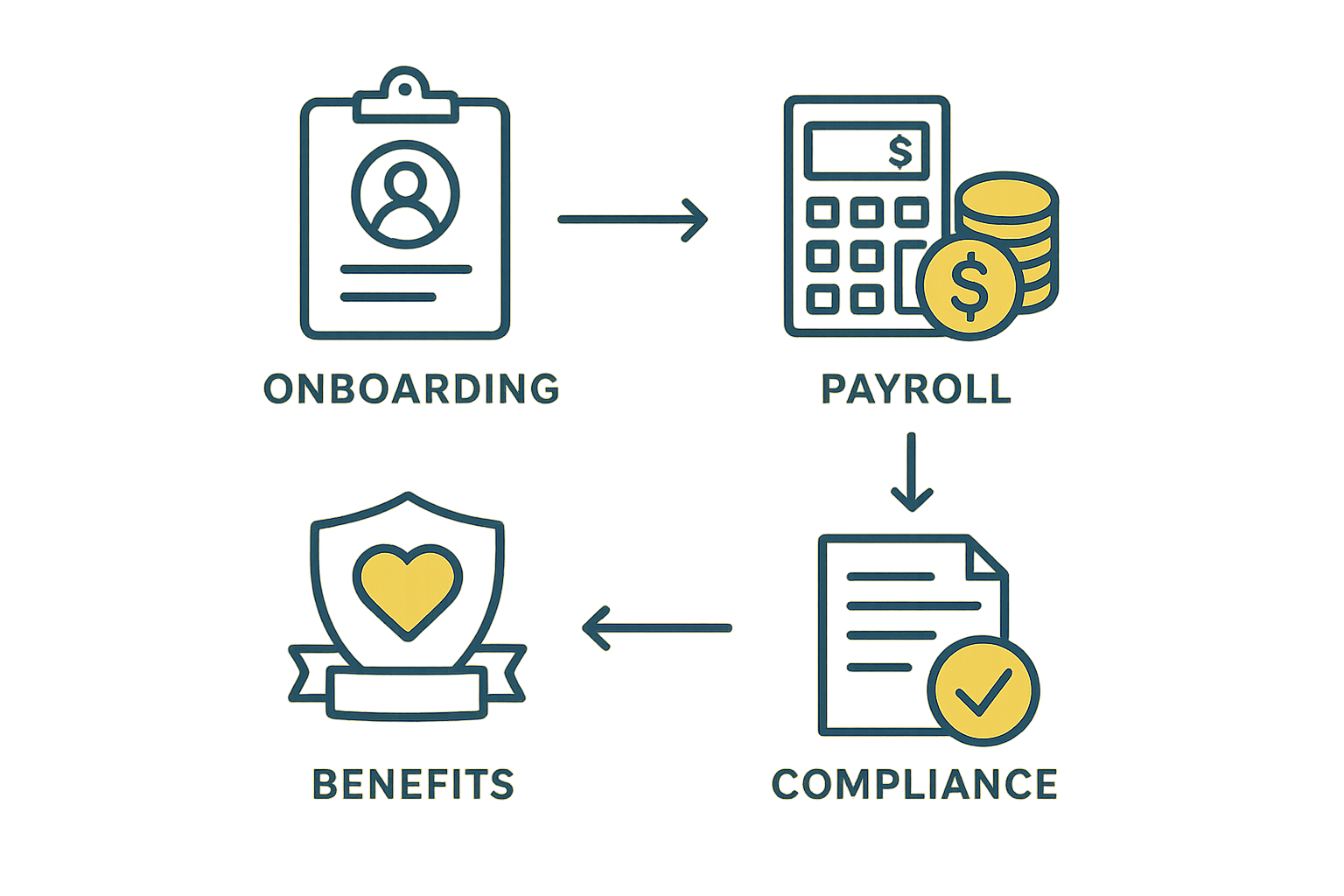
A typical hr admin services workflow moves from assessment to ongoing compliance monitoring.
Signs You Need HR Administration Support
Not sure whether it’s time to bring in help? Generally, a few warning signs stand out. For instance, if your handbook hasn’t been updated in over a year, or if the same person handling HR is also juggling operations and finance, gaps are likely forming. Similarly, if you’ve had a close call with a compliance issue—even one that didn’t turn into a lawsuit—that’s a signal worth taking seriously.
On the other hand, rapid hiring is another common trigger. As a result, businesses that double their headcount within a year often discover their onboarding and benefits processes simply weren’t built to scale. Soteria HR’s overview of the definition of human resource administration can help clarify exactly where those breaking points tend to appear.
Choosing the Right HR Admin Services Partner
Above all, the right partner should feel like an extension of your team, not a distant vendor filling out forms. Therefore, look for a provider who understands your industry, communicates in plain language, and takes a proactive approach to compliance rather than reacting after a problem occurs.
It also helps to understand the role you’re relying on internally or externally. Soteria HR’s breakdown of the HR administrator role, duties, and key skills is a helpful reference when evaluating whether to hire in-house or outsource. For companies exploring their options, Soteria HR offers full-service HR administration built specifically for growing organizations that need structure without the overhead of a large internal team.
Frequently Asked Questions About HR Admin Services
What are HR admin services?
HR admin services cover the day-to-day administrative tasks of managing employees, including onboarding, recordkeeping, benefits enrollment, and compliance documentation. They keep the operational side of HR running smoothly so leaders can focus on strategy.
How much do HR admin services typically cost?
Costs vary widely, but many outsourced HR admin services charge a per-employee monthly fee or a flat retainer based on company size and scope. Businesses often find this less expensive than hiring a full-time HR staff member.
Why do growing businesses outsource HR admin services?
Growing businesses outsource HR admin services to reduce compliance risk, save time, and avoid the cost of building an internal HR department too early. It also gives them access to expertise they couldn’t otherwise afford.
What is the difference between HR admin services and strategic HR consulting?
HR admin services handle transactional tasks like payroll coordination and file maintenance, while strategic HR consulting focuses on culture, leadership, and long-term workforce planning. Many providers offer both under one roof.
Can HR admin services help with compliance?
Yes, compliance monitoring is a core part of most HR admin services. Providers track changing federal and state employment laws and update policies before violations become costly problems.
What tasks are included in HR administration?
Typical HR administration tasks include onboarding and offboarding paperwork, benefits administration, employee file management, payroll coordination, and handbook updates. Some providers also assist with recruiting support.
How long does it take to set up HR admin services?
Most businesses can fully onboard an outsourced HR admin services partner within two to four weeks. The timeline depends on how much existing documentation and system integration is required.
What size company needs HR admin services?
Companies with 10 to 250 employees often benefit most, since they’ve outgrown informal HR handling but aren’t yet ready for a full internal department. However, even smaller teams facing compliance complexity can benefit.
What are common mistakes businesses make without HR admin support?
Common mistakes include misclassifying employees, missing benefits deadlines, and using outdated handbooks that don’t reflect current law. These errors can lead to fines, lawsuits, or employee turnover.
Do HR admin services integrate with existing payroll systems?
Most reputable HR admin services coordinate directly with your existing payroll provider rather than replacing it. This keeps disruption minimal while improving accuracy and timeliness.
How do HR admin services support employee retention?
By ensuring benefits are competitive, onboarding is smooth, and policies are fair and consistently applied, HR admin services help create a workplace employees want to stay in. Strong administration is the foundation of good culture.
What should I look for when choosing an HR admin services provider?
Look for a provider with experience in your industry, transparent pricing, and a proactive rather than reactive approach to compliance. It also helps to choose a partner who feels embedded in your team rather than a distant vendor.
Final Thoughts on HR Admin Services
Ultimately, HR admin services give growing businesses the structure they need to stay compliant, support employees well, and avoid the costly mistakes that come from stretching internal staff too thin. Whether you’re facing rapid hiring, tricky compliance questions, or simply running out of hours in the day, the right support can make a measurable difference. In particular, partnering with a provider like Soteria HR means gaining a team that understands your industry and treats your business like their own—so you can focus on growth instead of paperwork.