Daily HR administration responsibilities in a small company center on the recurring, hands-on tasks that keep employees paid, documented, and supported — things like maintaining personnel files, processing onboarding and offboarding paperwork, coordinating payroll inputs, and tracking leave requests. In a small company, these duties often land on a founder, office manager, or finance lead who juggles HR alongside other roles. However, missing even one of these daily tasks can create compliance gaps or payroll errors that cost far more to fix later than to prevent.
Key Takeaways
- Daily HR administration responsibilities in a small company include recordkeeping, onboarding/offboarding, leave tracking, payroll coordination, and policy upkeep.
- HR administration is transactional and daily, while HR consulting is strategic and advisory — small companies often need both.
- Federal recordkeeping rules, such as the FLSA, require certain payroll records to be kept for at least three years.
- A documented, weekly review process prevents small HR gaps from becoming compliance or payroll problems.
- Companies roughly in the 10–250 employee range often reach a point where outsourced HR administration becomes practical.
What Are Daily HR Administration Responsibilities in a Small Company?
Daily HR administration responsibilities in a small company are the ongoing, operational tasks that keep employment records accurate, employees paid correctly, and basic compliance requirements on track. In particular, these tasks repeat on a daily or weekly cycle rather than happening once a year.
Specifically, this work covers four broad areas: documentation, transitions, time and pay, and policy maintenance. For example, a small company with 25 employees still needs the same core administration as a larger business — it simply has fewer hands to do it. As a result, many of these tasks get handled inconsistently, which is one reason small companies turn to a dedicated HR administration partner rather than leaving the work to whoever has time that week.
Core Daily HR Administration Tasks for Growing Teams
Below is a closer look at the tasks that typically make up a small company’s daily HR administration workload. In addition, each area connects directly to compliance, employee experience, or payroll accuracy.
Employee Records and Documentation
Every employee needs a secure, organized file containing signed offer letters, I-9 verification, tax forms, and policy acknowledgments. Therefore, someone has to update these files whenever a title, pay rate, or address changes. Without a consistent system, records scatter across email threads, shared drives, and someone’s personal laptop — which becomes a real problem during an audit or a wage claim.
Onboarding and Offboarding Paperwork
New hires need offer letters, benefits enrollment, system access, and payroll setup completed within their first days. Similarly, departing employees need final pay calculated correctly, benefits termination processed, and company property collected. In particular, consistent onboarding and offboarding checklists reduce both legal exposure and awkward last-minute scrambling.
Leave and Time-Off Coordination
Someone must track vacation balances, sick time, and any leave requests tied to laws like the federal Family and Medical Leave Act (FMLA) or applicable state leave programs. Consequently, errors here create either understaffing surprises or employee disputes over unpaid balances.
Payroll Coordination and Benefits Support
Daily HR administration also involves feeding accurate hours, new-hire data, and deduction changes into payroll systems, plus handling benefits enrollments, terminations, and carrier communication. For example, a missed deadline for COBRA (a federal law allowing eligible employees to continue health coverage after leaving a job) can create real liability. Above all, this is where accuracy matters most, since mistakes directly affect an employee’s paycheck.
How Daily HR Administrative Duties Differ From HR Consulting
HR administration and HR consulting are related but distinct. HR administration handles the recurring, transactional tasks described above — the “keep the lights on” work. HR consulting, in contrast, focuses on strategic questions: how to structure compensation, how to improve retention, or how to build a performance management process.
A small company often needs both, even if it only has budget or bandwidth for one at a time. For a deeper explanation of where the line sits, see what HR administration really means for growing companies and how it complements consulting support.
“Most small companies don’t lack HR knowledge — they lack a consistent system for the daily administration work that supports every employee, every pay period.” — Soteria HR
A Step-by-Step Process to Organize Daily HR Administration Tasks
Building structure around daily HR administration responsibilities does not require a full HR department. Instead, it requires a repeatable process. The following steps outline a practical starting point.
- Centralize employee records. Create one secure, organized system for storing employee files, signed policies, and I-9 documentation so records are not scattered across emails, binders, and someone’s personal laptop.
- Build a documented onboarding checklist. Write down every onboarding task, from offer letter to system access, so payroll, benefits, and compliance steps are completed the same way for every new hire.
- Standardize offboarding. Create a checklist for final pay, benefits termination, and equipment return so every departure stays consistent, legally sound, and professional regardless of who manages it.
- Schedule a weekly compliance check-in. Set a recurring thirty-minute block each week to review leave requests, payroll inputs, and upcoming deadlines so small issues do not turn into larger backlogs.
- Decide what to delegate or outsource. Identify which daily HR administration tasks consume the most internal time, then evaluate whether an outsourced partner could handle them more consistently and accurately.
When Daily HR Administration Work Outgrows an Internal Team
According to the Society for Human Resource Management (SHRM), benchmarking research has generally found a median of roughly one to two HR staff per 100 employees across organizations. Therefore, a company with no dedicated HR hire is almost always running HR administration on borrowed time from someone else’s role.
This is where an ASO (Administrative Services Organization) arrangement can help. In this model, the client company remains the legal employer and keeps responsibility for employment decisions and applicable obligations — the ASO simply provides tailored administrative support without co-employment. Soteria HR, based in Pasadena, California, works this way with employers across Los Angeles, Orange County, and nationwide, supporting companies that have no internal HR department as well as those with an existing HR team that needs extra hands. For more detail on scope, see which daily HR administration tasks are commonly outsourced.
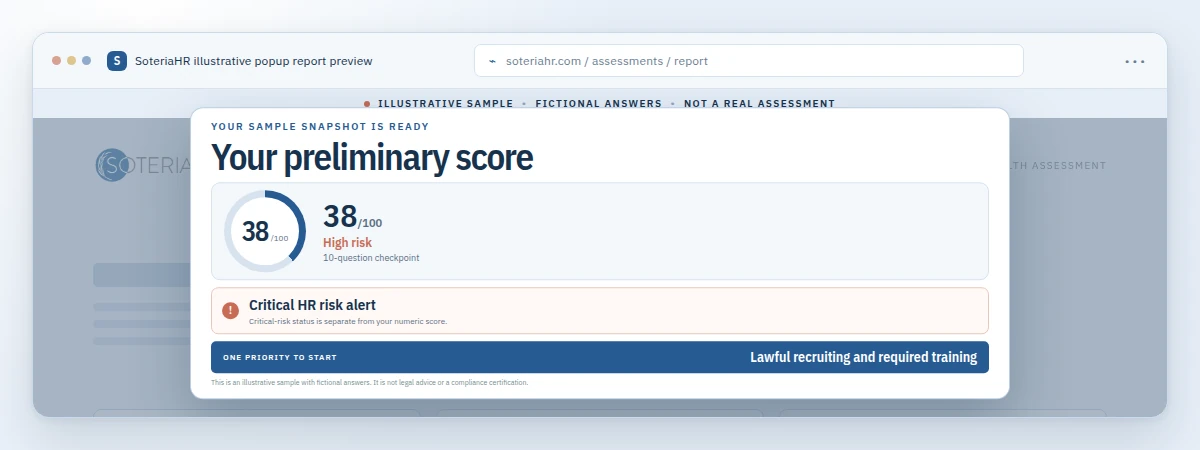
If you are unsure whether your current setup has gaps, Soteria’s free HR Health Assessment is a reasonable starting point. It is self-reported and preliminary — not a certification of compliance or a formal legal audit — but it can highlight priorities worth discussing. From there, you can talk to an HR expert or call (800) 399-2458 to review your specific situation.
In-House vs. Outsourced Daily HR Administration
| Factor | In-House (No Dedicated HR) | Outsourced (ASO Model) |
|---|---|---|
| Who handles daily tasks | Founder, office manager, or finance lead, part-time | Dedicated HR specialists, full-time focus |
| Employment responsibility | Company holds full responsibility | Client remains employer; no co-employment |
| Compliance monitoring | Inconsistent; dependent on available time | Ongoing, built into the service |
| Scalability | Requires new hires as headcount grows | Scales with the engagement, no new hire needed |
| Payroll coordination | Often manual and error-prone | Reviewed and coordinated with providers |
Frequently Asked Questions About Daily HR Administration Responsibilities in a Small Company
What are the daily HR administration responsibilities in a small company?
Daily HR administration responsibilities in a small company typically include maintaining employee records, processing onboarding and offboarding paperwork, coordinating payroll inputs, tracking leave and attendance, and keeping policies current. In most small companies, one person handles these tasks alongside other operational duties.
How is HR administration different from HR consulting?
HR administration covers daily, transactional tasks like recordkeeping and payroll coordination, while HR consulting focuses on strategic guidance such as workforce planning and culture. Many small companies need both but only have capacity for one at first.
Why does daily HR administration matter for small businesses?
Consistent HR administration reduces payroll errors, keeps compliance documentation audit-ready, and prevents small oversights from becoming costly disputes. Without it, companies risk missed deadlines for benefits enrollment or leave tracking.
How many employees need a dedicated HR administrator?
There is no fixed employee count that triggers the need for dedicated HR support; the right timing depends on workload, turnover, and compliance complexity. Many companies roughly in the 10 to 250 employee range find it practical to formalize or outsource administration around this stage.
What is a common mistake small companies make with HR administration?
A common mistake is letting HR tasks sit entirely with a founder or office manager without documented processes, which creates a single point of failure. When that person is unavailable, payroll, leave approvals, and recordkeeping can stall.
How much does outsourced HR administration cost?
Pricing varies based on employee count, scope of services, and whether benefits administration or payroll coordination is included. Most outsourced HR providers, including ASO arrangements, offer a customized quote after reviewing a company’s current structure.
How long does it take to set up proper HR administration systems?
A basic recordkeeping and onboarding system can often be organized within a few weeks, though full compliance reviews may take longer. Companies working with an outsourced HR partner typically see structured systems in place within the first month of the engagement.
What records must employers keep for compliance?
Employers generally must retain payroll records, time cards, and certain employment documents for specific periods set by federal and state law. For example, the U.S. Department of Labor’s FLSA recordkeeping fact sheet requires most payroll records to be kept for at least three years.
Can outsourced HR administration replace an internal HR team?
Outsourced HR administration can support an existing internal team or stand in where no HR department exists yet; it is not an all-or-nothing choice. Many companies blend internal staff with outsourced specialists for these tasks.
Does an ASO arrangement change who is legally the employer?
No. In an ASO (Administrative Services Organization) model, the client company remains the legal employer and retains responsibility for employment decisions, unlike some co-employment arrangements. The ASO provides administrative support rather than assuming employer status.
What is the best way to track employee leave requests daily?
The most reliable approach is a single, centralized system — whether a spreadsheet, HR software, or outsourced coordinator — where every leave request, approval, and balance update is logged in real time.
How can a small company tell if its HR administration is falling behind?
Warning signs include missed benefits deadlines, inconsistent onboarding, repeated payroll corrections, and policies that have not been updated in years. In particular, repeated employee questions about basic policies often signal gaps worth assessing, for example through the EEOC guidance on recordkeeping and nondiscrimination requirements.
What tools help manage daily HR administration tasks?
Many small companies use HR information systems (HRIS), shared file structures, and payroll platforms to track records digitally. However, software alone does not replace consistent review; according to SHRM, someone still needs to own the process daily for it to stay reliable. For additional context on scope, see what HR administration means for your business today.
In summary, the daily HR administration responsibilities in a small company span recordkeeping, onboarding and offboarding, leave tracking, payroll coordination, and policy upkeep — and all of it needs a consistent owner to stay reliable. Therefore, whether that owner is an internal hire, a shared responsibility, or an outsourced partner matters less than whether the process is documented and followed every week. As a result, companies that build structure early avoid the compliance and payroll surprises that come from ad-hoc administration. If you want a clearer picture of where your own HR administration stands, Soteria HR’s free HR Health Assessment at soteriahr.ai is a reasonable first step, and the team can discuss priorities afterward by phone at (800) 399-2458.