A cost of benefits per employee calculator is one of the most practical tools a growing business can use—and yet most small business owners are flying blind when it comes to what benefits actually cost them. If you’ve ever wondered whether you’re spending too much, too little, or just right on employee benefits, this guide will give you a clear framework to find out.
According to the U.S. Bureau of Labor Statistics, benefits account for approximately 29–31% of total compensation for private-sector employees. For a worker earning $60,000 per year, that’s roughly $17,000–$19,000 in additional employer costs. Understanding that number—and how it breaks down—is essential for budgeting, hiring, and staying competitive.
What Is a Cost of Benefits Per Employee Calculator?
A cost of benefits per employee calculator is a tool—or a structured formula—that helps employers estimate the total annual expense of providing benefits to each worker. It pulls together every employer-paid benefit cost, divides it by headcount, and produces a clear per-employee figure.
In short, it answers the question: “Beyond salary, how much am I actually spending on each person?” That answer matters whether you’re building a budget, evaluating a new hire, or deciding whether to upgrade your benefits package.
Furthermore, knowing this number helps you communicate total compensation to candidates—a powerful recruiting tool that many small businesses underuse. For a deeper look at what drives these costs, visit our guide on the cost of employee benefits.

Understanding your cost of benefits per employee starts with organizing all employer-paid expenses into one clear picture.
What Benefits Should You Include in the Calculation?
Before you can calculate anything, you need a complete list of what counts. Many employers forget several categories—and that leads to a serious undercount. Specifically, your calculation should include:
- Health, dental, and vision insurance premiums (employer share)
- Employer retirement contributions (401(k) match or pension)
- Paid time off (PTO) — calculated as a salary percentage
- Life and disability insurance premiums
- Payroll taxes — FICA, FUTA, SUTA, and workers’ compensation
- Voluntary perks — wellness stipends, tuition reimbursement, commuter benefits
- Employee assistance programs (EAPs) and other ancillary benefits
Many small businesses remember health insurance but overlook payroll taxes. However, employer FICA alone adds 7.65% to every dollar of wages—a significant line item. To learn more about what types of benefits are available, explore our overview of types of employee benefits.
How to Calculate Cost of Benefits Per Employee: Step-by-Step
The formula itself is straightforward. What takes effort is gathering accurate data for each input. Here is the complete process:
- List all employer-paid benefits. Create a complete inventory of every benefit your company provides—health, dental, vision, life insurance, retirement, PTO, and any voluntary perks or stipends.
- Assign an annual dollar value to each benefit. Pull actual invoices, carrier statements, and payroll records to assign a precise annual employer-paid cost to each category for the full workforce.
- Add mandatory payroll taxes and insurance. Include employer-side payroll taxes—FICA, FUTA, SUTA—and workers’ compensation premiums. These are real labor costs beyond salary, and they add up quickly.
- Sum all benefits costs and divide by headcount. Add together every annual benefits expense, then divide the total by your number of full-time equivalent (FTE) employees. That result is your average annual cost of benefits per employee.
- Benchmark your result and adjust your plan. Compare your figure against industry benchmarks from sources like the Society for Human Resource Management (SHRM), then decide whether to adjust offerings to stay competitive while managing your budget.
For example, if your total annual benefits spend across all categories is $420,000 and you have 30 employees, your cost of benefits per employee is $14,000 per year—or about $1,167 per month per person.
A Simple Benefits Cost Formula
Annual Benefits Cost Per Employee =
Total Employer Benefits Spend ÷ Number of FTE Employees
To find the benefits-to-salary ratio, divide the per-employee benefits cost by the average salary and multiply by 100.
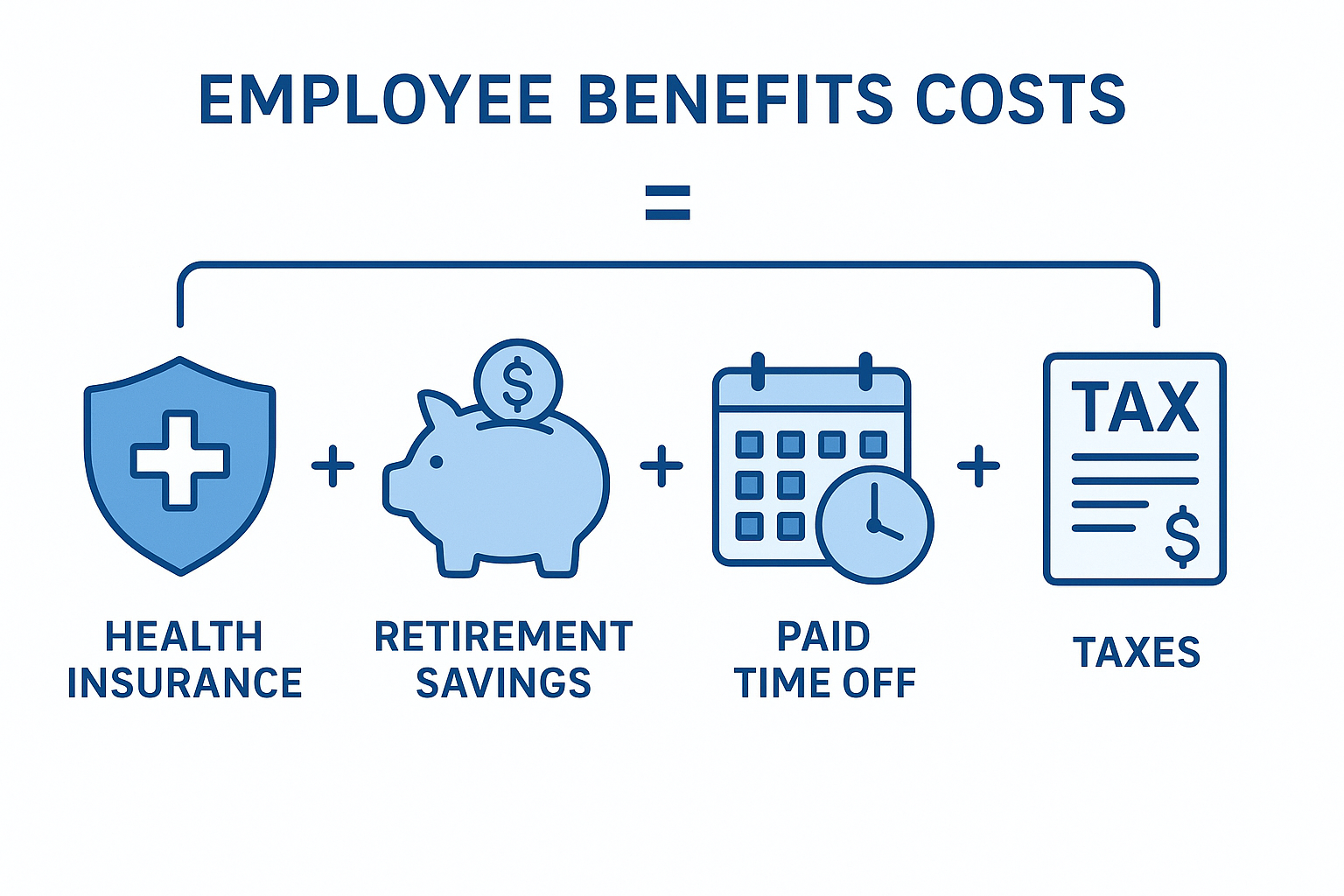
Breaking down each benefits category makes the calculation—and the budget conversation—much easier to manage.
Average Employee Benefits Costs: What the Numbers Say
Benchmarking your results is essential. Without context, a number like $14,000 per employee per year is meaningless. Here is what current data suggests for private-sector employers:
- Total benefits as % of compensation: 29–31% on average (BLS, 2024)
- Health insurance employer contribution: $7,000–$15,000+ per employee annually
- Retirement plan employer match: 3–6% of salary on average
- PTO value: Typically 5–10% of base salary
- Payroll taxes (employer share): Approximately 7.65–10% of wages
In addition, industry and company size significantly affect these figures. A tech company competing for engineers may spend 35–40% of compensation on benefits, while a small service business might budget closer to 20–25%. Therefore, always benchmark against your specific industry, not just national averages.
Why This Number Matters for Small and Mid-Sized Businesses
For growing companies with 10–250 employees, the cost of benefits per employee directly impacts hiring decisions, pricing models, and profitability. Specifically, here’s why getting this number right matters:
Accurate labor cost budgeting. A new hire’s true cost isn’t just their salary—it’s salary plus benefits. Underestimating benefits costs can throw off your entire financial model.
Competitive talent attraction. Candidates increasingly evaluate total compensation. Consequently, employers who can clearly articulate their full benefits value win more offers. Our guide on building an employee benefits plan that retains talent explores this in depth.
Compliance risk management. Certain benefits have legal thresholds—ACA requirements, ERISA rules, and state-specific mandates. Knowing your current benefits spend helps you identify gaps before regulators do. The IRS provides detailed ACA employer guidance worth reviewing.
How to Offer Benefits Without Breaking the Budget
Many small business owners assume competitive benefits are out of reach. However, that’s rarely true with the right structure. Some practical strategies include offering high-deductible health plans (HDHPs) paired with Health Savings Accounts (HSAs), joining a group purchasing arrangement, and prioritizing the benefits employees actually value most.
For a practical roadmap, see our resource on how to offer employee benefits for growing companies.

Reviewing your benefits plan as a team ensures every dollar spent aligns with what employees actually need and value.
When to Outsource Benefits Management
Calculating benefits costs is one thing. Managing them is another. As your team grows, benefits administration becomes a serious time sink—open enrollment, carrier negotiations, compliance filings, and employee questions all pile up fast.
Outsourcing benefits management to a dedicated HR partner can reduce your administrative burden, improve plan design, and often uncover cost savings you’d never find on your own. At Soteria HR, we handle benefits management as part of a comprehensive outsourced HR solution—so growing businesses get expert support without the overhead of a full-time HR department.
Furthermore, having a partner who monitors regulatory changes means you’re never caught off guard by a compliance shift that affects your benefits obligations. Learn more about how employee benefits administration outsourcing works in practice.
Frequently Asked Questions About Cost of Benefits Per Employee Calculator
What is a cost of benefits per employee calculator?
A cost of benefits per employee calculator is a tool that helps employers estimate the total annual or monthly expense of providing benefits to each worker. It typically factors in health insurance, retirement contributions, paid time off, and other perks to produce a per-employee benefits cost figure. This number is essential for accurate labor budgeting and total compensation planning.
How much do employee benefits cost per employee on average?
According to the U.S. Bureau of Labor Statistics, benefits account for roughly 29–31% of total employee compensation for private-sector workers. For a $60,000 salary, that translates to approximately $17,000–$19,000 in annual benefits costs per employee. However, actual costs vary significantly by industry, company size, and benefits package richness.
What benefits should I include when calculating cost per employee?
Include health, dental, and vision insurance premiums; employer retirement contributions; paid time off value; life and disability insurance; payroll taxes; and voluntary perks like wellness stipends or tuition reimbursement. Missing any of these categories will underestimate your true benefits spend.
Why is calculating employee benefits cost important for small businesses?
Knowing your benefits cost per employee helps you budget accurately, price products or services correctly, and stay competitive when recruiting talent. Without this number, small businesses often underprice labor or get surprised by unexpected year-end costs.
How do I calculate the cost of benefits per employee manually?
Add up all annual employer-paid benefits expenses—health premiums, retirement match, PTO value, taxes, and other perks—then divide by your total number of full-time equivalent employees. The result is your average annual benefits cost per employee.
What percentage of salary should go toward employee benefits?
Most employers budget between 20–40% of base salary for total benefits. Smaller companies often land in the 20–25% range, while larger organizations with richer packages may reach 30–40%. The right number depends on your industry, location, and talent strategy.
Are employee benefits tax-deductible for employers?
Yes, most employer-paid benefits are tax-deductible as ordinary business expenses. Health insurance premiums, retirement contributions, and certain fringe benefits qualify. The IRS provides specific guidance on which benefits are deductible and which are taxable to employees.
What is the biggest cost driver in employee benefits?
Health insurance is typically the largest single benefits expense for employers. Employer contributions to group health plans can range from $6,000 to over $15,000 per employee annually depending on plan type, coverage tier, and geography.
How can small businesses reduce the cost of employee benefits?
Small businesses can reduce benefits costs by offering high-deductible health plans paired with HSAs, benchmarking plans annually, and negotiating carrier rates. Outsourcing benefits management to an HR partner like Soteria HR can also uncover savings and reduce administrative overhead.
What is the difference between mandatory and voluntary employee benefits?
Mandatory benefits are legally required—such as Social Security, Medicare, unemployment insurance, and workers’ compensation. Voluntary benefits are employer-chosen extras like health insurance, retirement plans, and paid leave that help attract and retain talent.
How does employee benefits cost affect total compensation planning?
Benefits are a core part of total compensation. When comparing offers, candidates weigh the full package—not just salary. Employers who understand their benefits cost per employee can present a compelling total compensation figure that helps win top candidates.
Should I outsource employee benefits management?
Outsourcing benefits management makes sense when your team lacks dedicated HR expertise or when compliance complexity is growing. An outsourced HR provider can manage carrier relationships, open enrollment, and cost benchmarking—often saving money while reducing admin burden.
How often should I recalculate my cost of benefits per employee?
You should recalculate at least annually—typically during open enrollment or budget planning season. Additionally, recalculate whenever you add or change benefit offerings, hire significantly, or experience a major shift in carrier premiums.
Conclusion: Know Your Numbers, Build a Better Benefits Strategy
Using a cost of benefits per employee calculator isn’t just a finance exercise—it’s a strategic move that helps you hire smarter, budget confidently, and compete for top talent. When you know exactly what each employee costs beyond their paycheck, you can make better decisions about plan design, headcount, and total compensation positioning.
In summary, the key steps are to list every benefit, assign real dollar values, include payroll taxes, divide by headcount, and benchmark the result. From there, you can optimize your plan to balance cost control with employee satisfaction.
If you’d rather have a trusted partner handle all of this for you, Soteria HR is built exactly for that. We work with growing businesses to design, manage, and optimize benefits programs—so you get competitive offerings without the administrative headache. Reach out to learn how we can put the right benefits strategy in place for your team.