
An organization development strategy is a planned, systematic approach to improving how your business functions, grows, and adapts over time. In practical terms, it means aligning your people, processes, and culture with the goals you’re actually trying to reach. For growing businesses especially, having this strategy in place is the difference between scaling with confidence and scrambling to keep up.
According to the Society for Human Resource Management (SHRM), organizations that invest in intentional development practices see measurably higher employee engagement and lower turnover. That’s not a coincidence — it’s strategy working.
What Is an Organization Development Strategy?
An organization development (OD) strategy is a long-term plan that helps a business improve its effectiveness, culture, and capacity to handle change. It draws on behavioral science, HR best practices, and leadership theory to create lasting improvements — not just quick fixes.
Specifically, OD strategy focuses on three interconnected areas: people, structure, and processes. When all three are aligned, organizations become more resilient, more productive, and far better places to work. To explore the foundational concepts in depth, the overview of what organizational development means on the Soteria HR blog is a strong starting point.
Furthermore, OD strategy is not a one-time project. It’s an ongoing commitment to learning, adapting, and growing as a company — not just as individual employees.

Building an effective organization development strategy starts with getting the right people in the room and aligned on the same direction.
Why Growing Businesses Need an OD Strategy Now
Many small and mid-sized businesses delay OD work until something breaks — a wave of resignations, a compliance crisis, or a leadership vacuum. However, by then, the cost is already significant. Research from Gallup estimates that voluntary employee turnover costs U.S. businesses over $1 trillion annually — much of it preventable with proactive people strategy.
In addition, companies scaling from 10 to 100 employees face a particularly tricky window. Informal systems that worked at 15 people simply don’t hold up at 50. Without a deliberate development strategy, culture drifts, accountability blurs, and good people leave.
That’s precisely where Soteria HR helps — providing outsourced HR expertise that gives growing organizations the strategic foundation they need without the overhead of a full in-house team.
The Core Components of an Effective OD Strategy
A strong organization development strategy typically includes several interconnected components. Together, these elements create a system rather than a checklist:
- Organizational Diagnosis — Understanding where you are before deciding where to go.
- Leadership Development — Building the management capacity to sustain growth.
- Culture Design — Intentionally shaping the values and behaviors that define your workplace.
- Change Management — Guiding people through transitions without losing momentum or trust.
- Employee Development — Investing in skills and career growth to retain top performers.
- Performance Systems — Creating clear expectations, feedback loops, and accountability structures.
For a deeper look at how these components fit together, the complete guide to the organization development framework walks through each layer in practical detail.
How to Build an Organization Development Strategy Step by Step
Building an OD strategy doesn’t require a team of consultants or a six-figure budget. However, it does require honest assessment, clear priorities, and consistent follow-through. Here’s a straightforward process to get started:
- Conduct an Organizational Diagnostic. Gather data through employee surveys, exit interviews, performance reviews, and leadership conversations. You need an honest picture of where things stand — strengths, gaps, and blind spots included. Don’t skip this step; it anchors everything that follows.
- Define Your Desired Future State. Articulate what a healthy, high-performing version of your organization looks like in one to three years. Be specific about culture, structure, and capability goals. Vague aspirations don’t drive action.
- Identify Gaps and Prioritize Initiatives. Compare where you are to where you want to be. Then rank the gaps by impact and feasibility. Trying to fix everything at once is a reliable way to fix nothing — so prioritize ruthlessly.
- Build Your Action Plan with Milestones. Assign clear owners, realistic timelines, and measurable success metrics to each initiative. Accountability is only real when it’s specific. Vague ownership leads to vague results.
- Implement, Measure, and Iterate. Launch in phases, track key metrics like engagement scores and retention rates, and adjust based on what the data tells you. OD strategy is a living document, not a binder on a shelf.
For additional guidance on executing these steps inside a real organization, the full guide to implementing change in an organization covers the practical mechanics in detail.
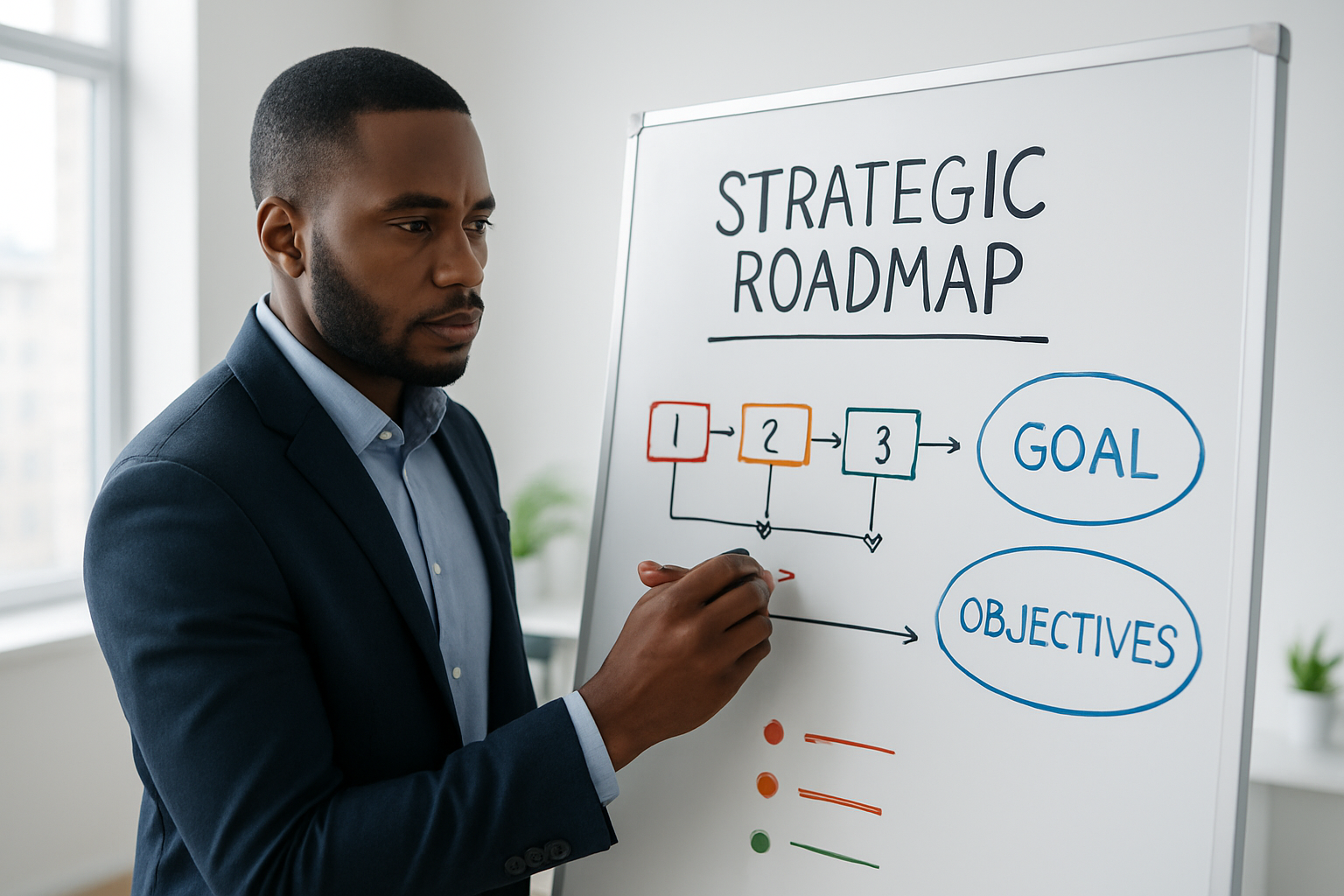
Mapping your organizational development strategy visually helps teams stay aligned and accountable through every phase of implementation.
Connecting OD Strategy to Employee Development
One of the most direct levers in any OD strategy is investing in your people’s growth. Employee development — through training, mentorship, stretch assignments, and career pathing — signals that the organization values its people beyond their current role.
Consequently, employees who see a future at your company are far more likely to stay, contribute, and bring others along. The employee development strategies explored on Soteria HR’s blog offer concrete ways to build this into your everyday operations.
According to LinkedIn’s Workplace Learning Report, 94% of employees say they would stay at a company longer if it invested in their learning and development. That’s a powerful return on a relatively modest investment.
Aligning OD Strategy with Business Goals
An OD strategy that exists in isolation from business goals is just a feel-good exercise. In contrast, when development work is tightly linked to revenue targets, market expansion, or operational efficiency, it becomes a genuine competitive advantage.
For example, if your business goal is to double headcount in 18 months, your OD strategy should address manager readiness, onboarding scalability, and culture preservation before you start hiring — not after. Similarly, if you’re entering a new market, your strategy should include capability building and change management to support that transition.
The organizational development strategies that work best are always anchored to specific business outcomes — not generic HR best practices.
Common Pitfalls to Avoid in Organizational Development
Even well-intentioned OD efforts can stall or backfire. Therefore, it’s worth knowing the most common mistakes before you invest time and resources:
- Skipping the diagnostic phase. Acting on assumptions instead of data leads to solving the wrong problems.
- Treating OD as a one-time initiative. Development is continuous — not a workshop or a retreat.
- Excluding employees from the process. People support what they help create. Top-down mandates rarely stick.
- Underestimating culture change timelines. Behavioral change takes time. Expecting results in 30 days sets everyone up for disappointment.
- Lack of leadership alignment. If leaders aren’t modeling the desired behaviors, no program will overcome that gap.

Regularly reviewing engagement and performance data keeps your organization development strategy grounded in reality rather than assumptions.
How Soteria HR Supports Your OD Strategy
Most growing businesses don’t have a full-time HR leader equipped to drive OD strategy while also managing day-to-day people operations. That’s a real gap — and it’s exactly what Soteria HR is built to fill.
Soteria HR provides strategic HR consulting, custom HR playbooks, compliance support, and hands-on leadership coaching — all tailored to where your business is right now. Rather than delivering cookie-cutter programs, the team embeds with your organization to understand your goals, your culture, and your people. The result is an OD strategy that actually fits — and actually gets executed.
Furthermore, because Soteria HR operates as an outsourced partner, you get seasoned expertise at a fraction of the cost of a full in-house team. That means growing companies can invest in strategic development work without waiting until they’re “big enough” to afford it.
Frequently Asked Questions About Organization Development Strategy
What is an organization development strategy?
An organization development strategy is a planned, systematic approach to improving a company’s effectiveness, culture, and capacity for change. It aligns people, processes, and structure with long-term business goals. In practice, it’s the roadmap that keeps your organization healthy as it grows.
Why is organization development strategy important for small businesses?
Small businesses often lack formal HR infrastructure, making a clear OD strategy essential for managing growth and reducing turnover. Without it, scaling up can quickly lead to costly people problems. Proactive planning prevents reactive firefighting.
How do you build an organization development strategy from scratch?
Start by assessing your current state through employee feedback and data, then define your desired future state. From there, identify gaps, prioritize initiatives, and create an action plan with measurable milestones. Revisit and adjust the plan regularly as your business evolves.
What is the difference between organization development and HR?
HR focuses on day-to-day people management tasks like payroll, hiring, and compliance. Organization development is broader and more strategic, focusing on long-term culture, change, and organizational effectiveness. Both are important — but OD is the engine that drives lasting improvement.
How long does it take to implement an organization development strategy?
Timelines vary widely depending on company size and complexity. Most organizations see meaningful progress within 6 to 18 months, though culture change often takes 2 to 3 years to fully embed. Patience and consistency are essential throughout the process.
What are common mistakes in organization development planning?
Common mistakes include skipping the diagnostic phase, failing to involve employees in the process, and treating OD as a one-time project. Lack of leadership buy-in is also a frequent pitfall that undermines even well-designed strategies.
What role does leadership play in an organization development strategy?
Leadership is the single most important factor in OD success. Leaders must model desired behaviors, champion change, and allocate resources to support development initiatives consistently. Without visible leadership commitment, OD efforts rarely gain traction.
How does organization development strategy relate to change management?
Change management is a core component of OD strategy. While OD sets the long-term direction for organizational improvement, change management provides the tools and frameworks to guide people through specific transitions effectively. The two disciplines work best when integrated.
What metrics should I track for an organization development strategy?
Key metrics include employee engagement scores, retention rates, time-to-productivity for new hires, internal promotion rates, and performance review completion rates. These indicators reveal whether your OD efforts are gaining traction. Track them consistently over time for the most meaningful insights.
Can an outsourced HR partner help with organization development strategy?
Yes. An outsourced HR partner like Soteria HR can provide strategic OD consulting, custom HR playbooks, and hands-on support to help growing businesses build and execute an effective organization development strategy. This approach delivers expert-level results without the cost of a full in-house team.
What industries benefit most from organization development strategies?
Virtually every industry benefits, but companies in human services, tech, professional services, and manufacturing tend to see the greatest returns. These sectors face rapid change, talent competition, and compliance complexity that OD directly addresses. Strong values and high accountability amplify the impact further.
How does employee development fit into an organization development strategy?
Employee development is a foundational pillar of any strong OD strategy. Investing in skills, career growth, and learning directly improves performance, engagement, and retention across the organization. As a result, it’s one of the highest-ROI components of any people strategy.
Conclusion: Start Your Organization Development Strategy Today
A well-executed organization development strategy is one of the most powerful investments a growing business can make. It reduces turnover, strengthens culture, improves performance, and positions your organization to scale without losing what makes it great. The key takeaways are straightforward: diagnose before you prescribe, align development work to real business goals, involve your people throughout, and treat OD as an ongoing commitment rather than a one-time project.
Above all, don’t wait for a crisis to start. The organizations that build strong development foundations early are the ones that grow with confidence — and keep their best people along the way. If you’re ready to get started, Soteria HR is here to help you build a strategy that fits your business, your culture, and your goals.