Organisational frameworks are the invisible architecture behind every business that runs well — and the missing piece in every business that doesn’t. Simply put, an organisational framework is a structured model that defines how your company organises its people, processes, authority, and strategy. For growing small to mid-sized businesses, choosing and applying the right framework is one of the highest-leverage decisions a leader can make. Without it, you’re building on sand.
The good news? You don’t need a Fortune 500 budget or a full internal HR department to get this right. In fact, many companies between 10 and 250 employees benefit most from a clear, practical framework — precisely because they’re at the stage where chaos is most expensive.
What Are Organisational Frameworks? A Direct Answer
Organisational frameworks are structured models that define how a business organises its people, processes, and strategy. They provide a repeatable blueprint for decision-making, accountability, and growth. Think of them as the operating system beneath your company — everything else runs on top of it.
According to Wikipedia’s overview of organizational structure, the way a company arranges its roles and authority directly affects its efficiency, culture, and ability to adapt. That’s not just theory — it’s the daily reality for every founder who has watched their team double in size and suddenly found that nothing works the way it used to.
Furthermore, a well-chosen framework isn’t just an org chart. It encompasses how decisions get made, how information flows, how people are held accountable, and how your company culture is reinforced at scale.
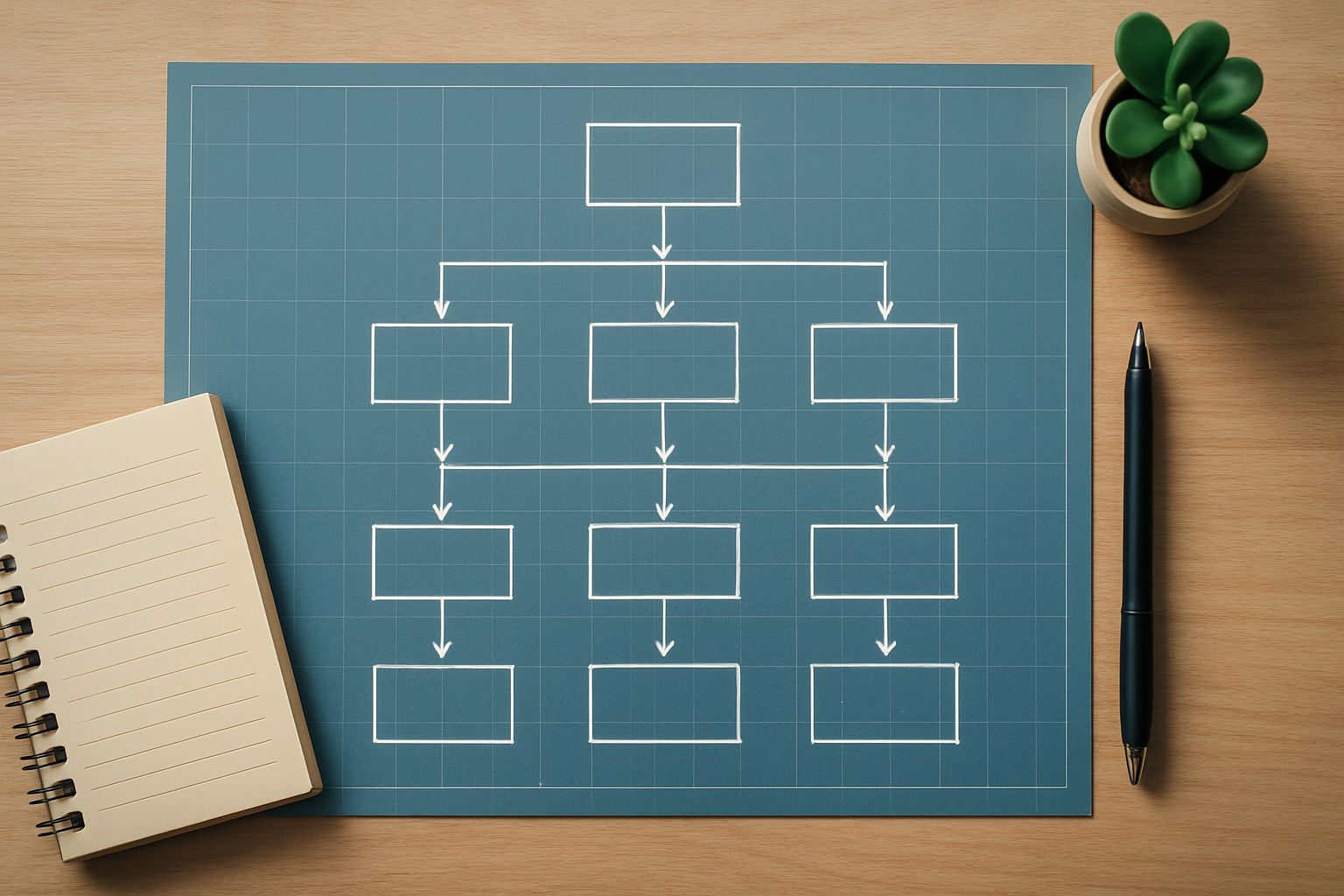
A clear organisational framework maps how people, roles, and decisions connect — making growth far more manageable.
Why Structure Matters More Than You Think
Here’s a sobering stat: according to Gallup research, employees who clearly understand their role are 2.5 times more likely to be engaged at work. Role clarity is a direct output of a solid organisational framework — and engagement drives retention, productivity, and profitability.
In contrast, companies that skip this step often experience the same familiar pain: duplicated effort, accountability gaps, compliance exposure, and a revolving door of talent. These aren’t personality problems. They’re structural ones.
Additionally, a strong framework supports compliance by creating consistent, documented processes for onboarding, performance management, and policy enforcement. That matters enormously when employment law changes — as it does constantly. For a deeper look at how structure connects to compliance risk, explore Soteria HR’s complete guide to organisation development frameworks.
Common Types of Business Structure Models
Not every framework fits every company. Here are the most widely used models and when each makes sense:
Functional Structure: Groups employees by specialisation — HR, finance, operations. Works well for companies with clear departments and defined workflows. However, it can create silos if cross-team communication isn’t actively managed.
Flat Structure: Minimal hierarchy, maximum autonomy. Ideal for agile startups and creative teams. As a result, decisions happen faster — but accountability can blur as headcount grows.
Divisional Structure: Organises around products, markets, or geographies. Specifically suited to companies with distinct revenue lines or regional operations.
Matrix Structure: Combines functional and project-based reporting. Powerful for complex organisations, though it requires strong communication norms to avoid confusion over authority.
The McKinsey 7-S Framework offers a more holistic approach. It examines seven interconnected elements — strategy, structure, systems, shared values, skills, style, and staff — to assess whether all parts of your business are aligned. For growing companies undergoing change, this model is particularly valuable.
How to Choose and Implement an Organisational Framework
Choosing the right framework starts with honest self-assessment. Follow these steps to move from confusion to clarity:
- Assess your current state. Audit your existing structure. Identify role overlaps, accountability gaps, and compliance risks. Be honest about what’s broken — you can’t fix what you won’t name.
- Define your goals and growth stage. Clarify what the framework needs to achieve. Is it faster hiring? Better compliance? Clearer accountability? Your goal shapes your choice.
- Select the right framework model. Match your goals to a proven model. A flat structure suits agile teams; a functional hierarchy fits specialised departments. Consider the McKinsey 7-S model if alignment across all business areas is the priority.
- Document roles, processes, and policies. Create clear job descriptions, process maps, and an employee handbook that reflect the new framework. Specifically, ensure everything aligns with current employment law and compliance requirements.
- Communicate and train your team. Roll out the framework through structured communication and manager training. Every employee should understand their role within the new structure — and why it matters.
- Monitor, measure, and refine. Track HR and business metrics after implementation. Revisit the framework quarterly to ensure it continues to support your growth and compliance needs.
For more detail on navigating structural change, Soteria HR’s guide on implementing change in an organisation walks through the process step by step.

Effective framework design is a team effort — clarity comes from collaboration, not just top-down mandates.
The HR Connection: People Are the Framework
No organisational framework works without the people practices to support it. Therefore, your HR strategy and your structural model must be designed together — not in separate silos.
Specifically, this means aligning your recruiting, onboarding, performance management, and employee development processes to the structure you’ve chosen. For example, a divisional structure needs HR practices that support semi-autonomous teams, while a functional structure benefits from centralised HR policies and consistent management training.
This is where many growing companies get stuck. They build the structure on paper but forget to build the people systems around it. The result? The framework exists in a slide deck but not in daily reality. Explore how employee development services can anchor your framework in real, measurable growth.
Avoiding the Most Common Framework Mistakes
Even well-intentioned leaders fall into predictable traps. The most common mistakes include copying a framework that doesn’t fit your culture, skipping employee communication during rollout, and treating the framework as a one-time project rather than a living system.
Consequently, frameworks that aren’t revisited regularly become outdated fast — especially in growing companies where headcount, strategy, and market conditions shift constantly. Build in a quarterly review from day one.
Additionally, don’t confuse the framework with the org chart. The Balanced Scorecard approach, for instance, reminds us that true organisational alignment spans financial, customer, process, and learning dimensions — not just reporting lines on a page.
How Soteria HR Helps You Build the Right Structure
Growing companies rarely have the internal bandwidth to design and implement a robust organisational framework on their own. That’s exactly where Soteria HR comes in.
Soteria HR works as an embedded partner — not a vendor — for small to mid-sized businesses navigating growth. Services include custom HR playbooks, employee handbook creation, compliance and risk management, and strategic HR consulting. In short, Soteria builds the people infrastructure that makes your chosen framework actually work in practice.
For companies ready to take a more strategic approach, the organisational development strategies Soteria offers are designed specifically for businesses at the 10 to 250 employee stage — where structure matters most and the cost of getting it wrong is highest.
Furthermore, if your organisation is navigating a period of change — a merger, rapid hiring, or a leadership transition — understanding what organisational change management involves is a critical first step before redesigning your framework.
Frequently Asked Questions About Organisational Frameworks
What are organisational frameworks?
Organisational frameworks are structured models that define how a business organises its people, processes, and strategy. They provide a repeatable blueprint for decision-making, accountability, and growth. In practice, they function as the operating system that every other business process runs on top of.
Why do small businesses need an organisational framework?
Small businesses need organisational frameworks to avoid chaos as they scale. Without a clear structure, roles overlap, accountability gaps form, and compliance risks multiply quickly. A framework gives everyone — from the CEO to a new hire — a shared understanding of how the company works.
What is the McKinsey 7-S Framework?
The McKinsey 7-S Framework is a management model that examines seven interconnected elements: strategy, structure, systems, shared values, skills, style, and staff. It helps organisations assess alignment across all areas of the business. It’s particularly useful during periods of significant change or growth.
How do I choose the right organisational framework for my company?
Start by identifying your company’s size, growth stage, and primary pain points. Then match a framework to those needs — a flat structure suits agile startups, while a functional hierarchy fits companies with specialised departments. When in doubt, work with an HR partner who can assess your situation objectively.
What is the difference between an organisational framework and an org chart?
An org chart shows reporting lines visually, while an organisational framework defines the underlying logic — the rules, values, and processes that govern how work actually gets done. Frameworks are the strategy; org charts are one output of that strategy.
How long does it take to implement an organisational framework?
Implementation timelines vary widely. A basic framework can be introduced in 30 to 60 days, but full adoption — including culture alignment and process integration — typically takes three to six months. The more complex your organisation, the longer the integration phase.
Can an outsourced HR provider help with organisational frameworks?
Yes. Outsourced HR partners like Soteria HR help growing companies design, document, and implement organisational frameworks tailored to their stage of growth. This includes role clarity, compliance alignment, and custom HR playbooks. It’s one of the highest-value services an outsourced HR partner can provide.
What are common mistakes when building an organisational framework?
The most common mistakes include copying a framework that doesn’t fit your culture, skipping employee communication during rollout, and treating the framework as a one-time project rather than a living system. Additionally, many companies fail to align their HR practices with the new structure, which causes the framework to exist only on paper.
How does an organisational framework support compliance?
A well-designed framework clarifies roles and responsibilities, which reduces compliance gaps. It also creates consistent processes for onboarding, performance management, and policy enforcement — all critical to staying legally protected. Without this structure, compliance becomes reactive rather than proactive.
What is a functional organisational structure?
A functional organisational structure groups employees by specialisation — such as HR, finance, or operations. It improves efficiency within departments but can create silos if cross-functional communication isn’t managed carefully. It’s one of the most common structures for mid-sized companies with defined departments.
How do organisational frameworks affect employee retention?
Clear frameworks improve retention by giving employees a sense of direction, defined career paths, and consistent expectations. According to Gallup, employees who clearly understand their role are 2.5 times more likely to be engaged at work. Engaged employees stay longer and perform better.
What is an organisational development framework?
An organisational development framework is a strategic model that guides how a company improves its people, processes, and culture over time. It connects HR practices directly to business outcomes. Unlike a static org chart, it’s designed to evolve as your business grows.
Conclusion: Structure Is a Strategic Advantage
Organisational frameworks aren’t bureaucratic overhead — they’re a strategic advantage. When you get the structure right, everything else becomes easier: hiring, compliance, performance, retention, and growth. Therefore, investing time in choosing and implementing the right framework is one of the smartest moves a growing business can make.
The key is to match your framework to your actual stage of growth, align your HR practices to support it, and treat it as a living system rather than a one-time project. Above all, remember that the best framework is the one your people actually understand and operate within every day.
If you’re ready to build a structure that supports your next stage of growth, Soteria HR is ready to help. We bring the strategy, the HR expertise, and the hands-on support to make your organisational framework work in the real world — not just on a whiteboard.