Workforce compliance management is the ongoing process of making sure an organization’s employment practices, policies, and documentation meet federal, state, and local labor requirements. For founders and operations leaders juggling growth, hiring, and daily operations, compliance can quietly slip down the priority list—until a wage claim, audit, or employee complaint forces the issue. Soteria HR, a Pasadena-based outsourced HR partner serving employers across Los Angeles, Orange County, and nationwide, works with growing companies to build compliance into everyday HR operations rather than treating it as a once-a-year scramble.
Direct answer: Workforce compliance management means systematically tracking, documenting, and updating HR policies so a business satisfies applicable employment laws—covering wage and hour rules, anti-discrimination requirements, leave entitlements, and benefits administration. It is an ongoing responsibility, not a one-time project, and it typically grows more complex as headcount increases.
What Is Workforce Compliance Management?
In short, workforce compliance management is the system a business uses to meet its legal obligations as an employer. It combines policy, documentation, and oversight so that hiring, pay practices, leave handling, and benefits all line up with current law. Because requirements differ by state and by headcount, there is no single checklist that fits every employer.
For example, wage and hour rules enforced by the U.S. Department of Labor set minimum standards nationwide, but California and other states layer on additional requirements around overtime, meal and rest breaks, and paid sick leave. Similarly, anti-discrimination protections are shaped both by the Equal Employment Opportunity Commission at the federal level and by state agencies. Consequently, a workforce compliance management program has to account for every layer of law that applies to where employees actually work.
In practice, this looks like current handbooks, accurate job classifications, documented training, and a process for catching legal changes before they become violations. As a result, compliance becomes a habit built into HR operations rather than an annual fire drill.

A structured audit is often the first visible step in workforce compliance management.
Why Compliance Management Matters as Headcount Grows
As a company adds employees, it often crosses legal thresholds without realizing it. For instance, certain anti-discrimination and leave requirements apply only once a business reaches a specific employee count, and missing that trigger point is one of the most common compliance gaps among growing employers. Specifically, benefits rules such as ACA reporting obligations and COBRA continuation coverage can apply at headcounts many founders don’t expect.
The financial stakes are real. The U.S. Department of Labor’s Wage and Hour Division recovers hundreds of millions of dollars annually in back wages for workers across industries, according to published enforcement data available through dol.gov. In addition, EEOC charge statistics show that workplace complaints remain a persistent source of litigation risk for employers of all sizes.
Above all, proactive compliance management protects the business and its employees at the same time. A company that documents policies clearly and applies them consistently tends to face fewer disputes and resolves the ones that do arise more quickly.
Core Components of HR Compliance Management
Most compliance programs, regardless of industry, share the same core building blocks:
- Wage and hour practices: accurate classification of exempt and non-exempt employees, overtime calculation, and timekeeping.
- Anti-discrimination and harassment prevention: policies, reporting channels, and required training.
- Leave administration: tracking entitlements under federal and state leave laws, including sick leave and family leave.
- Benefits compliance: ACA, COBRA, Section 125, and Form 5500 obligations where applicable.
- Recordkeeping: personnel files, I-9 documentation, and retention schedules that meet legal minimums.
Building a Workforce Compliance Management Process: 5 Steps
Rather than tackling every regulation at once, most employers make faster progress by following a structured sequence. Here is a practical starting point:
- Audit current policies and documentation. Review existing employee handbooks, job classifications, and personnel files to identify outdated language, missing policies, or inconsistent recordkeeping practices across the organization.
- Map applicable requirements. Identify which federal, state, and local employment laws apply based on headcount, industry, and the states where employees physically work or live.
- Update handbooks and leave policies. Revise employee handbooks, leave policies, and benefits documentation so they reflect current legal requirements and match how the business actually operates day to day.
- Train managers and employees. Deliver training so managers understand their responsibilities around leave requests, performance documentation, and harassment-prevention obligations required in many jurisdictions.
- Monitor, document, and reassess. Set a recurring schedule to track regulatory changes, document compliance activities, and reassess policies whenever headcount grows or new locations are added.
For a deeper look at identifying gaps before they become liabilities, see this complete guide to managing compliance risks in HR.

Manager training is a core step in any workforce compliance management strategy.
Common Compliance Risks and Mistakes
Even well-intentioned employers run into predictable pitfalls. Misclassifying employees as exempt when their duties don’t meet legal tests is one frequent issue, since it affects overtime eligibility. Likewise, handbooks that haven’t been updated in several years often contain outdated leave policies or conflicting procedures.
Leave tracking is another common gap. Without a consistent process, it’s easy to lose track of which employees qualify for protected leave and for how long. Soteria HR’s overview of leave management walks through how a structured approach reduces this risk.
Finally, California employers in particular should pay close attention to state-specific wage statements, meal and rest break rules, and paid sick leave requirements published by the California Department of Industrial Relations. Requirements can change, so it’s worth confirming current thresholds before relying on older guidance.
Compliance Management vs. Outsourcing to an ASO Partner
Some employers handle workforce compliance management entirely in-house, usually through an internal HR team supported by legal counsel. Others choose an Administrative Services Organization, or ASO, which provides tailored HR support without co-employment. Under an ASO arrangement, the client remains the employer of record and keeps responsibility for employment decisions, while the HR partner provides hands-on administrative and compliance support.
This differs from a PEO model, which typically involves shared employment responsibilities. For companies without a full internal HR department, or those whose existing team needs extra support, an ASO relationship can fill specific gaps without restructuring how the business operates. To see how this fits into broader HR strategy, review this overview of HR management as an ally for small businesses and this guide on how HR keeps pace with changing laws.
How Soteria HR Supports Workforce Compliance Management
Soteria HR provides hands-on outsourced HR support for growing small and mid-sized organizations, with core services spanning HR administration, HR consulting, and benefits administration. Because compliance touches nearly every one of those areas, it’s typically addressed as part of the broader HR relationship rather than as a standalone add-on. Payroll coordination and the ASO option round out the support available to companies that want structure without taking on co-employment.
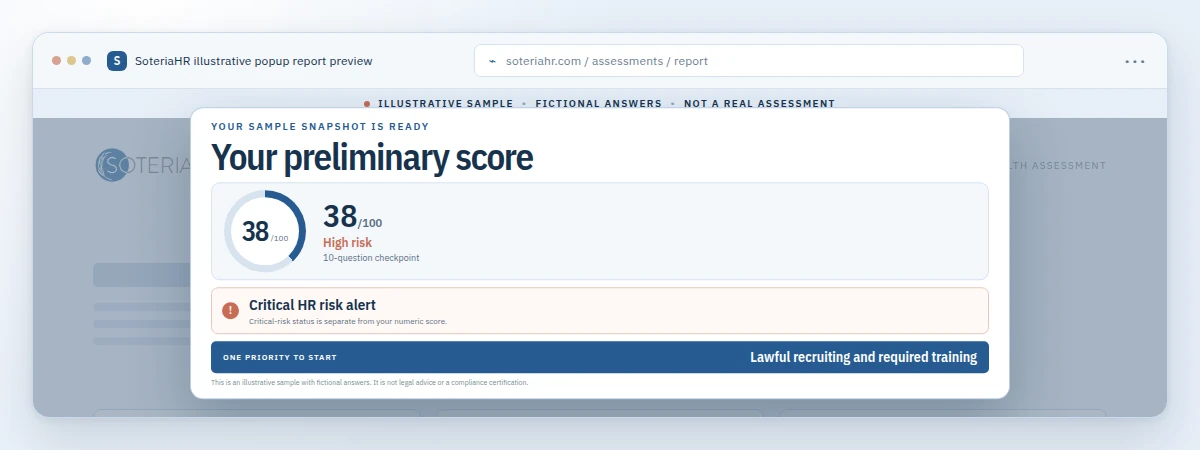
If your team wants a starting point, Soteria’s free HR Health Assessment at soteriahr.ai offers a Quick HR Check and a more detailed Complete HR Health Assessment to surface potential gaps and priorities. Results are self-reported and preliminary, so they work best as a conversation starter rather than a formal audit. To see how this fits into day-to-day operations, Soteria’s guide on optimizing workforce HR best practices offers additional context.
Learn more about Soteria HR’s approach at soteriahr.com, or call (800) 399-2458 to talk through your organization’s specific compliance priorities with an HR expert.

A short consultation call often clarifies which compliance priorities matter most right now.
Frequently Asked Questions About Workforce Compliance Management
What is workforce compliance management?
Workforce compliance management is the ongoing practice of tracking, documenting, and updating HR policies so a business meets federal, state, and local employment laws. It covers areas such as wage and hour rules, anti-discrimination requirements, leave entitlements, and benefits administration.
Why is workforce compliance management important for small businesses?
Small and mid-sized employers often lack dedicated legal or HR staff, which raises the risk of missed requirements. Consistent workforce compliance management reduces exposure to wage claims, discrimination complaints, and costly penalties.
What laws are typically covered by workforce compliance management?
Common areas include the Fair Labor Standards Act, Title VII and related anti-discrimination statutes, leave laws such as the FMLA or state equivalents, workplace safety rules, and benefits regulations like ACA and COBRA. Requirements vary by jurisdiction and headcount, so it’s worth confirming current thresholds.
How does workforce compliance management differ from HR administration?
HR administration covers day-to-day tasks like onboarding, recordkeeping, and payroll coordination. Compliance management is narrower and focused specifically on meeting legal and regulatory obligations tied to those activities.
What are the biggest workforce compliance risks for growing companies?
Misclassifying employees, outdated handbooks, inconsistent leave tracking, and missed benefits deadlines are among the most common risks. Growth often outpaces policy updates, which widens compliance gaps over time.
How much does workforce compliance management cost?
Costs vary based on company size, industry, and whether compliance work is handled internally or through an outsourced HR partner. A consultation is typically the best way to get a scope-specific estimate.
How long does it take to build a compliance program?
An initial audit and policy update can often be completed in a few weeks, while fully embedding compliance into daily operations may take a few months. Timelines depend largely on company size and existing documentation quality.
What is the difference between compliance management and a PEO?
A PEO typically involves co-employment, where the provider shares certain employer responsibilities. An ASO-style compliance management approach, like Soteria HR’s, delivers tailored HR support while the client remains the sole employer of record.
Can a small business handle workforce compliance management internally?
Yes, but it requires ongoing attention to changing laws at the federal, state, and local level. Many growing businesses without a full HR department choose outside support to keep pace with requirements.
What is an HR Health Assessment and how does it help with compliance?
An HR Health Assessment is a self-reported questionnaire that highlights potential gaps in HR practices, including compliance-related areas. It is a preliminary tool meant to start a conversation, not a certification of compliance or a formal legal audit.
What are common workforce compliance mistakes employers make?
Frequent mistakes include outdated employee handbooks, inconsistent recordkeeping, and failing to train managers on current policies. Overlooking state-specific requirements, especially in states like California, is another recurring issue.
How often should compliance policies be reviewed?
Most employers benefit from reviewing policies at least once a year, with additional reviews whenever headcount crosses a regulatory threshold or a law changes. Significant business changes, like expanding to a new state, should also trigger a review.
Final Thoughts
Workforce compliance management isn’t a single project with a finish line; it’s an ongoing discipline that grows alongside the business. Therefore, employers that build it into regular HR operations—through audits, updated policies, manager training, and consistent monitoring—tend to catch problems early rather than after they become expensive. In contrast, businesses that treat compliance as an afterthought often discover gaps only when an employee complaint or audit forces the issue.
Whether your organization handles this work internally or partners with an outside HR team, the goal remains the same: consistent, well-documented practices that protect both the business and its people. Soteria HR’s promise is simple—we’ve got your back, so you can focus on growth. To talk through your organization’s workforce compliance management priorities, call (800) 399-2458 or submit a consultation request today.