HR policy development services help growing businesses create clear, written workplace policies that set expectations, reduce legal risk, and support consistent decision-making. If your company has outgrown informal rules or a borrowed template, these services close that gap by building policies tailored to your workforce, industry, and jurisdiction. Soteria HR, based in Pasadena, California, works alongside founders and HR leaders across Los Angeles, Orange County, and nationwide to turn scattered practices into a cohesive policy set.
Quick answer: HR policy development services are hands-on support, usually from outsourced HR consultants, that help employers write, update, and implement workplace policies such as employee handbooks, leave rules, and conduct standards. The process typically includes an audit of current practices, research into federal and state requirements, drafting, and rollout guidance.
What Are HR Policy Development Services?
HR policy development services cover the full process of turning informal company rules into written, enforceable policies. Specifically, this means auditing what already exists, identifying gaps against current law, drafting new language, and training managers to apply it consistently.
Many small and mid-sized employers operate for years without a true handbook, relying instead on verbal agreements or a founder’s memory of “how we do things.” As a result, enforcement becomes uneven, and the company has little documentation if a dispute or audit arises. Consequently, formal policy work becomes a priority once headcount passes roughly ten to twenty-five employees.
In practice, this service is rarely a one-time document drop. Instead, it functions as an ongoing relationship where policies are revisited as laws change and the business evolves.

Reviewing current practices is the starting point for most HR policy development services.
Why Workplace Policy Creation Matters for Growing Companies
Workplace policy creation matters because unwritten rules create risk long before anyone notices a problem. For example, two managers handling the same attendance issue differently can expose a company to a discrimination claim, even if neither manager acted with bad intent.
Furthermore, several federal and state laws effectively require certain written policies. The U.S. Equal Employment Opportunity Commission (EEOC) expects employers to maintain a documented harassment complaint process, and many states, including California, require specific sick leave and meal-and-rest-break notices.
In addition, clear policies support faster, fairer decisions. When a manager can point to a written rule rather than a personal judgment call, employees generally perceive the outcome as more consistent. Above all, documentation protects the company if a decision is later challenged in a wage claim, unemployment hearing, or lawsuit.
Companies that have scaled quickly, such as those explored in this guide on building a stronger team through resource management consulting, often discover policy gaps at the same time they discover staffing gaps.
What’s Included in a Policy Development Engagement
A typical policy development engagement includes several core deliverables. Specifically, most engagements cover:
- An audit of current handbooks, offer letters, and informal practices
- Drafted or updated employee handbook sections
- Leave, attendance, and conduct policies tailored to the business
- Harassment prevention and complaint-handling procedures
- Manager training on applying policies consistently
- A rollout plan with employee communication and acknowledgment forms
Beyond the initial handbook, many employers also need ongoing support such as the practical guidance covered in HR administration services for growing businesses. Therefore, policy work is often paired with broader HR administration rather than treated as a standalone project.
How Employee Handbook Development Works: A Step-by-Step Process
Employee handbook development generally follows a predictable sequence. Below is the process most HR consultants, including Soteria HR, follow when building or refreshing a handbook.
- Audit current practices. Review existing handbooks, offer letters, and informal practices to identify gaps, outdated language, and inconsistencies across departments or locations.
- Research applicable requirements. Identify federal, state, and local rules that apply based on employee count, industry, and the states where staff work, since thresholds and obligations vary widely.
- Draft tailored policies. Write policy language that reflects the company’s actual size, culture, and operations instead of relying on generic templates that may not fit the workforce.
- Review for compliance. Have the drafted policies reviewed against current agency guidance and, where appropriate, by legal counsel before anything is finalized or distributed to staff.
- Roll out with training. Distribute the finished policies with manager training and employee communication sessions, then collect signed acknowledgment forms for each employee’s personnel file.
- Schedule ongoing updates. Set a recurring annual review, plus triggered reviews whenever employment law changes, to keep every policy current and enforceable.
According to the U.S. Department of Labor, employment regulations are updated frequently at both the federal and state level, which is one reason step six should never be skipped.

Training and communication help new policies stick once HR policy development services finish drafting.
Common Mistakes in HR Policy Development
Even well-intentioned employers make avoidable mistakes when writing policies on their own. For instance, copying a handbook template built for a different state often leaves out required notices, such as California’s paid sick leave or harassment prevention language.
Similarly, policies that exist on paper but are never enforced create a dangerous gap. If a company’s handbook says one thing but managers do another, that inconsistency can become evidence against the employer in a dispute. In contrast, a policy that is consistently applied and documented tends to hold up far better under scrutiny.
Other frequent errors include skipping signed acknowledgment forms, failing to update handbooks after a law changes, and writing vague language that leaves too much room for interpretation. Avoiding these pitfalls is one reason many employers choose ongoing support rather than a single project, similar to the approach described in this piece on how HR consulting helps a manufacturing company manage complex, multi-shift policy needs.
Custom HR Policies vs. DIY Templates
Free templates are tempting because they are fast and inexpensive. However, custom HR policies built through professional HR policy development services are designed around your actual state requirements, employee count, and industry risks, rather than a generic national average.
| Factor | DIY Template | Professional Policy Development |
|---|---|---|
| State-specific accuracy | Often missing or outdated | Tailored to each jurisdiction |
| Ongoing updates | Rarely included | Built into the relationship |
| Manager training | Not provided | Typically included |
As a result, companies that start with a template often return to professional support once they realize gaps exist, particularly around leave administration similar to needs described in HR administration services essential for small teams.
How Soteria HR Supports HR Policy Development Services
Soteria HR provides HR policy development services as part of its broader HR administration and consulting support for employers with roughly 10 to 250 employees, though this is a priority focus rather than a strict cutoff. Clients remain the employer of record throughout the engagement; Soteria’s Administrative Services Organization (ASO) option provides tailored support without co-employment.
Specifically, Soteria works with founders, CEOs, COOs, and HR or operations leaders to audit existing documents, draft compliant policies, and train managers on consistent enforcement. This work is often paired with benefits administration and payroll coordination so that policies, pay practices, and benefits communications stay aligned, including considerations relevant to HR services best suited for tech companies and other fast-growing teams.
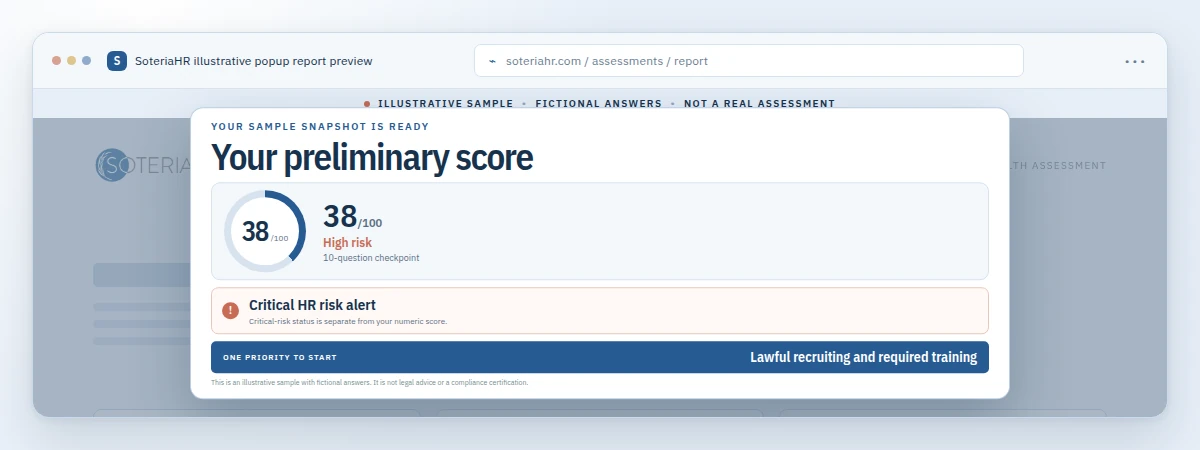
For employers who want a quick gap check before a full project, Soteria also offers a free HR Health Assessment at soteriahr.ai. The assessment is self-reported and preliminary, not a certification of compliance, but it can highlight policy priorities worth discussing with an HR professional.
Frequently Asked Questions About HR Policy Development Services
What are HR policy development services?
HR policy development services are professional support offerings, often from outsourced HR consultants, that help employers write, update, and roll out workplace policies such as employee handbooks, leave rules, and codes of conduct. They typically include an audit, research into applicable law, drafting, and implementation guidance.
How long does HR policy development take?
A full policy development project, including an employee handbook, generally takes four to eight weeks depending on company size and complexity. Smaller updates to a single policy can often be completed in one to two weeks.
Why do growing companies need formal HR policies?
Growing companies need formal HR policies because informal, word-of-mouth practices become inconsistent and risky once headcount increases. Written policies create consistent expectations, support fair decision-making, and reduce exposure to wage, leave, and discrimination claims.
What’s included in HR policy development services?
A typical engagement includes a review of existing documents, research on federal and state requirements, drafting of handbook sections, manager training, and a rollout plan. Ongoing updates as laws change are often part of the service.
How much do HR policy development services cost?
Cost varies by company size, number of policies, and whether the work is a one-time project or part of an ongoing HR relationship. Many employers find bundling policy work into a broader HR administration or ASO engagement more cost-effective than a standalone handbook project.
What’s the difference between HR policy development services and free templates?
Free templates are generic and rarely reflect a company’s state, industry, or workforce size, which can leave gaps or outdated language. HR policy development services tailor language to your specific jurisdiction and operations, then help you keep policies current.
How often should HR policies be updated?
Most employers should review HR policies at least once a year and whenever a significant law changes or the business grows past a new employee-count threshold. Leave, pay transparency, and anti-harassment rules change frequently at the state level.
What are common mistakes in HR policy development?
Common mistakes include copying templates from another state, failing to get signed acknowledgments, writing policies no manager actually enforces, and forgetting to update handbooks after a law change. Inconsistent enforcement is one of the biggest legal risk factors.
Do small businesses need an employee handbook?
Yes, even small businesses benefit from a handbook because it documents expectations around pay, leave, conduct, and safety before disputes arise. Some state-mandated notices, such as harassment prevention policies, apply even to very small employers.
How does HR policy development differ between states like California and others?
California imposes additional requirements around meal and rest breaks, paid sick leave, and harassment prevention training that many other states do not require. A multi-state employer needs policy sections tailored to each jurisdiction rather than one blanket document.
Can HR policy development services help with harassment prevention policies?
Yes, harassment prevention policies are a core part of most HR policy development engagements, since the EEOC and many state agencies expect a documented complaint process. Services often include training recommendations to support the written policy.
What’s the best way to roll out new HR policies to employees?
The best rollout combines a written notice, a short live or recorded explanation from a manager, and a signed acknowledgment form kept in each employee’s file. Giving employees a chance to ask questions reduces confusion and improves compliance.
Who should be involved in HR policy development?
Leadership, HR or an outsourced HR partner, and in some cases legal counsel should all review new policies before rollout. Frontline managers should also weigh in, since they are responsible for enforcing the policy day to day.

A finished, acknowledged handbook is the end result of most HR policy development services projects.
Bringing It All Together
In summary, HR policy development services give growing companies a structured way to replace informal rules with clear, consistent, and defensible written policies. From the initial audit through drafting, legal-informed review, and training, each step reduces the risk that comes with inconsistent enforcement or outdated templates. Therefore, whether you are writing your first handbook or updating one that has not changed in years, working with an experienced HR partner helps ensure the result actually fits your workforce and jurisdiction.
If your organization needs support building or refreshing workplace policies, Soteria HR’s team can walk through your current documents and flag priority gaps. You can start with the free HR Health Assessment at soteriahr.ai or reach out directly through soteriahr.com to talk through next steps. Above all, remember that effective HR policy development services are not a one-time task but an ongoing partnership that grows with your business.
Ready to build HR policies that fit your business?
Talk to an HR Expert: Call (800) 399-2458 or submit a consultation request at soteriahr.com.