
Employee Benefits Strategy
Benefits Outsourcing Companies: The Complete Guide to Saving Time, Cutting Costs, and Staying Compliant
Everything your business needs to know — from what benefits outsourcing companies actually do, to how to choose one, avoid costly mistakes, and get the most from a long-term partnership.
Benefits outsourcing companies are specialized third-party providers that manage your entire employee benefits program — from plan selection and open enrollment to compliance reporting, life event changes, and direct employee support. For businesses of every size, partnering with one of these firms can dramatically reduce administrative overhead, strengthen compliance, and deliver benefit packages competitive with the largest corporations in your industry.
According to the Society for Human Resource Management (SHRM), outsourcing HR functions can reduce administrative costs by up to 32%. Yet the decision involves far more than cost alone — the right provider becomes a strategic partner that keeps your organization compliant, your employees engaged, and your HR team focused on work that actually drives business growth.
This guide covers everything: what benefits outsourcing companies do, why the advantages go deeper than most businesses realize, how to evaluate and select the right provider, what the transition looks like step by step, how to avoid the most expensive mistakes, and what the ongoing relationship should deliver month after month.
What Are Benefits Outsourcing Companies?
Benefits outsourcing companies are vendors that assume full or partial management of a company’s employee benefits program. Rather than building and staffing an internal benefits team, employers delegate specific functions — or the entire program — to a provider with deep expertise, dedicated technology, and the carrier relationships needed to get better outcomes at lower cost.
The scope of services varies by provider, but typically includes:
- Benefits plan design and carrier selection — identifying the right combination of health, dental, vision, retirement, and ancillary plans for your workforce demographics and budget
- Open enrollment administration — communications, employee decision-support tools, elections processing, and deadline management
- Ongoing plan administration — life event changes, COBRA administration, qualifying event tracking, and billing reconciliation
- Compliance management — ERISA filings, ACA reporting (Forms 1094/1095), COBRA notices, SPD distribution, and state mandate tracking
- Employee support — answering benefits questions, resolving claims issues, and providing educational resources through dedicated support teams or self-service portals
- Reporting and analytics — utilization reports, cost trend analysis, and renewal benchmarking data
Benefits Outsourcing vs. PEO: An Important Distinction
Many business owners confuse benefits outsourcing companies with Professional Employer Organizations (PEOs). The difference is significant. A PEO enters a co-employment arrangement — it technically becomes a co-employer of your workforce, taking on payroll, HR, and benefits collectively under its own EIN. A dedicated benefits outsourcing firm, by contrast, manages your benefits program while your employment relationship with employees remains entirely intact.
This matters because co-employment carries implications for employer liability, tax treatment, and workforce control that many businesses prefer to avoid. Benefits outsourcing gives you the administrative and compliance expertise of a full HR department without surrendering the employment relationship. The right choice depends on how much HR support your business needs beyond benefits alone.
The Role of Benefits Technology Platforms
Modern benefits outsourcing companies are inseparable from their technology. Nearly all reputable providers deploy cloud-based HRIS (Human Resource Information System) platforms or benefits administration software that employees access directly. These self-service portals allow workers to compare plans, model cost scenarios, make elections, submit life event documentation, and view their current coverage — from any device, at any time.
For HR teams, the same platform provides a real-time dashboard of enrollment status, plan utilization, and compliance deadlines. Critically, most platforms integrate with payroll software — eliminating the manual data entry that causes errors, premium discrepancies, and audit exposure.
When evaluating any provider, their technology stack is not a secondary consideration — it is central to whether outsourcing actually reduces your workload or simply shifts it.

A structured benefits review with your outsourcing partner is typically the first step in building a program that serves both your workforce and your bottom line.
The Full Benefits of Outsourcing Employee Benefits Administration
The case for working with benefits outsourcing companies extends well beyond cost savings. Here is an in-depth look at every major advantage — and why each one matters more than most businesses initially appreciate.
1. Lower Costs Through Collective Purchasing Power
Because a benefits outsourcing company serves dozens or hundreds of employer clients simultaneously, it can negotiate group insurance rates that individual employers — especially smaller ones — simply cannot access. Carriers compete for the provider’s entire book of business, which drives premiums down across the board.
The result: small and mid-sized businesses gain access to benefit packages that rival those offered by Fortune 500 employers, at a cost per employee that would be unachievable going directly to carriers. This group buying power is one of the highest-value arguments for outsourcing — and it compounds over time as your provider’s client base grows.
Beyond premiums, outsourcing also reduces internal costs. You spend less on HR staffing dedicated to benefits administration, less on compliance counsel, and less on the technology that would otherwise need to be purchased and maintained independently.
2. Dramatically Reduced Administrative Burden
Benefits administration is one of the most time-intensive HR functions in any organization. Open enrollment alone — coordinating communications, updating elections, processing changes, resolving errors — can consume weeks of HR staff time each year. Add ongoing tasks like COBRA notices, life event processing, billing reconciliation, and employee inquiries, and the total burden is significant.
Outsourcing transfers the bulk of this operational work to specialists whose entire job is managing it efficiently. Your internal HR team is freed to focus on recruiting, culture, performance management, and the strategic work that actually differentiates your organization as an employer.
In practice, most businesses report that their HR staff recaptures between 10 and 20 hours per week after transitioning to an outsourced benefits model — hours previously consumed by routine administration, employee questions, and error correction.
3. Robust Compliance Support Across Multiple Regulatory Frameworks
Employee benefits compliance is one of the most complex, fast-changing areas of employment law. Failure to comply is expensive — and the penalties accumulate quickly.
Key regulatory frameworks your benefits program must navigate include:
- ERISA (Employee Retirement Income Security Act) — fiduciary standards, plan document requirements, Summary Plan Description (SPD) distribution, and Form 5500 filings
- ACA (Affordable Care Act) — employer mandate compliance for applicable large employers (ALEs), Forms 1094-C and 1095-C reporting, minimum essential coverage standards
- COBRA — qualifying event notices, election periods, premium collection, and coverage continuation timelines
- HIPAA — privacy protections for health information exchanged during enrollment and administration
- FMLA interactions — benefit continuation requirements during protected leave periods
- State-specific mandates — paid family leave programs, state continuation coverage rules, and local insurance requirements that vary significantly by jurisdiction
A qualified benefits outsourcing partner employs dedicated compliance specialists who monitor regulatory changes, update your plans and documents proactively, and ensure all required filings are submitted correctly and on time. Non-compliance with ACA reporting alone can trigger IRS penalties of $310 per return (as of current thresholds) — for a 100-person company, one filing error cycle can easily exceed $30,000 in penalties.
For a broader perspective on how outsourcing reduces legal and operational risk across all HR functions, the team at Soteria HR explains why outsourcing HR is increasingly viewed as a risk management strategy, not just an administrative convenience.
4. Access to Enterprise-Grade Benefits for Smaller Employers
One of the most important — and frequently underappreciated — benefits of outsourcing is that it eliminates the competitive disadvantage small and mid-sized businesses face in benefits offerings. When a 30-person company partners with an outsourcing firm that represents thousands of covered lives, it can offer health plans, dental coverage, vision benefits, life and disability insurance, and 401(k) programs with employer match contributions that match or exceed what a 1,000-person competitor offers.
This has a direct effect on recruiting and retention. A 2023 SHRM benefits survey found that 60% of employees say benefits are among the top factors influencing their decision to stay with or leave an employer. When your benefits package competes at the enterprise level, you compete for talent at that level too.
5. Improved Employee Experience and Engagement
Benefits confusion is a persistent problem in most organizations. Employees frequently misunderstand their coverage, miss enrollment windows, or make plan elections that do not serve their actual needs. This leads to dissatisfaction, increased HR questions, and lower perceived value of the benefits offered.
Benefits outsourcing companies address this directly through dedicated employee support channels — phone, email, chat, and self-service portal resources — that guide workers through decisions and resolve coverage questions without burdening your HR team. Many providers also offer year-round employee education programs and decision-support tools that help individuals choose the right plan based on their specific health history, family status, and budget.
When employees understand and feel confident in their benefits, engagement and satisfaction scores improve — which directly supports retention.
6. Scalability as Your Business Grows
Benefits administration becomes exponentially more complex as headcount increases. Adding employees across multiple states introduces new carrier contracts, new state-specific mandates, and new reporting requirements. A benefits outsourcing partner scales with you automatically — the systems, carrier relationships, and compliance infrastructure are already in place for wherever you expand.
Businesses approaching an acquisition, a geographic expansion, or a rapid hiring phase frequently cite scalability as the primary driver of their decision to outsource. Internal benefits teams rarely have the capacity to absorb sudden headcount increases without adding staff — outsourced providers absorb growth as part of their standard service model.

Compliance management — across ERISA, ACA, COBRA, HIPAA, and state mandates — is one of the highest-value services benefits outsourcing companies deliver.
What Types of Employee Benefits Can Be Outsourced?
A comprehensive benefits outsourcing company can manage virtually every benefit category your organization offers. Understanding what is available helps you identify which functions represent the greatest opportunity for relief and cost reduction.
- Medical insurance — group health plans including HMO, PPO, HDHP, and self-funded structures; carrier negotiations and annual renewal management
- Dental and vision coverage — standalone or bundled plans with enrollment, billing, and claims liaison support
- Retirement plans — 401(k) plan administration, participant enrollment, contribution processing, loan and distribution management, and Form 5500 filings
- Life and AD&D insurance — group term life, supplemental life, and accidental death and dismemberment coverage administration
- Short-term and long-term disability — claims coordination and leave-related benefit continuation
- Flexible Spending Accounts (FSAs) and Health Savings Accounts (HSAs) — account setup, contribution tracking, and reimbursement processing
- Employee Assistance Programs (EAPs) — mental health, financial counseling, and work-life resources
- COBRA administration — qualifying event notices, election tracking, premium collection, and coverage termination
- Voluntary and supplemental benefits — critical illness, hospital indemnity, legal plans, pet insurance, and identity theft protection
- Wellness programs — program design, incentive tracking, and vendor coordination
For a deeper breakdown of which HR functions are best suited for outsourcing beyond benefits specifically, this guide on outsourcing HR functions provides practical detail on each area and when to make the move.
How to Choose the Right Benefits Outsourcing Company: A Step-by-Step Process
Selecting the right benefits outsourcing partner is one of the most consequential vendor decisions your HR function will make. The following process gives you a structured, thorough approach to evaluation and selection — one that protects your business and sets the relationship up for long-term success.
- Audit your current benefits setup. Before evaluating any vendor, document your existing plans, coverage gaps, cost per employee, compliance obligations, and the specific administrative tasks consuming the most internal time. This baseline makes every subsequent conversation more productive and prevents overselling.
- Define your budget and required service scope. Clarify your total outsourcing budget and list the exact services you need — open enrollment support, compliance reporting, employee portal, COBRA administration, or full-service plan design. Knowing your scope prevents you from paying for services you do not need or missing services that are critical.
- Research and build a shortlist of qualified providers. Search for firms with demonstrated experience in your industry vertical, company size range, and state(s) of operation. Review third-party ratings on G2, Capterra, or Clutch, and ask peer networks for referrals. Build a shortlist of three to five candidates.
- Issue a formal RFP and compare proposals side by side. Request detailed written proposals covering service scope, carrier partnerships, technology platform, implementation timeline, compliance credentials, employee support model, and pricing structure. Use a standardized scoring rubric to compare responses consistently.
- Evaluate compliance expertise with rigor. Ask each provider to demonstrate their compliance track record. Verify that they employ certified HR professionals (SHRM-CP, SHRM-SCP, or CEBS credentials are indicators of depth). Ask specifically how they monitor and communicate regulatory changes, and request documentation of recent compliance updates they delivered proactively to clients.
- Assess the technology platform in a live demo. Require a live demonstration of the benefits administration platform — both the employer dashboard and the employee self-service portal. Confirm integrations with your payroll software, check mobile responsiveness, and evaluate the quality of decision-support tools. Technology failures are the most common source of post-contract dissatisfaction.
- Check references from current clients in similar situations. Ask each finalist for references from clients of similar size and industry. Specifically ask references about the quality of ongoing support (not just implementation), how quickly issues are resolved, and whether the provider’s compliance team has ever caught a problem before it became a penalty.
- Negotiate contract terms carefully before signing. Review the service level agreement in detail. Pay particular attention to response time guarantees, renewal terms, pricing escalation clauses, data ownership and portability provisions, and exit clause requirements. A contract that looks straightforward often contains terms that become problems 18 months in — have legal counsel review it before execution.
What to Expect During the Transition to Outsourced Benefits
Understanding the transition process ahead of time reduces anxiety and prevents the communication failures that can erode employee confidence. Most implementations with reputable benefits outsourcing companies follow a predictable arc.
Implementation Timeline: What the First 60 Days Look Like
Typical transitions take two to eight weeks depending on company size, plan complexity, and how clean your existing data is. The implementation phases generally follow this sequence:
- Week 1–2: Discovery and data gathering — Your dedicated implementation specialist collects census data, existing plan documents, carrier contact information, and payroll system credentials for integration setup.
- Week 2–4: System configuration and integration — The provider configures your HRIS platform, builds your plan structures, establishes payroll integration, and populates employee records.
- Week 4–6: Testing and validation — A full test cycle runs through enrollment scenarios, data sync testing, and compliance document generation to confirm everything functions correctly before employee access is enabled.
- Week 6–8: Employee launch — Communications are sent, training resources are distributed, and employees are onboarded to the self-service portal. Most providers offer live Q&A sessions and recorded walkthroughs during this phase.
The quality of the implementation experience is one of the best early indicators of what the ongoing relationship will look like. A provider who is disorganized, slow to respond, or vague about timelines during implementation will likely be the same way after you are under contract.
Employee Communication During the Transition
Employees are understandably sensitive about any change to their benefits. Clear, proactive communication before, during, and after the transition is non-negotiable. Your outsourcing partner should provide templated communication materials — emails, FAQs, portal guides — that you can customize and distribute. At minimum, employees should receive:
- An announcement explaining what is changing and why
- A clear timeline showing when they will gain access to the new portal
- Contact information for the provider’s employee support team
- Reassurance that current coverage is uninterrupted during the transition
Ongoing Management After Launch: What a Good Partner Delivers
Implementation is the beginning, not the end. A strong benefits outsourcing company should deliver the following on an ongoing basis:
- Monthly or quarterly utilization reports — showing claims trends, plan usage patterns, and cost projections that inform renewal decisions
- Proactive compliance alerts — notifying you of regulatory changes before deadlines, not after
- Annual renewal strategy meetings — reviewing benchmarking data, modeling plan design changes, and presenting carrier alternatives
- Dedicated account management — a named point of contact who knows your account and can escalate issues quickly
- Mid-year check-ins — identifying issues with employee adoption, underutilized benefits, or emerging compliance risks between renewal cycles
You can explore the full range of outsourced HR and benefits management solutions available through Soteria HR, a provider supporting businesses looking for scalable, expert-driven HR and benefits administration.
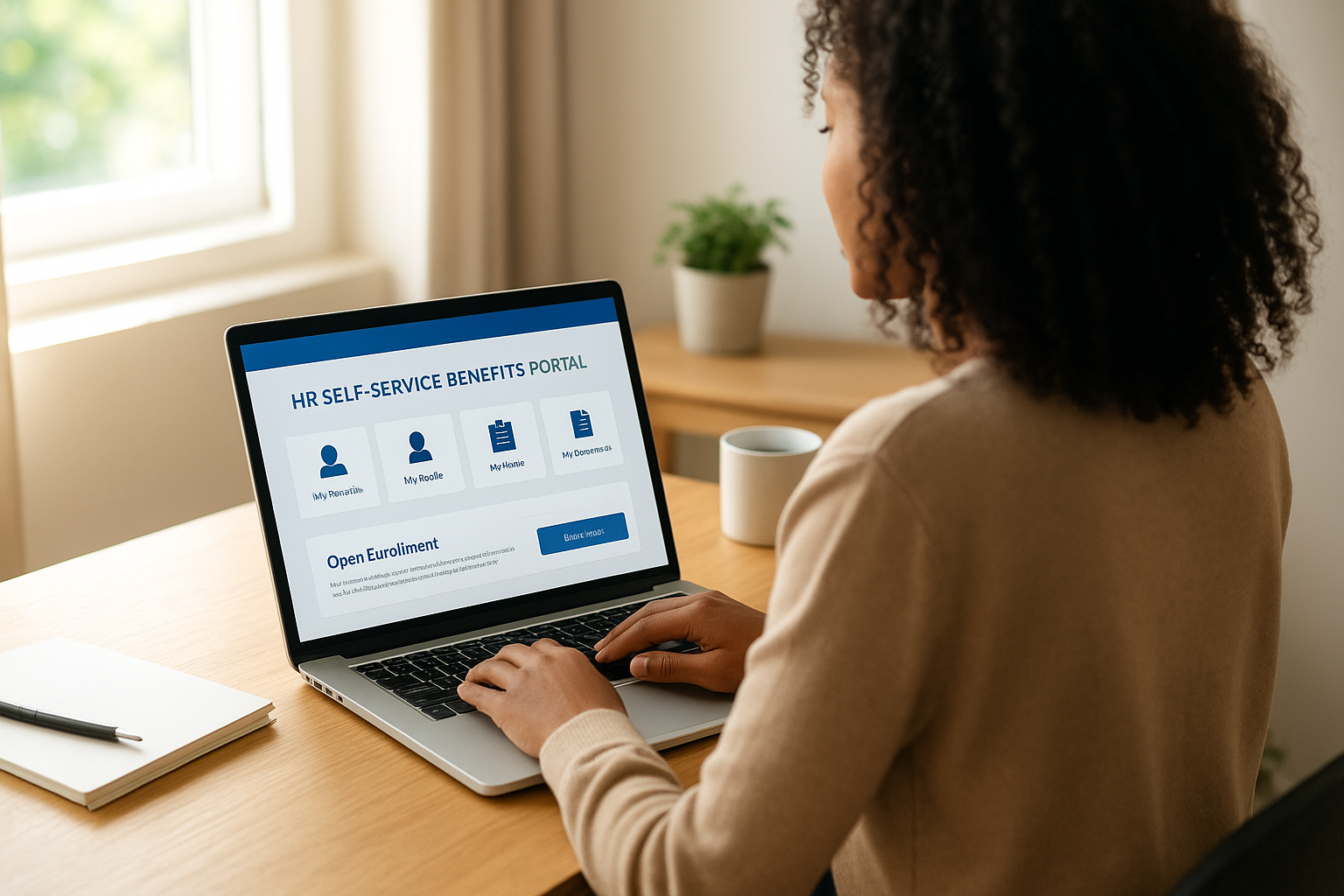
Self-service benefits portals give employees direct control over enrollment decisions while dramatically reducing HR support volume.
Costs and Pricing: What Benefits Outsourcing Companies Typically Charge
Pricing for benefits outsourcing services varies significantly by provider, scope, and company size — and it is one of the least transparent areas in the market. Understanding the common pricing models helps you evaluate proposals accurately and avoid surprises after signing.
Common Pricing Models
- Per-employee-per-month (PEPM) — The most common model, ranging from $4 to $20 PEPM for technology-only platforms and $15 to $60 PEPM for full-service administration. Larger employee counts typically qualify for lower per-head rates.
- Flat annual fee — Some providers charge a fixed annual contract price based on a negotiated scope of work, regardless of headcount fluctuations. This can offer budget predictability but may not reflect your actual utilization.
- Percentage of premium — Less common for outsourcing firms (more typical of benefits brokers), this model charges a percentage of total insurance premium as compensation. Be cautious — this creates an incentive to recommend higher-premium plans.
- Tiered service packages — Many providers offer base, standard, and premium tiers. Confirm exactly what is included at each tier — particularly compliance support, employee phone access, and implementation fees.
Hidden Costs to Watch For
- Implementation fees — One-time setup charges that can range from $500 to $10,000+ depending on complexity
- Payroll integration fees — Some providers charge separately for connecting to your payroll platform
- COBRA administration fees — Often billed separately, either per-notice or per-enrollee
- ACA reporting fees — May be included or may be an add-on, especially for mid-year filings or corrections
- Early termination penalties — Contracts with multi-year terms may include significant fees for exiting early
Always request a fully itemized pricing schedule and ask providers to confirm in writing which services are included in the base fee versus billable as add-ons. Total cost of ownership — not just the headline PEPM rate — is the only valid basis for comparison.
Is Benefits Outsourcing Right for Your Business Size?
The case for outsourcing benefits looks different depending on where your organization sits on the growth curve. Here is a realistic assessment by company size.
Small Businesses (1–50 Employees)
Small businesses have the most to gain from outsourcing. Without the internal HR infrastructure to manage compliance, negotiate with carriers, or support employee benefits questions, most small employers are either underserving their workforce or exposing themselves to significant regulatory risk. An outsourced provider fills both gaps simultaneously — and the group buying power advantage is most pronounced at this size, where direct carrier negotiations yield the weakest results.
Mid-Sized Businesses (50–500 Employees)
Mid-sized organizations often have dedicated HR staff but find benefits administration increasingly burdensome as the workforce grows and diversifies across multiple states. Outsourcing at this stage allows HR generalists to redirect their capacity toward talent strategy, while compliance and administration specialists handle the growing complexity of multi-state benefits programs and ACA reporting obligations for applicable large employers (ALEs).
Large Enterprises (500+ Employees)
Larger organizations may benefit from a hybrid model — outsourcing specific functions (COBRA administration, FSA/HSA management, ACA reporting) while retaining strategic benefits design in-house. Fully managed outsourcing is still viable at enterprise scale, particularly for organizations with high administrative costs, complex self-funded plan structures, or a desire to consolidate multiple point-solution vendors into a single integrated platform.
Common Mistakes to Avoid When Outsourcing Employee Benefits
Even well-intentioned transitions can produce poor outcomes when avoidable errors occur. Here are the most consequential mistakes — and what to do instead.
- Choosing on price alone. The lowest PEPM rate often reflects limited compliance depth, a technology platform that lacks critical integrations, or an employee support model that leaves workers without adequate assistance. Always evaluate total value — compliance track record, technology quality, support responsiveness, and carrier relationships — not just the fee structure.
- Skipping the contract review. Service level agreements with vague performance standards leave you with no recourse when a provider underperforms. Before signing, ensure the contract defines response time commitments, compliance delivery timelines, data ownership rights, and exit terms explicitly.
- Underinvesting in employee communication. A benefits platform change that employees do not understand generates confusion, distrust, and increased HR contact volume — the opposite of the outcome you sought. Develop a deliberate communication plan before, during, and after launch.
- Ignoring payroll integration requirements. A benefits platform that does not connect cleanly with your payroll system creates manual data entry, deduction errors, and reconciliation headaches. Confirm specific integration capabilities and existing connectors before committing to any vendor.
- Treating outsourcing as entirely hands-off. Outsourcing reduces your administrative burden — it does not eliminate your strategic responsibility. You still need to review utilization reports, attend renewal strategy meetings, monitor compliance deliverables, and stay informed about changes that affect your employees.
- Failing to verify the provider’s compliance credentials. Ask specifically for the provider’s compliance team structure, certifications held, and examples of proactive compliance guidance delivered to clients. A provider without dedicated compliance staff — or one who relies solely on software to manage regulatory requirements — is insufficient for most employer benefit programs.
- Not planning for the transition period carefully. Timing matters. Avoid launching a new outsourcing relationship immediately before open enrollment if possible. Give yourself sufficient runway for implementation testing and employee onboarding before live enrollment decisions are made.
Frequently Asked Questions About Benefits Outsourcing Companies
What are benefits outsourcing companies and what do they do?
Benefits outsourcing companies are third-party providers that manage employee benefits programs on behalf of an organization. They handle plan design, open enrollment administration, compliance filings, COBRA management, employee support, billing reconciliation, and reporting — allowing internal HR teams to focus on strategic priorities rather than administrative execution.
How do benefits outsourcing companies save businesses money?
They generate savings in two primary ways: by leveraging group buying power to negotiate lower insurance premiums across their entire client base, and by reducing the internal HR staffing and overhead costs associated with managing benefits in-house. According to SHRM, outsourcing HR functions can reduce administrative costs by up to 32%. Additional savings come from avoided compliance penalties and eliminated technology licensing fees.
What types of employee benefits can be outsourced?
Virtually any benefit can be outsourced: medical, dental, and vision insurance; 401(k) and retirement plans; life and disability coverage; FSAs and HSAs; COBRA administration; EAPs; voluntary and supplemental benefits; and wellness programs. Most full-service providers can manage the complete benefits program under a single contract.
Is benefits outsourcing suitable for small businesses?
Yes — and small businesses often benefit most. Without internal HR infrastructure or direct carrier leverage, small employers are typically underserved by their benefits programs and over-exposed to compliance risk. Outsourcing gives them enterprise-level benefit packages, dedicated compliance support, and employee self-service technology that would otherwise be unaffordable independently.
What is the difference between a benefits outsourcing company and a PEO?
A PEO enters a co-employment arrangement, becoming a joint employer of your workforce and managing payroll, HR, and benefits under its own EIN. A benefits outsourcing company manages your benefits program without any co-employment relationship — your employees remain solely your employees. Benefits outsourcing is the right choice when you want specialized benefits expertise without transferring employment responsibilities to a third party.
What compliance regulations do benefits outsourcing companies help manage?
They help businesses maintain compliance across ERISA fiduciary standards and Form 5500 filings, ACA employer mandate and 1094/1095-C reporting, COBRA qualifying event notices and administration, HIPAA health information privacy protections, FMLA benefit continuation requirements, and state-specific insurance mandates and paid leave programs. Non-compliance with ACA reporting alone can generate penalties exceeding $30,000 for a 100-person company in a single filing cycle.
How long does the transition to outsourced benefits administration take?
Most transitions take two to eight weeks. The timeline depends on company size, plan complexity, and data readiness. Reputable providers assign a dedicated implementation specialist who manages data migration, system configuration, payroll integration, and employee launch. Complex multi-state programs or self-funded plan structures may require additional time.
Can employees still choose their own benefits when administration is outsourced?
Absolutely. The employer defines which plans are offered; the outsourcing company administers the enrollment process. Most providers give employees access to a self-service portal with plan comparison tools, cost calculators, and decision-support resources so they can make informed choices. The employer retains complete control over benefits strategy — outsourcing affects administration, not governance.
What does benefits outsourcing typically cost?
Pricing typically ranges from $4 to $20 per employee per month for technology-only platforms and $15 to $60 PEPM for full-service administration. Additional fees may apply for implementation, payroll integration, COBRA administration, and ACA reporting. Always request a fully itemized pricing schedule and compare total cost of ownership — not just the headline rate.
How do I choose the right benefits outsourcing partner?
Evaluate providers on compliance expertise and certifications, technology platform quality and payroll integrations, employee support model and responsiveness, carrier relationships and plan access, transparent pricing with no hidden fees, and client references from organizations similar to yours. Issue a formal RFP, require a live technology demo, and check references from current clients before making a final decision.
Do benefits outsourcing companies manage open enrollment?
Yes — open enrollment management is a core service. Providers handle all communications, portal setup, employee education, election processing, deadline management, and post-enrollment reconciliation. Many also offer decision-support tools that guide employees toward the plan best suited for their individual situation, reducing errors and post-enrollment complaints.
What questions should I ask before signing a contract with a benefits outsourcing company?
Ask about their compliance track record and team certifications, which payroll platforms they integrate with, how employee benefits questions are handled and what response time standards apply, how mid-year plan changes and life events are processed, what happens to your data if you exit the contract, and what implementation fees and add-on charges apply beyond the base rate. Request answers in writing before executing any agreement.
What technology platforms do benefits outsourcing companies use?
Leading providers use cloud-based HRIS and benefits administration platforms that integrate with major payroll software including ADP, Paychex, Gusto, and Paylocity. These systems offer real-time enrollment tracking, automated compliance reporting, digital document delivery, and mobile-accessible employee self-service portals. When evaluating any provider, require a live demo of their platform — both the employer dashboard and the employee-facing interface.
Conclusion: Making the Right Decision on Benefits Outsourcing
Benefits outsourcing companies offer a compelling, well-documented case for businesses at every growth stage. The combination of lower premiums through group buying power, reduced administrative burden, robust compliance support across ERISA, ACA, COBRA, and state mandates, enterprise-grade benefit packages, and improved employee experience creates a value proposition that is difficult to replicate in-house — particularly for small and mid-sized employers who lack the scale to justify dedicated internal benefits staff.
The decision to outsource is straightforward for most businesses. The work — and where most organizations get into trouble — lies in selecting the right provider, structuring the contract carefully, communicating the transition to employees clearly, and staying engaged as an informed client once the relationship is live.
Use the evaluation framework in this guide, require substantive answers from every provider you consider, and choose a partner whose compliance depth, technology quality, and support model match your organization’s actual needs — not just their marketing materials. Done right, outsourcing employee benefits administration is one of the highest-return operational decisions a growing business can make.
To explore what a comprehensive, scalable benefits and HR outsourcing partnership looks like in practice, visit Soteria HR for solutions designed specifically for growing businesses. For a deeper walkthrough, see our 12 Benefits of Workforce Planning for Growing Companies.