The cost of HR per employee is one of the most important — and most misunderstood — numbers in a growing business’s budget. Most leaders know they need HR. Far fewer know what they’re actually spending, what’s reasonable, or where they’re quietly bleeding money. This guide breaks it all down in plain language so you can make smarter decisions about how you staff, structure, and fund your people operations.
What Is the Cost of HR Per Employee?
The cost of HR per employee is the total annual HR spend for an organization divided by its total headcount. It’s a straightforward benchmark — but the number it produces tells a surprisingly rich story about how well a company is managing its people function.
According to SHRM (Society for Human Resource Management), the median HR cost per employee for U.S. organizations sits between $1,000 and $3,000 per year. However, that range swings dramatically based on company size, industry, and how HR is structured — in-house versus outsourced.
Specifically, smaller companies almost always pay more per employee. Why? Because the fixed costs of HR — a staff member’s salary, software, compliance consulting — don’t shrink just because your headcount does.

Understanding your HR cost per employee starts with pulling together every line item — from salaries to software subscriptions.
What’s Included in HR Spending Per Employee?
Many business owners undercount their HR spend because they only think about HR salaries. In reality, the full picture is broader. Here’s what a complete HR cost calculation should include:
- HR staff salaries and benefits — The largest single line item for most organizations.
- HRIS and HR software — Platforms for payroll, onboarding, performance management, and time tracking. Curious about what these cost? Check out our breakdown of HRIS software pricing.
- Recruiting and hiring costs — Job board fees, recruiter commissions, background checks, and interview time.
- Compliance and legal fees — Employment law advice, audits, and regulatory filings.
- Training and development — Onboarding programs, manager training, and required compliance training.
- Benefits administration — The time and tools required to manage health insurance, retirement plans, and other offerings.
Furthermore, turnover costs are often invisible in HR budgets — yet they’re among the most expensive items of all. Replacing a single employee can cost 50% to 200% of their annual salary, according to Gartner research.
How to Calculate Your HR Cost Per Employee
Calculating this number doesn’t require a finance degree. Follow these five steps to get a clear, honest picture of your HR investment:
- Add up all HR-related expenses. Include staff salaries, software, recruiting fees, compliance costs, training, and any legal advisory fees for the year.
- Divide by your total headcount. Use full-time equivalent (FTE) numbers. For example: $150,000 in total HR costs ÷ 50 employees = $3,000 per employee.
- Compare against industry benchmarks. SHRM and Gartner both publish annual benchmarking data. Use those figures to assess whether you’re over- or under-investing relative to peers.
- Identify cost drivers and inefficiencies. Look for manual processes, high turnover, or fragmented software that inflates your spend unnecessarily.
- Evaluate outsourcing or automation options. Model what your per-employee cost would look like with outsourced HR or a consolidated HRIS platform. The savings are often significant.
HR Spending Benchmarks by Company Size
Company size is one of the most powerful variables in HR cost benchmarking. As a general rule, smaller organizations spend more per employee on HR because their fixed costs are the same as larger companies — just spread across fewer people.
Typical HR Cost Per Employee by Headcount
| Company Size | HR Cost Per Employee / Year | HR-to-Employee Ratio |
|---|---|---|
| 1–25 employees | $3,000 – $6,000+ | 1:10 – 1:25 |
| 26–100 employees | $2,000 – $4,000 | 1:40 – 1:60 |
| 101–250 employees | $1,500 – $3,000 | 1:50 – 1:75 |
| 250+ employees | $1,000 – $2,000 | 1:75 – 1:100+ |
In other words, a 20-person company might spend $5,000 per employee on HR annually — simply because one HR hire costs $100,000 in total compensation and there are only 20 people to absorb that cost. That’s not waste; that’s math.
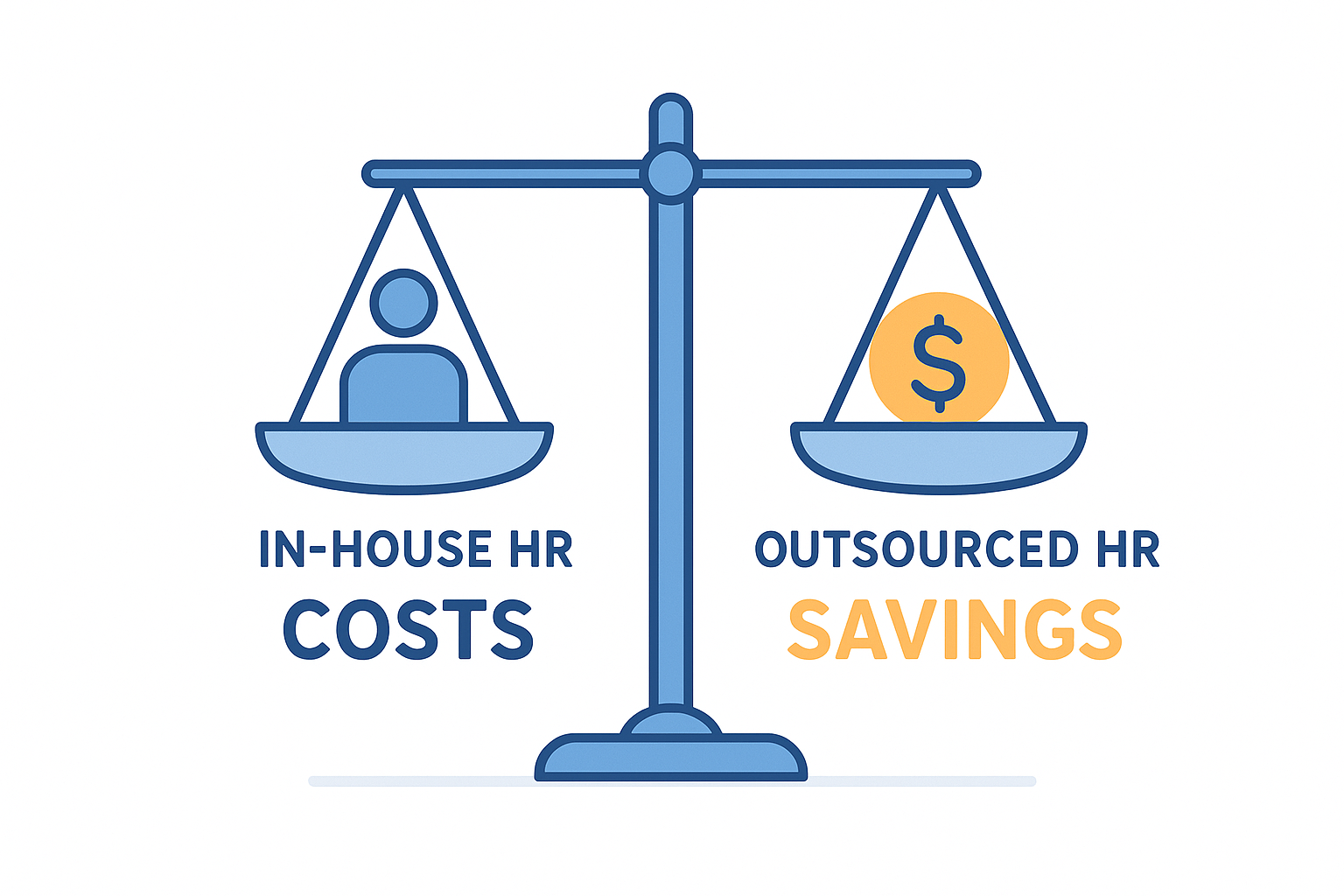
For many small businesses, outsourcing HR delivers expert-level support at a fraction of the cost of a full internal department.
In-House HR vs. Outsourced HR: Which Costs Less?
For companies with fewer than 150 employees, outsourced HR almost always wins on cost. Here’s why: a single mid-level HR manager in the U.S. earns between $65,000 and $95,000 per year — before benefits, payroll taxes, and software. Add those in, and you’re looking at a total cost of $90,000 to $130,000 annually for one person.
By contrast, outsourced HR services typically run $50 to $200 per employee per month, depending on the scope. For a 50-person company, that’s $30,000 to $120,000 per year — often for a broader range of expertise than one generalist can provide. You can explore a detailed comparison in our guide to the cost of HR outsourcing.
Additionally, outsourcing eliminates the risk of a knowledge gap. A single HR hire might be strong in recruiting but weak in compliance — or vice versa. An outsourced HR partner brings a team with depth across all disciplines.
The Hidden Cost of Getting HR Wrong
Underinvesting in HR isn’t free. It just moves the cost to a more painful line item. According to the U.S. Equal Employment Opportunity Commission (EEOC), workplace discrimination charges result in hundreds of millions of dollars in settlements every year — most involving employers without strong HR practices in place.
Furthermore, high turnover — often a symptom of poor HR — compounds costs fast. When you factor in recruiting, onboarding, training, and the productivity dip while a new hire ramps up, the real price of replacing an employee frequently exceeds their annual salary. Our article on the costs of not having HR support digs into these numbers in detail.
How to Reduce Your HR Cost Per Employee Without Cutting Corners
Reducing your HR spend doesn’t mean doing less HR. It means doing HR smarter. Here are the most effective levers growing companies can pull:
- Automate admin tasks with HRIS software. The right platform can eliminate hours of manual work each week. See how pricing stacks up in our HRIS software pricing guide.
- Standardize processes with an HR playbook. Documented workflows reduce errors, speed up onboarding, and protect you legally.
- Invest in retention before turnover hits. Strong onboarding, regular check-ins, and competitive benefits cost far less than replacing people.
- Consider outsourced HR for full-spectrum coverage. For most SMBs, this delivers more capability at lower total cost than building internally.
- Audit your HR spend annually. Identify redundant tools, underused subscriptions, and functions that could be consolidated or automated.
At Soteria HR, we work with growing businesses — typically 10 to 250 employees — to build HR structures that are both cost-effective and genuinely protective. We handle everything from compliance and benefits management to recruiting and employee handbooks, so leaders can focus on growing the business instead of managing HR complexity. You can also review our complete HR consulting pricing guide to understand what professional HR support typically costs.

The right HR structure helps small and mid-sized teams grow with confidence — without ballooning overhead.
Frequently Asked Questions About HR Cost Per Employee
What is the average cost of HR per employee?
The average cost of HR per employee ranges from $1,000 to $3,000 per year for mid-sized organizations, according to SHRM benchmarking data. Smaller companies often spend more per head because fixed HR costs are spread across fewer employees.
How do you calculate HR cost per employee?
Divide your total annual HR department spend — including salaries, benefits, software, and training — by your total headcount. For example, $150,000 in HR costs divided by 50 employees equals $3,000 per employee.
What is the recommended HR-to-employee ratio?
SHRM recommends roughly one HR professional for every 50 to 75 employees. However, smaller companies often need a higher ratio because they face the same compliance demands with fewer people to share the workload.
Why is the HR cost per employee higher at small businesses?
Small businesses pay a larger share of fixed HR costs per person because those costs don’t scale down proportionally with headcount. A solo HR hire costs roughly the same whether you have 20 or 200 employees.
What costs are included in HR spending per employee?
HR spending per employee typically includes HR staff salaries and benefits, HR software and HRIS subscriptions, recruiting and onboarding costs, compliance and legal fees, and training and development programs.
Is outsourced HR cheaper than an in-house HR department?
For most companies with fewer than 150 employees, outsourced HR is significantly cheaper than maintaining a full in-house team. You avoid salary, benefits, and overhead while still getting expert-level support.
How much does outsourced HR cost per employee per month?
Outsourced HR typically costs between $50 and $200 per employee per month, depending on the scope of services. Full-service packages that include compliance, recruiting, and benefits management sit at the higher end of that range.
What happens if a company doesn’t invest enough in HR?
Underinvesting in HR exposes businesses to compliance violations, high turnover, and costly legal disputes. Research shows that a single employment lawsuit can cost a small business an average of $160,000 in legal fees and settlements.
How can a growing company reduce its HR cost per employee?
Growing companies can reduce HR costs per employee by outsourcing HR functions, investing in HRIS software to automate admin tasks, and standardizing processes through an employee handbook and HR playbook. Each of these cuts time and overhead.
What is a good HR budget percentage of total payroll?
Most organizations allocate 1% to 3% of total payroll to HR operations. The exact percentage depends on company size, industry, and the complexity of your compliance environment.
Does company size affect the cost of HR per employee?
Yes, significantly. Larger organizations benefit from economies of scale, spreading fixed HR costs across more employees. Smaller companies typically pay more per employee because their fixed costs remain high relative to headcount.
What HR software costs should I budget for per employee?
HRIS and HR software typically costs between $5 and $25 per employee per month, depending on the platform and features. Payroll, onboarding, and performance management modules each add to the total.
What is the biggest hidden cost in HR spending?
Turnover is often the largest hidden HR cost. Replacing an employee can cost 50% to 200% of their annual salary when you factor in recruiting, onboarding, training, and lost productivity.
The Bottom Line on HR Cost Per Employee
Understanding the cost of HR per employee is the first step toward building a people function that actually supports your growth instead of quietly draining your budget. For most SMBs, the answer isn’t to spend less on HR — it’s to spend smarter. That means automating what can be automated, standardizing what should be standardized, and getting expert help where the stakes are highest. Whether you build internally, outsource, or blend both approaches, knowing your numbers puts you in control. And if you’re not sure where to start, Soteria HR is here to help you figure it out — without the jargon, the guesswork, or the bloated retainer fees.