Proactive HR support for startups is the practice of setting up people processes before problems force the issue. For a young company, that means getting hiring, records, policies, and benefits right while the team is still small. It is easier, calmer, and usually cheaper than cleaning up later.
Quick answer: Start with worker classification, consistent hiring and onboarding, organized records, and a basic handbook. Then add benefits and manager training. If you do not have an HR department, an outsourced HR partner can carry the day-to-day work.
What Is Proactive HR Support for Startups?
Proactive HR support for startups is hands-on guidance and administration that builds HR foundations ahead of need. It covers the basics a growing team relies on: offer letters, onboarding, personnel files, policies, leave coordination, and benefits.
Reactive HR works the other way. A complaint arrives, an employee leaves unexpectedly, or an agency sends a letter, and the founder improvises. In contrast, a proactive approach gives you a plan before that day comes.

Founders reviewing an onboarding checklist, a core step in proactive HR support for startups.
Why Early-Stage HR Matters More Than Founders Expect
Most founders do not set out to ignore HR. However, product, funding, and customers take priority, so people tasks slip. As a result, small gaps grow quietly.
Employment rules also apply from the first hire. The U.S. Department of Labor enforces wage and hour rules, and the EEOC enforces federal anti-discrimination laws. State rules, especially in California, can add requirements. Thresholds often depend on employer size, so check current official sources for your location.
For a deeper look at the founder’s perspective, see this guide to HR support for startups.
What to Set Up First: A Step-by-Step Plan
You do not need a large HR program on day one. You need a sensible order. Use this sequence as a starting point.
- Confirm worker classification. Review whether each person is an employee or contractor under federal and state rules, and document your reasoning.
- Standardize hiring and onboarding. Use consistent offer letters, job descriptions, and an onboarding checklist.
- Organize employee records. Keep personnel, payroll, and medical or leave files separate, secure, and access-limited.
- Write core policies. Cover conduct, anti-harassment, time off, and complaint procedures, adjusted for your state and city.
- Plan benefits and manager training. Decide what you can offer and teach managers how to give feedback and document concerns.
- Review regularly. Revisit your setup each quarter or at each hiring milestone.
Common Startup HR Gaps to Watch
| Gap | Why it matters | Early fix |
|---|---|---|
| Informal records | Hard to prove decisions or answer questions | Central, secure files |
| No written policies | Inconsistent treatment across employees | Basic handbook |
| Unprepared managers | Small issues become larger ones | Short manager training |
| Unclear classification | Wage, tax, and benefit implications | Documented review |
For more on this theme, read this practical guide to HR risk management for startups.
Outsourced HR as Early-Stage Startup Support
Many startups cannot justify a full-time HR hire yet. Outsourced HR fills that space. A hands-on HR partner can handle HR administration, advise on employee relations, and coordinate benefits administration while you focus on growth.
Soteria HR provides this kind of support for growing small and mid-sized organizations. It is based in Pasadena, California, and serves employers in Los Angeles, Orange County, and nationwide. Its core services are HR administration, HR consulting, and benefits administration, with payroll coordination as a complement. To see how an advisor fits a young team, read about how an HR consultant helps a growing startup.
ASO and co-employment: what to know
An ASO (Administrative Services Organization) provides HR support without co-employment. Soteria HR offers an ASO option. Under it, you remain the employer and keep responsibility for employment decisions and applicable obligations. PEOs work differently and can suit some employers well, so compare models against your own needs.
Strategy: Matching HR to Your Stage
Your needs change as you grow. At two or three employees, clean paperwork and clear offer terms matter most. At 15 to 25, managers, benefits, and policies take center stage.
Therefore, build in layers rather than all at once. For stage-by-stage ideas, see which HR strategies work best for startups. Technical teams may also want this founder’s guide to HR consulting for tech startups.

A small team planning hiring and policies together before growth makes them urgent.
Find Your Gaps with a Free HR Health Assessment
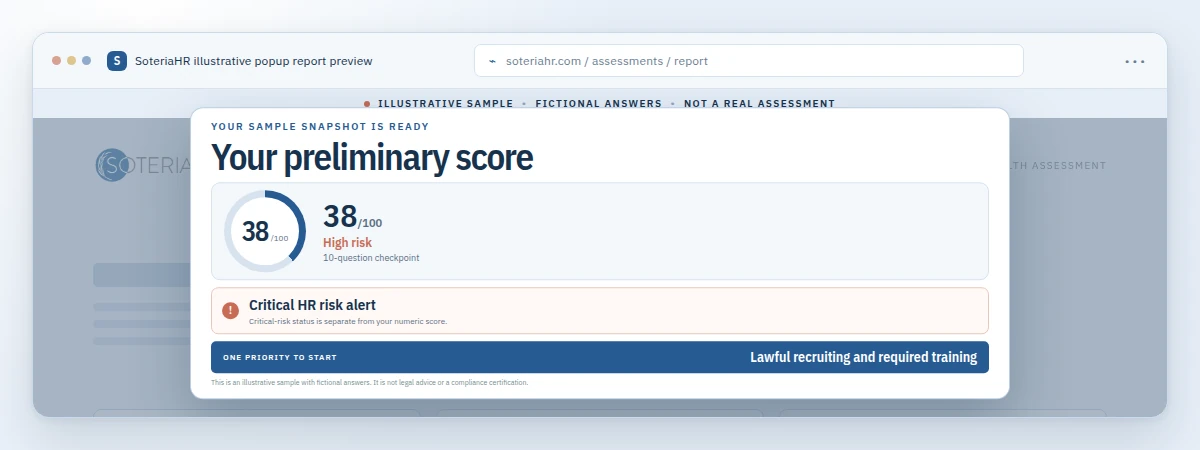
If you are unsure where to begin, the free HR Health Assessment at soteriahr.ai introduces potential gaps and priorities. Results are self-reported and preliminary. They are not a certification of compliance or a legal audit, but they give you a useful starting list for a conversation.
This content is for general information and is not legal or tax advice. Requirements vary by location, employer size, and circumstances. Consult qualified counsel or an appropriate advisor for guidance on your situation.
Frequently Asked Questions
What is proactive HR support for startups?
It means putting HR basics in place before problems appear. That includes policies, hiring practices, records, onboarding and benefits administration, so the founder is not scrambling after an issue.
When should a startup first think about HR?
Ideally before or at the first hire. Even one employee brings payroll, recordkeeping, and workplace rules that apply from day one.
What is the difference between proactive and reactive HR?
Reactive HR responds after a complaint, audit, or departure. Proactive HR sets up clear processes ahead of time so issues are less likely and easier to handle.
What HR tasks should a startup handle first?
Start with correct worker classification, offer letters, onboarding paperwork, personnel records, and a basic handbook. Then add benefits, manager training, and performance practices.
Do startups need an employee handbook?
Federal law does not require a handbook in general, but some state or local rules require specific written policies. A handbook also sets consistent expectations.
Can outsourced HR work for a startup without an HR department?
Yes. Outsourced HR gives a startup access to HR administration and consulting without hiring a full-time HR leader.
What is an ASO and how does it differ from a PEO?
An ASO (Administrative Services Organization) provides HR support without co-employment, so the client stays the employer. A PEO uses a co-employment model. Which fits best depends on your needs.
Does outsourcing HR remove my legal responsibilities?
No. With an ASO arrangement, you remain the employer and keep responsibility for employment decisions and applicable obligations.
How much does HR support cost for a startup?
Cost depends on scope, headcount, and the services you choose. A consultation lets an HR partner scope the work and give a quote.
What are common HR mistakes startups make?
Common mistakes include misclassifying workers, skipping written policies, keeping informal records, and delaying manager training. Each is easier to fix early.
How can I find my HR gaps quickly?
A self-reported tool like the free HR Health Assessment can surface potential gaps and priorities. Results are preliminary and do not certify compliance.
How do I get proactive HR support for my startup?
Identify your top priorities, then talk to an HR partner about scope. Soteria HR offers consultations by phone at (800) 399-2458 or through a consultation request.
Conclusion
Proactive HR support for startups comes down to a few early habits: classify workers carefully, hire and onboard consistently, keep clean records, write core policies, and train managers. Start small, then build as you grow. If you want a partner on your side, Soteria HR can help you decide what to put in place first. Talk to an HR Expert at (800) 399-2458 or submit a consultation request.