HR metrics for small to mid-sized companies are the handful of numbers that show how well your hiring, retention, and people practices are working. You do not need a large analytics team to use them. You need a short list, clear definitions, and a regular habit of reviewing the results.
Quick answer: Start with five to eight metrics: turnover rate, time to fill, absenteeism, headcount, and training completion. Define each one in writing, set a baseline, and review them monthly or quarterly.

A manager reviews a short list of HR metrics at a desk.
What Are HR Metrics and Why Do They Matter?
HR metrics are measurements of people-related activity, such as how many employees leave, how long a role stays open, or how often staff miss work. They turn hunches into facts. As a result, leaders can spot problems earlier and decide where to put time and budget.
For growing organizations, this matters more each year. When headcount rises, informal knowledge stops scaling. Therefore, a few consistent numbers give founders, CFOs, and operations leaders a shared view of the workforce.
Core Workforce Measures to Track First
Begin with measures that use data you already have. The table below shows common starting points and how to calculate them.
| Metric | How to calculate | What it tells you |
|---|---|---|
| Turnover rate | Separations ÷ average headcount × 100 | How well you retain people |
| Time to fill | Days from job opening to accepted offer | Where hiring slows down |
| Absenteeism rate | Unplanned absence days ÷ scheduled workdays × 100 | Possible workload or morale issues |
| New-hire 90-day retention | New hires still employed at 90 days ÷ total new hires × 100 | How effective onboarding and selection are |
| Training completion | Completed assignments ÷ assigned × 100 | Whether required training is on track |
A Simple Hypothetical Example
Imagine a company with an average of 80 employees that had 12 separations last year. Its turnover rate is 12 ÷ 80 × 100, or 15 percent. That number alone is neutral. However, if most separations happened within a worker’s first 90 days, the story points to hiring or onboarding rather than pay or culture.
Which Metrics Fit Your Stage of Growth?
The right list depends on where you are. A 15-person team and a 200-person team need different views.
- About 10 to 50 employees: headcount, turnover, time to fill, and new-hire retention.
- About 50 to 150 employees: add absenteeism, training completion, and manager-level turnover.
- About 150 to 250 employees: add engagement survey results, internal promotion rate, and benefits participation.
These bands are a guide, not a rule. For a deeper list, see our guide on HR metrics for small businesses.

A short quarterly review keeps people data connected to decisions.
How to Start Tracking HR Metrics for Small to Mid-Sized Companies
You can set up a workable system in about an hour. Follow these steps.
- Pick two or three business questions, such as why people leave or why hiring takes so long.
- Choose five to eight metrics that answer those questions.
- Write down exactly how each metric is calculated and who is included.
- Pull the last 6 to 12 months of data to set a baseline.
- Review monthly or quarterly, choose one action, and assign an owner.
Tools, Data Quality, and Privacy
A spreadsheet is enough for many teams. Later, HR systems can automate reports, and our overview of HR data analytics tools explains the options.
Data quality matters more than software. Inconsistent definitions, such as counting contractors in one report but not another, make trends meaningless. Privacy matters too. Limit access to people who need it, report in aggregate, and avoid sharing results for very small groups. Use hypothetical examples when discussing data outside HR.
For external context, the U.S. Bureau of Labor Statistics publishes job openings and turnover data by industry. Likewise, the Society for Human Resource Management offers research and benchmarking resources. Always check the definition and date of any benchmark before comparing it to your own numbers.
Common Mistakes to Avoid
- Tracking too many numbers and acting on none.
- Changing definitions from one period to the next.
- Comparing yourself to benchmarks from a different industry or size.
- Treating one bad month as a trend.
When Outside HR Support Helps
Many leaders are too busy to build and maintain this work. An outsourced HR partner can organize records, define metrics, and help turn results into practical actions. Soteria HR is a Pasadena-based, hands-on HR partner serving growing small and mid-sized organizations in Los Angeles, Orange County, and nationwide. Its HR administration, HR consulting, and benefits administration services, including an ASO (Administrative Services Organization) option without co-employment, can support this kind of reporting. Clients remain the employer and keep responsibility for employment decisions.
If cost is a concern, read about whether outsourcing HR is cost-effective and what to budget for HR per employee. You can also explore HR solutions for growing firms.
Not sure where to begin? Talk to an HR Expert at (800) 399-2458 or submit a consultation request through soteriahr.com.
Frequently Asked Questions
What are HR metrics?
HR metrics are numbers that show how your people practices are performing. They cover areas such as turnover, hiring, absence, and training. Tracked over time, they reveal trends.
Which HR metrics for small to mid-sized companies should I track first?
Start with turnover rate, time to fill, absenteeism, and headcount. These are easy to calculate from records you already have. Add more once the basics are reliable.
How do I calculate employee turnover rate?
Divide the number of separations in a period by your average headcount for that period, then multiply by 100. Use the same period each time so results compare fairly.
How often should I review HR metrics?
Review most metrics monthly or quarterly. Look at turnover and engagement results over longer windows, since single months can be misleading.
Do I need HR software to track metrics?
No. A well-kept spreadsheet works for many smaller teams. Software helps once manual tracking takes too much time or errors creep in.
What is a good turnover rate?
It depends on your industry, location, and roles. Compare yourself against your own history and against published industry data, such as that from the U.S. Bureau of Labor Statistics.
What is time to fill?
Time to fill is the number of days between opening a job and the accepted offer. It helps you see where hiring slows down.
How many HR metrics are too many?
More than you can act on is too many. Most small teams do well with five to eight metrics tied to specific business questions.
How do I protect employee privacy when tracking HR data?
Limit access to those who need it, report in aggregate where possible, and avoid sharing results for very small groups. Check applicable privacy and data rules for your location.
What mistakes do companies make with HR metrics?
Common mistakes include tracking too much, using inconsistent definitions, and collecting data without acting on it. Another is comparing numbers without context.
Can outsourced HR help with metrics?
Yes. An outsourced HR partner can help define metrics, organize records, and interpret results. The employer still makes the final employment decisions.
How does the HR Health Assessment relate to HR metrics?
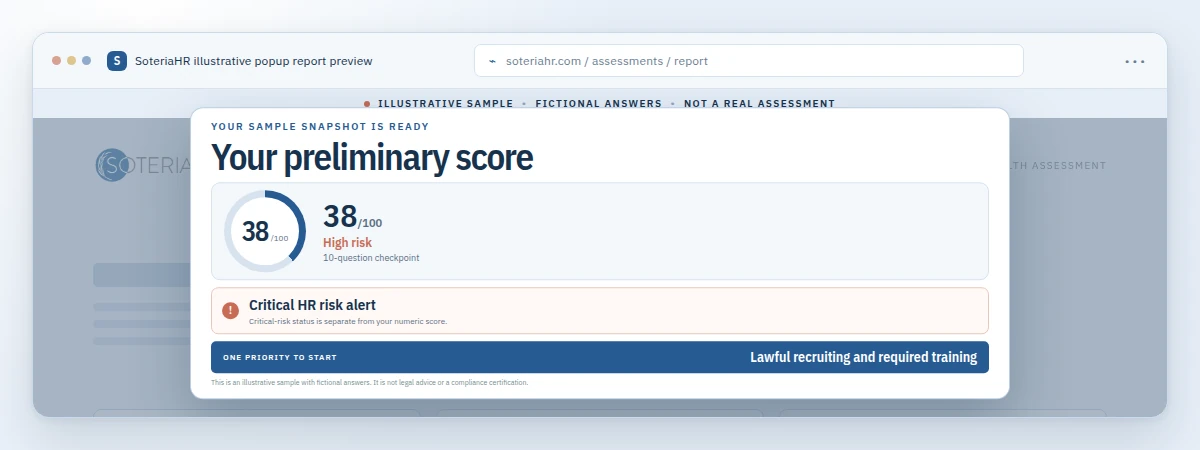
The free HR Health Assessment is a self-reported, preliminary look at potential HR gaps and priorities. It is not a legal audit or a certification of compliance, but it can help you decide what to measure first.
Conclusion
Good HR metrics for small to mid-sized companies are simple, clearly defined, and reviewed on a steady schedule. Start with turnover, time to fill, absenteeism, and new-hire retention, set a baseline, and act on what you learn. If you want a hands-on partner to help, Soteria HR is ready when you are. Talk to an HR Expert at (800) 399-2458.
This content is for general information and is not legal or tax advice. Requirements vary by location, employer size, and circumstances. Consult qualified counsel or an appropriate advisor for guidance on your situation.