
Reinsurance is the financial backbone that keeps the entire insurance industry standing when disaster strikes, yet most policyholders — and even many insurance professionals — only understand it in vague terms. In simple language, reinsurance is insurance that insurance companies buy for themselves. When a primary insurer takes on more risk than it can safely hold, it transfers a slice of that risk to a reinsurer in exchange for a share of the premium. Soteria Re was built around this exact need: helping insurance carriers of every size transfer risk, protect their balance sheets, and stay solvent even after a catastrophic loss year.
Because a single hurricane, earthquake, or liability verdict can wipe out years of underwriting profit, having the right reinsurance partner is not a luxury — it is a survival requirement. This guide goes further than a quick overview. It walks through how reinsurance actually works, the structures available, the step-by-step process of setting up a program, the mistakes that sink unprepared carriers, and the regulatory forces shaping the market today. By the end, you will understand reinsurance more completely than any short explainer video could possibly cover.
What Is Reinsurance? Definition, Purpose, and How Soteria Re Delivers It
At its core, reinsurance is a contract in which one insurance company (the “cedent” or primary insurer) transfers part of its risk portfolio to another insurer (the “reinsurer”) in return for a portion of the premium. In other words, reinsurance spreads risk even further than the original policy did, so that no single company — and no single event — can bankrupt the system. Soteria Re operates specifically in this layer of the market, acting as a dedicated reinsurance provider that blends traditional underwriting discipline with modern, data-driven risk modeling.
According to the reinsurance industry overview on Wikipedia, the global reinsurance market has exceeded $300 billion in annual premiums in recent years — a figure that keeps climbing as climate volatility, inflation, and litigation costs push claims higher worldwide. Soteria Re participates in this enormous market by offering flexible, client-specific programs rather than rigid, one-size-fits-all terms. Unlike a passive reference resource, Soteria Re actively structures, prices, and monitors coverage alongside each carrier it works with.
A Brief History of Reinsurance
Reinsurance is not a modern invention. In fact, the earliest known reinsurance contract dates back to 14th-century Genoa, where marine insurers transferred a portion of shipping risk to other parties. Consequently, the concept has survived for nearly seven centuries precisely because it solves a timeless problem: no single insurer wants — or can afford — to hold 100% of every risk it writes. Today’s reinsurance market, led by global players alongside specialized providers like Soteria Re, is simply a far more sophisticated version of that original Genoese idea.

Soteria Re helps insurers assess and transfer risk through structured reinsurance programs tailored to each carrier’s portfolio.
Core Reinsurance Structures: Treaty vs. Facultative Explained
Understanding the two primary structures is essential before choosing a program. Soteria Re supports both major approaches, and each serves a distinct purpose:
Treaty Reinsurance — This structure automatically covers an entire class or portfolio of policies under one agreement. For example, an insurer writing homeowners policies in hurricane-prone states can place a single treaty that covers all such policies up to a defined limit. As a result, treaty reinsurance provides broad, consistent protection and dramatically simplifies administration.
Facultative Reinsurance — In contrast, this approach covers individual risks one at a time. It is particularly useful for large commercial properties, specialty lines, or risks that fall outside standard treaty terms. Each facultative placement is separately negotiated, priced, and underwritten — which makes it slower but far more precise.
Furthermore, Soteria Re offers both proportional and non-proportional structures within these two categories. Proportional treaties share premiums and losses in a set ratio, whereas excess-of-loss treaties only activate once losses exceed a defined retention level. Choosing between the two is one of the most consequential decisions a carrier will make.
Why Proportional vs. Excess-of-Loss Matters
Choosing between proportional and excess-of-loss reinsurance depends entirely on your financial goals. Proportional treaties reduce volatility across all losses, large and small, which smooths earnings but costs more in ceded premium. In contrast, excess-of-loss structures focus protection specifically on severe, tail-risk events — making them ideal for catastrophe exposure at a lower relative cost. Soteria Re’s underwriting team models both options side by side before a client commits to either structure, so the decision is based on data rather than guesswork.
Reinsurance vs. Primary Insurance: Key Differences
Readers new to the topic often confuse reinsurance with ordinary insurance. The table below clarifies the distinction at a glance.
How to Set Up a Reinsurance Program with Soteria Re
Setting up a reinsurance arrangement is a structured, repeatable process. Below is a step-by-step guide to working with Soteria Re. For a deeper walkthrough, see our Workforce Planning Services: What They Are for Growing SMBs.
- Assess Your Risk Exposure — Review your entire book of business to identify the types, volumes, and geographic concentrations of risk that need protection, including historical loss data and stress tests for catastrophic scenarios.
- Define Your Reinsurance Structure — Decide whether treaty, facultative, or a hybrid approach best fits your portfolio, taking into account your retention appetite and the maximum single-event loss you can absorb.
- Contact Soteria Re — Reach out through soteriahr.com to present your risk profile and begin discussions on program design, pricing, and timeline.
- Negotiate and Finalize Terms — Work with Soteria Re’s underwriters to agree on retention levels, coverage limits, premium rates, and any special conditions, and review the terms of service carefully before signing.
- Implement and Monitor the Program — Integrate the reinsurance terms into your underwriting guidelines and review program performance at least annually, especially after significant loss events or portfolio changes.
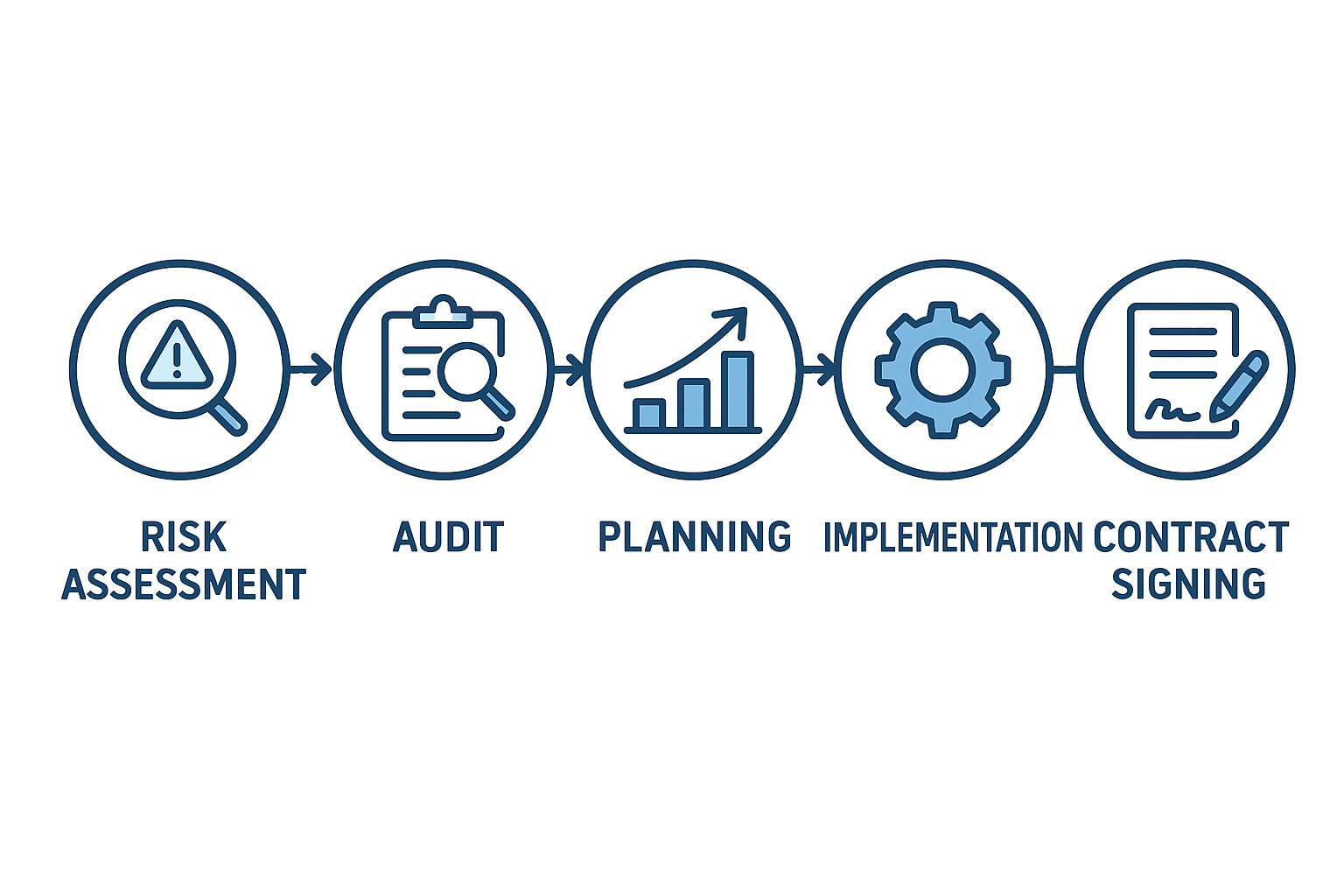
A clear five-step process helps insurers structure and launch a reinsurance program efficiently.
Risk Transfer Strategies That Protect Insurers
Effective risk transfer is the foundation of every strong reinsurance program. Soteria Re approaches this through a combination of quantitative modeling and market expertise. Specifically, the team analyzes an insurer’s loss history, exposure accumulation, and geographic concentration to recommend the most efficient structure for that carrier’s unique situation.
Proportional Risk Sharing Explained
In a proportional arrangement, the insurer and reinsurer share both premiums and losses in a pre-agreed ratio. As a result, the reinsurer participates from the first dollar of loss, providing immediate relief on both attritional and large claims. This structure is especially valuable for growing carriers that want to stabilize their combined ratios while expanding premium volume.
Catastrophe Reinsurance and Tail-Risk Events
Catastrophe reinsurance is one of the most critical tools in the risk transfer toolkit. For instance, when a major hurricane strikes a coastal region, primary insurers can face claims that far exceed normal loss expectations. Catastrophe reinsurance activates above a defined aggregate threshold, absorbing the excess and preventing insolvency. In fact, the Insurance Information Institute notes that without reinsurance, many regional carriers would not survive a single major storm season.
Alternative Risk Transfer: Catastrophe Bonds, ILS, and Retrocession
Traditional reinsurance is not the only tool available. Over the past two decades, the market has developed several alternative risk transfer mechanisms that complement — rather than replace — standard treaty and facultative arrangements.
- Catastrophe bonds (cat bonds) — Insurance-linked securities sold to capital market investors. If a specified catastrophe occurs, investor principal is used to pay claims; otherwise, investors earn an attractive yield.
- Insurance-linked securities (ILS) — A broader category of instruments, including cat bonds, that transfer insurance risk to non-traditional capital, diversifying where reinsurance capacity comes from.
- Retrocession — This is, in effect, reinsurance for reinsurers. A reinsurer that wants to further diversify its own exposure cedes part of its book to a retrocessionaire, adding yet another layer of protection to the system.
Consequently, a sophisticated reinsurance strategy today often blends traditional treaties with one or more of these alternative structures, giving carriers access to both insurance-market and capital-market capacity.
Financial Stability Benefits for Insurance Carriers
Beyond loss protection, reinsurance delivers tangible financial stability benefits. Carriers that use reinsurance effectively can write more premium volume without proportionally increasing their capital requirements. This is known as capital relief — freeing up money that would otherwise sit idle as a buffer against losses — and it is one of the most strategically valuable aspects of a well-designed reinsurance program.
Capital Relief and Underwriting Capacity
When a reinsurer absorbs a portion of expected losses, the primary insurer needs to hold less statutory capital against that same book of business. Therefore, the carrier can redeploy that freed-up capital toward new growth, technology investment, or shareholder returns — all while maintaining the same safety margin regulators require.
Rating Agencies, Solvency Requirements, and Regulatory Oversight
Reinsurance also improves an insurer’s credit profile. Rating agencies such as AM Best consider a carrier’s reinsurance program when assessing financial strength, and a robust arrangement can support a higher rating. In the United States, state insurance departments coordinated through the National Association of Insurance Commissioners (NAIC) also review reinsurance treaties as part of solvency oversight, since an under-reinsured carrier poses a risk to policyholders statewide. You can also review the Soteria Re privacy policy to understand how your business data is handled throughout the underwriting and placement process — transparency in data practices is an important consideration when selecting any reinsurance partner.

Reinsurance creates a financial balance that allows carriers to grow their business without overexposing their capital base.
The Global Reinsurance Market by the Numbers
To appreciate the scale of this industry, consider the numbers. Global reinsurance premiums now exceed $300 billion annually, spread across a mix of large global reinsurers and specialized regional providers like Soteria Re. In particular, property catastrophe reinsurance pricing has hardened considerably in recent years, driven by rising climate-related losses, inflation in rebuilding costs, and increased frequency of severe convective storms. As a result, carriers that fail to plan their reinsurance renewals well in advance risk being caught off guard by sudden rate increases or reduced capacity at renewal time.
Common Mistakes Insurers Make When Buying Reinsurance
Even experienced underwriters sometimes make avoidable errors when structuring reinsurance. Here are the most common pitfalls to watch for:
- Underestimating accumulation risk — Failing to account for how individual risks cluster geographically can lead to unexpected correlated losses in a single event.
- Choosing the wrong structure — Selecting a treaty that does not match the actual risk profile results in either over-paying for coverage or leaving dangerous gaps in protection.
- Neglecting annual reviews — As a carrier’s book of business changes, so does its reinsurance need; failing to update treaty terms can leave a carrier underprotected or paying for unnecessary capacity.
- Ignoring counterparty credit risk — A reinsurer that cannot pay claims is worse than no reinsurance at all, so always verify the financial strength rating of your reinsurance partner.
- Waiting until renewal week — Starting negotiations too late leaves little room to shop alternative markets, which usually means accepting less favorable terms than a well-planned process would achieve.
Beyond Financial Risk: Why Insurance Carriers Also Need Strong Workforce Strategies
Reinsurance protects the balance sheet, but insurers still depend on skilled underwriting and claims teams to execute a program well. Consequently, carriers that invest in competitive employee benefits often retain the specialized talent needed to manage complex treaty and facultative placements. For example, offering strong benefits packages helps carriers attract and retain experienced underwriting talent, which thoughtful strategic benefits planning can support directly. In addition, well-managed benefits enrollments and terminations keep HR operations running smoothly even as a carrier’s workforce grows alongside its premium volume. Finally, some carriers find that a thoughtful boomerang hiring strategy — bringing back former employees who already understand the company’s risk appetite — helps fill specialized reinsurance and underwriting roles faster than starting from scratch.
Quick-Reference Glossary of Reinsurance Terms
Cedent: The primary insurer that transfers risk to a reinsurer.
Retention: The amount of risk an insurer keeps for its own account before reinsurance applies.
Ceding commission: A fee paid by the reinsurer to the cedent to offset acquisition costs.
Combined ratio: A key profitability metric equal to losses plus expenses divided by earned premium.
Retrocession: Reinsurance purchased by a reinsurer to protect its own book of business.
Frequently Asked Questions About Reinsurance and Soteria Re
What is Soteria Re?
Soteria Re is a reinsurance platform that provides risk transfer, treaty, and facultative reinsurance solutions designed to strengthen the financial stability of insurance carriers. It serves both large national carriers and smaller regional insurers with customized program structures.
What exactly is reinsurance, in plain terms?
Reinsurance is insurance that an insurance company buys for itself. It transfers part of the risk the insurer has already assumed to a reinsurer, in exchange for a share of the premium, so that no single company carries all of the potential loss.
How does Soteria Re help insurance companies?
Soteria Re helps insurance companies by absorbing a portion of their risk exposure, which protects their balance sheets and allows them to underwrite more policies with confidence. This leads to greater premium volume without proportionally increasing capital requirements.
What types of reinsurance does Soteria Re offer?
Soteria Re offers both treaty reinsurance, which covers an entire portfolio of policies, and facultative reinsurance, which covers individual high-value or complex risks. Both proportional and excess-of-loss structures are available within these categories.
Why is reinsurance important for financial stability?
Reinsurance spreads risk across multiple parties, preventing a single large loss event from destabilizing an insurer. According to the Insurance Information Institute, reinsurance is a critical tool for maintaining solvency in the face of catastrophic events.
What is the difference between treaty and facultative reinsurance?
Treaty reinsurance automatically covers all policies within a defined class, while facultative reinsurance is negotiated individually for specific risks that fall outside standard treaty terms. Treaty is broader; facultative is more targeted.
How does risk transfer work in reinsurance?
Risk transfer works by shifting a portion of an insurer’s liability to a reinsurer in exchange for a premium. This reduces the primary insurer’s potential loss on any given event and smooths out earnings volatility over time.
Is Soteria Re suitable for small insurance carriers?
Yes. Soteria Re’s flexible structures make it accessible to both large and small insurance carriers seeking proportional or excess-of-loss protection tailored to their book of business. Smaller carriers often benefit most from the capital relief reinsurance provides.
What is catastrophe reinsurance?
Catastrophe reinsurance protects insurers against large-scale losses caused by events like hurricanes, earthquakes, or floods. It activates when aggregate losses exceed a defined threshold, providing a critical safety net for tail-risk events.
What is retrocession in reinsurance?
Retrocession is reinsurance purchased by a reinsurer to protect its own book of business. In essence, it extends the same risk-sharing principle one layer further up the chain, spreading risk even more broadly across the global market.
Are catastrophe bonds a form of reinsurance?
Catastrophe bonds function similarly to reinsurance but source capacity from capital market investors instead of traditional reinsurers. They are considered an alternative risk transfer tool that complements standard reinsurance treaties.
How do I get started with Soteria Re?
You can get started by visiting soteriahr.com and contacting their team directly to discuss your risk profile, coverage needs, and program structure options. The process typically begins with a risk assessment and loss data submission.
What are the privacy practices of Soteria Re?
Soteria Re maintains a clear privacy policy that outlines how client data is collected, used, and protected. You can review the full details at their official privacy policy page.
What common mistakes should insurers avoid when buying reinsurance?
Common mistakes include underestimating exposure accumulation, choosing the wrong reinsurance structure, and failing to review treaty terms annually as the book of business evolves. Ignoring counterparty credit risk is also a significant and often overlooked error.
How is the cost of reinsurance determined?
Reinsurance pricing depends on factors such as the insurer’s loss history, the type and volume of risk, geographic concentration, and current market conditions. Hard market cycles typically push reinsurance rates higher, while soft markets offer more favorable pricing.
Conclusion: Why Reinsurance With Soteria Re Matters for Modern Insurers
In summary, reinsurance is the practical and strategic mechanism that keeps insurance carriers solvent, competitive, and ready to grow, and Soteria Re represents a dedicated partner for navigating an increasingly volatile risk environment. Whether you need broad treaty protection, targeted facultative coverage, or catastrophe reinsurance for tail-risk events, the platform offers the flexibility and expertise to build a program that fits your exact book of business. Above all, the financial stability and capital relief that reinsurance provides are not luxuries — they are competitive necessities in today’s market. By partnering with Soteria Re, insurers can grow their business with confidence, knowing that their exposure is managed by a dedicated and experienced reinsurance team. Visit soteriahr.com to explore your options and take the first step toward a stronger, more resilient insurance operation.