The implementation of change in an organization is the structured process of executing a planned transition — moving people, processes, and systems from a current state to a desired future state through deliberate leadership, communication, and people management. Done well, it delivers competitive advantage. Done poorly, it costs millions and erodes trust for years.
According to McKinsey & Company, roughly 70% of organizational change initiatives fall short of their goals. Yet the 30% that succeed are not luckier — they follow identifiable, learnable practices. This guide maps every one of them, step by step, with the depth and specificity that leaders actually need at the point of execution.
What you will find here: a full definition, a deep look at why change fails, a comparison of leading frameworks, a detailed step-by-step implementation process, people management tactics, measurement metrics, mistakes to avoid, type-specific guidance, and a comprehensive FAQ — everything a practitioner needs in one place.
What Is the Implementation of Change in an Organization?
The implementation of change in an organization refers to the active execution phase of a change management plan — the point where decisions leave the boardroom and become real actions that affect real people. It encompasses every task, communication, adjustment, and decision needed to shift the organization from its current operating model to the intended new one.
This is meaningfully different from change planning. Planning defines what will change and why. Implementation is where the complexity, resistance, and real risk actually live. Most change failures are not planning failures — they are implementation failures: well-designed strategies that collapse at the execution stage because of poor communication, weak leadership follow-through, or inadequate people support.
For a broader grounding in the full discipline, see our guide on what is organizational change management.
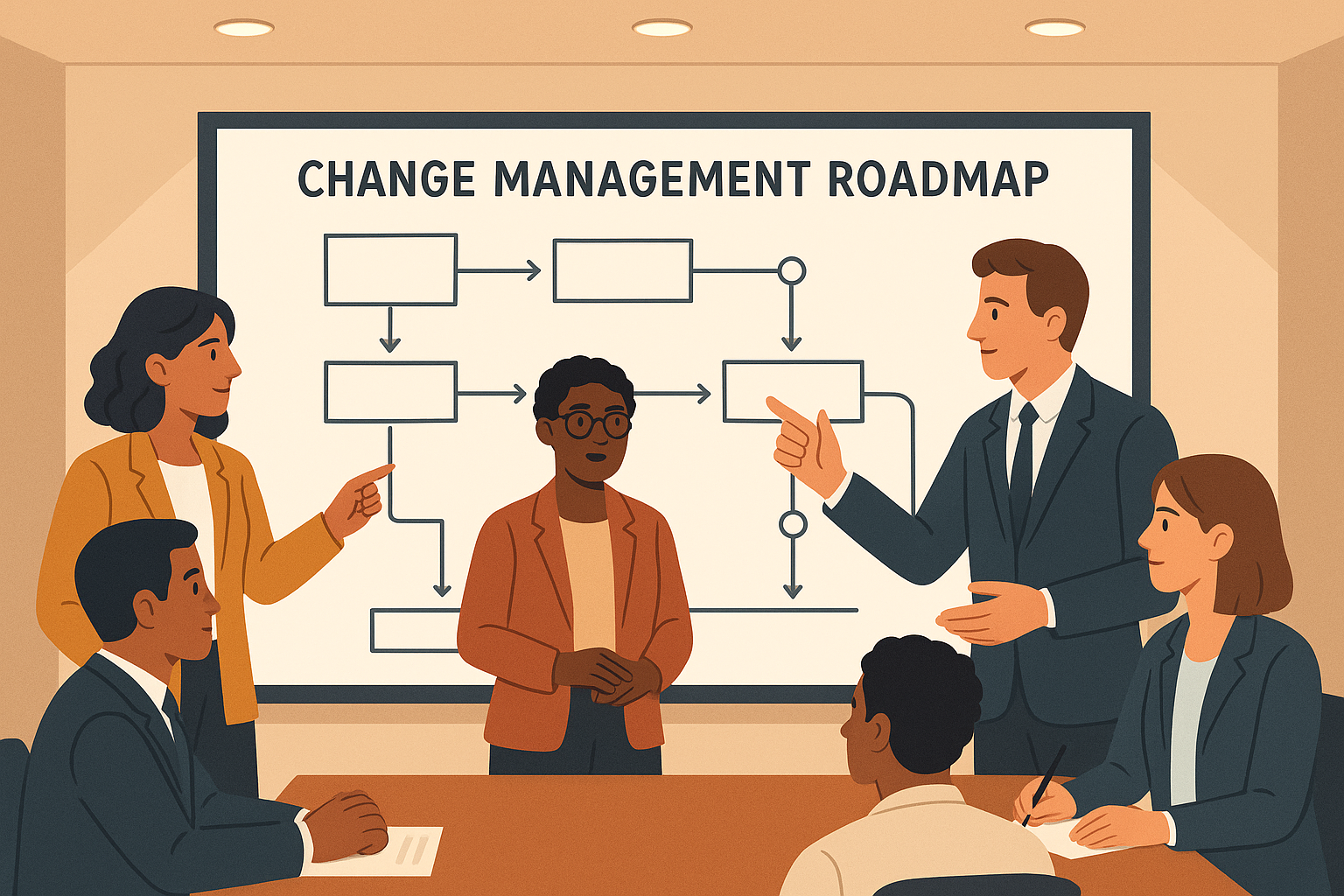
A cross-functional team aligning on a phased change roadmap — a critical early step in successful organizational transformation.
Types of Organizational Change — and Why Each Requires a Different Approach
Not all organizational change is the same. The implementation approach must match the type of change you are managing. Using a heavy transformation playbook for a minor process update wastes resources; using a light-touch approach for a full cultural overhaul invites failure. The four major categories:
1. Structural Change
Involves reorganizing reporting lines, departments, or business units. Common triggers include mergers, acquisitions, or leadership redesigns. Implementation focus: clarity on new roles and accountabilities, and early communication to prevent power-vacuum anxiety.
2. Process or Technological Change
Involves upgrading or replacing systems, tools, or workflows — ERP rollouts, CRM migrations, automation initiatives. Implementation focus: comprehensive training, parallel-run periods, and robust technical support during cut-over.
3. Cultural Change
The hardest type to implement. Culture change asks people to modify deeply held beliefs and behavioral norms — not just what they do, but how they think. Implementation focus: modeling from the top, long-horizon reinforcement (typically 2–5 years), and story-driven communication that connects values to daily decisions.
4. Strategic Change
Involves shifting the entire direction of the business — entering new markets, pivoting the business model, or responding to disruptive competitive threats. Implementation focus: executive alignment first, cascading communication strategy, and real-time performance tracking to catch course deviations early.
Why Organizational Change Implementation Fails: The Real Root Causes
Change fails for reasons that are well understood — and therefore preventable. Beyond surface-level issues, the deeper causes fall into three clusters that compound each other:
Employee Resistance
Humans are pattern-seeking creatures. When established routines are disrupted, the brain registers it as threat — even if the change is objectively beneficial. Employees resist for specific, addressable reasons: fear of job loss, anxiety about new skills they might lack, reduced autonomy, or uncertainty about where they will fit in the future organization. Resistance is not irrational — it is predictable information that, when listened to, reveals exactly where implementation needs more support.
Leadership Misalignment
When senior leaders publicly support a change but privately hedge their bets — or when different executives send contradictory signals — employees read it immediately. The fastest way to stall a change initiative is visible disagreement among the leadership team. Alignment is not just about getting everyone in the same room; it is about creating a coalition that actively and visibly demonstrates commitment every week throughout the implementation.
Communication Failures
Vague, infrequent, or one-directional communication is consistently the top cited failure point in post-mortem change reviews. Employees need to hear why the change is happening, what it means for them specifically, and when each milestone will occur — repeated across multiple channels, multiple times. According to Towers Watson research, organizations with highly effective change communication are 3.5 times more likely to outperform their peers during major transitions.
Underestimating the Change Burden
Organizations frequently underestimate how much cognitive, emotional, and behavioral load a change places on employees who are simultaneously expected to maintain normal productivity. Change saturation — running too many simultaneous initiatives — is a growing problem in high-growth organizations and one of the most predictable implementation killers.
Skipping the Reinforcement Phase
Perhaps the most common and most damaging mistake: declaring victory the moment the rollout is complete. Research consistently shows that without deliberate, sustained reinforcement, most people revert to old behaviors within 3–6 months of a change initiative. The implementation is not done when the system goes live — it is done when the new way has become the only way people know.
Leading Frameworks for Implementing Organizational Change
Frameworks give shape and structure to what can otherwise feel like an overwhelming, ambiguous process. Here are the four most widely applied models, with a clear-eyed view of when each one works best.
Kotter’s 8-Step Change Model
Developed by Harvard Business School professor John Kotter, this remains one of the most widely referenced frameworks for large-scale organizational transformation. The eight steps are:
- Create a sense of urgency
- Build a guiding coalition
- Form a strategic vision and initiatives
- Enlist a volunteer army
- Enable action by removing barriers
- Generate short-term wins
- Sustain acceleration
- Institute change in culture
Best for: large-scale, enterprise-wide transformations where building momentum from the top down is critical. Limitation: less granular at the individual employee level, which is where resistance actually lives.
Prosci ADKAR Model
ADKAR is an acronym for Awareness, Desire, Knowledge, Ability, and Reinforcement. Unlike top-down models, ADKAR tracks where each individual employee is in their own change journey. This makes it exceptionally useful for diagnosing exactly why a person is resistant — and targeting the right intervention. For example, if an employee has Awareness and Desire but lacks Knowledge, the solution is training, not more communication about why the change matters.
Best for: managing resistance at the individual and team level, especially in mid-size organizations or in the people-management layer of a larger transformation. Many organizations use Kotter’s model for high-level planning and ADKAR for frontline coaching.
Lewin’s 3-Stage Change Model
One of the oldest and most foundational models, developed by organizational psychologist Kurt Lewin. It describes change in three phases: Unfreeze (destabilize the current state and create readiness), Change (execute the transition), and Refreeze (embed the new state as standard). Lewin’s model is elegantly simple and helps leaders understand that preparation and consolidation matter as much as the execution phase itself.
Best for: organizations new to structured change management who need an accessible mental model, or as a diagnostic framework to assess which phase a stalled initiative is stuck in.
McKinsey 7-S Framework
The McKinsey 7-S Framework maps the seven interdependent organizational elements that must be aligned for change to succeed: Strategy, Structure, Systems, Shared Values, Style, Staff, and Skills. It is less a step-by-step process model and more an alignment diagnostic — helping leaders spot where misalignment will create friction during implementation.
Best for: pre-implementation analysis and for understanding second-order effects of a proposed change. If restructuring your sales team (Structure), this model prompts you to ask: does our incentive system (Systems) still align? Do our managers have the right skills (Skills)?
Step-by-Step: How to Implement Change in an Organization
The following eight-step process synthesizes best practices across leading change models and reflects what actually works in real organizational environments. Work through these steps in sequence — each one builds the foundation for the next.
- Define the problem and articulate a compelling vision. Before anything else, be ruthlessly clear about what is driving the need for change — financial pressure, competitive threat, operational failure, strategic opportunity. Then translate that into a vivid, specific, and emotionally resonant vision of what the organization will look like after the change succeeds. Without a compelling “why” that connects to employees’ daily work, no amount of planning will generate voluntary adoption.
- Conduct a stakeholder analysis and readiness assessment. Map every group affected by the change. For each group, assess: How much will they be impacted? How much influence do they have? How resistant are they likely to be? A readiness assessment also benchmarks current organizational capacity — if your teams are already stretched thin by competing priorities, your implementation timeline and support structures need to account for that.
- Build a cross-functional guiding coalition. Assemble a team of leaders, middle managers, and respected frontline employees who will champion the change. Critically, this coalition must include influential informal leaders — the people colleagues trust and turn to, regardless of title. These individuals shape peer perceptions and can either accelerate or silently sabotage adoption.
- Develop and execute a multi-channel communication plan. Build a structured communication calendar that covers every phase of implementation. Use town halls for big announcements, team meetings for Q&A, email for written reference, and manager-led conversations for personalized messaging. Every communication should answer three questions: Why is this happening? What does it mean for me specifically? What comes next and when? Communicate early, often, and in both directions — listening is as important as broadcasting.
- Identify and dismantle barriers to adoption. Audit every structural, process, skill-based, and cultural obstacle that could prevent people from working in the new way. Barriers include: outdated policies that contradict new behaviors, incentive structures that reward old habits, skill gaps that make the new process feel impossible, and cultural norms that punish the visible failures that come with learning. Remove these barriers before the rollout, not after.
- Deliver targeted training and support resources. Generic one-time training sessions are rarely sufficient. Design role-specific training that gives each employee exactly the knowledge and practice repetitions they need to perform confidently in the new environment. Supplement with job aids, FAQs, peer learning groups, and dedicated support channels so employees have somewhere to turn when problems arise during the live implementation.
- Execute in phases, monitor KPIs, and adjust in real time. Wherever possible, implement in planned phases — pilot, expanded rollout, full deployment — rather than a single organization-wide switch. Phased rollouts generate learning, contain risk, and build proof-of-concept stories that help convince skeptics. At every milestone, track leading indicators (adoption rate, training completion, early feedback sentiment) and lagging indicators (productivity, goal achievement). When data signals a problem, act immediately.
- Reinforce, recognize, and institutionalize the change. This is the step most organizations rush or skip — and it is why change fails even after a successful rollout. Deliberately reinforce new behaviors through recognition programs, performance reviews, and public celebration of early adopters. Update job descriptions, onboarding materials, and policy documents to embed the new way permanently. Conduct formal post-implementation reviews at 30, 60, and 90 days to catch regression early.
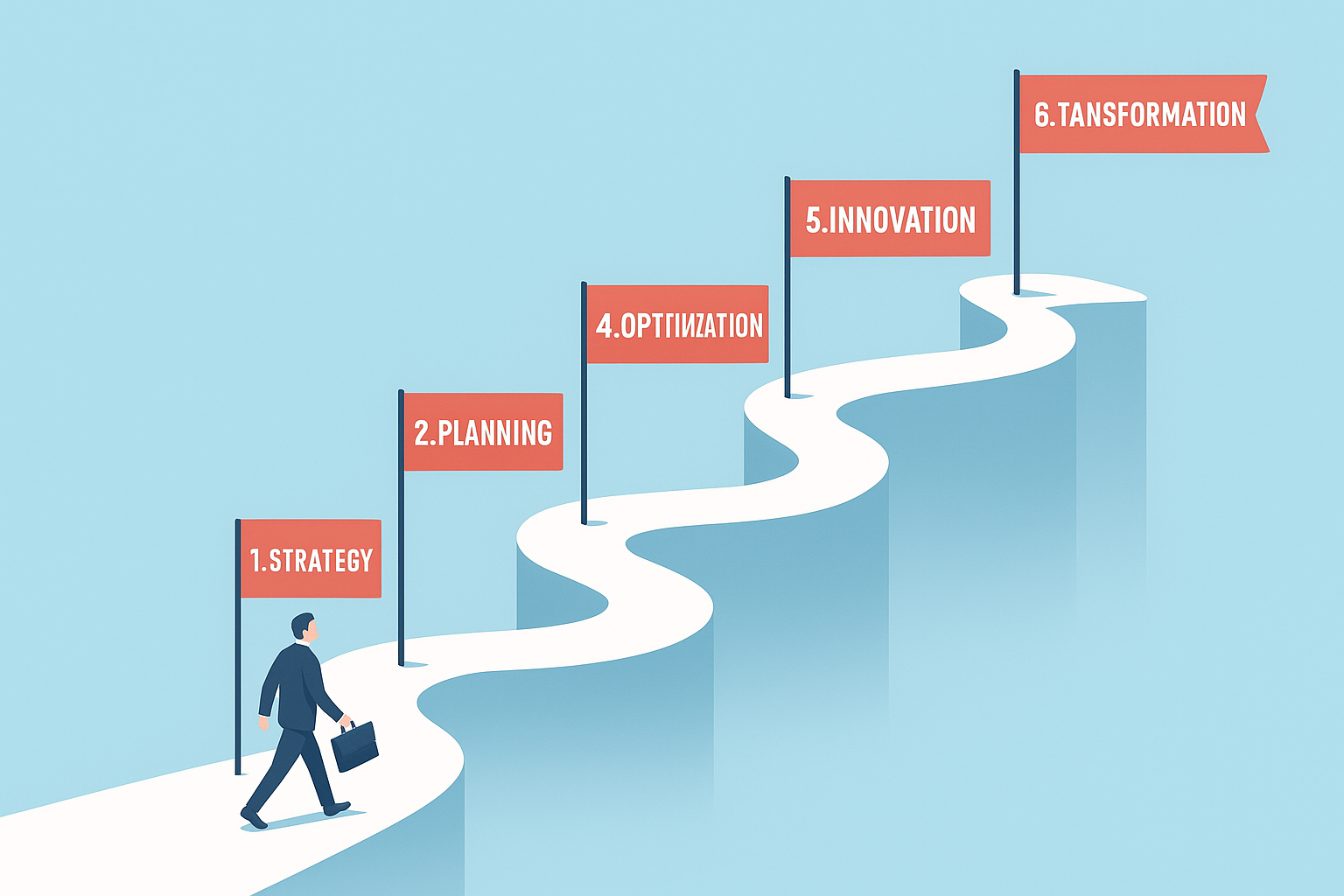
A phased, sequential implementation approach reduces risk and builds the organizational momentum needed to sustain lasting change.
The Role of Leadership in Organizational Change
Leadership is the single most powerful determinant of whether the implementation of change in an organization succeeds or fails. Not strategy. Not budget. Not technology. Leadership behavior — what executives and managers visibly do every day — determines whether employees believe the change is real and permanent, or performative and temporary.
What Effective Change Leaders Do Differently
- They model the new behaviors themselves, publicly and consistently — before asking anyone else to change.
- They protect the change from organizational immune responses — the informal systems, competing priorities, and short-term performance pressures that erode new behaviors.
- They make themselves visible and accessible during the hardest phases of the transition, not just at the launch event.
- They connect every decision and milestone back to the original “why” — reinforcing purpose when effort fatigue sets in.
- They actively solicit and act on feedback, demonstrating that the implementation is a collaborative effort rather than a top-down directive.
The Critical Role of Middle Managers
Middle managers are the most underestimated variable in organizational change. They are the translation layer between executive strategy and daily team behavior. When middle managers are aligned, equipped, and supported, they multiply the impact of change leadership throughout the organization. When they are confused, uncommitted, or poorly briefed, they become a buffer that insulates their teams from the change.
Invest in manager-specific change coaching early and continuously. Provide them with: a clear narrative for their teams, answers to the hard questions employees will ask, the authority to make small local adaptations, and a feedback channel directly to the implementation team. A manager who feels supported will fight for the change; one who feels abandoned will protect their team by quietly maintaining old ways.
Managing People Through Organizational Change
People are the most important variable in any change effort. Investment in employee experience throughout the implementation is not a soft optional extra — it is directly correlated with adoption rates and long-term sustainability. When employees feel respected, heard, and supported, resistance drops and momentum builds.
Practical People-Management Tactics
- Run two-way feedback sessions, not just broadcasts. Create structured channels where employees can raise concerns and receive genuine responses — not just hear updates from leadership.
- Deploy change champions at every level. Assign visible advocates at the team level, not just the executive level. Peer-to-peer influence is often more powerful than top-down messaging.
- Acknowledge the emotional reality. Change is stressful even when it is necessary. Leaders who name this honestly — “we know this is hard” — build more trust than those who project false positivity.
- Provide mental health and wellbeing support. Proactively offer access to EAP resources, flexible working arrangements, and increased manager check-ins during high-stress transition periods.
- Recognize early adopters publicly. Social proof is a powerful adoption accelerator. Publicly celebrating employees who embrace the change normalizes the new behavior and motivates fence-sitters.
- Segment your communication by audience. What matters to a frontline production worker is different from what matters to a regional sales manager. Tailored messaging dramatically outperforms generic all-staff announcements.
For deeper context on the people side of change, explore our resource on what is employee relations and how it connects to implementation success.
Understanding the Emotional Curve of Change
Most employees move through a predictable emotional arc during organizational change — often described as the Change Curve, adapted from Kübler-Ross’s stages of grief. The typical arc moves through: Shock → Denial → Frustration → Depression → Experimentation → Decision → Integration. Understanding where your employees are on this curve at any given point tells you what kind of support intervention they need, and prevents leaders from misinterpreting normal emotional responses as permanent resistance.

Continuous feedback collection allows implementation leaders to intervene precisely when and where adoption is faltering.
Building an Effective Change Communication Strategy
Communication is arguably the highest-leverage activity in change implementation. According to research by Towers Watson, organizations with highly effective change communication are 3.5 times more likely to outperform their peers. Yet most organizations treat communication as an afterthought — a few announcements assembled at the last minute rather than a strategic, sustained program.
Core Principles of Change Communication
- Communicate before people ask. Anticipate the questions your employees will have and address them proactively, before the rumor mill fills the vacuum.
- Use multiple channels. Town halls, team meetings, email updates, manager briefings, intranet posts, and one-on-one conversations each reach different people in different ways. Use all of them.
- Be consistent, not just frequent. Contradictory messages from different leaders destroy trust faster than silence. Align messaging before it goes out.
- Personalize for impact. Generic “company update” emails land softly. Messages that explain specifically how this change affects this team, this role, or this process drive real engagement.
- Report progress openly. Share what is working, what is harder than expected, and what adjustments are being made. Transparency about imperfect implementation builds more trust than sanitized success-only reporting.
The Communication Calendar Template
Every major change implementation should have a formal communication calendar mapped to the project timeline:
- Pre-announcement (4–8 weeks out): Leadership alignment sessions, manager briefings, talking-point preparation.
- Announcement phase: Town hall, written summary to all staff, FAQ document published on intranet.
- Implementation phase (ongoing): Weekly manager updates, bi-weekly all-staff progress emails, monthly town halls for Q&A.
- Post-rollout (30/60/90 days): Adoption milestone reports, recognition communications, reinforcement messaging.
Measuring the Success of Organizational Change Implementation
You cannot manage what you do not measure. Rigorous measurement of change implementation is the difference between leaders who react to problems once they become crises and leaders who catch drift early and correct it cheaply. Track both leading indicators (early signals of adoption and engagement) and lagging indicators (final business outcomes).
Leading Indicators to Track
- Training completion rate: Are employees completing required training before the go-live date?
- Communication engagement rate: Are employees opening emails, attending town halls, asking questions?
- Sentiment pulse scores: Short, frequent surveys measuring how employees feel about the change process.
- Early adoption rate: In pilot phases, what percentage of the test group is using the new process correctly?
- Support ticket volume: For technology changes, a spike in help desk tickets signals a training or usability gap that needs immediate attention.
Lagging Indicators to Track
- Full adoption rate: What percentage of the target population is consistently using the new process or system at 60 and 90 days post-launch?
- Productivity metrics: Has output returned to or exceeded pre-change levels, accounting for the expected learning curve dip?
- Employee engagement scores: Annual or quarterly engagement survey results compared to pre-change baseline.
- Goal achievement: Are the specific business objectives that justified the change — cost reduction, revenue growth, quality improvement — being realized?
- Turnover rate: Did the change drive unwanted attrition in critical talent populations?
The 30/60/90-Day Post-Implementation Review
Conduct structured reviews at 30, 60, and 90 days after launch. The 30-day review catches acute adoption problems and quick wins worth amplifying. The 60-day review identifies regression patterns and communication gaps. The 90-day review determines whether the change is becoming embedded in culture or fading. Each review should produce a short written summary with specific actions, owners, and deadlines.
Common Mistakes to Avoid During Change Implementation
Even well-resourced, well-intentioned organizations make these errors. Knowing them in advance gives you a real competitive advantage at the implementation stage.
- Declaring victory too early. A successful launch is not a successful implementation. Celebrating before behaviors are truly embedded signals to employees that the pressure is off — and old habits return within weeks.
- One-and-done communication. A single all-staff announcement creates initial awareness at best. Sustained behavioral change requires repeated, consistent, multi-channel messaging over months, not days.
- Ignoring cultural fit. Change that directly conflicts with deeply held organizational values will face fierce, sustained resistance that no amount of project management skill can overcome. Do the cultural alignment work before you launch.
- Designing change for leadership, not for frontline users. Executive-level change plans often look elegant in a PowerPoint but create enormous friction for the people actually doing the work. Involve frontline employees in design, not just communication.
- Neglecting the manager layer. Briefing the executive team and expecting the message to cascade automatically is a recipe for inconsistent implementation. Middle managers need their own dedicated preparation and support.
- Running too many simultaneous changes. Change saturation is real. When employees are asked to adapt to multiple major initiatives at once, cognitive overload drives superficial compliance rather than genuine adoption.
- Skipping the reinforcement phase. Without sustained reinforcement — updated processes, aligned incentives, ongoing recognition — most changes unravel within six months of launch regardless of how smooth the rollout was.
- Failing to address the “what’s in it for me” question. Employees are not motivated by organizational strategy alone. They need to understand the personal benefit of the change — or at minimum, the personal cost of not changing.
Sustaining Change: How to Make It Stick Long-Term
Successful implementation of change in an organization is ultimately measured not at go-live, but 12–18 months later. Sustainability requires deliberate architecture:
- Update all process documentation to reflect the new way — not just the systems that are going live, but the informal guides, training materials, and onboarding resources new hires will encounter.
- Align performance management to the new behaviors. If the change requires a new behavior, that behavior should appear in performance reviews, promotion criteria, and compensation frameworks.
- Build the change into onboarding. Every new employee should join an organization where the post-change state is simply “how we do things here.” Never let the old way survive in onboarding materials.
- Create institutional memory. Document what worked, what failed, and what you would do differently. This library of organizational learning makes the next change significantly easier to execute.
- Celebrate and tell the story. Share the outcomes — cost savings, productivity gains, quality improvements — with the whole organization. This closes the loop and builds the evidence base for future change initiatives.
Frequently Asked Questions About Implementation of Change in an Organization
What is the implementation of change in an organization?
The implementation of change in an organization is the structured, active execution of a change management plan — encompassing all the tasks, communications, training, leadership actions, and reinforcement activities required to move an organization from its current state to a defined future state. It is distinct from change planning in that it is where real behavioral and operational transitions actually occur.
Why do most organizational change initiatives fail?
McKinsey research consistently shows that approximately 70% of change initiatives fall short of their goals. The most common causes are employee resistance rooted in fear or uncertainty, leadership misalignment that sends contradictory signals, poor or inconsistent communication, skipping the reinforcement phase, and change saturation from running too many simultaneous initiatives.
What are the main steps in implementing organizational change?
The eight core steps are: (1) define the problem and vision, (2) conduct a stakeholder and readiness assessment, (3) build a guiding coalition, (4) develop and execute a multi-channel communication plan, (5) identify and remove adoption barriers, (6) deliver targeted training and support, (7) execute in phases while monitoring KPIs, and (8) reinforce, recognize, and institutionalize the change. Each step builds on the previous one to create sustained momentum.
How long does it take to implement change in an organization?
Timelines vary significantly by change type and scale. Small process improvements can be embedded in weeks. Mid-scale structural or technological changes typically require 3–12 months to fully implement and stabilize. Large cultural transformations — where you are changing how people think and behave, not just what tools they use — typically require 2–5 years of sustained reinforcement before the new state is genuinely embedded.
What is the ADKAR model and when should you use it?
ADKAR stands for Awareness, Desire, Knowledge, Ability, and Reinforcement. Developed by Prosci, it is a goal-oriented model that tracks where each individual employee is in their personal change journey. Its primary value is diagnostic: if an employee is resistant, the ADKAR model helps you pinpoint exactly why — is it lack of awareness of the need? Unwillingness to change? A skill gap? The right intervention depends entirely on which ADKAR element is missing.
How do you handle employee resistance during organizational change?
Start by treating resistance as information rather than obstruction — it tells you what fears, concerns, or gaps need to be addressed. Practical tactics include involving employees early in the process design, communicating the reasons for change clearly and consistently, providing role-specific training, creating genuine two-way feedback channels, and addressing the “what’s in it for me” question directly. Employees who feel heard and supported are dramatically less likely to actively resist.
What role does leadership play in implementing organizational change?
Leadership is the most critical determinant of change success. Effective change leaders visibly model the new behaviors before asking others to adopt them, maintain alignment across the executive team to prevent contradictory messaging, actively remove organizational barriers that block frontline adoption, and sustain visible commitment throughout the entire implementation — not just at the announcement stage.
What is Kotter’s 8-Step Change Model?
Kotter’s 8-Step Change Model, developed by Harvard Business School professor John Kotter, provides a sequential framework for large-scale organizational transformation. Its eight steps are: create urgency, build a guiding coalition, form a strategic vision, enlist a volunteer army, enable action by removing barriers, generate short-term wins, sustain acceleration, and institute change in culture. It is most effective when used for enterprise-wide transformations where building energy and momentum from the top is critical.
What is the difference between change management and change implementation?
Change management is the broader discipline encompassing the full lifecycle of organizational change — diagnosis, strategy, planning, execution, and reinforcement. Change implementation specifically refers to the execution phase: the active rollout of planned actions, training, communication, and monitoring that transforms the strategy into operational reality. Most failures occur at the implementation stage, not the planning stage.
How do you measure whether organizational change was successful?
Measure success through a combination of leading and lagging indicators. Leading indicators include training completion rates, early adoption rates, communication engagement rates, and sentiment pulse scores. Lagging indicators include full adoption rate at 90 days, productivity recovery, employee engagement scores, goal achievement against original business objectives, and turnover rates in affected populations. Conduct formal post-implementation reviews at 30, 60, and 90 days to catch regression early.
What are the most common mistakes organizations make when implementing change?
The most damaging mistakes include: declaring victory at launch before behaviors are embedded, using one-time communication instead of a sustained multi-channel strategy, neglecting the middle manager layer, ignoring cultural fit, running too many simultaneous initiatives (change saturation), skipping the reinforcement phase, and failing to address employees’ personal “what’s in it for me” concerns. Any one of these can derail an otherwise well-designed initiative.
How does communication affect the implementation of change?
Communication is among the highest-leverage activities in organizational change. Towers Watson research found that companies with highly effective change communication are 3.5 times more likely to outperform peers during transitions. Effective change communication is not just frequent — it is consistent across leaders, tailored by audience, delivered through multiple channels, and explicitly designed to answer the questions employees actually have, not just the ones leadership is comfortable addressing.
What is the difference between the four types of organizational change?
The four major types are structural change (reorganizing reporting lines, departments, or business units), process or technological change (upgrading systems, tools, or workflows), cultural change (shifting deeply held beliefs, values, and behavioral norms), and strategic change (pivoting business direction or model). Each type requires a different implementation approach — cultural change demands the longest timeline and the deepest reinforcement investment, while process change demands the most rigorous training and technical support.
Conclusion: Building an Organization That Can Change
Successful implementation of change in an organization is never accidental. It demands structured planning, aligned leadership, relentless communication, genuine investment in people, and disciplined reinforcement that continues long after the go-live date. The organizations that do this consistently well do not just complete change initiatives — they build organizational agility as a permanent competitive capability.
The frameworks, steps, and tactics in this guide reflect the documented practices of organizations that land in the successful 30%. The work is demanding — but so are the alternatives: stalled initiatives, disengaged employees, and competitors who outmaneuver you precisely because they learned to change faster than you did.
For further guidance on the people and HR dimensions of organizational change, visit Soteria HR — practical change management and employee relations resources built for growing organizations.