Training for senior managers is one of the most strategic investments a growing organization can make — and one of the most frequently underestimated. When your most experienced leaders lack the right development, the effects cascade downward through every team they touch. Poor decisions, disengaged employees, and preventable conflict all trace back to leadership gaps at the senior level.
Gallup research consistently shows that managers account for at least 70% of the variance in employee engagement scores. That figure isn’t abstract — it represents your culture, your retention rate, and your profitability, shaped almost entirely by how well your leaders lead.
Consequently, if your organization is serious about growth, it must be serious about senior manager development. This guide covers everything you need to know — from what effective programs look like to how to build one, avoid common mistakes, and measure real results.
What Is Training for Senior Managers?
Training for senior managers is a structured, intentional development process designed to sharpen the leadership, strategic thinking, and interpersonal skills of your most experienced management-level employees. Unlike training aimed at new supervisors, senior manager development focuses on big-picture decision-making, organizational influence, and the ability to lead other leaders effectively.
This type of development goes well beyond task delegation or basic people management. Instead, it addresses complex challenges like navigating organizational change, building high-performance cultures, managing multi-team dynamics, and aligning department objectives with company-wide strategy.
Furthermore, it isn’t a one-time event. The most effective programs are ongoing — blending workshops, executive coaching, peer learning, and real-world application over months and years. For a solid foundation, this overview of manager training explains how development programs are structured for different leadership levels.
According to the Wikipedia overview of management development, organizations with structured leadership programs consistently outperform those relying on informal or ad hoc approaches — a pattern supported by decades of research.

Effective training for senior managers is collaborative, strategic, and tied to real business challenges — not generic lecture content.
Why Senior Manager Development Is Fundamentally Different
Senior managers operate in a different world than frontline supervisors. They’re expected to think strategically, influence without positional authority, and actively develop the managers reporting to them. Consequently, the development they need looks very different from what you’d offer a newly promoted team lead.
For example, a frontline manager might need coaching on how to run a single performance review conversation. A senior manager, however, needs to understand how to design an entire performance management system — and then coach their direct reports to run better reviews themselves. That’s a fundamentally different skill level.
The Unique Pressures Senior Leaders Face
Senior managers typically face pressures that don’t appear in standard management training curricula. Specifically, these include:
- Cross-functional influence — driving results through teams they don’t directly control
- Executive visibility — presenting strategy and results to boards or senior leadership
- Succession planning — identifying and developing future leaders within their teams
- Organizational politics — navigating competing priorities across departments
- Culture ownership — modeling and reinforcing organizational values at scale
According to the Society for Human Resource Management (SHRM), organizations that invest in continuous leadership development report measurably higher retention rates, stronger succession pipelines, and better overall business performance. In short, the return on investment is real and well-documented.
Senior vs. Mid-Level Manager Training: A Direct Comparison
| Focus Area | Mid-Level Manager | Senior Manager |
|---|---|---|
| Decision scope | Team-level | Department or organizational |
| Primary focus | Task execution and supervision | Strategy, culture, and leadership development |
| Key skill need | People management | Organizational influence and coaching |
| Training format | Skills-based workshops | Blended: coaching + peer learning + strategy |
| Outcome measured | Individual team metrics | Retention, engagement, succession pipeline |
Core Topics Every Senior Manager Training Program Must Cover
Not all programs are created equal. However, the most effective training for senior managers consistently addresses the same core competency areas. Below are the topics that matter most — and why each one belongs in your curriculum.
1. Strategic Leadership and Vision-Setting
Senior managers must connect daily decisions to long-term organizational goals. This requires training in strategic planning frameworks, prioritization under uncertainty, and communicating vision in a way that motivates teams without prescribing every step.
2. Performance Management
Setting expectations, delivering meaningful feedback, and holding teams accountable with confidence are non-negotiable skills at this level. For a detailed breakdown, performance management training for managers covers this area in depth and offers practical guidance you can apply immediately.
3. Change Management
Change is constant in growing organizations. Senior managers must be trained to guide teams through uncertainty, manage resistance, and maintain momentum when structures shift. This includes communicating “why,” not just “what,” during transitions.
4. Coaching and Developing Other Leaders
The best senior managers act as multipliers — building the leadership capability of every person below them. This means learning how to ask powerful questions, give developmental feedback, and identify high-potential employees early.
5. Conflict Resolution and Difficult Conversations
Interpersonal tension, underperformance, and team friction don’t resolve themselves. Senior managers need structured frameworks for addressing conflict before it escalates — including how to mediate between managers, not just between individual contributors.
6. Communication and Executive Presence
At the senior level, communication isn’t just about clarity — it’s about earning trust, driving alignment across functions, and projecting confidence in high-stakes situations. This includes written communication, presentation skills, and the art of listening at a strategic level.
7. Compliance, Employment Law, and HR Fundamentals
Senior managers must understand their legal obligations — from hiring and termination to workplace accommodations and harassment prevention. A single misstep at the senior level can expose the entire organization to significant legal and reputational risk.
8. Emotional Intelligence and Self-Awareness
Research consistently shows that emotional intelligence (EQ) — the ability to recognize and manage one’s own emotions and those of others — is a stronger predictor of leadership effectiveness than IQ or technical expertise. Senior manager training should include self-assessment tools, 360-degree feedback, and coaching on EQ development.
9. Succession Planning and Talent Pipeline Development
Senior managers who actively build talent pipelines ensure the organization can grow without depending on any single individual. Training in succession planning helps leaders identify, document, and develop internal candidates for critical roles — reducing risk and accelerating readiness.
Best Training Formats for Senior Managers
Format matters as much as content. Senior managers are experienced professionals with limited time and a low tolerance for generic instruction. Therefore, the delivery method must match their level and learning preferences.
- Executive coaching (1:1) — Personalized, confidential, and directly tied to the individual’s current challenges. This is the gold standard for senior-level development but requires skilled, credentialed coaches.
- Peer learning cohorts — Small groups of senior managers from different departments meet regularly to share challenges, exchange perspectives, and hold each other accountable. This format is particularly effective because it leverages collective experience.
- In-person or virtual workshops — Structured sessions on specific topics, delivered by facilitators with senior-level credibility. Works best as a starting point or for introducing new frameworks.
- Self-paced online learning — Useful for building baseline knowledge or reinforcing concepts between live sessions. However, this format alone is insufficient for senior manager development — it must supplement, not replace, interactive learning.
- Action learning projects — Assigning senior managers to lead cross-functional initiatives or solve real organizational problems as part of their development. This approach combines learning and doing, which accelerates skill transfer.
- 360-degree feedback programs — Structured feedback from peers, direct reports, and supervisors gives senior managers a clear, data-driven view of how their leadership is perceived — and where development is most needed.
In practice, the most effective programs blend at least three of these formats. Specifically, combining coaching, peer learning, and real-world application tends to produce the strongest, most lasting results.
How to Build a Senior Manager Training Program: Step by Step
Building an effective program doesn’t have to be complicated. However, it does require intentional design. Follow these five steps to develop a program that actually changes behavior — not just knowledge.
- Assess current leadership gaps. Start with 360-degree feedback surveys, performance review data, and structured one-on-one conversations. Identify where your senior managers are genuinely struggling — and where they’re already performing well. Skipping this step leads to irrelevant training and wasted resources.
- Define clear, measurable learning objectives. Translate identified gaps into specific, observable outcomes. For example, instead of “improve communication,” aim for “managers will conduct structured monthly one-on-ones with each direct report and document action items.” Specificity creates accountability and makes results measurable.
- Select the right blend of formats. Consider your managers’ schedules, learning preferences, and organizational budget. A strong program typically combines in-person workshops, executive coaching, peer learning, and some self-paced content. No single format is sufficient on its own.
- Launch with visible executive buy-in. Senior manager training only sticks when the C-suite publicly supports it. Therefore, involve senior leadership in the kickoff, communicate expectations clearly, and ensure facilitators have the credibility to engage experienced professionals at a strategic level.
- Measure results and iterate continuously. Collect post-training feedback immediately, then track engagement scores, retention rates, promotion rates, and 360-degree feedback trends over the following two to three quarters. Use that data to refine and improve the program on an ongoing basis.
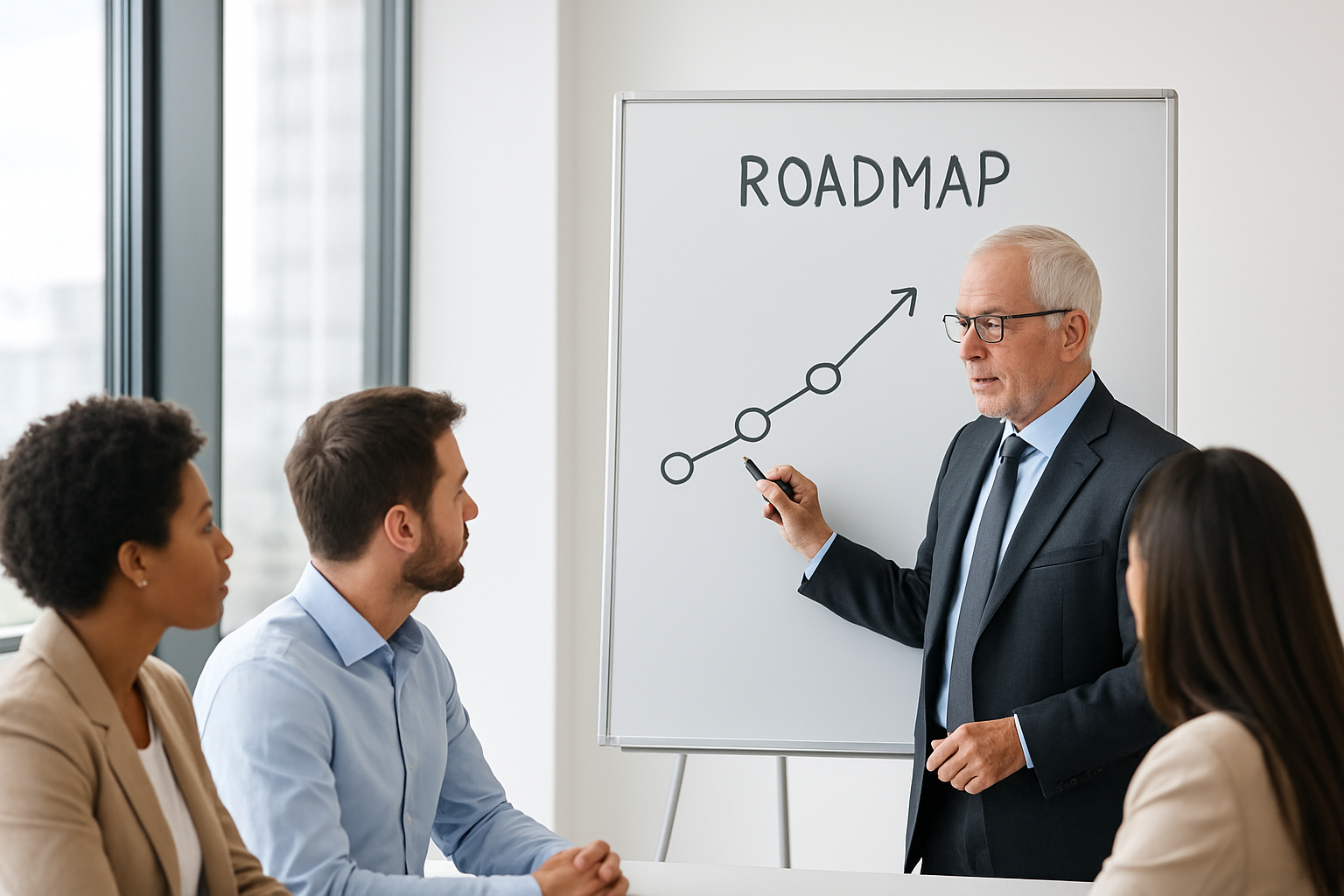
A clear development roadmap helps senior managers translate training into measurable organizational impact.
How to Measure the ROI of Senior Manager Training
Investing in leadership development without measuring outcomes is a missed opportunity. Fortunately, there are several concrete ways to track whether your training for senior managers is delivering real results.
Leading Indicators (Early Signals)
- Post-training knowledge assessments and confidence ratings
- Participant satisfaction scores and qualitative feedback
- Observed behavioral changes within the first 30 days (e.g., are managers holding more structured one-on-ones?)
- Manager self-assessment before and after training
Lagging Indicators (Business Outcomes)
- Employee engagement scores — track quarter-over-quarter changes in teams led by trained managers
- Voluntary turnover rates within those teams
- Internal promotion rates — are trained managers developing more promotable talent?
- 360-degree feedback improvement over time
- Reduction in HR escalations or employee complaints
- Revenue or productivity outcomes tied to departments with trained leaders
Additionally, consider using a pre-training and post-training baseline for each of these metrics. This makes it far easier to isolate the impact of your development program from other organizational variables.
Common Mistakes That Undermine Senior Manager Training
Even well-resourced programs can fail. Here are the most common pitfalls — and how to avoid them before they cost you time and credibility.
Treating Training as a One-Time Event
A two-day workshop in January will not change behavior by March. Real leadership development requires repetition, reinforcement, and sustained accountability over time. Therefore, build in follow-up coaching sessions, peer check-ins, and application assignments between formal training events.
Using Generic, Off-the-Shelf Content
Senior managers are experienced professionals. They disengage quickly from content that feels irrelevant to their actual challenges. Consequently, tailor every program element to your industry, your culture, and your specific organizational objectives. Generic training is a false economy.
Excluding Managers from the Design Process
When senior managers have no voice in their own development, buy-in collapses. Involve them in identifying priorities, shaping the program format, and reviewing content before launch. They’re far more likely to engage with — and apply — what they helped create.
Failing to Tie Training to Business Outcomes
Training disconnected from real organizational goals rarely changes behavior. Instead, anchor every learning objective to a specific business result — whether that’s reducing voluntary turnover by 15%, improving engagement survey scores, or filling three succession-ready roles within 18 months.
Neglecting Post-Training Reinforcement
Research from the Association for Talent Development (ATD) indicates that without reinforcement, learners forget up to 70% of new information within 24 hours. Structured follow-up — including spaced repetition, job aids, and accountability partners — is not optional; it’s essential.
How HR Drives Effective Executive Leadership Development
HR is the strategic engine behind great senior manager development. From diagnosing leadership gaps to designing programs, sourcing facilitators, and tracking outcomes, HR professionals are involved at every critical stage.
However, many small and mid-sized organizations don’t have the internal HR capacity to do this well. Building a senior leadership development function from scratch requires expertise in instructional design, organizational development, and executive coaching — skills that typically live outside a generalist HR team.
That’s where a trusted outsourced HR partner makes a decisive difference. At Soteria HR, we work directly with growing organizations to design custom leadership development strategies that match their stage of growth — not a generic template. We understand that your senior managers are too important to leave to guesswork.
Furthermore, strong HR support ensures that senior manager training connects to broader people programs — including employee development strategies that build capability at every level. Leadership development works best as part of an integrated talent strategy, not as a standalone initiative.
For a deeper look at the leadership dimensions of management growth, leadership training for managers explores how to develop leaders who inspire teams and consistently drive results. And if you need practical implementation guidance, how to train managers on performance management walks through the process in clear, actionable terms.
Senior Manager Training for Small and Mid-Sized Businesses
Many business owners assume that comprehensive senior manager training is only accessible to large enterprises with dedicated L&D (learning and development) budgets. In reality, that assumption costs smaller organizations dearly.
For SMBs, the cost of a single bad hire at the senior management level — accounting for lost productivity, rehiring, and team disruption — typically ranges from 50% to 200% of that role’s annual salary. That far exceeds the cost of a well-designed development program.
Cost-Effective Options for Smaller Organizations
- Group coaching cohorts — Sharing the cost of a skilled executive coach across 4 to 6 senior managers makes coaching accessible at a fraction of 1:1 pricing
- Outsourced HR partners — Fractional HR support that includes embedded leadership development, without the overhead of a full internal team
- Curated online learning — Platforms like LinkedIn Learning or Coursera offer credible content at low cost, ideal as a supplement to live coaching
- Peer learning circles — Structured internal groups where senior managers meet monthly to discuss challenges, share feedback, and hold each other accountable
- Industry association programs — Many trade associations offer leadership development programs specifically designed for senior managers in specific sectors
Above all, the most important factor isn’t budget size — it’s intentionality. Even a modest, well-designed program with clear objectives and consistent follow-through will outperform an expensive generic one every time.
Frequently Asked Questions About Training for Senior Managers
What is training for senior managers?
Training for senior managers is a structured development program that builds leadership, strategic thinking, and communication skills in experienced managers. It goes beyond basic supervision to address executive-level challenges like change management, culture building, and organizational alignment.
Why is senior manager training different from standard manager training?
Senior managers operate at a higher strategic level and influence entire departments or organizations. Their training focuses less on task management and more on leadership presence, organizational strategy, succession planning, and developing other managers.
What topics should be covered in training for senior managers?
Core topics include strategic leadership, performance management, change management, coaching and developing others, conflict resolution, executive communication, compliance awareness, emotional intelligence, and succession planning. The best programs customize content to the organization’s specific goals and culture.
How often should senior managers receive development training?
Most experts recommend continuous development rather than annual one-time events. Quarterly workshops, monthly peer learning sessions, ongoing coaching, and an annual leadership retreat together form a robust, sustainable development cadence.
What are the measurable benefits of investing in senior manager training?
Well-trained senior managers improve employee engagement, reduce voluntary turnover, strengthen compliance, accelerate succession readiness, and drive better business performance. Gallup data shows managers account for at least 70% of the variance in employee engagement scores — making this investment directly tied to bottom-line results.
How do I measure the effectiveness of a senior manager training program?
Track both leading indicators (post-training confidence scores, observed behavioral changes) and lagging indicators (employee engagement scores, retention rates, internal promotion rates, and 360-degree feedback results). Pre- and post-training baselines make it easier to isolate program impact.
Can small businesses afford senior manager training programs?
Yes. Cost-effective options include group coaching cohorts, peer learning circles, curated online learning platforms, and outsourced HR partners who provide embedded leadership development. The cost of poor senior management — through turnover, disengagement, and missed growth — consistently exceeds the investment in structured training.
What is the difference between coaching and training for senior managers?
Training delivers structured knowledge and skills to a group — often through workshops or courses. Coaching is personalized, confidential, and ongoing, focused on the individual’s specific challenges and goals. The most effective senior manager programs combine both approaches for maximum and lasting impact.
What common mistakes do organizations make with senior manager training?
The most damaging mistakes include treating training as a one-time event, using generic off-the-shelf content, excluding managers from program design, failing to tie training to business outcomes, and neglecting post-training reinforcement. Each of these undermines behavior change and wastes investment.
How does HR support senior manager development?
HR identifies skill gaps, designs development plans, sources qualified facilitators and coaches, integrates training with broader people programs, and tracks outcomes over time. Outsourced HR partners like Soteria HR provide this strategic capability without the cost of a full in-house team.
Should senior managers be involved in designing their own training?
Absolutely. Senior managers who co-design their development priorities are significantly more engaged and more likely to apply what they learn. Collaborative program design also ensures training addresses real, current challenges — not assumed ones.
What role does emotional intelligence play in senior manager training?
Emotional intelligence (EQ) is one of the strongest predictors of leadership effectiveness at the senior level. Training that develops self-awareness, empathy, and emotional regulation produces managers who make better decisions, handle conflict more effectively, and build stronger, more resilient teams.
Conclusion: Make Training for Senior Managers a Strategic Priority
Training for senior managers is not a luxury — it is a strategic necessity for any organization serious about sustained growth. When your most experienced leaders are equipped to lead with clarity, coach with confidence, and navigate complexity without flinching, the entire organization benefits. Furthermore, those benefits compound over time: better-trained senior managers develop better mid-level managers, who develop better frontline teams.
The ripple effects of strong senior leadership reach every team, every hire, and every customer interaction. Conversely, the cost of neglecting this development — in turnover, disengagement, missed succession opportunities, and preventable compliance failures — is far higher than most organizations realize until it’s too late.
You don’t have to build this alone. Whether you need help identifying leadership gaps, designing a custom program, or simply knowing where to start, Soteria HR works with growing organizations every day to build the HR infrastructure and leadership capability they need to scale with confidence. Ready to invest in the leaders who drive your business forward? Connect with Soteria HR and let’s build something worth leading.