
Soteria Re is a modern reinsurance platform built to help insurance carriers transfer risk, protect their balance sheets, and maintain long-term financial stability. In an industry where a single catastrophic event can threaten an insurer’s solvency, having the right reinsurance partner is not optional — it is essential.
Reinsurance, broadly defined, is insurance for insurance companies. It allows a primary insurer to cede a portion of its risk to another party — the reinsurer — in exchange for a share of the premium. This mechanism has been a cornerstone of the global insurance market for centuries, and today it underpins trillions of dollars in coverage capacity worldwide.
What Is Soteria Re and How Does It Work?
Soteria Re is a dedicated reinsurance provider offering structured risk transfer solutions for insurance carriers of all sizes. Specifically, it operates at the intersection of traditional reinsurance principles and modern, data-driven underwriting practices. The platform enables insurers to customize their protection programs rather than accepting one-size-fits-all terms.
According to the reinsurance industry overview on Wikipedia, the global reinsurance market was valued at over $300 billion in premiums in recent years, reflecting just how critical this layer of protection has become for primary insurers. Soteria Re participates in this market by offering flexible, responsive solutions designed around each client’s unique risk profile.

Soteria Re helps insurers assess and transfer risk through structured reinsurance programs tailored to each carrier’s portfolio.
Core Reinsurance Structures Offered
Understanding the two primary structures is key to choosing the right program. Soteria Re supports both major approaches:
Treaty Reinsurance — This structure automatically covers an entire class or portfolio of policies. For example, an insurer writing homeowners policies in hurricane-prone states can place a treaty that covers all such policies up to a defined limit. Treaty reinsurance provides broad, consistent protection and simplifies administration significantly.
Facultative Reinsurance — This approach covers individual risks on a case-by-case basis. It is particularly useful for large commercial properties, specialty lines, or risks that fall outside standard treaty terms. Each facultative placement is separately negotiated and underwritten.
Furthermore, Soteria Re offers both proportional and non-proportional structures within these two categories. Proportional treaties share premiums and losses in a set ratio, while excess-of-loss treaties only activate once losses exceed a defined retention level.
Why Proportional vs. Excess-of-Loss Matters
Choosing between proportional and excess-of-loss reinsurance depends on your financial goals. Proportional treaties reduce volatility across all losses, large and small. In contrast, excess-of-loss structures focus protection on severe, tail-risk events — making them ideal for catastrophe exposure. Soteria Re’s underwriting team helps clients model both options before committing to a structure.
How to Set Up a Reinsurance Program with Soteria Re
Setting up a reinsurance arrangement is a structured process. Here is a step-by-step guide to working with Soteria Re:
- Assess Your Risk Exposure — Review your book of business to identify the types, volumes, and geographic concentrations of risk that need protection. This includes analyzing historical loss data and stress-testing for catastrophic scenarios.
- Define Your Reinsurance Structure — Decide whether treaty, facultative, or a hybrid approach best fits your portfolio. Consider your retention appetite and the maximum single-event loss you can absorb.
- Contact Soteria Re — Reach out through soteriahr.com to present your risk profile and begin discussions on program design and pricing.
- Negotiate and Finalize Terms — Work with Soteria Re’s underwriters to agree on retention levels, coverage limits, premium rates, and any special conditions. Review the terms of service carefully before signing.
- Implement and Monitor the Program — Integrate the reinsurance terms into your underwriting guidelines. Review program performance at least annually, especially after significant loss events or portfolio changes.
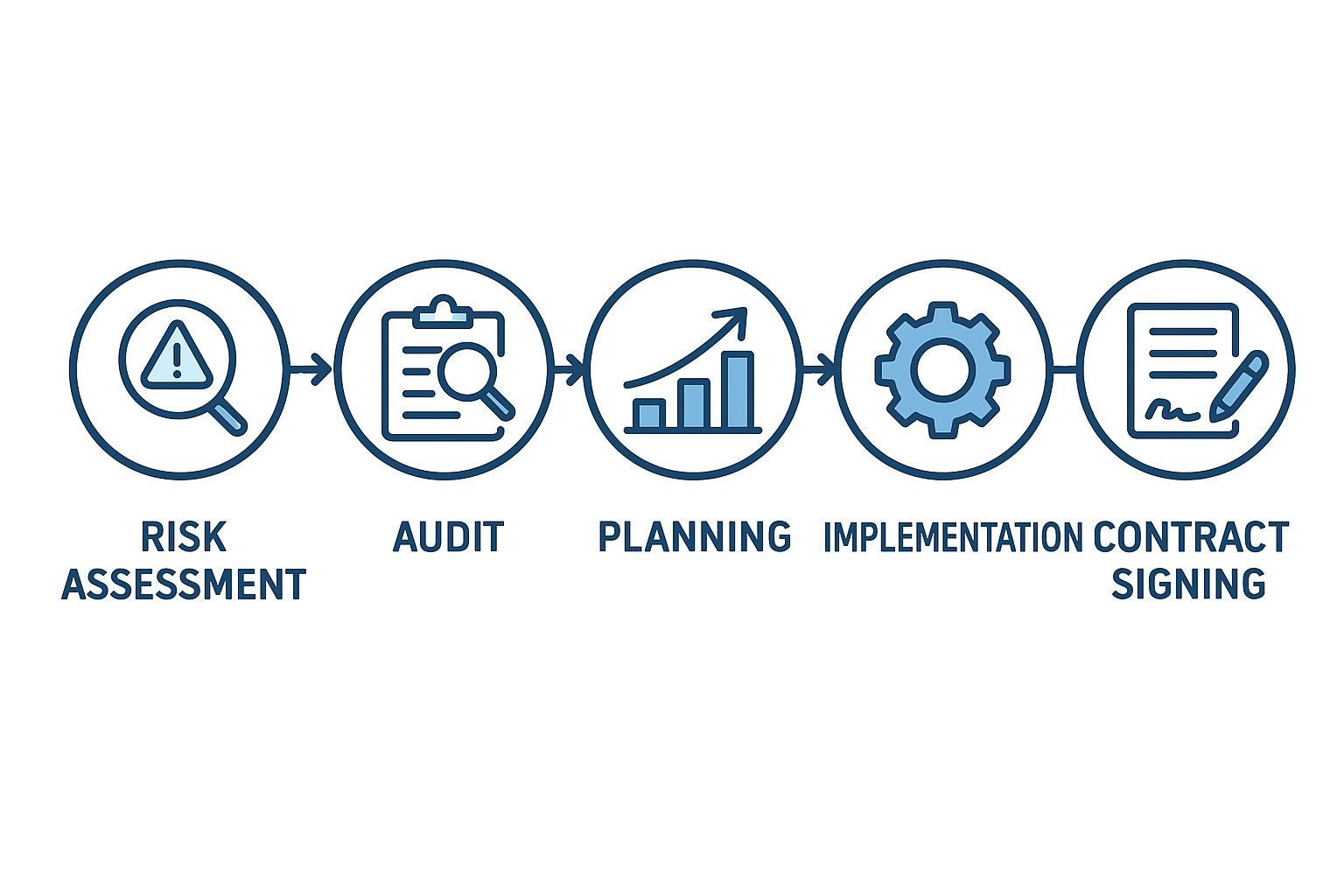
A clear five-step process helps insurers structure and launch a reinsurance program efficiently.
Risk Transfer Strategies That Protect Insurers
Effective risk transfer is the foundation of every strong reinsurance program. Soteria Re approaches this through a combination of quantitative modeling and market expertise. Specifically, their team analyzes an insurer’s loss history, exposure accumulation, and geographic concentration to recommend the most efficient risk transfer structure.
Catastrophe reinsurance is one of the most critical tools in this toolkit. For instance, when a major hurricane strikes a coastal region, primary insurers can face claims that far exceed their normal loss expectations. Catastrophe reinsurance activates above a defined aggregate threshold, absorbing the excess and preventing insolvency. The Insurance Information Institute notes that without reinsurance, many regional carriers would not survive a single major storm season.
Proportional Risk Sharing Explained
In a proportional arrangement, the insurer and reinsurer share both premiums and losses in a pre-agreed ratio. As a result, the reinsurer participates from the first dollar of loss, providing immediate relief on both attritional and large claims. This structure is especially valuable for growing carriers that want to stabilize their combined ratios while expanding their premium volume.
Financial Stability Benefits for Insurance Carriers
Beyond loss protection, reinsurance delivers tangible financial stability benefits. Carriers that use reinsurance effectively can write more premium volume without proportionally increasing their capital requirements. This is known as capital relief, and it is one of the most strategically valuable aspects of a well-designed reinsurance program.
Additionally, reinsurance improves an insurer’s credit profile. Rating agencies such as AM Best consider a carrier’s reinsurance program when assessing financial strength. A robust reinsurance arrangement can therefore support a higher financial strength rating, which in turn improves the insurer’s competitive position in the marketplace.
You can also review the Soteria Re privacy policy to understand how your business data is handled throughout the underwriting and placement process. Transparency in data practices is an important consideration when selecting any reinsurance partner.

Reinsurance creates a financial balance that allows carriers to grow their business without overexposing their capital base.
Common Mistakes Insurers Make When Buying Reinsurance
Even experienced underwriters sometimes make avoidable errors when structuring reinsurance. Here are the most common pitfalls to watch for:
- Underestimating accumulation risk — Failing to account for how individual risks cluster geographically can lead to unexpected correlated losses in a single event.
- Choosing the wrong structure — Selecting a treaty that does not match the actual risk profile results in either over-paying for coverage or leaving dangerous gaps in protection.
- Neglecting annual reviews — As a carrier’s book of business changes, so does its reinsurance need. Failing to update treaty terms can leave a carrier underprotected or paying for unnecessary capacity.
- Ignoring counterparty credit risk — A reinsurer that cannot pay claims is worse than no reinsurance at all. Always verify the financial strength rating of your reinsurance partner.
Frequently Asked Questions About Soteria Re
What is Soteria Re?
Soteria Re is a reinsurance platform that provides risk transfer, treaty, and facultative reinsurance solutions designed to strengthen the financial stability of insurance carriers. It serves both large national carriers and smaller regional insurers with customized program structures.
How does Soteria Re help insurance companies?
Soteria Re helps insurance companies by absorbing a portion of their risk exposure, which protects their balance sheets and allows them to underwrite more policies with confidence. This leads to greater premium volume without proportionally increasing capital requirements.
What types of reinsurance does Soteria Re offer?
Soteria Re offers both treaty reinsurance, which covers an entire portfolio of policies, and facultative reinsurance, which covers individual high-value or complex risks. Both proportional and excess-of-loss structures are available within these categories.
Why is reinsurance important for financial stability?
Reinsurance spreads risk across multiple parties, preventing a single large loss event from destabilizing an insurer. According to the Insurance Information Institute, reinsurance is a critical tool for maintaining solvency in the face of catastrophic events.
What is the difference between treaty and facultative reinsurance?
Treaty reinsurance automatically covers all policies within a defined class, while facultative reinsurance is negotiated individually for specific risks that fall outside standard treaty terms. Treaty is broader; facultative is more targeted.
How does risk transfer work in reinsurance?
Risk transfer works by shifting a portion of an insurer’s liability to a reinsurer in exchange for a premium. This reduces the primary insurer’s potential loss on any given event and smooths out earnings volatility over time.
Is Soteria Re suitable for small insurance carriers?
Yes. Soteria Re’s flexible structures make it accessible to both large and small insurance carriers seeking proportional or excess-of-loss protection tailored to their book of business. Smaller carriers often benefit most from the capital relief reinsurance provides.
What is catastrophe reinsurance?
Catastrophe reinsurance protects insurers against large-scale losses caused by events like hurricanes, earthquakes, or floods. It activates when aggregate losses exceed a defined threshold, providing a critical safety net for tail-risk events.
How do I get started with Soteria Re?
You can get started by visiting soteriahr.com and contacting their team directly to discuss your risk profile, coverage needs, and program structure options. The process typically begins with a risk assessment and loss data submission.
What are the privacy practices of Soteria Re?
Soteria Re maintains a clear privacy policy that outlines how client data is collected, used, and protected. You can review the full details at their official privacy policy page.
What common mistakes should insurers avoid when buying reinsurance?
Common mistakes include underestimating exposure accumulation, choosing the wrong reinsurance structure, and failing to review treaty terms annually as the book of business evolves. Ignoring counterparty credit risk is also a significant and often overlooked error.
How is the cost of reinsurance determined?
Reinsurance pricing depends on factors such as the insurer’s loss history, the type and volume of risk, geographic concentration, and current market conditions. Hard market cycles typically push reinsurance rates higher, while soft markets offer more favorable pricing.
Conclusion: Why Soteria Re Matters for Modern Insurers
In summary, Soteria Re represents a practical and strategic solution for insurance carriers navigating an increasingly volatile risk environment. Whether you need broad treaty protection, targeted facultative coverage, or catastrophe reinsurance for tail-risk events, the platform offers the flexibility and expertise to build a program that fits. Above all, the financial stability and capital relief that reinsurance provides are not luxuries — they are competitive necessities. By partnering with Soteria Re, insurers can grow their business with confidence, knowing that their exposure is managed by a dedicated and experienced reinsurance team. Visit soteriahr.com to explore your options and take the first step toward a stronger, more resilient insurance operation.