What are the employee benefits that are required by law? For small and mid-sized employers, that question often surfaces the moment a new hire signs on — or worse, right after a compliance complaint lands on your desk. Federal and state law require most U.S. employers to provide a specific set of benefits, including Social Security and Medicare contributions, unemployment insurance, workers’ compensation, and unpaid leave under the Family and Medical Leave Act (FMLA). Beyond these baseline mandates, additional rules kick in depending on your company’s size, state, and industry. Understanding exactly which benefits are legally required — and which are simply competitive extras — helps you protect your business while building a workplace people trust.
Quick Answer: Employee benefits required by law include Social Security and Medicare taxes, state unemployment insurance, workers’ compensation coverage, and unpaid FMLA leave for eligible employers. Companies with 50 or more full-time employees must also offer ACA-compliant health coverage and comply with COBRA continuation rules.
What Are the Employee Benefits That Are Required by Law?
In short, the employee benefits that are required by law fall into two buckets: federal mandates that apply almost everywhere, and state-specific rules that vary widely by location. Every employer, regardless of size, must withhold and match Social Security and Medicare taxes under FICA. Similarly, most states require employers to carry workers’ compensation insurance and pay into unemployment insurance funds.
For companies with 50 or more full-time equivalent employees, the Affordable Care Act requires offering minimum essential health coverage. Meanwhile, employers with 50 or more employees within 75 miles must comply with the FMLA, granting eligible workers up to 12 weeks of unpaid, job-protected leave. As a result, the size of your workforce directly determines how many mandates apply to you.
- Social Security and Medicare (FICA) contributions
- State unemployment insurance
- Workers’ compensation coverage
- Unpaid leave under the FMLA (for covered employers)
- ACA-compliant health coverage (50+ employees)
- COBRA continuation coverage (20+ employees)

Reviewing what employee benefits are required by law is the first step toward compliance.
Mandatory Employee Benefits at the Federal Level
Federal law sets the floor for mandatory employee benefits, and it rarely changes without significant notice. Above all, employers should understand that payroll taxes fund Social Security and Medicare, while separate contributions fund state unemployment programs administered under guidelines from the U.S. Department of Labor.
Workers’ compensation, though regulated at the state level, is effectively mandatory nationwide because nearly every state requires it once a business hires its first employee. In contrast, the FMLA and COBRA only apply once a company crosses specific headcount thresholds — 50 and 20 employees, respectively. Therefore, growth stage matters just as much as industry when determining your obligations. For a deeper breakdown of these thresholds, Soteria HR’s guide to mandatory employee benefits walks through each requirement in plain language.
State-Required Benefits Employers Often Overlook
Beyond federal law, many states layer on their own requirements — and this is where employers frequently get caught off guard. States such as California, New York, New Jersey, Rhode Island, and Hawaii mandate short-term disability insurance. Additionally, a growing list of states and cities require paid sick leave or paid family leave, even for small employers.
Consequently, a company operating in multiple states can face very different obligations from one office to the next. Soteria HR’s guide to legally required benefits breaks down these state-by-state differences so employers don’t miss a filing deadline or notice requirement.
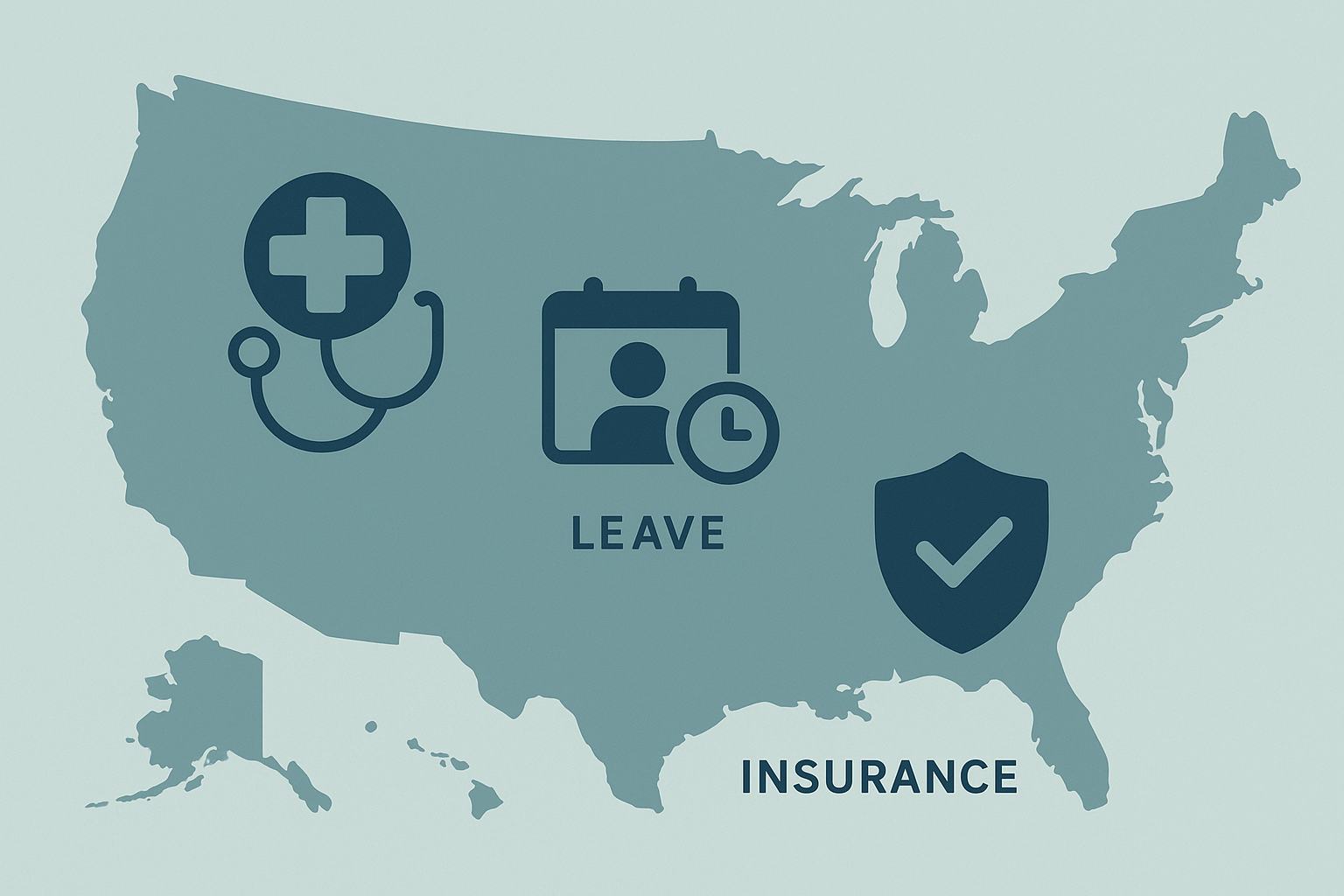
Legally required benefits often differ significantly from state to state.
How to Confirm You’re Meeting Legally Required Benefits
Staying compliant is not a one-time task; it’s an ongoing process. The following steps outline how growing companies typically approach a benefits compliance audit.
- Audit current benefits. Compare your existing benefits package against federal mandates, including Social Security, Medicare, unemployment insurance, and workers’ compensation coverage, to spot any gaps.
- Map state-specific obligations. Identify every state where employees work and research paid leave, disability insurance, or sick-time laws that may apply on top of federal rules.
- Check employer size thresholds. Review your headcount against ACA, FMLA, and COBRA thresholds since obligations often change once you cross 20, 50, or more full-time equivalent employees.
- Update handbook and notices. Revise your employee handbook, offer letters, and required workplace postings so they accurately reflect current mandatory benefits and leave policies.
- Partner with an HR compliance expert. Work with an outsourced HR partner to monitor law changes, run periodic audits, and correct compliance gaps before they turn into fines or lawsuits.
For a full walkthrough of this process, see Soteria HR’s complete guide to legally required employee benefits.
Common Compliance Mistakes with Required Employee Benefits
Even well-intentioned employers stumble over required employee benefits. Misclassifying workers as independent contractors, for instance, can strip them of protections like unemployment insurance and workers’ compensation — a mistake that often triggers state audits. Similarly, employers sometimes forget to send COBRA notices within the required timeframe, exposing the company to penalties.
In addition, businesses expanding into new states frequently apply their home-state rules everywhere, missing local paid leave or disability requirements entirely. According to the U.S. Bureau of Labor Statistics, benefits now account for nearly 30% of total employee compensation costs — a figure that underscores just how much is at stake when compliance slips. Soteria HR’s breakdown of what every employer must provide highlights the most frequent missteps and how to avoid them.

Regular reviews help employers stay ahead of legally required benefits.
Building a Compliance Habit, Not Just a Checklist
Ultimately, treating benefits compliance as an ongoing habit rather than an annual scramble pays off. Above all, companies that build recurring reviews into their HR calendar catch problems early — before they become expensive. Soteria HR’s employee benefits compliance resources offer a practical starting point for building that habit.
Furthermore, partnering with an outsourced HR team means someone is always watching for regulatory changes, so leadership can focus on running the business. If you’re unsure where your current benefits stand, Soteria HR can help you run a quick audit and flag any gaps before they turn into liabilities.
Frequently Asked Questions About Employee Benefits Required by Law
What are the employee benefits that are required by law?
The employee benefits that are required by law include Social Security and Medicare contributions, state unemployment insurance, workers’ compensation coverage, and unpaid leave under the FMLA for eligible employers. Larger employers must also provide ACA-compliant health coverage and COBRA continuation rights.
Which federal laws mandate employee benefits?
The main federal laws are FICA, the Federal Unemployment Tax Act, the FMLA, COBRA, and the Affordable Care Act. Each applies under different employer-size thresholds, so not every law affects every business.
Do small businesses have to offer health insurance?
No, businesses with fewer than 50 full-time equivalent employees are not federally required to offer health insurance. However, some states impose their own coverage or contribution rules for smaller employers.
What is the difference between mandatory and voluntary employee benefits?
Mandatory benefits are required by federal or state law, such as workers’ compensation and unemployment insurance. Voluntary benefits, like dental coverage or retirement matching, are offered at the employer’s discretion to stay competitive.
How does the FMLA affect required employee leave?
The FMLA requires covered employers to provide up to 12 weeks of unpaid, job-protected leave for qualifying medical or family reasons. It applies to employers with 50 or more employees within 75 miles.
What happens if an employer fails to provide legally required benefits?
Employers can face fines, back-pay obligations, lawsuits, and in some cases criminal penalties. Repeated violations often trigger audits from state labor agencies, which can be far costlier than fixing the issue upfront.
Are paid sick days required by law?
Paid sick leave is not required under federal law, but a growing number of states and cities mandate it. Employers should check local ordinances since requirements vary widely by jurisdiction.
How much does it cost employers to provide mandatory benefits?
According to the U.S. Bureau of Labor Statistics, benefits account for nearly 30% of total employee compensation costs. Mandatory benefits like payroll taxes and workers’ compensation make up a significant portion of that figure.
Do part-time employees receive the same required benefits as full-time employees?
Part-time employees are generally still covered by Social Security, Medicare, and unemployment insurance requirements. However, benefits like FMLA leave and ACA coverage often depend on hours worked and employer size.
What is COBRA and who must offer it?
COBRA allows employees to continue their group health coverage after a qualifying event, such as job loss, typically at their own expense. Employers with 20 or more employees are generally required to offer it.
How do state laws differ from federal benefit requirements?
States can add requirements beyond federal law, such as paid family leave, short-term disability insurance, or expanded sick leave rules. Employers operating in multiple states must track each jurisdiction separately.
How can a company like Soteria HR help with benefits compliance?
Soteria HR audits current benefit offerings against federal and state mandates, then builds a compliance plan tailored to company size and location. This proactive approach helps growing businesses avoid penalties before they happen.
How often do legally required benefits change?
Legally required benefits change frequently as new state laws pass and federal thresholds adjust for inflation. Employers should review their obligations at least annually or whenever they expand into a new state.
In summary, the employee benefits that are required by law start with federal payroll taxes, unemployment insurance, and workers’ compensation, then expand based on your headcount and the states where your team works. Getting these mandates right protects your business from fines while giving employees the security they expect. If you’d rather not track every regulation change alone, Soteria HR can build a compliance plan that fits your company’s stage of growth — no guesswork required.