An HR consultancy for compliance gives growing businesses hands-on support to meet federal, state, and local employment rules without building a full internal HR department. For founders, COOs, and operations leaders juggling hiring, payroll, and daily management, compliance can feel like a moving target as headcount climbs past 10, 20, or 50 employees. Soteria HR, based in Pasadena, California, works alongside leadership teams in Los Angeles, Orange County, and across the country to close compliance gaps before they turn into costly problems.
Quick answer: An HR consultancy for compliance is an outside HR partner that audits current practices, updates policies to match labor law, and provides ongoing guidance so a business avoids wage-and-hour violations, discrimination claims, and benefits missteps. Most engagements combine HR administration, HR consulting, and benefits oversight under a single, tailored relationship.
What Is an HR Consultancy for Compliance?
An HR consultancy for compliance is a professional service that monitors employment law, applies it to your workplace, and helps leadership implement the required policies, documentation, and training. Rather than leaving one internal employee to track every regulation alone, the consultancy brings a team with specialized knowledge across wage and hour rules, leave laws, and benefits administration.
In practice, this usually means ongoing access to HR administration for onboarding and recordkeeping, consulting for employee relations and workforce decisions, and benefits administration for enrollments and carrier coordination. Soteria HR also offers an Administrative Services Organization (ASO) option, which delivers tailored HR support without co-employment. The client remains the employer and keeps responsibility for employment decisions and applicable legal obligations, while the consultancy provides the guidance and infrastructure behind the scenes. For a closer look at how this applies in operationally complex industries, see how HR consulting supports manufacturing companies.
Why Businesses Turn to HR Compliance Consulting Services
Employment law rarely stands still. For example, the U.S. Equal Employment Opportunity Commission received 81,055 workplace discrimination charges in fiscal year 2023, a notable increase driven partly by new pregnancy-accommodation protections. Consequently, employers without dedicated compliance oversight often discover gaps only after a complaint, audit, or departing employee raises a concern.
In addition, smaller companies frequently lack the internal bandwidth to track every applicable rule at once. As a result, HR compliance consulting services step in to translate dense regulations into workable, documented processes. Soteria HR’s team, for instance, helps leaders turn compliance priorities into daily practices rather than a once-a-year scramble. Readers managing broader workforce challenges may also find it useful to review how resource management consulting helps build a stronger team alongside compliance work.
Common Compliance Gaps Small Employers Miss
- Outdated employee handbooks that no longer reflect current leave or wage laws.
- Misclassified employees as exempt, non-exempt, or independent contractors.
- Inconsistent documentation of performance issues and disciplinary actions.
- Missed benefits deadlines, such as COBRA notices or ACA reporting.
- No formal process for harassment-prevention training renewal.

Working with an HR consultancy for compliance often starts with a hands-on policy review.
What Does an Outsourced HR Compliance Partner Cover?
Scope varies by engagement, but most outsourced HR compliance support spans a similar set of core areas. The table below summarizes the areas Soteria HR typically addresses, though exact scope and applicability should always be confirmed during a consultation.
| Compliance Area | Why It Matters | Typical Oversight |
|---|---|---|
| Wage and hour rules | Governs overtime, exempt classification, and minimum wage under the FLSA. | U.S. Department of Labor |
| Leave management | Covers FMLA and state-specific paid sick leave requirements. | DOL / state labor agencies |
| Anti-harassment training | Required for many California employers on a recurring basis. | California Civil Rights Department |
| Benefits compliance | Addresses ACA, COBRA, Section 125, and Form 5500 obligations where applicable. | IRS / DOL |
To understand how these pieces connect to broader risk management, Soteria HR’s guide on the best HR resources for managing compliance risks walks through additional tools employers can use alongside a consultancy relationship.
How an HR Consultancy for Compliance Works With Your Team
Although every engagement is tailored, most HR compliance consulting relationships follow a similar sequence. Understanding these steps helps set expectations before the first call.
- Conduct an HR compliance assessment. The consultancy reviews employee files, classifications, handbooks, and benefits documentation to identify gaps against current federal and state employment requirements.
- Update policies and the employee handbook. Outdated or missing policies are rewritten to reflect applicable wage and hour rules, leave laws, and anti-harassment requirements specific to your jurisdiction.
- Implement ongoing monitoring and training. The partner tracks regulatory changes, schedules required training such as harassment prevention, and keeps documentation current as headcount grows.
- Provide support during claims or audits. When a claim, audit, or employee dispute arises, the consultancy helps leadership respond with documentation, guidance, and a defensible process already in place.

Handbook updates are often the first visible step in an HR compliance consulting engagement.
Outsourced HR Compliance Support vs. Building an Internal Team
Hiring a full internal HR department is one way to manage compliance, but it is not the only path. In contrast, outsourced HR compliance support gives a growing company access to a team of specialists, often for less than the cost of a single senior HR hire.
Specifically, the ASO model lets a business keep its status as the employer of record while still receiving tailored guidance on policies, benefits, and documentation. This differs from some PEO arrangements that introduce co-employment. Either way, the goal is the same: fewer surprises and a clearer paper trail. Companies without a full HR department, as well as those supporting an existing internal HR team, can both use this model. For more on reducing exposure at smaller organizations, see what HR resources can help reduce compliance risks in small companies.
Signs Your Business Needs an HR Compliance Consultant
Not every company needs outside help on day one. However, certain signals suggest it is time to bring in an HR compliance consultant:
- Your employee handbook has not been updated in more than a year.
- Leadership is unsure which employees qualify as exempt from overtime.
- Headcount recently crossed a threshold that triggers new legal obligations.
- A recent employee complaint revealed gaps in documentation.
- Benefits enrollment and COBRA notices are managed informally, without a clear process.

Recurring training is one practical output of ongoing HR compliance consulting.
Finding the Right HR Compliance Consulting Partner
When comparing options, look for a partner that offers hands-on HR administration, consulting, and benefits support rather than a one-size-fits-all package. Soteria HR, for example, works with employers that have roughly 10 to 250 employees, though that range reflects a priority segment rather than a strict cutoff. Based in Pasadena, the team serves organizations across Los Angeles, Orange County, and nationwide, supporting both companies without an internal HR function and those looking to extend an existing HR team.
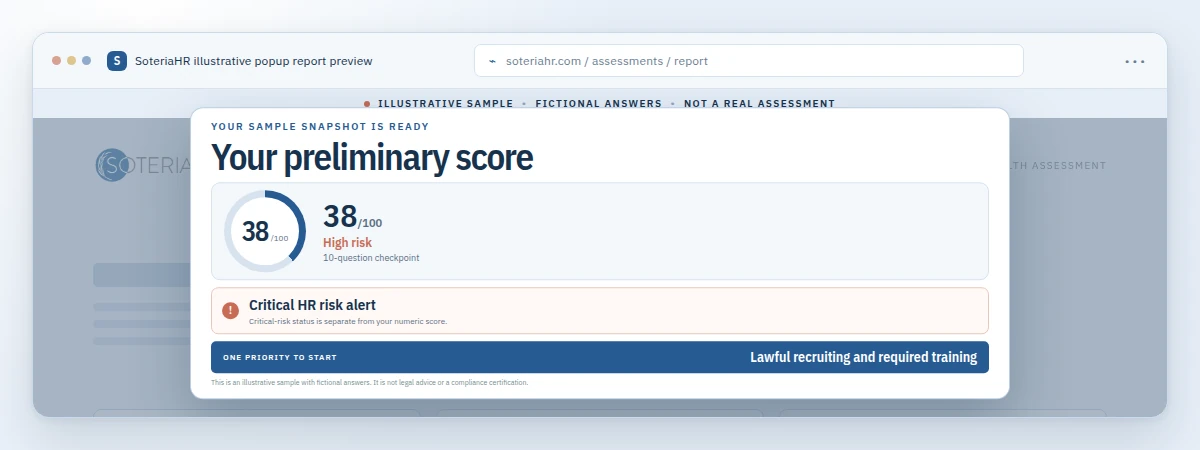
Before committing to a full engagement, many employers start with the free HR Health Assessment, which includes a short 10-question check or a more detailed 40-question review. Results are self-reported and preliminary, so they work best as a conversation starter rather than a certification of compliance. From there, leaders can talk with an HR expert at Soteria HR or call (800) 399-2458 to discuss specific priorities.
Frequently Asked Questions About HR Consultancy for Compliance
What does an HR consultancy for compliance actually do day to day?
An HR consultancy for compliance reviews current policies, payroll coordination, and employee records, then fixes gaps against federal and state employment rules. Day to day, that can mean updating handbooks, advising on a termination, or tracking new leave-law requirements.
How is HR compliance consulting different from hiring an HR director?
HR compliance consulting gives access to a team of specialists for a fraction of one full-time salary, while an internal HR director is a single employee with broader but shallower coverage. Many growing companies eventually use both together as headcount increases.
How much does outsourced HR compliance support typically cost?
Pricing varies based on company size, number of employees, and the scope of services included, such as benefits administration or payroll coordination. Most providers price engagements through a consultation rather than a flat published rate.
How long does it take to see results from an HR compliance consultant?
Initial policy fixes and handbook updates often happen within the first 30 to 60 days of an engagement. However, deeper improvements to culture, training, and recordkeeping typically build over several months of ongoing support.
What is the difference between an ASO and a PEO for compliance purposes?
An ASO provides HR support and guidance while the company remains the employer of record, keeping responsibility for employment decisions. A PEO typically establishes co-employment, which shifts certain employer responsibilities to the PEO itself.
Can an HR consultancy help with California-specific compliance rules?
Yes, California has distinct requirements around paid sick leave, meal and rest breaks, and harassment-prevention training that go beyond federal law. A consultancy familiar with California rules can help employers in Los Angeles and Orange County apply them correctly.
What are the most common HR compliance mistakes small businesses make?
Common mistakes include outdated employee handbooks, misclassifying workers as exempt or as contractors, and inconsistent recordkeeping. Missed benefits deadlines, such as COBRA notices, are another frequent gap.
Does an HR consultancy for compliance replace our in-house HR person?
Not necessarily. Many consultancies support an existing internal HR team by handling specialized compliance tasks, while others serve as the entire HR function for companies without one yet.
What federal laws does HR compliance consulting typically cover?
Coverage typically includes the Fair Labor Standards Act, Title VII of the Civil Rights Act, the Family and Medical Leave Act, and ACA requirements for applicable employers. Specific scope should always be confirmed with a consultant based on company size and industry.
How often should HR policies and handbooks be reviewed?
Most employers should review handbooks and policies at least once a year, and sooner whenever a significant law changes. An HR compliance partner typically tracks these updates so the business does not have to monitor every regulatory change independently.
What happens during an HR compliance audit or assessment?
A compliance audit usually involves reviewing employee files, classifications, handbooks, and benefits documentation against current legal requirements. The consultant then delivers a prioritized list of gaps and recommended fixes, often starting with a short self-assessment tool.
Is HR compliance consulting only for companies with HR problems already?
No, proactive employers often engage HR compliance consulting before problems appear, specifically to avoid claims, audits, and penalties. Waiting until a complaint or audit arrives usually costs more than addressing gaps early.
How do I start working with an HR compliance consulting firm?
Most engagements start with a consultation call to discuss company size, current practices, and priority risks. From there, the firm typically proposes a scope of work covering administration, consulting, and benefits support tailored to the organization.
Final Thoughts
Ultimately, an HR consultancy for compliance exists to take a recurring source of risk off a leadership team’s plate. Instead of tracking every wage-and-hour update, leave law, or benefits deadline alone, employers gain a partner who handles the details while they focus on running the business. Whether a company has 15 employees or 200, the right HR compliance consulting relationship can reduce exposure, improve documentation, and make growth less stressful. For employers ready to see where their own practices stand, starting with a short assessment or a direct conversation with an HR expert is a practical next step.