HR metrics for small businesses turn everyday people decisions into numbers leaders can actually use. Instead of guessing why turnover feels high or whether hiring takes too long, owners and HR leaders can look at a handful of core figures and catch problems before they grow. For companies without a full HR department, these metrics also point to exactly where outside support, like an ASO partnership, can close gaps. This guide explains which HR metrics for small businesses matter most, how to calculate them, and what to do once the data is in front of you.
Quick answer: HR metrics for small businesses are the numbers—like turnover rate, cost per hire, time to fill, and absenteeism—that measure how well people processes are working. Tracking even five to seven of these consistently gives leaders an early warning system for cost, compliance, and retention problems.

Reviewing HR metrics for small businesses on a simple dashboard helps leaders catch issues early.
What Are HR Metrics for Small Businesses?
HR metrics for small businesses are measurable data points that describe how the workforce is performing and how HR processes are running. Specifically, they cover areas like hiring speed, turnover, absenteeism, benefits participation, and compliance activity. Unlike large-enterprise dashboards with dozens of indicators, a small business usually needs only a focused set of metrics to see the full picture.
In practice, these numbers answer plain questions leaders already ask informally, such as “are we losing too many people?” or “is hiring taking longer than it should?” Therefore, the goal is not data for its own sake. It is giving founders, CEOs, and operations leaders enough signal to act before a small issue becomes an expensive one.
Why Small Business HR Metrics Matter
Small companies often run HR by instinct, which works until growth, turnover, or a compliance question outpaces memory and spreadsheets. As a result, consistent HR data becomes a practical tool rather than a corporate formality.
For example, the U.S. Bureau of Labor Statistics reported that the median tenure of wage and salary workers was 3.9 years as of January 2024, a figure that varies widely by industry and age group. Comparing your own turnover and tenure numbers against that kind of baseline helps leaders judge whether retention is a real problem or just normal churn for the role type.
Similarly, SHRM’s benchmarking research has long shown that replacing an employee costs far more than most leaders expect once recruiting, training, and lost productivity are counted. In contrast, a business that tracks cost per hire and turnover together can catch a costly pattern, such as a single department bleeding talent, long before it shows up in annual financials.
7 Core HR Metrics for Small Companies to Track
Not every metric deserves equal attention from a growing company. Instead, these seven consistently give the clearest picture with the least administrative effort.
- Turnover rate — employees who left divided by average headcount, multiplied by 100. This is the clearest early signal of a retention or management problem.
- Cost per hire — total recruiting spend divided by number of hires in a period. It shows whether hiring is financially sustainable as headcount grows.
- Time to fill — calendar days from job posting to accepted offer. Long timelines often point to unclear job descriptions or a slow decision process.
- Absenteeism rate — unplanned absence days divided by total scheduled workdays. Rising absenteeism can signal burnout, disengagement, or an unaddressed workplace issue.
- Benefits participation rate — employees enrolled divided by eligible employees. Low participation may mean the benefits package needs better communication or redesign.
- Performance review completion rate — reviews completed on schedule divided by reviews due. Gaps here often predict turnover and unresolved performance issues.
- Compliance training completion rate — employees who finished required training divided by employees assigned. This metric supports documentation if a dispute or audit ever arises.
Taken together, these seven HR metrics for small companies give leadership a realistic, low-effort view of hiring, retention, and compliance health. For a deeper breakdown of how these connect to broader workforce planning, Soteria’s strategic HR management services page outlines how the metrics tie into longer-term staffing decisions.

A simple spreadsheet is often enough to start tracking HR metrics for small businesses.
How to Start Tracking HR Metrics in 5 Steps
Getting started does not require new software or a hired analyst. Rather, it requires a short, repeatable process that leadership can actually maintain.
- Pick three to five core metrics. Choose a small starting set, such as turnover rate, time to fill, and absenteeism, instead of trying to track everything at once across the organization.
- Define each metric the same way every time. Write down exactly how each number is calculated, including the time period and what counts as a departure, hire, or absence, so results stay comparable over time.
- Centralize the source data. Pull employee records, payroll data, and applicant tracking information into one spreadsheet or HR system so calculations do not depend on memory or scattered files.
- Set a recurring review schedule. Put a monthly or quarterly metrics review on the calendar with the relevant leaders so trends get noticed early instead of being discovered during a crisis.
- Turn findings into specific actions. When a metric moves in the wrong direction, assign one owner and one concrete next step, such as revising onboarding or adjusting a hiring process bottleneck.
Businesses that want outside guidance through this setup can review Soteria’s HR advice for small businesses resources, which cover related foundational practices beyond metrics alone.
Common Mistakes With Small Business HR Metrics
Even well-intentioned tracking efforts fail in predictable ways. Recognizing these patterns early saves time and avoids misleading conclusions.
First, many companies track too many metrics at once, which spreads attention thin and makes none of the numbers actionable. Second, calculation methods often change between reporting periods, which quietly breaks any trend comparison. Third, some businesses collect data diligently but never schedule a review, so the numbers sit unused until a crisis forces a scramble. Finally, a few leaders treat metrics as a one-time snapshot rather than an ongoing practice, which defeats the purpose of tracking in the first place. Avoiding these four mistakes alone puts a small business ahead of most peers.
When to Get Outside Help With HR Metrics for Small Businesses
At some point, interpreting HR metrics for small businesses requires more time and expertise than an owner or operations leader can spare. Specifically, if turnover is rising without an obvious cause, hiring costs keep climbing, or compliance training completion is inconsistent, it is usually time to bring in HR expertise rather than keep guessing.
This is exactly where Soteria HR’s HR consulting for small business support fits. Soteria’s team helps growing employers across Los Angeles, Orange County, and nationwide set up practical tracking systems and interpret what the numbers actually mean, without requiring a full in-house HR department. For companies unsure where to begin, Soteria also outlines where small business leaders can find reliable HR resources and support.
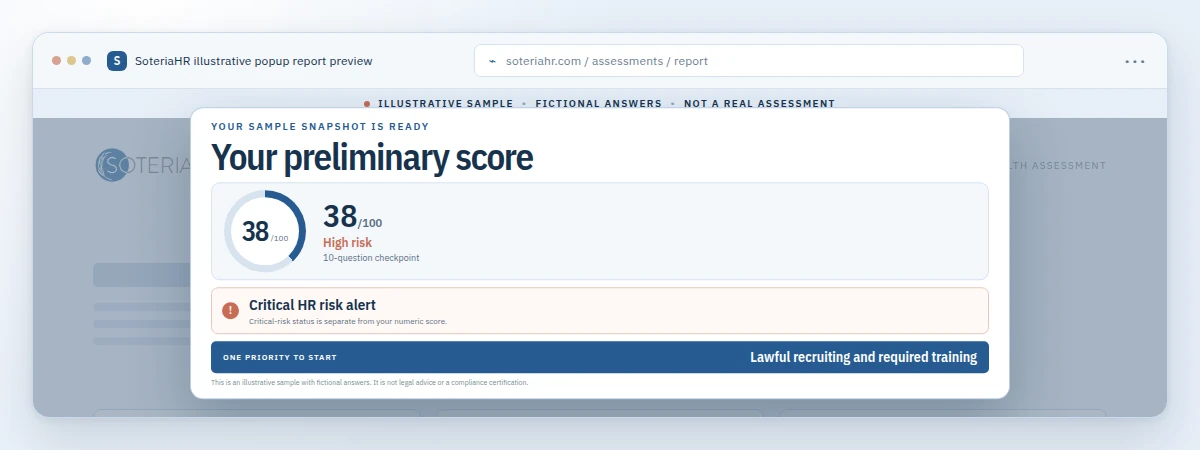
Before scheduling a conversation, many leaders start with Soteria’s free HR Health Assessment at soteriahr.ai, which offers a short Quick HR Check or a more complete assessment to flag potential gaps. Results are self-reported and preliminary, not a certification of compliance, but they give a useful starting point before talking with an HR expert. To compare outsourced options directly, see whether Soteria HR is the best choice for small business HR.

Discussing HR metrics for small businesses with an HR consultant can clarify which issues need immediate attention.
Frequently Asked Questions About HR Metrics for Small Businesses
What are HR metrics for small businesses?
HR metrics for small businesses are measurable data points, such as turnover rate, cost per hire, and absenteeism, that show how well people processes are working. They turn everyday HR activity into numbers leaders can track over time.
Which HR metric should a small business track first?
Turnover rate is usually the best starting point because it is simple to calculate and directly connects to cost, morale, and productivity. Once that is stable, add cost per hire and time to fill.
How do you calculate employee turnover rate?
Divide the number of employees who left during a period by the average number of employees during that same period, then multiply by 100. Most small businesses calculate this monthly or quarterly.
What is a good turnover rate for a small business?
There is no single universal benchmark, since healthy turnover varies by industry and role type. However, a sustained annual rate noticeably above your industry average usually signals a deeper retention or management issue worth investigating.
How much does it cost to track HR metrics?
Tracking core HR metrics manually in a spreadsheet costs nothing but staff time, while HR software platforms typically charge per employee per month. Many small businesses start with spreadsheets and move to software as headcount grows.
How often should small businesses review HR metrics?
Most core metrics, such as turnover and absenteeism, are worth reviewing monthly, while others, like cost per hire, work well on a quarterly cycle. Consistency matters more than frequency, since trends only emerge after a few reporting periods.
What is the difference between HR metrics and HR analytics?
HR metrics are the individual numbers, such as turnover rate or time to fill, while HR analytics is the practice of analyzing those numbers together to find patterns and causes. Small businesses typically start with metrics before building out analytics.
Why do small businesses struggle to track HR metrics?
Without a dedicated HR department, data often lives in scattered spreadsheets, emails, and payroll files, making it hard to calculate anything consistently. Limited time and HR expertise also make it easy to skip tracking altogether.
What is cost per hire and why does it matter?
Cost per hire adds up recruiting expenses, such as job ads, recruiter fees, and staff time, then divides by the number of hires in a period. It matters because it shows whether hiring spend is sustainable as the company grows.
Can HR metrics help with compliance issues?
Yes, metrics like overtime hours, training completion rates, and complaint resolution time can flag compliance risks before they become legal problems. Tracking these consistently supports better documentation if a claim or audit ever arises.
What mistakes do small businesses make with HR metrics?
Common mistakes include tracking too many metrics at once, changing calculation methods between periods, and collecting data without ever reviewing it. Choosing a few core metrics and reviewing them on a set schedule avoids most of these issues.
Do small businesses need HR software to track metrics?
No, a well-organized spreadsheet can track core HR metrics for small businesses effectively, especially under 50 employees. Software becomes more useful as headcount, locations, or reporting complexity increase.
How can outsourced HR help with metrics tracking?
An outsourced HR partner can set up consistent tracking systems, interpret what the numbers mean, and recommend specific fixes for turnover, hiring, or compliance gaps. This saves leadership time while adding HR expertise the company may not have in-house.
What is time to fill and how is it measured?
Time to fill measures the number of calendar days between posting a job opening and the candidate accepting an offer. Tracking it over several hires reveals bottlenecks in sourcing, interviewing, or decision-making.
Key Takeaways
In summary, HR metrics for small businesses do not need to be complicated to be useful. A focused set, covering turnover, hiring cost, time to fill, absenteeism, benefits participation, review completion, and compliance training, gives leaders an honest, ongoing view of workforce health. Above all, the value comes from reviewing these numbers consistently and acting on what they show, rather than collecting data for its own sake. When the trends raise more questions than a busy leadership team can answer alone, a conversation with an HR expert, such as the team at Soteria HR, can turn scattered numbers into a clear improvement plan. To take the next step, call (800) 399-2458 or submit a consultation request to talk with an HR expert about your HR metrics for small businesses today.