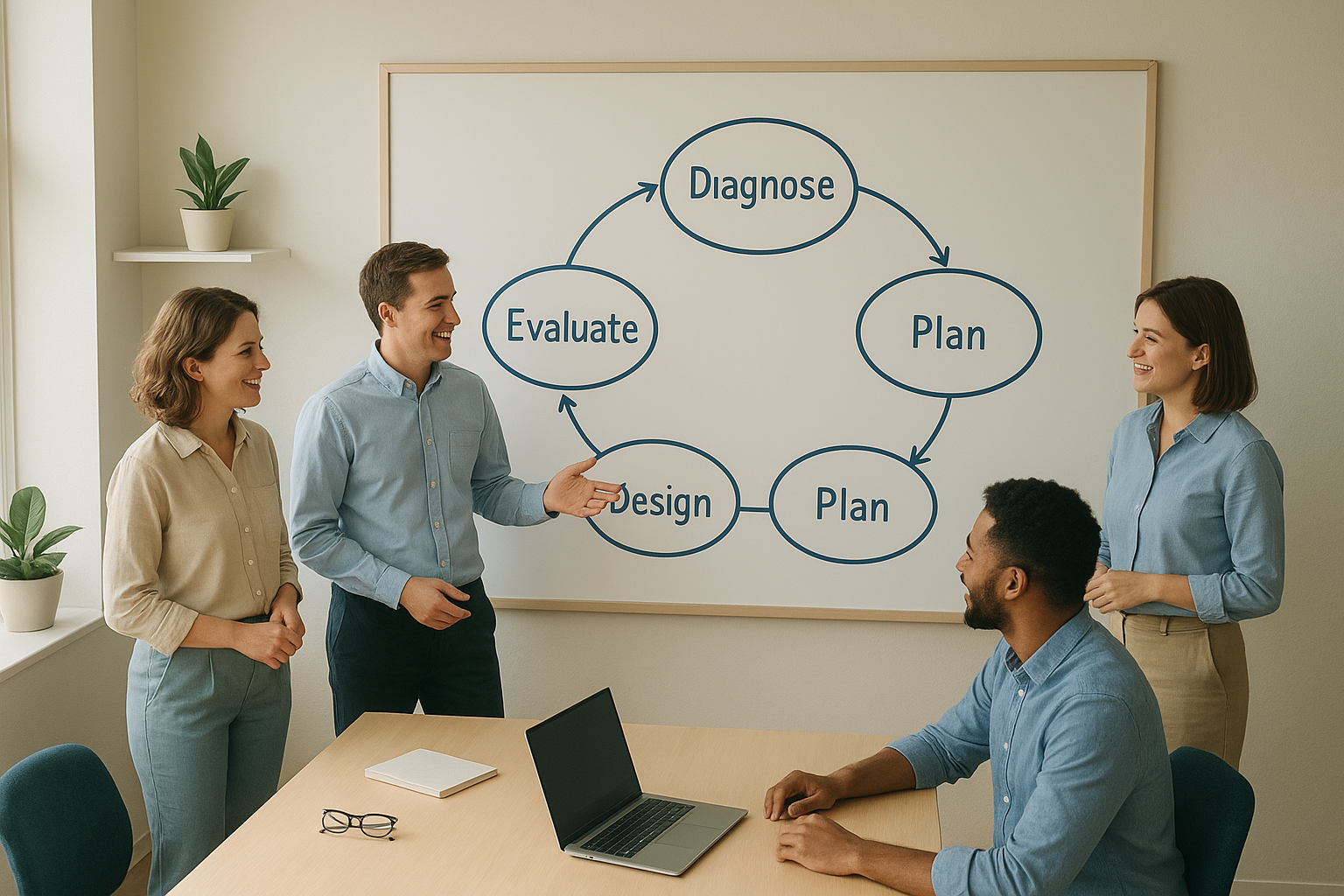
An organization development framework is a structured, repeatable system that guides how a business plans, implements, and sustains meaningful change across its people, culture, and processes. In short, it turns change from a chaotic event into a disciplined practice. For HR leaders and executives alike, having a clear framework is no longer optional — it is the backbone of long-term organizational health.
According to research in the field of organizational development, companies that use structured OD approaches are significantly more likely to sustain performance improvements over a three-year period compared to those that rely on ad hoc initiatives. Furthermore, McKinsey reports that roughly 70% of change programs fail to achieve their goals — largely due to the absence of a coherent guiding structure.
What Is an Organization Development Framework?
An organization development framework is a deliberate blueprint for improving organizational effectiveness. It defines the sequence of activities — from diagnosing problems to evaluating outcomes — that a company follows when it wants to grow, adapt, or transform. Think of it as the scaffolding that holds all your change efforts together.
Importantly, an OD framework is not a one-time project. Instead, it is an ongoing management discipline. It connects strategy, people, and operations into a coherent system that continuously evolves with the organization’s needs.
To explore the broader context behind this practice, you can read more about what organizational development means and how it shapes modern HR strategy.
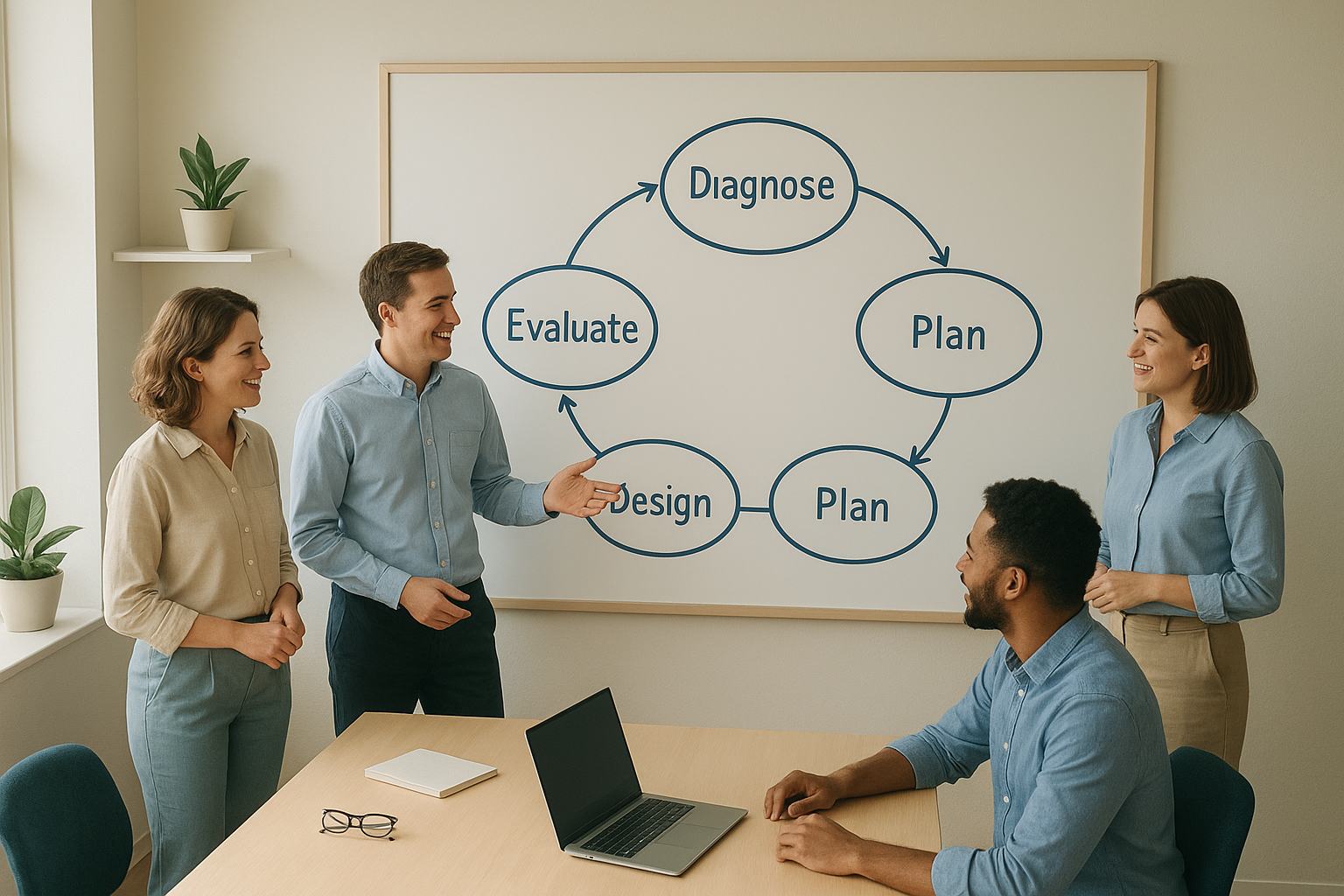
A well-designed organization development framework maps out each phase of change clearly, giving teams a shared language and direction.
Why Your Business Needs a Structured OD Approach
Without a structured approach, change efforts tend to be reactive and inconsistent. Teams work in silos, initiatives overlap, and results are difficult to measure. As a result, organizations often spend significant resources on programs that produce little lasting impact.
A proper framework solves this by providing three things: clarity of purpose, alignment across functions, and accountability for outcomes. Consequently, leaders can make informed decisions rather than guessing what interventions will work.
In addition, a structured OD approach builds organizational resilience. When the next disruption arrives — whether it is a market shift, a merger, or a talent crisis — companies with a mature framework can respond faster and more effectively than those without one.
Key Benefits at a Glance
- Aligns people strategy with business goals
- Reduces wasted effort on uncoordinated initiatives
- Creates measurable, repeatable improvement cycles
- Builds a culture of continuous learning
- Strengthens leadership capability at every level
Core Components of an Effective OD Framework
While specific frameworks vary, most effective models share five foundational components. Each component plays a distinct role in ensuring that change is both intentional and sustainable.
Specifically, these components are: organizational diagnosis, strategic goal-setting, intervention design, implementation, and evaluation. Together, they form a closed loop that prevents organizations from treating change as a linear, one-off event.
1. Organizational Diagnosis
Diagnosis is the foundation of any credible OD effort. This phase involves collecting data — through surveys, interviews, focus groups, and performance metrics — to understand where the organization currently stands. Without this step, interventions are little more than guesswork.
2. Strategic Goal Alignment
Once the diagnosis is complete, the next step is to translate findings into goals that connect directly to the company’s broader strategy. This alignment ensures that OD work is never done in isolation from business priorities.
3. Intervention Design
Interventions are the specific actions taken to close the gap between the current state and the desired future state. These may include leadership development programs, team restructuring, process redesign, or culture change initiatives. Importantly, interventions should be tailored to the root causes identified during diagnosis — not borrowed wholesale from another organization.
How to Build an Organization Development Framework: Step by Step
Building your own framework does not have to be overwhelming. In fact, following a clear sequence makes the process manageable for teams of any size. Below is a practical five-step process you can adapt to your organization.
- Conduct an Organizational Diagnosis. Gather qualitative and quantitative data through employee surveys, leadership interviews, and performance metrics. Your goal is to identify the root causes of gaps — not just the symptoms. This data becomes the foundation for every decision that follows.
- Define Strategic Goals and Priorities. Work with senior leadership to set clear, measurable OD objectives that align with the company’s business strategy. Avoid vague aspirations; instead, define success in concrete terms such as reducing turnover by 15% or improving engagement scores by 10 points.
- Design Targeted Interventions. Select and design specific programs or structural changes that directly address the root causes you identified. Each intervention should have a clear owner, timeline, and success metric attached to it.
- Implement and Communicate Changes. Roll out interventions with a robust communication plan. Employees at every level need to understand why change is happening, what it means for them, and how they can contribute. Consequently, transparency dramatically increases buy-in.
- Evaluate Results and Iterate. Measure outcomes against your defined metrics and gather ongoing feedback. Use what you learn to refine the framework continuously. This final step is what transforms a one-time project into a living organizational capability.
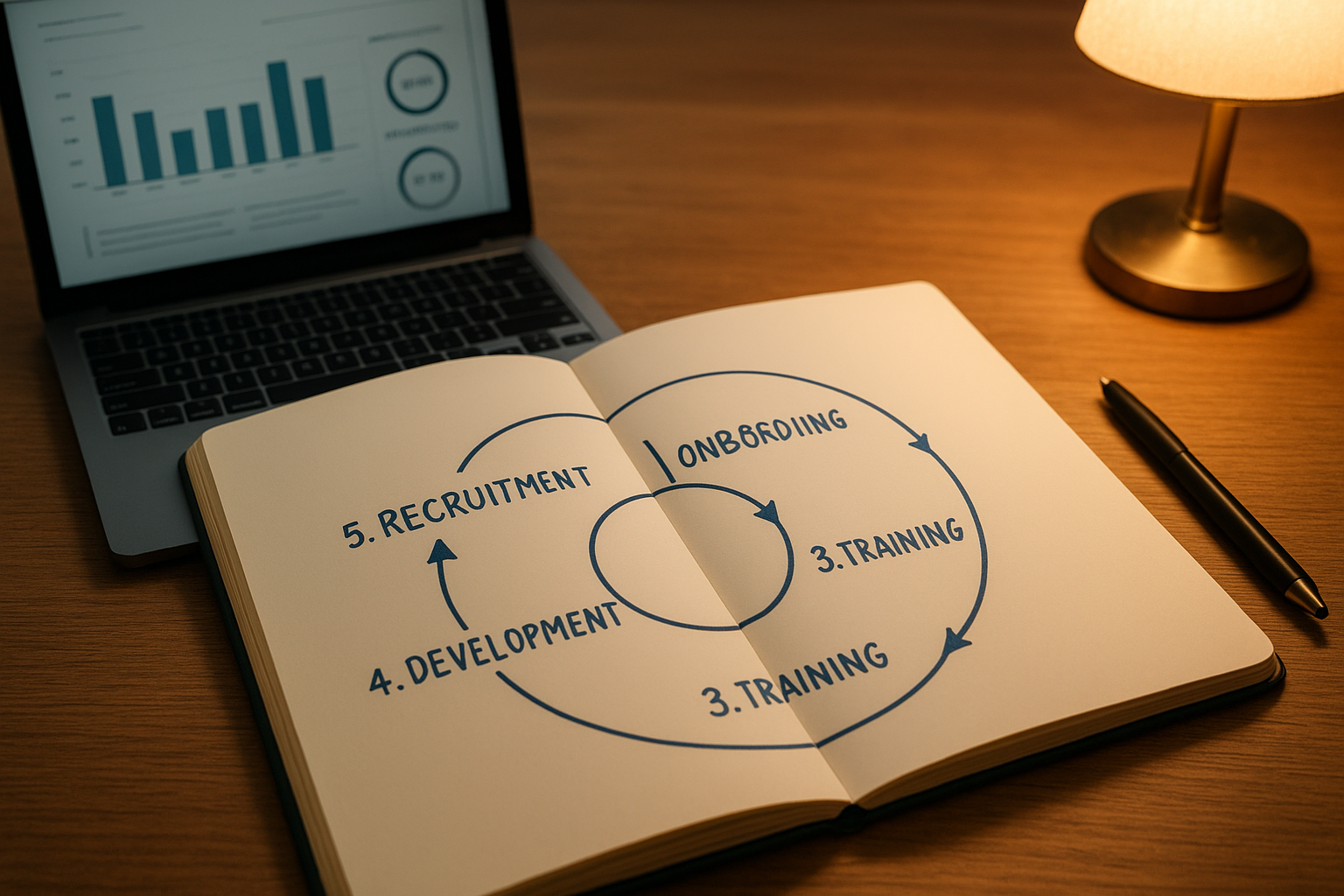
Tracking metrics at each stage of the development process keeps the framework grounded in real outcomes rather than assumptions.
Popular OD Models That Inform Modern Frameworks
Several well-established models can inform how you structure your OD approach. Understanding these models helps you borrow proven logic rather than starting from scratch.
Kurt Lewin’s Unfreeze-Change-Refreeze Model is one of the oldest and most cited frameworks. It argues that change requires first destabilizing the status quo (unfreezing), making the transition (changing), and then locking in the new behavior (refreezing). This model is particularly useful for culture change efforts.
McKinsey’s 7-S Framework examines seven interdependent organizational elements: strategy, structure, systems, shared values, style, staff, and skills. Because these elements are interconnected, changing one inevitably affects the others. Therefore, this model is especially valuable when diagnosing complex, systemic issues.
The Burke-Litwin Model distinguishes between transformational and transactional factors, helping leaders understand which levers drive deep cultural change versus surface-level operational improvement. For organizations undergoing significant reinvention, this model offers a more nuanced lens.
Connecting OD to Performance Management
A development framework does not operate in isolation. One of its most important connections is to performance management — the system that translates strategic goals into individual accountability. When these two disciplines are aligned, employees understand exactly how their daily work contributes to the organization’s larger direction.
For a deeper look at this connection, explore what performance management involves and how it reinforces organizational growth. Additionally, resources like Soteria HR offer practical tools and guidance for integrating OD and performance management into a unified people strategy.
Common Pitfalls to Avoid
Even well-intentioned OD efforts can stall. However, most failures share common root causes that are entirely avoidable with the right awareness.
Skipping the diagnosis phase is perhaps the most costly mistake. Without accurate data, organizations design interventions for the wrong problems. Similarly, failing to involve employees in the process creates resistance that undermines even the best-designed programs.
Treating the framework as a one-time project is another frequent error. OD is an ongoing discipline, not a campaign with a fixed end date. Furthermore, organizations that lack clear success metrics have no way to know whether their efforts are working — making course corrections impossible.
Finally, underestimating the role of leadership consistently derails OD initiatives. Leaders must actively model the behaviors they want to see. Without visible commitment at the top, employees quickly conclude that the change effort is performative rather than genuine.
Frequently Asked Questions
What is an organization development framework?
An organization development framework is a structured approach that guides how a company plans, implements, and sustains change across its people, processes, and culture. It provides a repeatable system for diagnosing problems and aligning solutions with business goals.
Why does every business need an OD framework?
Without a structured OD framework, change efforts tend to be reactive, inconsistent, and short-lived. A framework ensures that improvements are intentional, measurable, and aligned with the organization’s long-term strategy.
How is an OD framework different from a change management plan?
A change management plan addresses a single, specific transition. An OD framework is broader — it is an ongoing system for continuous improvement that can govern multiple change initiatives over time.
What are the core components of an OD framework?
Core components typically include diagnosis, strategy design, intervention planning, implementation, and evaluation. Each phase builds on the previous one to create sustainable organizational improvement.
How long does it take to implement an OD framework?
Implementation timelines vary widely depending on company size and complexity. Small teams may see initial results in three to six months, while enterprise-wide frameworks often take one to three years to fully embed.
What is the role of leadership in an OD framework?
Leadership commitment is one of the most critical success factors. Leaders must model the desired behaviors, allocate resources, and communicate the vision consistently for the framework to gain traction.
Which OD models are most commonly used?
Widely used models include Kurt Lewin’s Unfreeze-Change-Refreeze model, McKinsey’s 7-S Framework, and the Burke-Litwin Model of Organizational Performance. Each model emphasizes different drivers of change.
How do you measure the success of an OD framework?
Success is measured through a combination of quantitative metrics — such as employee engagement scores, turnover rates, and productivity — and qualitative indicators like culture surveys and stakeholder feedback.
What are common mistakes when building an OD framework?
Common mistakes include skipping the diagnosis phase, failing to involve employees in the process, and treating the framework as a one-time project rather than an ongoing discipline. Lack of clear metrics is also a frequent pitfall.
Can small businesses benefit from an OD framework?
Absolutely. Small businesses benefit from even a simplified OD framework because it creates clarity, reduces wasted effort, and builds a culture of continuous improvement from an early stage.
How does performance management connect to an OD framework?
Performance management is one of the key interventions within an OD framework. It translates strategic goals into individual accountability, making it a critical link between organizational strategy and day-to-day behavior.
What is the best first step when starting an OD framework?
The best first step is a thorough organizational diagnosis. This involves gathering data through surveys, interviews, and performance metrics to identify the root causes of gaps before designing any interventions.
Conclusion: Building Change That Lasts
An organization development framework is ultimately about building the capacity to change well — not just once, but repeatedly and with increasing confidence. When designed thoughtfully, it gives every leader, manager, and employee a shared map for navigating complexity and driving meaningful progress.
In summary, the most effective frameworks combine rigorous diagnosis, clear strategic alignment, targeted interventions, transparent communication, and honest evaluation. Furthermore, they are treated as living systems rather than static documents. As a result, they grow stronger with each cycle of use.
Whether you are just beginning to formalize your approach or looking to strengthen an existing one, the principles outlined here provide a solid starting point. Above all, remember that the goal is not a perfect framework on paper — it is a healthier, more capable organization in practice.