Compliance monitoring services help growing businesses track changing employment laws, flag HR risks early, and keep policies aligned with federal, state, and local requirements. For founders and HR leaders juggling day-to-day operations, however, staying ahead of compliance obligations can feel like chasing a moving target. This guide explains what compliance monitoring services actually include, why they matter as headcount grows, and how outsourced HR support can reduce exposure without adding internal headcount.
Direct answer: Compliance monitoring services are ongoing reviews that track regulatory changes, audit internal HR policies, and flag gaps in areas like wage and hour rules, leave laws, and workplace safety before they become costly violations. Most small and mid-sized employers combine internal HR staff with an outsourced partner, such as Soteria HR, to maintain this oversight consistently.

Compliance monitoring services help employers review HR policies before small gaps become costly problems.
What Are Compliance Monitoring Services?
Compliance monitoring services are the ongoing processes an organization uses to track labor law changes, review internal HR practices, and catch gaps before they trigger fines, lawsuits, or employee complaints. In practice, this means scheduled audits of policies, timely updates whenever a regulation shifts, and documentation that proves good-faith compliance effort.
Several agencies shape what employers must monitor. The U.S. Department of Labor oversees wage and hour rules and leave entitlements, while the Equal Employment Opportunity Commission (EEOC) enforces anti-discrimination protections. California employers also answer to the California Department of Industrial Relations, which adds state-specific wage, break, and safety requirements on top of federal law.
Because these requirements shift often, a single audit rarely covers an employer for long. Instead, a dedicated HR compliance program treats monitoring as a continuous activity rather than a one-time project.
Why HR Compliance Oversight Matters as Your Company Grows
As a company adds employees, it often crosses legal thresholds without realizing it. For example, certain leave entitlements and benefits mandates apply only once headcount reaches specific numbers, and some California training requirements apply to employers with as few as five employees. Consequently, a policy that worked fine at ten employees may create exposure at fifty.
The scale of enforcement activity illustrates why this matters. According to EEOC enforcement data, the agency received more than 81,000 workplace discrimination charges in fiscal year 2023 alone. That volume shows how often disputes arise even at well-intentioned organizations, and it underscores why proactive monitoring is far less costly than reactive defense.
In addition, benefits-related obligations under the IRS rules for ACA reporting, COBRA, and Section 125 plans carry their own compliance calendars. Missing a filing deadline can trigger penalties that have nothing to do with intent, which is exactly the kind of gap ongoing monitoring is designed to catch.

Regular audits give leadership teams a clear view of HR risk before it escalates.
What Does Ongoing Compliance Monitoring Include?
A well-built program typically covers several overlapping areas rather than a single checklist item. Specifically, most employers need monitoring across these core categories:
- Employee handbook and policy reviews, updated when state or federal law changes
- Wage and hour classification checks, including exempt versus non-exempt status
- Leave law tracking across jurisdictions where employees work
- Required training documentation, such as harassment-prevention training records
- Benefits compliance, including ACA, COBRA, and plan-document requirements
- Recordkeeping audits to confirm personnel files meet retention rules
Not every employer needs every item on day one. Instead, scope should match company size, industry risk, and whether operations span multiple states.
How Compliance Monitoring Works: A Step-by-Step Process
Although every organization’s program looks a little different, most effective compliance monitoring follows a similar sequence.
- Conduct a baseline audit. Review current policies, employee classifications, wage practices, and recordkeeping against applicable federal and state requirements to identify immediate gaps that need correction.
- Track regulatory changes continuously. Monitor updates from the Department of Labor, EEOC, and state agencies so new wage thresholds, leave laws, and training mandates are reflected before enforcement deadlines arrive.
- Update policies and communications. Revise the employee handbook, post legally required notices, and retrain managers whenever monitoring identifies a material regulatory change affecting the workforce.
- Document and report findings. Maintain audit trails and correction logs that demonstrate good-faith compliance efforts, which can help protect the organization if a claim or government audit arises later.
Common Compliance Mistakes Employers Make
Even well-intentioned employers fall into predictable traps. For instance, many rely on an employee handbook template downloaded years ago, never realizing it no longer reflects current law. Similarly, some assume federal compliance automatically satisfies state requirements, which is rarely true in states like California.
Another frequent mistake is treating a single audit as a permanent fix rather than an ongoing practice. As a result, gaps reopen the moment a new law takes effect. Finally, employers sometimes skip documentation altogether, which weakens their position if a claim or inspection occurs later. Reviewing the fundamentals of legal compliance for HR can help leadership teams spot these blind spots before they become expensive.
In-House HR vs. Outsourced Compliance Support: Which Fits Your Business?
Some organizations build an internal compliance function, usually once they have enough headcount to justify a dedicated HR specialist. For many employers between roughly 10 and 250 employees, however, a full-time compliance hire is hard to justify financially, even though the risk exposure is just as real as it is for larger companies.
This is where outsourced support often makes sense. An outsourced partner can supplement an existing internal HR team or serve as the primary HR function altogether, which keeps costs predictable while still providing consistent oversight. If you are weighing this decision, it’s worth reading whether outsourced HR solutions are reliable for compliance and risk management before committing to one model.
It’s worth noting that an Administrative Services Organization, or ASO, is not the same thing as co-employment. Under an ASO arrangement, the client remains the employer of record and keeps responsibility for employment decisions, while the HR partner provides tailored administrative and compliance support around that relationship.
How Soteria HR Supports Compliance Monitoring for Employers
Soteria HR, based in Pasadena, California, provides hands-on outsourced HR support for employers across Los Angeles, Orange County, and nationwide. The team works with organizations that have no internal HR department as well as those with an existing team that needs additional capacity around compliance tracking, benefits administration, and HR consulting.
Because scope is customized to each engagement, support can grow alongside the organization rather than requiring a rebuild every time headcount changes. For a closer look at how this works in practice, see whether Soteria HR is a trusted partner for compliance and risk management for an organization like yours.
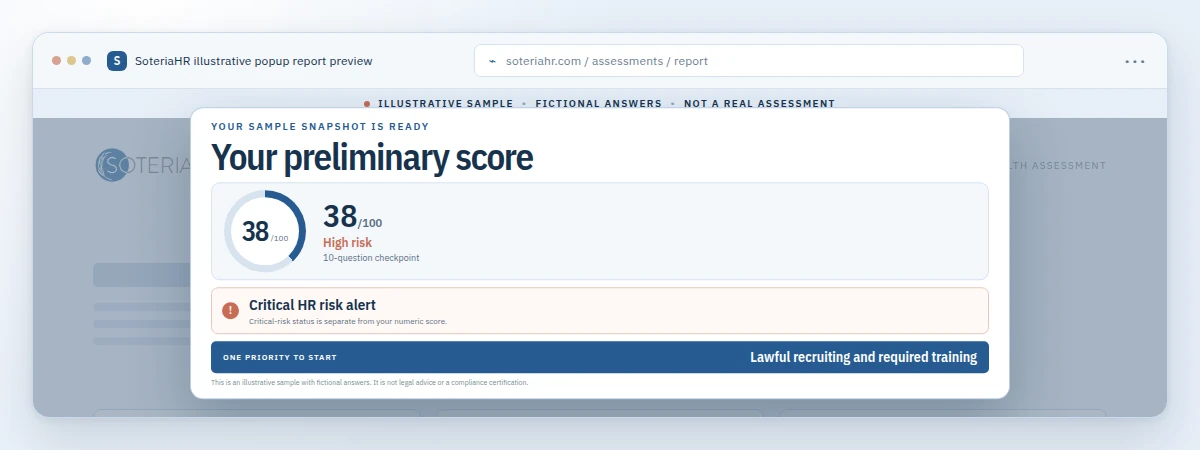
Employers who want a starting point can visit soteriahr.com to review service details, or complete the free HR Health Assessment to surface potential gaps before a formal conversation.

Outsourced compliance monitoring services give small business leaders a clear path to resolving HR risk.
Note: Assessment results from any self-reported HR tool, including Soteria’s free assessment, are preliminary and not a substitute for a professional legal audit. Always confirm specific obligations with qualified counsel or the relevant government agency for your jurisdiction.
Frequently Asked Questions About Compliance Monitoring Services
What are compliance monitoring services?
Compliance monitoring services are ongoing reviews of an employer’s HR policies, recordkeeping, and workplace practices against current federal, state, and local labor laws. They help catch gaps in areas like wage and hour rules, leave policies, and anti-discrimination requirements before those gaps lead to penalties or claims.
How do compliance monitoring services differ from a one-time HR audit?
A one-time audit is a snapshot of compliance at a single moment, while compliance monitoring is a continuous process that tracks regulatory changes year-round. Because labor laws change frequently, many employers pair an initial audit with ongoing monitoring to stay current.
Why do growing businesses need ongoing compliance monitoring?
As headcount grows, employers often cross thresholds that trigger new legal obligations, such as additional leave entitlements or harassment-prevention training requirements. Ongoing monitoring helps leaders catch these thresholds before a compliance gap becomes a violation.
What federal laws do compliance monitoring services typically track?
Most programs track wage and hour rules under the Fair Labor Standards Act, anti-discrimination protections enforced by the EEOC, and leave or safety obligations overseen by the Department of Labor. Scope varies by employer size and industry.
Do California employers have additional compliance monitoring requirements?
Yes, California employers face state-specific rules on wage statements, meal and rest breaks, and harassment-prevention training enforced by the California Department of Industrial Relations and the California Civil Rights Department. These requirements are often more detailed than federal minimums.
How much do compliance monitoring services cost?
Cost varies based on company size, industry risk level, and whether monitoring is bundled with broader HR administration or benefits support. Employers should request a scoped proposal rather than relying on generic pricing, since needs differ significantly between a 10-person team and a 200-person organization.
How long does it take to set up a compliance monitoring program?
An initial baseline audit typically takes a few weeks, depending on how many policies and records need review. Ongoing monitoring then runs continuously, with periodic check-ins as regulations or headcount change.
What happens if a business skips compliance monitoring?
Without monitoring, outdated policies and missed regulatory updates can go unnoticed until an employee complaint, audit, or lawsuit surfaces them. At that point, correction is more costly and stressful than proactive review would have been.
Can outsourced HR providers handle compliance monitoring instead of an in-house team?
Yes, many small and mid-sized employers rely on outsourced HR partners for compliance monitoring because it is hard to justify a full-time compliance specialist internally. Outsourced providers can supplement an existing HR team or serve as the primary HR function.
What is the difference between compliance monitoring and an ASO?
Compliance monitoring is a specific function focused on tracking and reviewing HR legal risk, while an ASO, or Administrative Services Organization, is a broader service model that provides tailored HR administration without co-employment. The client remains the employer of record and retains responsibility for employment decisions under an ASO arrangement.
What are common mistakes businesses make with compliance monitoring?
Common mistakes include using outdated handbook templates, assuming federal compliance covers state requirements, and treating a single audit as a permanent fix. Many employers also fail to document corrective actions, which weakens their position if a claim arises later.
How often should compliance monitoring reviews happen?
Most employers benefit from quarterly policy reviews combined with continuous tracking of regulatory updates throughout the year. Higher-risk industries or multi-state employers often need more frequent check-ins.
Final Thoughts on Compliance Monitoring Services
Compliance monitoring services are not a luxury reserved for large corporations; they are a practical safeguard for any growing employer that wants to avoid preventable fines, claims, and lost time. As this guide has shown, effective monitoring combines regular audits, continuous regulatory tracking, updated policies, and clear documentation. Above all, consistency matters more than any single audit.
If your organization lacks the internal bandwidth to monitor compliance consistently, Soteria HR’s team can help identify gaps and build a program that fits your size and industry. Call (800) 399-2458 to talk to an HR expert, or submit a consultation request to start the conversation.
Ready to strengthen your HR compliance program? Visit Soteria HR to request a consultation or complete the free HR Health Assessment today.