An organizational development strategy is a deliberate, long-term plan that improves how a company functions, adapts, and grows — aligning people, culture, and business goals in a way that produces lasting results. For growing businesses navigating rapid change, a well-built organizational development strategy is the difference between scaling with confidence and constantly reacting to problems that should have been prevented.
However, most companies mistake a collection of HR policies for a true OD strategy. They are not the same thing. In this guide, you will get a complete, practical breakdown of what an organizational development strategy actually involves — including the core components, a step-by-step build process, the major theoretical frameworks that underpin it, and the most common mistakes that cause well-intentioned efforts to fail.
Whether you run a team of 30 or 300, this resource is designed to give you everything you need to build, execute, and sustain an effective organizational development strategy.

Building an effective organizational development strategy starts with getting the right people in the room and asking the right questions.
What Is an Organizational Development Strategy?
An organizational development (OD) strategy is a structured, evidence-based approach to improving an organization’s long-term health and effectiveness. It draws on behavioral science, systems thinking, and HR best practices to close the gap between where a company is today and where it needs to be in the future.
Unlike reactive HR — which addresses problems after they surface — organizational development is proactive and planned. It asks fundamental questions: What does our culture need to look like at twice our current size? How do we develop leaders before we desperately need them? How do we manage large-scale change without losing our best people?
Specifically, OD strategy encompasses four interconnected domains working together toward unified business outcomes:
- Change management — guiding people through transitions with minimal disruption
- Leadership development — building the capability of individuals who drive culture
- Employee engagement — creating conditions where people do their best work
- Organizational design — structuring teams, roles, and processes for effectiveness
For a deeper foundation on this topic, see our guide on what organizational development actually means and why it is far more than an HR buzzword.
OD Strategy vs. HR Strategy: Understanding the Difference
Many leaders conflate OD strategy with general HR strategy. In reality, they serve different purposes. HR strategy governs day-to-day operations: hiring, payroll, compliance, and benefits administration. Organizational development strategy, by contrast, focuses on long-term transformation — building organizational capabilities that allow the business to evolve, compete, and grow over years, not months.
Think of HR strategy as keeping the engine running. OD strategy is about engineering a better engine.
Why Your Business Needs an Organizational Development Strategy Now
Most small and mid-sized companies hit a predictable wall between 25 and 100 employees. Processes that worked when the team was small begin breaking down. Culture becomes inconsistent across departments. Turnover rises. Leaders who were exceptional individual contributors struggle to manage people effectively.
These are not random problems. They are symptoms of a missing organizational development strategy.
Consider the data: Gallup research consistently finds that only about 23% of employees worldwide are engaged at work. Furthermore, disengaged employees cost organizations an estimated 18% of their annual salary in lost productivity. For a 50-person company paying average salaries of $60,000, that is roughly $540,000 in annual productivity drag — before accounting for turnover costs.
A strong OD strategy directly addresses engagement, alignment, and performance. As a result, it is one of the highest-ROI investments a growing company can make — not a luxury reserved for large enterprises.
The Business Case for OD in Growth-Stage Companies
Growth creates complexity. Specifically, companies scaling from startup to mid-market face a set of people and culture challenges that cannot be solved with more hiring or a better tech stack. Without a deliberate organizational development strategy, growth often amplifies existing dysfunction rather than resolving it.
Research from McKinsey’s organizational performance practice shows that companies prioritizing organizational health alongside business performance are 2.2 times more likely to outperform their peers financially. The business case is clear.
Key Theoretical Frameworks Behind OD Strategy
An effective organizational development strategy is grounded in proven theory, not guesswork. Understanding the major frameworks helps practitioners choose the right interventions for the right situations.
Lewin’s Change Management Model
Kurt Lewin’s three-stage model — Unfreeze, Change, Refreeze — remains one of the most foundational frameworks in OD. It describes change as a deliberate process: you must first loosen existing behaviors and assumptions (unfreeze), implement the new approach (change), and then embed it as the new normal (refreeze). Most OD failures happen because organizations skip the unfreezing stage and try to force change into a rigid culture.
McKinsey 7-S Framework
The McKinsey 7-S Framework identifies seven interdependent organizational elements: Strategy, Structure, Systems, Shared Values, Style, Staff, and Skills. Consequently, it is valuable for diagnosing misalignment — when one element shifts, all others must adapt. This framework is particularly useful during organizational redesigns, mergers, or major strategy pivots.
The Burke-Litwin Causal Model
This model distinguishes between transformational factors (mission, leadership, culture) and transactional factors (management practices, systems, climate). In practice, it helps OD practitioners understand which levers drive deep, lasting change versus surface-level adjustments. For example, changing a performance management system (transactional) without addressing leadership culture (transformational) rarely produces sustainable results.
Action Research Model
The Action Research model treats organizational development as a continuous cycle: diagnose, plan, act, observe, and reflect. Unlike one-time consulting engagements, this approach builds internal learning capability over time. As a result, organizations become progressively better at identifying and solving their own challenges rather than depending on external expertise indefinitely.
Core Components of an Effective Organizational Development Strategy
Every strong organizational development strategy is built on a set of non-negotiable pillars. These are not optional add-ons — they are the foundation that separates genuine OD from well-intentioned activity without results.
1. Organizational Assessment and Diagnosis
You cannot fix what you have not properly diagnosed. An honest assessment of your current culture, leadership effectiveness, structural gaps, and operational health is the essential starting point. This typically involves employee engagement surveys, leadership interviews, focus groups, and a review of key HR metrics — including turnover rates, time-to-fill, and absenteeism. Without this data, OD strategy is just informed guessing.
2. Clear Goals Tied Directly to Business Outcomes
OD strategy without business alignment is just activity. Specifically, your goals should connect directly to measurable business outcomes — whether that is reducing voluntary turnover by 20% over 12 months, improving leadership effectiveness scores by 15 points, or successfully executing a market expansion with minimal cultural disruption. Vague goals produce vague results.
3. Change Management Planning
Change is fundamentally hard for most people. Most OD initiatives fail not because the strategy was wrong, but because the change management was weak or entirely absent. Therefore, every OD plan needs a clear communication strategy, defined ownership of each initiative, a stakeholder engagement plan, and a deliberate process for managing resistance. Change management research consistently shows that organizations with structured transition plans see significantly faster adoption of new practices.
4. Leadership Development
Leaders are the single biggest variable in whether an organizational development strategy succeeds or fails. Consequently, investing in leadership coaching, manager training, and succession planning is not a luxury reserved for large enterprises — it is a core deliverable of any serious OD effort. Leaders must model the behaviors the strategy is designed to produce.
5. Employee Engagement Initiatives
Engagement is not a feeling — it is a measurable organizational outcome. Effective OD strategies include deliberate mechanisms for improving engagement: pulse surveys, structured feedback channels, recognition programs, career pathing, and psychological safety initiatives. Above all, engagement efforts must be systemic, not episodic.
6. Measurement and Accountability Framework
What gets measured gets managed. Your OD strategy needs clearly defined KPIs — engagement scores, retention rates, productivity benchmarks, leadership effectiveness ratings — reviewed on a regular quarterly cadence so you can adjust course in real time. Without measurement, you are flying blind.

An experienced HR partner helps small businesses translate OD goals into a clear, actionable roadmap with defined milestones.
Types of OD Interventions: Choosing the Right Approach
An organizational development strategy is delivered through specific interventions — structured activities designed to produce measurable change. Understanding the main categories helps you select the right tools for your specific situation.
Human Process Interventions
These focus on improving interpersonal relationships, team dynamics, and communication. Examples include team-building workshops, conflict resolution programs, group process consultation, and sensitivity training. They are most effective when cultural or interpersonal dysfunction is the primary obstacle to performance.
Technostructural Interventions
These address organizational design and workflow. Specifically, they include job redesign, restructuring, process reengineering, and the implementation of new technology systems. They work best when organizational structure or operational processes are creating inefficiency or role confusion.
Human Resource Management Interventions
These connect OD strategy to the talent lifecycle. They include performance management redesign, career development programs, diversity and inclusion initiatives, and compensation restructuring. In particular, these interventions help align HR systems with the broader organizational goals the OD strategy is designed to achieve.
Strategic Interventions
These operate at the highest organizational level, addressing mission, vision, culture, and competitive positioning. Examples include organizational transformation programs, culture change initiatives, and mergers and acquisitions integration. Strategic interventions require sustained executive sponsorship to succeed.
How to Build an Organizational Development Strategy: Step by Step
Building a strong OD strategy does not require a massive internal HR department. However, it does require a structured process and disciplined execution. Here is the practical, step-by-step framework any growing company can follow.
- Conduct a Thorough Organizational Assessment. Gather data on your current culture, leadership effectiveness, employee engagement, and operational gaps. Use surveys, structured interviews, focus groups, and HR analytics to build an honest picture of where you stand today. Specifically, look for patterns in exit interview data, turnover by department, and engagement score variances across teams.
- Define Clear Goals and Priorities Tied to Business Outcomes. Based on your assessment, identify the top 3 to 5 organizational outcomes you want to achieve. Be specific — for example, reducing voluntary turnover by 20% within 12 months, improving manager effectiveness scores by 15 points, or successfully onboarding 30 new hires without culture dilution. Ambiguous goals produce ambiguous results.
- Select Your OD Interventions. Match the right type of OD intervention to each identified problem. A culture alignment issue calls for human process interventions. A structural inefficiency calls for technostructural intervention. Resist the temptation to apply the same generic solution to every problem.
- Build a Detailed Change Management Plan. Map out how changes will be communicated, who owns each initiative, and how you will proactively manage resistance. Above all, make sure employees understand the specific “why” behind each change before it is implemented — not after. Create a stakeholder communication calendar and stick to it.
- Execute Initiatives and Secure Leadership Alignment. Launch your OD initiatives in sequenced phases. Ensure senior leaders are visibly championing the strategy — not just endorsing it in a memo. Equip managers with the coaching support and talking points they need to carry the strategy through their teams.
- Measure, Adjust, and Sustain. Track progress against your defined KPIs quarterly. Celebrate visible wins to build momentum. Identify what is not working early and adjust before small problems compound. Above all, treat the OD strategy as a living document — revisit and update it as business conditions evolve.
For a more detailed breakdown of this process, our practical guide to organization development strategy walks through each phase with real-world examples and templates.
Organizational Development Strategy and Organizational Culture
Culture is not a byproduct of organizational development strategy — it is the primary target. Every component of an effective OD strategy ultimately aims to shape the behaviors, beliefs, and norms that define how work gets done inside the organization.
In practice, culture change is the hardest work in OD. Culture is deeply rooted in history, relationships, and unspoken norms. Consequently, it cannot be changed through a single workshop, a new values poster, or an updated mission statement. It changes through sustained leadership behavior, reinforced daily through recognition, accountability, and storytelling.
Diagnosing Cultural Gaps
Effective culture diagnosis looks beyond engagement surveys. It includes observational data — how meetings are run, how decisions are made, how conflict is handled — alongside quantitative metrics. Moreover, it examines the gap between espoused values (what the company says it believes) and enacted values (what the company actually rewards and tolerates). That gap is where cultural dysfunction lives.
Building Psychological Safety as an OD Outcome
Psychological safety — the belief that it is safe to speak up, take risks, and make mistakes without punishment — is one of the most powerful cultural levers available to OD practitioners. Research by Amy Edmondson at Harvard Business School has consistently shown that psychologically safe teams innovate faster, learn more effectively, and outperform less safe teams across nearly every measure. Therefore, building psychological safety should be an explicit goal in any organizational development strategy focused on culture.
OD Strategy, Talent Management, and the Employee Lifecycle
A mature organizational development strategy does not operate in isolation from talent management. In fact, the most effective OD programs are tightly integrated with every stage of the employee lifecycle — from onboarding through succession planning.
Onboarding as an OD Touchpoint
Onboarding is the first and most critical moment when organizational culture is transmitted to new employees. For example, a strong OD strategy might identify that early attrition is driven by a weak onboarding experience — then address it with updated processes, structured manager check-ins at 30-60-90 days, and clear cultural orientation. This is OD and operational HR working in tandem.
Performance Management Redesign
Traditional annual performance reviews are increasingly recognized as poor OD tools. They are backward-looking, infrequent, and rarely drive behavior change. A modern OD-aligned performance management approach uses continuous feedback cycles, quarterly development conversations, and goal frameworks like OKRs (Objectives and Key Results) to connect individual performance to organizational priorities in real time.
Succession Planning and Leadership Pipeline Development
Succession planning is an OD imperative, not just an HR administrative task. Organizations without a leadership pipeline are always one departure away from a crisis. A well-designed succession plan identifies high-potential employees early, provides structured development experiences, and builds organizational resilience. This is especially critical for growth-stage companies where leadership gaps can stop momentum entirely.
Common OD Strategy Mistakes That Derail Progress
Even well-resourced, well-intentioned companies stumble when building and executing their organizational development strategy. In fact, most failures trace back to a handful of predictable, avoidable mistakes.
Skipping the diagnostic phase. Jumping straight to solutions without understanding root causes is one of the fastest ways to waste time and money. Interventions built on assumptions rather than data rarely produce sustainable change. Always start with evidence.
Treating OD as a one-time project. Organizational development is not a workshop, a policy update, or a consulting deliverable. It is an ongoing, sustained commitment. Companies that treat it as a checkbox rarely see lasting change — because lasting change requires lasting effort.
Underestimating the role of leadership. If senior leaders are not genuinely bought in — not just verbally supportive, but behaviorally modeling the change — your OD strategy will stall. Leadership alignment is not optional. It is the engine that powers everything else.
Neglecting measurement from day one. Without clear, pre-defined metrics, you cannot demonstrate ROI, identify what is working, or know when to adjust. Build your measurement framework before you launch, not after you are already three months in.
Ignoring the middle manager layer. Middle managers are the critical transmission layer between executive strategy and frontline behavior. Many OD initiatives focus exclusively on senior leadership and overlook the managers who actually implement change day to day. Investing in manager capability is as important as executive alignment.
You can also explore our resource on organizational development strategies in practice to see how other growing companies have navigated these challenges and avoided the most common pitfalls.
Measuring the Success of Your OD Strategy
Measurement is what separates organizational development strategy from organizational development theater. Without rigorous tracking, it is impossible to know whether your interventions are producing real outcomes or just creating pleasant activity.
Leading vs. Lagging OD Metrics
Effective OD measurement uses both leading indicators (which predict future outcomes) and lagging indicators (which confirm past results). For instance, pulse survey scores and manager effectiveness ratings are leading indicators. Turnover rates and productivity benchmarks are lagging indicators. Tracking both provides a complete picture of OD progress.
- Employee engagement scores (quarterly pulse surveys)
- Voluntary turnover rate by department and tenure band
- Manager effectiveness ratings from direct report surveys
- Internal promotion rate as a measure of leadership pipeline health
- Time to productivity for new hires as an onboarding effectiveness measure
- eNPS (Employee Net Promoter Score) as an overall organizational health indicator
- Culture alignment scores from periodic organizational culture assessments
Building a Quarterly OD Review Cadence
Quarterly reviews create the accountability rhythm that keeps OD strategy from drifting. Each review should include a metric dashboard update, a qualitative assessment of initiative progress, a review of what needs to change, and a formal communication to leadership. This cadence transforms OD from a passive document into an active, living management tool.
How Outsourced HR Partners Accelerate OD Strategy
Many small and mid-sized businesses lack the internal bandwidth — or the specialized OD expertise — to build and execute a comprehensive organizational development strategy on their own. That is precisely where an outsourced HR partner creates genuine, measurable value.
Rather than absorbing the cost of a full internal OD team, companies can work with a strategic partner like Soteria HR to access embedded, expert-level HR support — including OD planning, change management execution, leadership development, and compliance — without the overhead of a full-time department.
Soteria HR specializes in working with growth-minded companies of 10 to 250 employees — exactly the stage where a well-designed OD strategy delivers the greatest return on investment. From building custom HR playbooks and leadership development programs to managing complex people transitions, the team brings hands-on expertise that translates directly into business results.
Additionally, the Society for Human Resource Management (SHRM) notes that organizations with dedicated OD support consistently outperform peers on engagement, retention, and profitability metrics. For smaller companies without internal OD capability, outsourcing that expertise levels the playing field significantly.
To learn more about what professional OD support looks like in practice, explore our organizational development consulting services tailored specifically for growing companies.
Integrating OD Strategy Into Your Broader HR Framework
Organizational development does not exist in isolation. It produces the greatest results when it is fully embedded within a broader HR framework that includes compliance, benefits, recruiting, and day-to-day people operations.
For example, a strong OD strategy might identify that your onboarding process is contributing to early attrition among new hires. However, fixing that requires HR operational support — updated documentation, improved manager training, and structured milestone check-ins — not just a strategic recommendation that sits in a document.
That is why the most effective approach integrates OD strategy with full-service HR execution. Our complete guide to organization development frameworks explores how to structure this integration for maximum, lasting impact.
Furthermore, research consistently demonstrates that organizations integrating OD strategy with operational HR see faster adoption of new practices and significantly lower resistance from employees. The two functions reinforce each other — and the gap between strategic intent and operational reality narrows as a result.
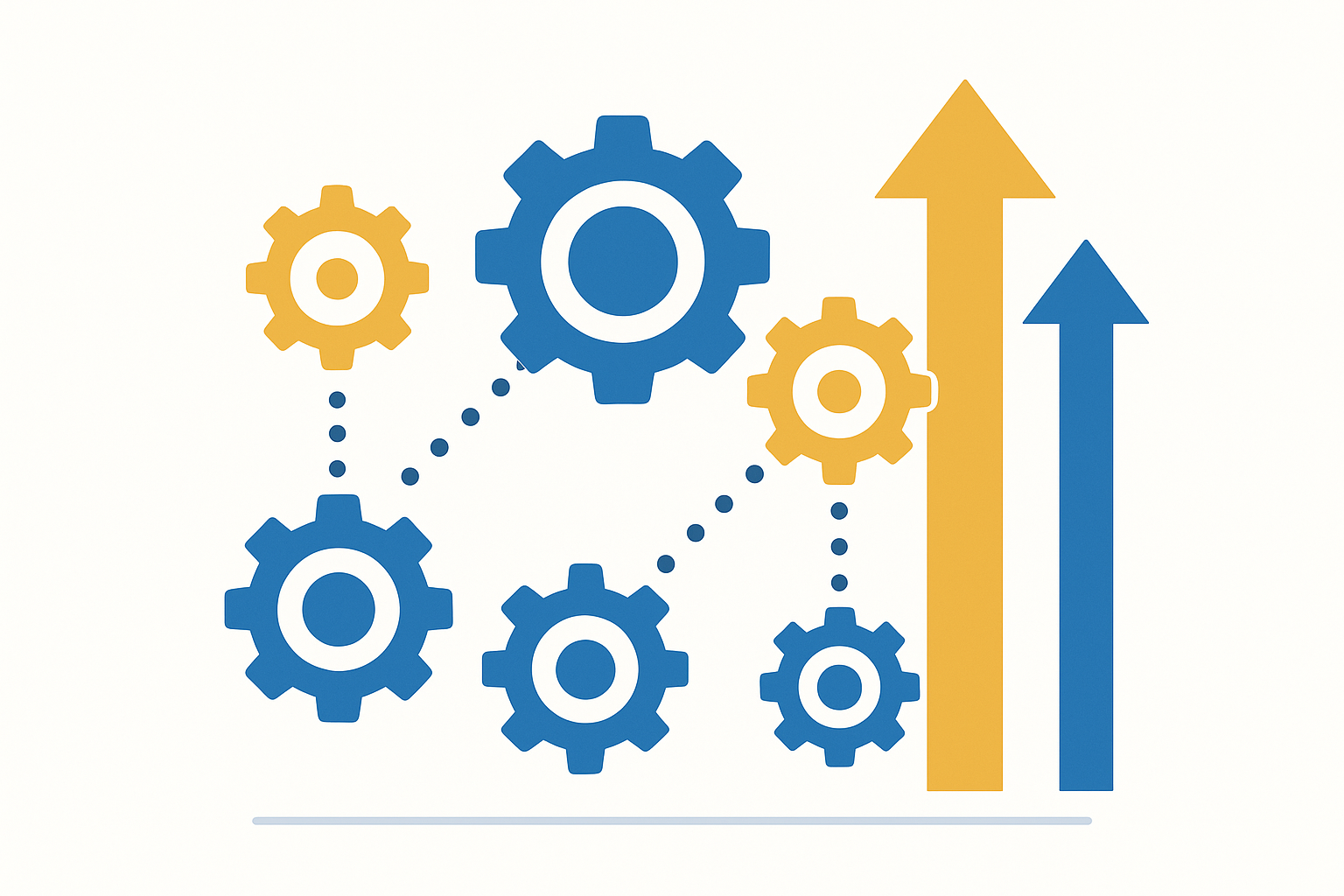
A fully integrated organizational development strategy connects people, processes, and business goals into a single coherent system that drives compound improvement over time.
Frequently Asked Questions About Organizational Development Strategy
What is an organizational development strategy?
An organizational development strategy is a planned, long-term effort to improve a company’s health, effectiveness, and capacity to grow. It uses behavioral science and HR best practices to align people, processes, and business goals — proactively rather than reactively.
Why does an organizational development strategy matter for small businesses?
Small businesses are especially vulnerable to people problems. Turnover, poor culture, and leadership gaps can derail growth fast. A clear OD strategy gives smaller teams the structure and direction they need to scale sustainably without losing what makes their culture work.
How is organizational development different from general HR?
HR focuses on day-to-day people operations — hiring, payroll, compliance, and benefits. Organizational development is more strategic and forward-looking. It focuses on long-term culture change, leadership capability, change management, and overall organizational effectiveness.
What are the core components of an effective OD strategy?
Core components include a thorough organizational assessment, clearly defined business-aligned goals, a structured change management plan, leadership development programming, employee engagement initiatives, and a measurement framework with regular review cadences.
How long does it take to implement an organizational development strategy?
Timelines vary by company size and complexity. Most organizations see meaningful progress within 6 to 12 months. Full cultural transformation — the deepest OD goal — typically requires 2 to 3 years of consistent, sustained effort led by committed leadership.
What theoretical frameworks underpin organizational development strategy?
The most widely used frameworks include Lewin’s Unfreeze-Change-Refreeze model, the McKinsey 7-S Framework, the Burke-Litwin Causal Model, and the Action Research Model. Each serves a different purpose, from diagnosing misalignment to guiding large-scale transformation.
What are common mistakes companies make with organizational development?
The most common mistakes include skipping the diagnostic phase, treating OD as a one-time project, failing to secure genuine leadership buy-in, neglecting middle managers, and not defining measurable success criteria before launching initiatives.
How do you measure the success of an OD strategy?
Success is measured through a combination of leading and lagging indicators: employee engagement scores, voluntary turnover rates, manager effectiveness ratings, internal promotion rates, eNPS, and time-to-productivity for new hires. Quarterly reviews keep measurement active and actionable.
Can a small company without an HR department build an OD strategy?
Absolutely. Many small companies partner with outsourced HR firms like Soteria HR to build and execute a full OD strategy without the overhead of an internal HR department. This approach is typically faster to implement and more cost-effective than building internal capability from scratch.
What is the difference between organizational development and organizational design?
Organizational design focuses on structure — how roles, teams, and reporting lines are arranged. Organizational development focuses on people, culture, and behavior — how the organization learns, adapts, and grows over time. Both are important and frequently overlap in practice.
What types of OD interventions are most effective for growing businesses?
For growth-stage companies, the highest-impact interventions typically include leadership development programs, onboarding redesign, culture alignment workshops, performance management redesign, and succession planning. The right mix depends on what the organizational assessment reveals.
What is the best first step when starting an organizational development strategy?
The best first step is a thorough organizational assessment — sometimes called a diagnostic. This process identifies gaps in culture, leadership, structure, and operations so that your OD strategy is grounded in data and reality rather than assumptions and good intentions.
Conclusion: Build Your Organizational Development Strategy With Intention
A well-built organizational development strategy is one of the most powerful and highest-ROI investments a growing company can make. It addresses the root causes of turnover, disengagement, leadership gaps, and cultural drift — before they become expensive, hard-to-reverse problems that stall business momentum.
The key takeaways are clear: start with an honest diagnostic, set goals tied to real business outcomes, select the right OD interventions for your specific situation, invest in your leaders, manage change with intention, and measure everything from day one. Above all, treat your organizational development strategy as a living, ongoing commitment — not a one-time project you complete and file away.
If you are a growing business that needs expert support building or executing your organizational development strategy, Soteria HR is built for exactly that. We provide hands-on, strategic HR support for teams of 10 to 250 — without the overhead of a full internal department. Explore what Soteria HR can do for your team and start building the organization you actually want to lead.